
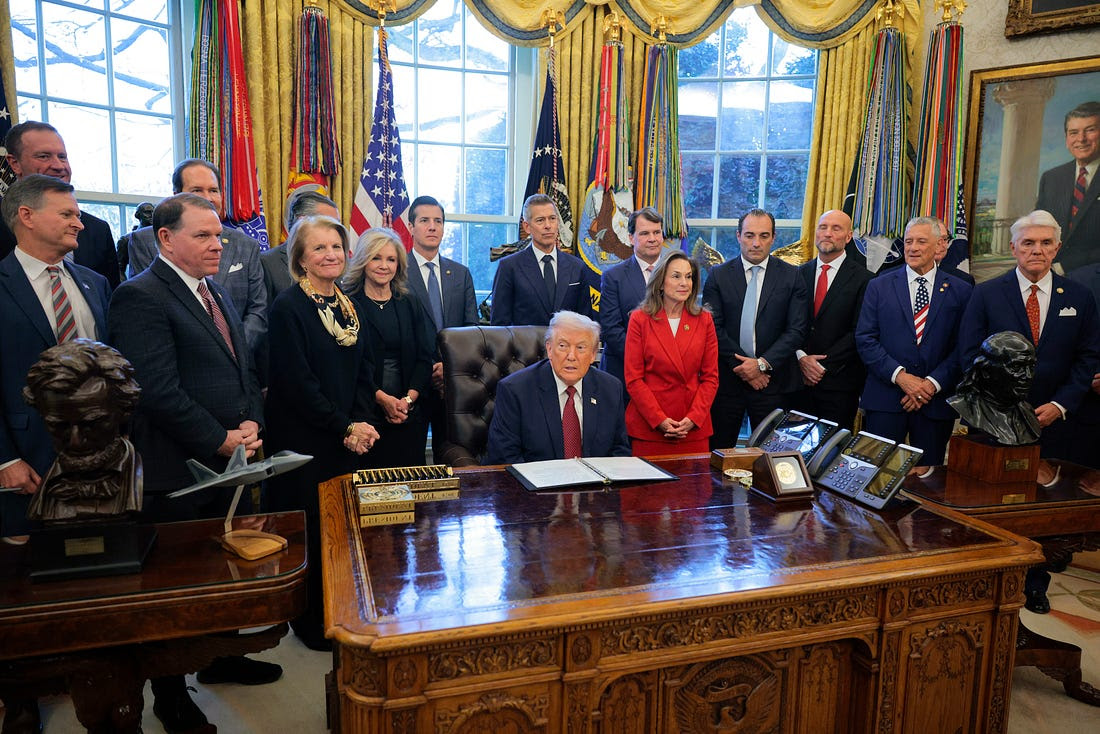
Not Without Consequences: Trump Rolls Back Biden’s Gasoline Mandate

One of Trump’s ugliest moments as President, and there have been far too many, occurred yesterday when, surrounded by applauding auto executives, he rolled back Biden’s 50 mpg gasoline mandate to 35 mpg by 2031, assuring along with suspension of tax credits, the death of electric vehicles in the U.S.

This can only mean more trucks, more SUVs. And—yes—more carbon discharge, escalating ocean temperatures already soaring, the disruption of marine life, and rising seas as the Alaskan Arctic and Antarctica glaciers continue to melt.

In the meantime, what a boon all of this is to China’s burgeoning EV sales in world markets that includes Europe as well as Africa, Asia and Oceania, some models selling in the $10,000 dollar range. China now is a majority stock holder in Volvo.

But Trump thinks climate change is just a hoax, despite overwhelming scientific evidence to the contrary, declaring on signing the bill into law that climate change is “the greatest scam in American history, the Green New Scam a quest to end the gasoline powered car. This is what they wanted to do even though we have more gasoline than any other country by far.”

What Trump has just done will have its consequences, the best estimates of media and environmental groups informing us that under the earlier standards, gasoline consumption would have been reduced by 14 billion gallons by 2050: Long term, more drought, more forest fires and, ominously, the dissolution of ocean currents fundamental to mammal well-being, which includes ourselves.

Trump’s lackeys argue the president’s bill is a boon to consumers, reducing car prices by a projected $1000, as if that’s going to dent a stagnant auto market, the average vehicle price now $50,000 and faulting on auto loans at a record high.

Mind you, this is just empty rhetoric when it comes to curbing inflation, The truth is the president’s tariffs potentially increase builder costs from $7,500 to $10,000 per home, with every $1,000 increase in the median price of a new home pricing out roughly 106,000 potential buyers, according to the National Home Builders Association.

Along with rising home prices, this president’s hysteria when it comes to renewables is costing you monthly electric bills averaging 12% over those of 2024, all of which means less disposable income, and fated to impact low wage households the most.

But back to CO₂, pollutants from tailpipe emissions like nitrogen oxides (NO), volatile organic compounds (VOC), and particulate matter hasten poor air quality and generate respiratory health issues as well.

Trump gets none of this. He runs government as a business, reaping profits for himself and family members. A derelict president, he’s more absent than present in the Oval Office, this fiscal year thus far, spending $371 million dollars on flights at tax payer expense to play golf at his Florida haven, Mar-a-Lago.

Off message as usual, he used the occasion to assault Minnesota’s Somali community whom, the day before, he called “garbage.” Today, it was “they had “destroyed Minnesota” and “destroyed our country.” The “Somalians should be out of here.”

If I asked you what was the fastest warming area of the U.S. outside of Alaska, would it surprise you that it’s New England, where I was born and raised in my early years? The winters I knew as a child are filled with memories of frequent snow fall, frozen lakes, hockey, sledding, skiing, and maple syrup.

Weather experts report New England “has heated up by 2.5C (4.5F) on average from 1900 to 2024, far in excess of the global average, with the world warming by around 1.3C due to the release of heat-trapping gases from burning fossil fuels” (The Guardian, 4 December 2025).

That’s a shocking increase and may prove a portent of what lies ahead. The UN and climate experts have set a maximum goal of 1.5°C (2.7°F) of warming above pre-industrial levels as the threshold, above which we reach the tipping point of near impossible reversal.

Meanwhile, Trump ignores the coming apocalyptic fallout of unrestrained fossil fuel policy, eco systems destroyed, famine common, forest fires ubiquitous, unbearable heat, polluted air, whales and elephants reduced to children’s picture books.

In sum, the Trump administration’s assault on the environment in the context of exponential climate change exhibits all too well the earmarks of corporate denial in the pursuit of monetary gain, whose consequences none of us will escape.

A nation can survive incompetence; what it cannot survive is deliberate blindness to the world burning at its door.

–RJ

Amazon: Anatomy of a Behemoth

Despite its humble beginnings in a Seattle two car garage in 1994 and web presence in 1995 as a purveyor of books, Amazon has subsequently grown into a behemoth, becoming the world’s largest online retailer with a current market cap of $1.61 trillion.

Founder Jeff Bezos, ever the visionary and e-commerce pioneer, observing that the internet was growing at a rate of 2300% a year, quit his job at a Wall Street firm and moved to Seattle, hoping his venture world payoff in the best and largest online mall.

He initially dubbed his new company Cadabra, Inc, but after his lawyers misheard it as cadaver, he decided on a change. Browsing through a dictionary, the word Amazon for the world’s largest river caught his eye.

It wasn’t long before Amazon moved beyond its foothold of selling books to diversifying in 1999 into selling and auctioning toys, electronics, tools and hardware, and kitchenware.

Sales took off and Amazon hired 20,000 seasonal employees to meet demand.

Today, Amazon continues to be the global leader in e-commerce, providing a refined marketplace which connects buyers with sellers, boasting the largest fulfillment network in the world, and promoting a vibrant culture of innovation and emerging technologies.

The Seattle based company employs more than 90,000 people in the state of Washington, with the actual number of employees exceeding 380,000 worldwide, making Amazon one of the biggest job creators in the last decade. These jobs consist of anything from corporate engineers and marketers to hourly warehouse and customer service representatives. The company operates at a scale unequaled in contemporary business and technology.

Unfortunately, it’s become “a bloody beast,” says one of its critics, swallowing up independent brick and mortar enterprises, commencing with its purchase of Whole Foods in 2017, a $13.7 billion deal.

Now a multifaceted eCommerce platform, it earns its income through arrangements of retail, third-party sellers, subscriptions and,more recently, in servers and other forms of employee data storage.

Innovation has been the hallmark of Amazon’s continuing success. Kindle, for example, proved one of its best, changing the way the public buys its books to the chagrin of physical bookstores.

Currently, Amazon has been investing in drone delivery, which would revolutionize how packages are sent and received worldwide.

Despite Amazon’s critics, the public’s response has been very favorable, with Amazon delivery trucks now a daily sight in residential neighborhoods .

Amazon’s adoption of public reviews of its many goods is a stroke of genius. Readers can see what others think before making a purchase.

Then there’s the convenience of not having to climb into your car, consuming time and gas. The fallout, of course, is huge for local retail.

Amazon is also consumer friendly, offering fast delivery, easy return of goods, and speedy refunds. According to the American Customer Satisfaction Index, Amazon is the #1 company in the US for customer satisfaction. Over 100 million paid subscribers globally have signed up for Amazon Prime, which allows for two day delivery on more than 100 million items, unlimited streaming of movies and TV shows, along with a million songs.

Recently, it purchased audio.books.

Critics have too often ignored its progressive hiring policies. Amazon has ranked in the top three for new job creation in the United States. Its employee headcount has grown from 31,000 in 2008 to 382,400 in 2017, and it is expected to continue growing. Amazon is known for creating jobs that are not temporary or seasonal.

A study done by eHealth found that Amazon ranks first as the most Military Spouse Friendly Employer in the list of the top 50. Additionally, Amazon has fulfilled its pledge to hire 25,000 Veterans and Military Spouses by 2021. Amazon is committed to training and hiring Veterans for the Career Choice Program, which is exclusively for active duty service members and spouses. The program educates and prepares them for job placement at Amazon or any other company. This exclusive program is a win for Veterans who are searching for a new career, as they receive training for a job that is guaranteed to them.

Moreover, Amazon is dedicated to hiring people with disabilities and provides accommodations for over 120 roles. They have expedited the hiring process to as little as 48 hours for those who apply.

Amazon is one of the front runners in hiring ex-offenders and individuals who were recently incarcerated. With the Ban the Box movement gaining momentum, many companies are removing criminal offense questions from their initial job applications.

Amazon has also approached the United States and Canadian Governments for vital roles in public sectors and special clearance jobs that help fund public projects. An example of this is Amazon’s creation of a second headquarters (HQ2), in Arlington, VA, which is expected to create an estimated 50,000 jobs and $5 billion in investments over the next 10-15 years.

Amazon is focused on long-term employment and has been implementing various initiatives to improve job quality and employee benefits. An example of this is the large recruiting and hiring efforts in the state of Wisconsin.

But there remain negative aspects that merit attention; namely with regard to warehouse employees, pressured to take on physically demanding tasks, skip bathroom breaks to maximize targets, penalized for taking sick days or time off, resulting in high turnover.

The extent of Amazon surveillance has led to numerous complaints as workers feel their privacy is being compromised and that they’re being treated like robots. In 2018, warehouse workers reported they were being monitored by GPS tags, with exact details of their location and any rest breaks they take.

Alongside surveillance, there are strict productivity quotas involving a completion rate of tasks within a certain time frame. Failure to do so can lead to warnings and in worse cases, termination of employment.

When it comes to stock units paid to new employees in their third or fourth year, many aren’t around to receive them.

Stress is inherent with any Amazon hire, whether in a warehouse, office, or delivery. Amazon ranks employees against each other and eliminates the bottom 6% annually.

Meanwhile, Amazon has maintained a tough stance against unions, hiring the firm Complete Solution Staffing to inform its employees of the problems with unions.

Amazon has recently been subjected to controversy over its tax policies and their implications. Over the past few years, the corporation has paid very little or no taxes to the government. Contrary to most U.S. based corporations, Amazon paid no federal taxes for the year 2017 and 2018, despite the fact it was a highly profitable company.

Despite this, the company has contributed state taxes that total almost $1.2 billion dollars and has created many jobs that have in turn, increased tax revenue. Amazon defended their tax payment policy in a statement to Business Insider: “Amazon pays all the taxes we are required to pay in the U.S. and every country where we operate, including paying $2.6 billion in corporate tax and reporting $3.4 billion in tax expense over the last three years.”

Critics cite Amazon’s dynamic growth as a detriment to retail business, under selling them and driving them out of existence. Former Amazon chief financial officer Warren Jenson commented that if your business makes a profit, Amazon sees you as the competition and will be coming for you. Currently, it seeks to imitate highly successful Trader Joe’s.

The Federal Trade Commission has recently sued Amazon for being an illegal monopoly, where 40% of online shopping occurs on Amazon.com, creating higher prices for consumers. 

Amazon vigorously disputes the FTC assertion and continues to seek expansion.

—rj

On Class Warfare in America: The Yacht Mentality Revisited

yachts3

I wanted to revisit my last post of several days ago, “The Yacht Mentality that Threatens our Economy,” with this apropos poem by William Carlos Williams, one of America’s foremost modernist poets.  As you may have surmised, it’s called “Yachts,” which I employed as my central metaphor in depicting the economic inequity rampant in our nation.

Williams, by the way, was a physician from Hoboken, NJ, who compassionately dedicated his practice to treating the poor, who were never far from his thoughts.  We see this vividly in his symbolically dense poem that comes close to being allegory in its one-to-one application, or depiction, of the tensions governing the relationship between the oligarchy of the economically privileged (shall we call them them the 1%?) and the majority, marginalized working class folk like you and me.  But first the poem, then my commentary:

Poem:

The Yachts

contend in a sea which the land partly encloses
shielding them from the too heavy blows
of an ungoverned ocean which when it chooses

tortures the biggest hulls, the best man knows
to pit against its beatings, and sinks them pitilessly.
mothlike in mists, scintillant in the minute

brilliance of cloudless days, with broad bellying sails
they glide to the wind tossing green water
from their sharp prows while over them the crew crawls

ant-like, solicitously grooming them, releasing,
making fast as they turn, lean far over and having
caught the wind again, side by side, head for the mark.

In a well guarded arena of open water surrounded by
lesser and greater craft which, sycophant, lumbering
and flittering follow them, they appear youthful, rare

as the light of a happy eye, live with the grace of all
that in the mind is fleckless, free and
naturally to be desired. Now the sea which holds them

is moody, lapping their glossy sides, as if feeling
for some slightest flaw but fails completely.
Today no race. Then the wind comes again.  The yachts

move, jockeying for a start, the signal is set and they
are off.  Now the waves strike at them but they are too
well made, they slip through, though they take in the canvas.

Arms with hands grasping seek to clutch at the prows.
Bodies thrown recklessly in the way are cut aside.
It is a sea of faces about them in agony, in despair

until the horror of the race dawns staggering the mind,
the whole sea becomes an entanglement of watery bodies
lost by the world bearing what they cannot hold.  Broken,

beaten, desolate, reaching from the dead to be taken up
they cry out, failing, failing! Their cries rising
in waves still as the skilled yachts pass over.

Commentary:

When you first get into this poem it seems to feature Man vs Nature, but by l. 13 with the specifics about the crew, which “crawls solicitously,” it dawns on you that it also takes in humans pitted against one another.

If the earlier portion of the poem (up to l. 13) gives an imaginative, blissful view of Nature in relation to Man and, in turn, of Man’s inter-relationships, the latter portion gives you the awful reality masked by the seeming tranquility, or the potential for revolt from the status quo of both Nature and Man.

Mention of a “race” sets the stage for transition into a contest for mastery, initially of yacht vs. yacht, but note how the diction changes here with sinister implications:

“Now the sea which holds them is moody”

 “As if feeling for some slightest flaw”

“Now the waves strike at them”

Note as well how the ominous turns into a personification of unleashed violence in what becomes a power struggle waged between haves and have nots, with the yachts metaphorized into repressive knife slashing entities indifferent to whom they maim:

“Bodies thrown recklessly in the way are cut aside.

“It is a sea of faces about them in agony, in despair.”

Williams’ subterranean intent now surfaces:  we have a revolt put down by the yachts, the poem’s symbol for connoting the wealthy, of the normally “solicitous,” or working classes, whose labor has made their wealth possible, though they’ve gleaned little for themselves, “bearing what they cannot hold.”

“…the horror of the race dawns staggering the mind,
the whole sea become an entanglement of watery bodies

The yachts, or impervious upper class, obviously win out on this particular day, but not without leaving in their wake their decimated victims:

“Broken,
beaten, desolate, reaching from the dead to be taken up
they cry out, failing, falling! their cries rising
in waves still as the skillful yachts pass over.

In sum, Williams has delivered a Marxist polemic of poignant genius in its thematic rendering of class struggle against inequity.  The very style of the poem adroitly reinforces this theme of worker repression by the economically removed in its run-on lines and skillful alliteration at poem end, the yachts unheeding of the crying wounded in “waves still as the skillful yachts pass over,” suggesting speed and, hence, indifference.  For Williams, this hierarchy “live(s) with the grace of all that in the mind is fleckless, free and naturally to be desired.”

In short, their narcissism of self-indulgence (materialism) mirrors behind its proffered beauty their willful escape from responsibility to the working classes on whom their wealth is built (“the crew crawls/ant-like, solicitously grooming them”).

In an America where 37% possesses half its wealth and the top 1% often pays minimal taxes, Williams’ poem reminds us that we have much work to do to render the American dream palpable for not just a few, but for the many.

–rj

To Truman: Beloved Friend

photo 1

You came into our lives twelve years ago in late August 2001, a compact Bichon bundle of playful love, in a pre-arranged handoff at an I-64 road stop.  I had ordered you by phone from a breeder in Myrtle Beach.  It was instant mutual love.  We decided to call you Truman, and it fit you just right.

Rarely, but it does happen, a mind-boggling event brands itself into memory and we never forget what we were doing and where we were at.  My father often reminisced that early Sunday morning, December 7, 1941.  For me, it had been November 22, 1963 and July 20, 1969 that stood out.  And now a third:  You were getting your first shots.  Our vet, a dog show judge, was admiring your confirmation, saying it was the best he had come across among Bichons in his practice, when the news broke of horrendous misdeeds.  It was September 11, 2001.

Now that’s one of the compelling reasons I’ve always been drawn to dogs and cats.  Unlike many humans caught-up in calculated self-interest with cruel consequences, they want only to love and be loved.  You loved everyone and they loved you.  But you gave me preference, waiting at the door for Daddy’s entrance, then bounding up with enthusiasm on my legs.  How wonderful to come home daily from a world of stress and non-entity to unconditional, uninhibited affection.

How you loved your backyard and how we loved watching you playing the mighty hunter card, one-cautious step after another, standing still, then more steps, gaining, then only, inevitably, the scurrying squirrel, knowing you were there all the time, hustling up the tree.  You at its trunk, patiently looking up, waiting for it to come down

You liked roaming the perimeter or fence line.  Your joy was complete when you heard neighbor dogs bark and scrambled full speed for canine fellowship.  I had read  somewhere that for all their human contact, given a choice, dogs prefer their own kind.  I can understand that, sometimes myself opting for their company over that of homo sapiens.

I remember how tiny you were at first and that there were several times you squeezed through the board fencing, even though I had spent days in winter cold nailing chicken wire over the gaps.  There was the time you got into the neighbor’s yard behind us where several llamas grazed and I climbed over the fence to rescue you from an advancing llama, only to have it come after me.  I grabbed you and jumped over to safety.  Close call for us both!

You liked walking on your leash with me down the street.  I never really had to train you at it, since from the beginning you took instantly to walking at my heel on my left, seldom pulling to get ahead.

But I did enroll you in an individualized obedience course.  Unfortunately, your trainer relied on treats and I could never find a way to wean you away from your addiction and do something simply because it was worthy for its own sake.  But then our own children aren’t all that different.  Getting you to stay was simply impossible for someone as passionate as you.  The gold standard was to take you to a safe area of a shopping mall and get you to stay.  I didn’t even try.  $300 dollars down the drain.  Ironically, you trained me!  Still, you did retain the habit of sitting on cue right up to the end, until your arthritic limbs compelled my pardoning you.

You liked keeping company with us on the couch, snuggling up to Karen and me.  You also had this funny habit of flipping the pillows off the couch and finding your way to the other arm and propping yourself up for a cozy snooze.

You also had this cute habit of carrying your metal dish over to your living room pad after your evening meal and licking it clean.  You delighted us with this gesture from the time you were a pup up almost to the end.

How excited you got to go outside with me to feed the birds whenever you saw me filling the plastic pitcher with seed!

At night when we turned out the living room lights, always the landmark clicking of your nails on the hallway floor as you made your way to join us in slumber.

When you were seven they found a heart murmur and I felt then the first scary pangs I might lose you.  You liked to run at full speed.

Around age nine, they found calcium crystals in your bladder, and so they put you on meds and a special diet.  I don’t know if the crystals caused you any discomfort.  You always acted the happy part.

At age eleven you had slowed down and seemed to labor in your walk.  We put you on glucosomine for that.

Just after your twelfth birthday, or this past June, I took you in for another checkup for the crystals and arthritis.  The ultrasound was distressing, showing not only more crystals despite your prescribed diet, but a tumor  over the right adrenal gland and a nodule adjacent to the left adrenal.  Ominously, the tumor occluded the vena cava, making any surgery risky.   The follow-up radiology report didn’t clearly indicate metastasis, but it remained a possibility.

You were still your active self through June, but then came the weight loss.  Once a robust 21 pounds, you were down to 18 by September, and 14 by the end.  You found it difficult to shadow Daddy from room to room and pretty much snoozed on the couch most of the day.  Your dark black eyes, tinged with sadness, gave off a pleading gaze–as if to say, “please help me”!

I knew things were getting really bad when you increasingly turned away from your food or ate very little, though I tried tempting you with lots of treats and canned meat in place of your former kibbles.  You were always crazy after peanut butter filled bones,  but now  you no longer could muster the appetite to enjoy the feast.

It hurt you to walk and even to lie down.  You couldn’t hold your water.  That last night, Tuesday, I knew we needed to do the right thing when you let out two yelps, one of them when Karen tried to pet your head.  Obviously you were hurting all over.

I caught myself in my own selfishness.  I had wanted to keep you forever.  I should have been thinking about your interests.  I needed to let go as my ultimate gift of love for you, my friend, our friend, always kind, gentle and loving.

Yesterday at the vet’s, we were with you in your final moments.  You seemed unafraid as I stroked you and laid a last kiss on your darling head. You went quickly and peacefully into that long sleep.  No more suffering.

I know that death is part of the deal we make for life, but it doesn’t lessen our grief or bridge the emptiness.  We miss you terribly.  You were a gift of love and we thank you for the daily joy you brought into our lives.  You will be in our hearts forever.

–rj and kj