
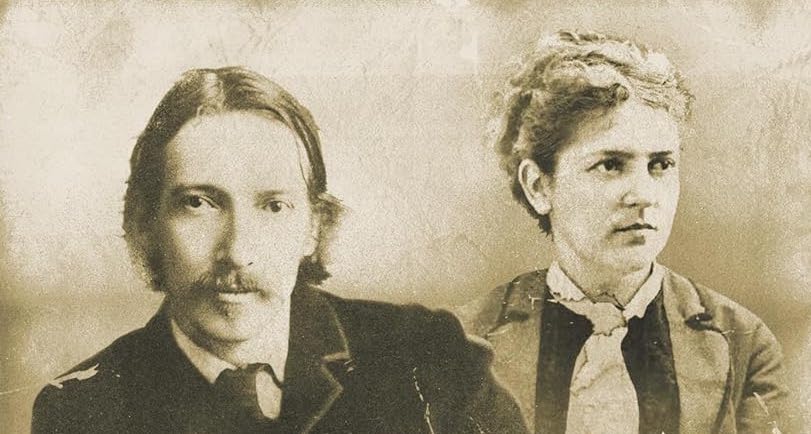
Literary Hub: Robert Louis Stevenson and Fanny
Leo Damrosch, now in his mid-eighties and the author of acclaimed biographies of Swift, Johnson and Boswell, Rousseau, Casanova, Tocqueville, and Blake, has given us another spellbinder in The Life of Robert Louis Stevenson: Story Teller.
Readers may fairly wonder why another Stevenson biography. There had been Frank McLynn’s 1994 life, which The Christian Science Monitor thought “magisterial,” followed by Camille Peri’s A Wider Shore, appearing only a year before this one.
Damrosch claims no new discoveries, and critics are right that his book is largely a synthesis. But I think it offers three things the others do not.
First, he lets Stevenson speak. Much of the life is told through the nearly 3,000 surviving letters collected in the eight-volume-volume Yale edition (1994–95) by Booth and Mehew.
Ironically, Stevenson found letter-writing a chore, yet drafted each one several times to make it seem casual. The result is a kind of autobiography he intended, but never wrote.
Second, Damrosch looks at the whole body of work, not just the famous novels. I was struck by the essays, where Stevenson defends indigenous peoples and condemns the excesses of capitalism, and by the poetry, which scholars have overlooked, revelatory of his inner life. We don’t think of Stevenson as a social activist, yet it was woven into his passionate nature.
Third, he shows how much landscape mattered. Although Stevenson disliked Scotland’s wind, rain, and chill, he delighted in the mountainous Highlands, its violent history shaping Kidnapped and its topography nearly a character, as in Thomas Hardy’s novels. His landscapes are kinetic in their motion, redolent in sound, felt rather than described. He disliked adjective pile-ups.
Nothing is overlooked: Stevenson’s lifelong respiratory illnesses and fragility that would launch a peripatetic search for a more favorable clime that concluded with Samoa, the temporary breach with his family when he renounced their devout Calvinist faith and refused to follow the family profession of engineering, his early amours, his friendships, and quarrels, his momentous marriage to flamboyant Californian Fanny Osbourne, a divorcee twelve years older than himself, with two children, defying social mores.
Fanny was central to his success, despite her mercurial moods, gifted with an intuitive critical intelligence that he took seriously.
There was nothing in his early years of schooling predictive of his future writing prowess. He found the curriculum boring and was averse to mathematics. His ennui continued at the University of Edinburgh, where he took a degree in law to please his worried parents. He wanted to be a writer.
Fluent in French, he was a Francophile, enamored of sun-drenched Provence, where he and Fanny lived two years, charmed by its hilltop houses of stone, winding lanes, and proximity to the Mediterranean. One novel, The Wrecker, co-written with his stepson, Lloyd, and several of his novellas, short stories and travelogues have French settings.
He read widely, focusing especially on Melville’s South Pacific novels, Omoo and Typee, with their depiction of an idyllic, unspoiled archetypal paradise increasingly imperiled by European intrusion—from lustful whalers bearing fatal diseases that ravaged Polynesian immune systems to missionaries enforcing Western norms on a traditional way of life.
Melville kindled in Stevenson an eager desire to taste the Pacific’s delights, inspiring the journey to his final Samoan home. There, he embraced the island warmth, cherishing the thunderous advancing surf and its reluctant, muffled retreat.
Tall and very thin, his clothes drooped from his skeletal frame like rags on a hanger. And yet his voice was magical and compelling, strong and melodious, rhythmically poetic, mesmerizing in his command of so many subjects. His presence filled a room. Congenial, he made friends easily.
Damrosch gives thoughtful attention to all the principal works, Treasure Island, Strange Case of Dr Jekyll and Mr Hyde, and Kidnapped among them, and wants us to see Stevenson as a deliberate artist, not just a writer of adventure stories. Stevenson himself believed the great storyteller satisfies “the nameless longings of the reader” and obeys “the ideal laws of the daydream.”
Rising early, he gave four hours to writing in the morning and two more in the afternoon, a conscientious sentence smithy, revising repeatedly for clarity, cadence, and eloquence.
Damrosch is candid about what made some of Stevenson’s novels succeed and others fail. While admiring a perseverance that transcended repeated bouts of respiratory illness and constant financial pressure, yielding adventure narratives that continue to fascinate readers young and old, Damrosch nevertheless considers his artistry modest when compared to the expansive idea novels of George Eliot or Henry James. A slight quality of the jejune hovers over his penchant for heroic romance, pirates, and high-seas ventures: a proclivity Stevenson constantly wrestled with in his quest to be taken seriously as a literary artist.
I credit Damrosch for a biography truthfully told, a full portraiture of a gifted artist constrained by illness, Victorian taboos, and limited range from a greater achievement about to commence.
His books have never gone out of print. They speak to the human longing for the distant and the exotic. Stevenson’s gift was his ability to render that quest palpable.
Damrosch thinks Stevenson’s greatest completed novel, written during his Vailima sojourn, was Catriona, and Stevenson agreed: “I shall never do a better book than Catriona; that is my high water mark.”
Yet it is the unfinished Weir of Hermiston, set in the familiar Pentland Hills of his youth, that hints at a higher literary summit. As Damrosch notes, it is “no adventure yarn . . . but a tale of people trapped in the selves they can’t help being,” a tragic, richly autobiographical work marked by a central father-son feud and women far more fully realized than in any of his earlier fiction.
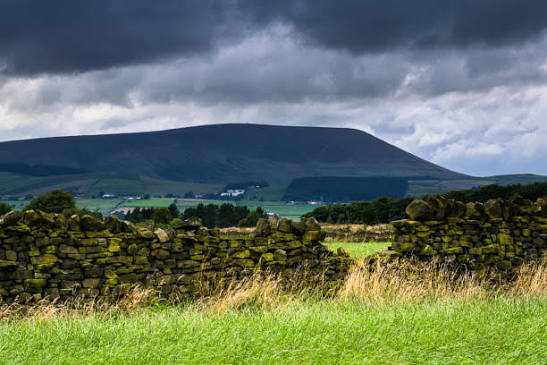
Pentland Hills
Every morning Stevenson paced the room, dictating it to his stepdaughter Belle, the words flowing as if the whole novel were already conceived.
Though a fierce opponent of imperialism, Stevenson lived in Samoa as a benign patriarch, operating his estate like a Scottish chieftain among his clan. The Samoans embraced him for defending their native autonomy, affectionately bestowing on him the title Tusitala, or “storyteller.”
Money worries dogged him incessantly. Having built the expansive estate of Vailima, Stevenson was the sole breadwinner for an immense extended household: his wife, mother, stepson Lloyd, stepdaughter Belle, her deadbeat husband Joe, and their son Austin. Compounding the strain was a retinue of nineteen full- and part-time Samoan staff, leaving Stevenson perpetually tethered to his desk to keep the estate afloat.
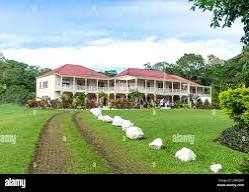
Vailima
They lived lavishly, as in his birthday feast, three weeks before his death, that included a whole heifer, twenty roasted pigs, and fifty chickens.
In those Vailima years, he had written “pot-boilers” to pay the bills and was ashamed of them.
Then came the evening of December 3. He had just filled the wine glasses and was helping Fanny make a salad when he suddenly grabbed his head and cried out, falling backward into the arms of his devoted servant Sosimo, never to regain consciousness.
Vailima had been a hiatus from chronic ailments. He seemed, though thin, to at last enjoy robust health. Yet in a cruel irony, the chronic lung trouble that had stalked him his entire life did not claim him. He died of a swift cerebral hemorrhage. He had just turned 44.
In accordance with his wishes, his ashes were interred on Mount Vaea, 700 feet above Vailima.
Vailima has been a museum since 1994, restored largely through American philanthropy sources, governed by a Samoan council, and attracting an estimated 180,000, visitors, mostly anglophones, annually.
News of Stevenson’s early death shocked his many friends in Europe, among them his lifelong friend and admirer Henry James who, reading his posthumously published unfinished Weir of Hermiston, lamented that its sheer beauty rendered his loss “doubly heartbreaking. . . the extinction of a talent that could still give one such a sense of freshness and life, of not yet having played, as it were, its highest card.”
–rj

