I’ve been reading the late Irish writer William Trevor’s The Collected Stories, a sprawling anthology of nearly 1300 pages, stories that have been compared with those of Chekhov and Joyce (Dubliners), culminating in many literary prizes and Trevor’s receiving honorary knighthood. The tributes, in fact, are endless, with many deeming him our most illustrious contemporary master of the genre. For many years, he was associated with The New Yorker.
His stories, however, may prove difficult going for many in these troubled times when we reach desperately for good tidings, not quotidian gloom. While his facility with language is indisputable in its ease and fluidity, his characterization impeccable, there seems never a relief to a bleak landscape of broken lives, shattered expectations, deceit and cruelty. Many of the stories deal with the angst of aging, declining physical and mental capability, a clinging to past memories, accompanying alienation, loneliness, and anxiety in the foreground of marauding mortality.
Despite all this, his psychological prescience sustains, with characters delineated by their own compulsions, denials and lethargies. In short, the characters are people we know, perhaps uncomfortably, even ourselves, wrestling like Hamlet with the dichotomy of desire and weakness and inability for resolution.
Stories are ceaselessly open-ended, with readers left to their own interpretive nuances, not unlike life in its ambiguities. Again, a lot like what we find in Chekhov and Joyce.
Still, I miss the understated, yet resonant symbolism of short story masters like Lawrence, Hemingway, Fitzgerald, and Mansfield, their tales exploding into collective nuance, often replete with stylistic eloquence. In this, Fitzgerald remains my favorite, often quotable and always unforgettable.
I’m longing for a bit of good cheer, absent in Trevor, to soften a grim grayness. (Is it accidental he chose to follow Hardy into residing in Dorset?) After all, life isn’t all winter and following storm, the sun does peak through, and most humans, for all their liabilities, harbor irrevocable kindness.
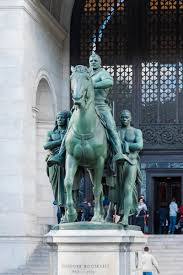
The press largely missed last week’s removal of the Teddy Roosevelt statue from the grounds of New York’s American Museum of Natural History, which had been in place for eighty years. Progressives argued it was colonialist in nature, a white man on horseback accompanied by an African and Native American on foot.
Roosevelt is consistently rated as among America’s best ten presidents, an ardent naturalist and political liberal. The African and Native American reflect his renowned role as explorer, not colonialist bent on exploitation. Nonetheless, the efforts of the Left, ignoring cultural antecedents, persist in rewriting history, or what I call “purging” it to conform with ideology.
I’m reminded of Orwell’s still relevant observation that “the really frightening thing about totalitarianism is not that it commits ‘atrocities’ but that it attacks the concept of objective truth; it claims to control the past as well as the future.” Similarly, progressives seek to assuage history’s realities by projecting their politics on to the past, while hypocritically ignoring the malignant realities of today’s Cuba, Venezuela, and Nicaragua.
As always, we do well to avoid peripheries, whether of Left or Right. We properly amend history by learning from its failures and not repeating them.
Some books are meant to be re-read, simply because they not only entertain, but because they engender an influence, often enduringly subtle, on what we think and do.
Moments ago, I finished William Boyd’s Any Human Heart (2001) for the second time, a melancholic exploration of a life’s passage by journal keeper Logan Mountstuart, who chronicles the perambulations of his career as a journalist, novelist, art connoisseur and private citizen.
I had been introduced to Any Human Heart previously, following its superb PBS adaptation in 2011. I refrain from calling it a novel, since it purports to being a series of journals. It isn’t my intent to summarize the plot, a non-starter really, since journals by their very nature cannot plot. My focus is primarily on Logan Mountstuart and how his journals define him.
Logan’s journals (there are several) are pensive in tone, which may deter some readers in giving thumbs-up to what they read. Tallying up life as its elderly witness, he resorts to math analogy: “That’s all your life amounts to in the end: the aggregate of all the good luck and the bad luck you experience. Everything is explained by that simple formula. Tot it up—look at the respective piles. There’s nothing you can do about it: nobody shares it out, allocates it to this one or that, it just happens. We must quietly suffer the laws of man’s condition, as Montaigne says.”
Luck, in fact, becomes a repeated motif in Any Human Heart from its outset, something very reminiscent of Hemingway perhaps, whose ironic intrusions frustrate human resolve in his narratives. Logan records meeting Hemingway in Paris and, as a mutual journalist in the Spanish civil war, enjoys a reciprocal friendship with him. His violent suicide shocks Logan.
Nor will every reader tolerate Logan Mountstuart’s licentiousness, if not sexual addiction, that compromises two of his three marriages and the boundaries of a key friendship. Incongruously, his psychiatrist recommends sleeping with two women simultaneously to dampen his sexual craving, counsel he carries out in recruiting two New York street prostitutes.
In defense of the protagonist, I offer Any Human Heart’s inveterate theme of the human condition, our limitations manifest in varied ways, the dichotomy of aspiring to our better selves, yet failure to do so, the assessing a life by its attempts, not its non-sequiturs. What I like is Logan’s honesty, no blemishes hidden, no journals burned. Logan is a man in search of himself.
The initial journal establishes the genesis of what will be lifelong friendships, beginning in boarding school, with Peter Scabius and and Ben Leeping. Both are successful, career-wise, more so than Logan, though differing in character make-up. A best selling novelist, Peter achieves knighthood, but behind his public persona relegates women, including multiple wives, to sexual subservience. Logan projects his own sexual infidelity on to Peter, finding it reprehensible.
On the other hand, Ben, a professional art dealer, proves consistently dependable for doing the right thing and a template for temperance and integrity.
So much of 20th century history is unfurled here, along with a pantheon of the century’s notable artists and writers, all of whom have crossed pathways with Logan, who vehemently disdains the Duke and Duchess of Windsor.
The only false notes in an otherwise attempt at plausibility is the allusion to a nonexistent painter, Nat Tate, an extension of a literary hoax Boyd had previously produced in a spoof biography (1998) in an otherwise meticulous attempt at realism to the point where Logan’s journals are replete with an editor’s introduction, efforts at authenticating probable dates and locales, explanatory footnotes, an index of people and fictional characters intrinsic to Mountstuart, and listing at end of works attributed to him
My crucial question in reading this sprawling 478 page narrative is Do we have a changed Logan Mountstuart at the last journal end? Certainly, that was author Boyd’s intended purpose at outset. The roman á clef here lies in recognizing we have several journals, not one. “For a start,” Boyd tells us, “it’s written without the benefit of hindsight, so there isn’t the same feeling you get when you look back and add shape to a life. There are huge chunks missing (The Telegraph, 16 April 2002). People aren’t one self. They’re an anthology of many selves (The book of life, The Guardian, 8 March 2003).
Logan’s tone mellows as he ages, transitioned subtly as we passage through time and place and from journal to journal. Boyd wanted the style to reflect the major theme that we change and grow throughout life: “I wanted the literary tone of each journal to reflect this and so the voice subtly changes as you read on: from pretentious school boy to modern young decadent, to bitter realist to drink soaked cynic, to sage and serene octogenarian, and so forth” (web.archive.org).
Life events and time’s forfeiture of youth, its infliction of inevitable loss, morbidity, the growing awareness of our imminent ending, can make us bitter and self pitying, but not surely so. Empathy is often time’s grace in lending cognizance of our universality and with it, our weaknesses committing the follies we wish could be undone.
We are individuals, yet in our collective experience across time, we are many evolving selves, linking us to a wider humanity, impacted by life events, with similar longings, disappointments and traumas that life brings. This is where Boyd’s introductory borrowing from Henry James accumulates its nuance: “Never say you know the last word about any human heart.”
Whatever his past shortcomings, the elderly Logan isn’t lacking in expansive empathy. There is his generosity to his step-daughter Gail, to whom he bequeaths his French homestead; his compassion for the sickly Gloria, Peter Scabius’ discarded wife, whom he takes in and nurses in her final weeks of cancer, despite his marginal financial resources; his intervention on behalf of Madame Gabrielle Dupetit, Sainte-Sabime neighbor, whose concern over the vandalization of her father’s memorial he takes on as his own.
He cries when his dog Bowser dies: “I experienced a form of grief so intense and pure I thought it would kill me. I howled like a baby with my dog in my arms. Then I put him in a wooden wine case and carried him into the garden and buried him under a cherry tree.”
We aren’t keeping company with the same man we met in the earlier journals. Logan acknowledges such in reviewing his journals from the retrospect of a man now in his eighties: “Rereading my old journals is both a source of revelation and shock. I can see no connection between that schoolboy and the man I am now. What a morose, melancholy, troubled soul I was. That wasn’t me, was it?”
I think of Kierkegaard: “Life can only be understood backwards; but it must be lived forwards.”
Time’s anvil has hammered a less selfish, more fulsome human being, well-liked by Sainte Subime’s citizenry. I don’t want to give the journals’ salient elements away, but Logan has endured “the slings and arrows of outrageous fortune” exceedingly beyond what most of us are heir to among life’s undulations: failed marriages, two years solitary confinement in war time, unanticipated deaths, and abject poverty that reduces him at one point to dining on dog food.
Much of the latter part of Any Human Heart deals with inevitable aging and its accompanying marginalization, demise, and hovering mortality. Its universality impels we live life meaningfully, experientially, mindful of our temporality.
On a beach crowded by young, handsomely tanned bodies, he reflects: “…highs and appalling lows, my brief triumphs and terrible losses and I say, no, no, I don’t envy you—you slim, brown, confident boys and girls and whatever futures await you….Over the beach and the ocean as the sun begins to drop down in the west, a strange sense of pride: pride in all I’ve done and lived through, proud to think of the thousands of people I’ve met and known and the few I’ve loved. Play on, boys and girls, I say, smoke and flirt, work on your tans, figure out your evening’s entertainment. I wonder if any of you will live as well as I have done.”
Though some readers will never latch-on to Logan Mountstuart, I venture most readers will likely mourn his death at Any Human Heart’s end, and that says everything for exchange of a static character for one whose maturation hints his redemption.
Yesterday’s Tampa Bay come-back win, led by legendary Tom Brady in the final two minutes over the Jets, highlights Brady’s remarkable career. His greatest moment, however, may have come with his compassion for troubled teammate Antonio Brown, who quit the team in the third quarter, tossing his shirt into the crowd and running into the exit tunnel. “I think everybody should do what they can to help him in ways that he really needs it. We all love him, we care about him deeply. We want to see him be at his best, and unfortunately it won’t be with our team.” Johns Hopkins Medicine reports that 26% of AmerIcans over 18 suffer from some form of mental illness, including anxiety disorders; of our homeless, an estimated 25% from mental illness. Obviously a troubled man, Brown, needs professional help, like so many others in these stressful times. “I think everyone should be very compassionate and empathetic toward some very difficult things that are happening,” Brady added. Thank you, Tom, for showing us the way. —rj
It was Benjamin Franklin who gave us the axiom that “in this world nothing can be said to be certain, except death and taxes.” He might have added tempus fugit, or that time flies. Here we are again, another New Year, launching a journey into the unknown, trusting it will end well. As I’ve done the last three years, I am posting my annotated draw-bag list of anticipated reads, fiction and non-fiction, drawn from the finest sources. Covering a wide range, they excel in delivering counsel, encouragement, enjoyment and, yes, sanctuary. Keeping a list has kept my reading disciplined and meaningful—the very best books, nothing less. Perhaps this list or one of your own will do the same for you. HAPPY NEW YEAR everyone! —rj
Fiction
Akhtar, Aryad. Homeland Elegies A Novel. (Akhtar’s second novel, a probing critique of America’s embraced narratives.)
Beaty, Paul. The Sellout. (First American to win Man Booker Prize, Beaty’s satiric novel depicts an isolated Black protagonist, whose case ultimately goes before the Supreme Court.)
Boyd, William. Any Human Heart. (Boyd’s sprawling novel and popular BBC dramatization sure to draw you in, and a reread for me. It’s that good. )
Butler, Samuel. The Way of All Flesh. (V. S. Pritchett called this book “the bomb of Victorian literature.” A clergyman loses his faith.)
Byatt, A. S. Possession. (Exhilarating Man Booker Prize intellectual novel of love and mystery.)
Camus. The Plague. (The classic more relevant than ever.)
Chandler, Raymond. The Big Sleep. (I never tire of a good mystery, and Chandler, the great master, never disappoints.)
Chaudhuri, Amit. Odysseus Abroad (Along with Salmon Rushdie, Chaudhuri ranks among India’s most prominent writers in English. With seven novels, this work is a good place to begin your acquaintance).
Herbert, Frank. Dune. (Among the most widely read science fiction novels, an exploration of a future interstellar landscape.)
Kundera, Milan. The Unbearable Lightness of Being. (A cogent examination of the way we live our lives.)
Leilani, Raven. Luster. (The adultery novel, successor to Anna Karenina and Madame Bovary, finds updated boldness in Leilani’s first novel. On Barak Obama’s reading list for 2020.)
Márquez, Gabriel García. One Hundred Years of Solitude. (The great master’s timeless novel.)
Pritchett, V. S. Short Stories. (Famed man of letters, especially known for his short stories, essays, and crafted sentences.)
Robinson, Marilynne. Gilead. (A Pulitzer Prize winner, first in series of four novels by America’s internationally acclaimed literary fiction writer.)
Tharoor, Shashi. The Great Indian Novel. (An amalgam of myth, legend, folklore and anecdote in a retelling of Indian history from its ancient beginnings to its present day.)
Trevor, William. The Stories of William Trevor. (Now an established literary presence, Trevor’s collected short stories will unceasingly delight.)
Yanagihara, Hanya. A Little Life. (National Book Award Finalist and NPR Best Book, 2015), four friends grapple with hopes, fears, and unspeakable losses.)
Non-Fiction
Arana, Marie. Bolivar: American Liberator. (Outstanding biography of Simon Bolivar, the South American revolutionary often compared to Washington.)
Benedict, Ruth. Patterns of Culture (Classic delineation of cultural patterns, drawing on Nietzsche’s Apollonian-Dionysian dichotomy).
Davis, Wade. Light at the Edge of the World: A Journey Through the Realm of Vanishing Cultures (Renowned anthropologist Davis explores unique indigenous versions of life and humanity’s loss consequent with tribal extinction.)
Diamond, Jared. Guns, Germs & Steel. (I have been aspiring for some time to read this best selling popular science book, translated into 33 languages and a Pulitzer winner. Diamond brings a wealth of knowledge from many disciplines, explaining historical European dominance.)
Ehrman, Bart D. Misquoting Jesus (Biblical scholar Ehrman chronicles his transition from belief in divine inspiration of the Bible to contradictory and falsified biblical texts.)
Frankl, Victor. Man’s Search for Meaning. (Holocaust survivor Frankl’s life-changing book on the aegis of human happiness.)
Gates, Bill. How to Avoid a Climate Disaster: The Solutions We Have and the Breakthroughs We Need (An optimistic, sensible argument that we possess the wherewithal to mitigate climate change apocalypse.)
hooks, bell. All About Love: New visions (The late black feminist’s acclaimed book defining love as it should be.)
Levi, Primo. If This is a Man. (A classic, riveting holocaust story of survival replete with resonant insights engendered through duress.)
Mance, Henry. How to Love Animals: In a Human-Shaped World. (A beautifully written, candid appraisal of humanity’s relationship to the animal world.)
Mishra, Pankai. Bland Fanatics. (Sixteen essays offering a revised reading of Western history in the context of racial exclusion.)
Orwell, George. A Collection of Essays. (I have always appreciated Orwell as one of our supreme essayists, forthright, prescient insights, and style mastery.)
Shapiro, James. Shakespeare in a Divided America: What His Plays Tell Us About Our Past And Our Future. (A Shakespeare scholar offers timely Shakespearian nuance for a troubled nation.)
Solnit, Rebecca. Orwell’s Roses. (An exploration of both Orwell’s political rage and his consummate love for cultivating roses, revealing a fascinating inner dimension. Solnit never disappoints. Makes me want to visit his Hereford cottage.)
Steele, Andrew. Ageless: The New Science of Getting Older Without Getting Old. (Exploration of future expansion of longevity and well-being. This book will get you moving.)
Williams, Joy. Ill Nature: Rants and Reflections on Humanity and Other Animals. (Essays by a short-listed National Book Award and Pulitzer nominee.)
Wilson, E.O. Half-Earth: Our Planet’s Fight for Life (The last in the eminent biologist’s trilogy, it offers bold strategies to save earth and ourselves.)
Wulf, Andrea. The Invention of Nature: Alexander von Humboldt’s New World (Wulf’s illuminating biography of the father of modern environmentalism, selected as A Best Book of the Year (2016) by The New York Times, The Atlantic, The Economist, Nature, Jezebel, Kirkus Reviews, Publishers Weekly, New Scientist, The Independent, The Telegraph, The Sunday Times, The Evening Standard, The Spectator.)
Should we be concerned about the growing aegis of international corporate entities monopolizing markets, often with the connivance of government?
A new iPod series, Capitalisn’t, hypothesizes our future. Facebook’s Mark Zuckerberg becomes President and manipulates anti-trust law in his favor, assuring his company can never be broken up. Too extreme? Luigi Zingales, of the University of Chicago, co-creator of the series along with Kate Waldock, of Georgetown University, reminds us of the disgraced Italian prime minister Silvio Berlusconi, who parlayed his media shares into political power. If Zuckerberg were able to emulate his example, he could conceivably become president and control both government and the world’s largest communication network.
Far-fetched? Not according to historian William Dalrymple, utilizing the East India Company as his exemplum, the threat is papable and emerges the underlying thesis of his recent highly esteemed The Anarchy: The East Corporate Violence and the Pillage of an Empire (2019).
Dalrymple, who lives in his adoptive India and has written fifteen other books on India, offers us a scenario where the unlikely actually happened in the swift rise of an initially small private enterprise to absolute power, replete with its own army, and achieving power hegemony over India.
I had come across Dalrymple’s book in compiling my drawbag reading favorites, posted annually on New Year’s day. Since I had majored in Victorian literature in grad school, I was not unfamiliar with the Company’s aggressive exploitation in Bengal under the ruthless Robert Clive in the mid-17th century, which saw its vast expansion.
I also remembered that John Stuart Mill, my favorite Victorian, had been a major functionary in the EIC for many years, ultimately becoming Chief Examiner, overseeing relations with several Indian states. His father had written the still highly influential History of British India and served as spokesman for the EIC’s board of Directors. I wasn’t aware of any notoriety on their part, so I was intrigued.
More specifically, The Anarchy traces the founding of the corporation, replete with stock investors in 1599 to 1803, when it had amassed a private army of 200,000, twice the size of the British army, and acquired dominance over the sub-continent with the defeat of the Marathi (not fully so until 1818), resulting in unprecedented opulence extracted from subjugated monarchs and ruthless taxation, even among the poor, setting the stage for the British Raj (1858), when the Company would become subordinate to the Crown following the sepoy rebellion of 1857.
India constituted Britain’s consolation prize for having lost its colonies in America. (Ironically, the EIC’s transgressions in India had agitated colonists that a like corporation might descend upon them.) In 1781, the defeated General Cornwallis at Yorktown was appointed Governor General by the EIC to preempt its repeat.
The book isn’t easy reading for the squeamish, as Indian history reeks with conspiracy, warfare, and carnage, continual conflict pitting huge armies, even by modern standards, against one another. Cities like Delhi and Calcutta are routinely pillaged and laid waste by rival Mughal factions serving-up unbridled brutality and repression, with the rare exception of enlightened monarchs like the blinded Shah Aram, last Mughal emperor, and the beloved Tipu Sultan, killed by EIC allied forces. A substantial portion of Dalrymple’s narrative details the many battles waged for control of India.
Dalrymple chronicles the rapacious Company’s opulence in a huge transfer of Indian wealth from trade, taxation, and payments from subjugated or protected local sovereigns. It brought to mind the Spanish in the New World bent on mercantile profit, heedless of unleashed cruelties on indigenous tribes.
One of the most riveting episodes of Company pecuniary malfeasance occurred with the horrendous famine of 1769-70, consequent with the absence of monsoon rain. Rice stocks grew ten times more expensive, exacerbating an already public emergency. Despite some efforts to provide famine relief, “anxious to maintain their revenues at a time, the Company, in one of the greatest failures of corporate responsibility in history, rigorously enforced tax collection and in some cases even increased revenue assessments by 10 per cent….Even starving families were expected to pay up; there were no remissions authorised on humanitarian grounds,” Dalrymple writes.
Two-thirds of Bengal peasantry perished from famine or ensuing disease. In all, an estimated 1.2 million died in Bengal, India’s formerly richest and most fertile province. Shamelessly, the Company would inform investors back in England of an increase in revenue, despite the famine.
Dalrymple’s account of the Company’s presence in India is balanced. There were good Brits, like distinguished linguist and simple living Warren Hastings, de facto first Governor General of India from 1773 to 1785. Hastings tried earnestly to stop the rampant looting of Bengal by Company associates. He would later wound his persistent antagonist Philip Drake, who survived being wounded, only to accuse him and his Chief Justice, Elijah Impey, of impropriety. Recalled to England, both would be tried in court, but ultimately acquitted.
That a relatively small private company succeeded in achieving the downfall of the Mughal Empire, attaining unprecedented power in short space, was due to three principal factors: rivalries among Indian ruling factions, some of whom would join the EIC ranks; superior training and weaponry among privately hired sepoys, reenforced by seasoned British military leadership; and no less, by speculative Indian money lenders advancing funds to the Company, allowing it to finance its huge military.
Dalrymple’s history serves as a warning of the dangers posed by international corporations, often in league with government investors, heedless of the public good. As Dalrymple comments in the “Epilogue,” “The Company’s conquest and plundering of India almost certainly remains the supreme act of corporate violence in world history. The East India Company remains today history’s most ominous warning about the potential for the abuse of corporate power – and the insidious means by which the interests of shareholders can seemingly become those of the state.”
Dalrymple has written an informed history, drawing upon multiple sources, scholarly, yet easy to read, relevant to our own time of growing corporate power and the dangers it imposes. –rj
Of all character attributes, what counts most? For me, it’s integrity, or doing the right thing, regardless of circumstance, especially when no one’s around. I say this because of the pervasive anonymity our high tech age confers. I confess to being a Marcus Aurelius devotee, who in Meditations wisely counseled, “Do not act as if you were going to live ten thousand years. Death hangs over you. While you live, while it is in your power, be good.”
I was seated by a corporate CE0 on a flight years ago and we began to converse. He shared that what he looked for most were trustworthy employees committed to doing the job right, workers not requiring micromanagement. Warren Buffett echoes this sentiment when he counseled, “We look for three things when we hire people. We look for intelligence, we look for initiative or energy, and we look for integrity. Without the latter, the first two can hurt you.“
In short, trustworthiness is primary, sorely lacking in business, politics and even religion today. And yes, too frequently in private conduct. Some may call it, ‘walking the talk.” I call it Integrity.—rj
I posted the other day in Facebook about having read Marcus Aurelius’ Meditations. I wish I had read it as a young man, ordering my life at its outset with its wise, profound counsel, bringing sanctuary and stability in an often troubled world. It’s that good, but read it in the Hays translation to ease your way. There are some books one should read every year. For me, Meditations is one of them:
“People try to get away from it all—to the country, to the beach, to the mountains. You always wish that you could too. Which is idiotic: you can get away from it anytime you like. By going within. Nowhere you can go is more peaceful—more free of interruptions—than your own soul.” (4.3) —Marcus Aurelius
In his Meditations, Marcus Aurelius recommends we accept all things, even the painful: “Convince yourself that everything is the gift of the gods.” Although this seems problematic, with everything that happens to us, good or bad, we can gain insight, transcend rather than recoil or take offense. If someone hurts me, I reach for the good that remains in that person. If stricken ill, I’m more mindful of healthy changes I must make. With the pandemic, I gain awareness of my need to protect others and give thanks for more time at home with those I love. As Epictetus, whom Aurelius follows, tells us, “Everything has two handles.” In all things, grasp the easier, more positive handle, and give thanks, both now and always.
Poaching continues to pose a massive threat to wildlife in Africa. According to the World Animal Foundation, one elephant is killed every 15 minutes. Over the last decade, 1000 park rangers have died, half of them killed by poachers. Exponentially contributing to wildlife loss is expanding agricultural intrusion, human settlement in animal sanctuary areas, and the relentless impact of climate change. In the last ten years, elephant numbers have declined 62%, with 100 killed daily for ivory, meat and body parts. Elephants may be extinct by the end of this decade.
It isn’t just about elephants. Animal numbers in general have declined 68% since 1970, as human infringement on dedicated eco systems continues unabated, according to the WWF and Zoological Society of London’s (ZSL) comprehensive biennial Living Planet Report 2020. It isn’t only Africa. In North America, for example, a 24% drop off in animal species has occurred, affecting reptiles, birds and fish as well as mammals. Shockingly, vertebrate wildlife has declined two thirds since 1970.
As Robin Freeman, who headed the ZSL research trenchantly said, ”It seems that we’ve spent 10 to 20 years talking about these declines and not really managed to do anything about it. It frustrates me and upsets me. We sit at our desks and compile these statistics but they have real-life implications. It’s really hard to communicate how dramatic some of these declines are.”
Sadly, our grandchildren are likely to know these once roaming herds of majestic, intelligent elephants only through photos.