Sending the Wrong Signal: The Obamas

We have an economy that is out of balance. It’s one in which most of the people in this room have benefited enormously over the last decade — and I include myself in that group. But it is an economy that has left millions of Americans behind” (Obama, political.com).

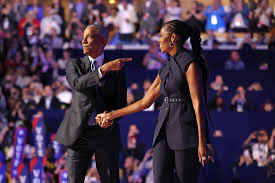
It’s the DNC, August 20, 2024: A crestfallen Michelle Obama, dressed in a belted, sleeveless, navy blue pant suit costing $3000 plus, shares lessons she’s learned from her family legacy, her audience, mesmerized and adoring:

…they were suspicious of folks who took more than they needed. They understood that it wasn’t enough for their kids to thrive if everyone else wanted around us was drowning.

Her words trigger flashback, a former president, his trademark poise and eloquence, exhorting the wealthy to give back.

As she speaks, millions of Americans struggle daily with making ends meet. Thirty-eight percent of Gen Zers, born since 1997, think themselves less secure than their parents at the same point, their living expenses ceasingly escalating (cnbc.com)—groceries, housing, transportation, clothing, their jobs tentative or inadequately remunerated. Even with a college degree, obtained at considerable debt, the American dream eludes their quest.

In a CNN poll conducted earlier this year, 71% of Americans rated the economy “poor”; another 38%, “very poor.”

Millennials (born 1981-1996), find themselves burdened with crushing debt, subjecting them to losing it all if another financial crisis occurs like that of 2008.

Since 2022, house prices alone have mushroomed 20 to 30% and interest rates jumped from 3% to nearly 8%. It’s become cheaper to rent than own.

Having children is a luxury (“What Broke the American Dream,” CNN, 2024).

The tab for childcare at a day care center runs an average $800-$900 monthly per child (care.com).

A family’s outlay for a health insurance policy reimbursing 70% of medical expenses averages $3,682 as of August, 2024 (kff.org).

While Michelle speaks, 132,232 homeless seek nightly shelter in NYC, 45, 745 of them children (June, 2024; coalition forthehomeless.com).

They’re the lucky ones. Thousands more sleep in subways, in parks, on the streets, or in cars.

Across America, you see them on city street corners with their cardboard signs, begging help.

As for racial demographics, 52% of heads of households in NYC shelters are disproportionately black; 32% hispanic (coalition for the homeless).

In 2021, an estimated 300,000 of all races and ethnicities in NY state lived doubled up with relatives and friends.

HUD reports an estimated 653,100 people across America are homeless, up 12% since 2022. Their numbers include not only the mentally ill and drug addicts, but the unemployed and underemployed.

Those numbers include 200,000 veterans, suffering post-traumatic stress from conflicts in Iraq and Afghanistan, sleeping nightly on city streets (National Coalition for Homeless Veterans).

All too often, we’ve this tendency to compartmentalize: it’s them, not us.

Truth be told, millions of Americans are separated from homelessness by a thin thread of tentative circumstance in a market economy where jobs can vanish in an inkling amid economic flux.

Meanwhile, the Obamas have financially estranged themselves from the the middle class they claim ro champion, their estimated net worth between $70 and $135 million, and climbing (NY Post, September 26, 2024).

Why shouldn’t the Obamas, having decried greed on many occasions, not be scrutinized, their feet held to the fire?

Let’s take a closer look.

After leaving the White House, the Obamas purchased a home in D. C.’s plush Kalorama neighborhood of diplomats, the wealthy, and the famous, for $8.1 million (2017). At 8,200 sq. feet, it features 8 bedrooms and 9 1/2 bathrooms. They’ve since made extensive revisions, adding a pool and a brick wall surrounding the property. Parking is available for ten cars.

Not long after (2020), they purchased a 29.3 acre property on exclusive Martha’s Vineyard with pristine water views and a dedicated pathway to the ocean beach. At 6,892 sq. feet, it has 7 bedrooms and 8 bathrooms and special design features. Cost: $11.5 million.

In 2000, the Obamas purchased a residence in Kenwood, a suburb adjacent to Chicago, featuring six bedrooms and six baths for a modest $1.65 million. They lived there from 2004-2008, or until Barack Obama became president. Frequented by tourists and blocked off, the Obamas are seldom there.

In 2015 Obama’s close friend, financier Marty Nesbitt, purchased a three acre Oahu property for the Obamas in a proxy deal for $8.7 million. Its $15 million dollar mansion, formerly home to Magnum PI TV series, has been leveled to accommodate something more grandiose, a compound consisting of three homes, one of them presumably for Secret Service. 

It hasn’t hasn’t been without controversy. Despite state and county laws protecting the coastal environment against the intrusion of sea walls, believed to inhibit beach migration inward, loopholes were exploited and exemptions granted to build a 70 foot seawall.

Obama, the environmental president, is keeping silent, deferring any comments to Nesbitt’s office.

Setting the record straight, the Ivy League Obamas have never been absent from privilege, victims of white bias or corporate exclusion—or bluntly, unemployed.

While a Senator, Barack and Michelle collectively earned $1.6 million.

As President, he made $400,000 along with a $50,000 expense account, a $100,000 tax free travel account, and $19,000 entertainment account (afrotech.com).

In retirement, former presidents receive $1 million in travel expenses yearly; their spouses, $500,000 (ntu.org).

There’s also a generous allowance for office space and staff.

According to Business Insider, Obama garnered $15.6 million in book royalties from 2005-2016.

He presently receives a $246,424 pension, indexed to inflation (National Tax Union Foundation).

With more than five years in Federal office, medical care at the nation’s best hospitals, is free, unlike for millions of retired Americans paying up to $200 monthly for Medicare that excludes vision, hearing and dental benefits and makes it necessary for seniors to fill in the gaps for deductibles and copays with supplemental insurance and a drug plan.

Their social security is likely to be taxed.

Longterm care for a dehabilitating illness or injury is out-of-reach for most middle class Americans, averaging $35,000 to $108,000 annually (National Council on Aging).

Since leaving the White House, Obama reportedly received $850,000 for two speeches and $2 million for three talks in 2017.

In 2018, the Obamas entered into an estimated $50 million production deal with Netflix.

Business Insider estimates the Obamas will ultimately earn $250 million in post White House earnings for books, speeches, tours, and movie productions.

As for Michelle, last year saw her walk away with $750,000 for a one hour speech in Germany before the Bits and Pretzels forum in Munich associated with the annual Oktoberfest (NY Post, September 26, 2024).

Her normal speaking fee starts at $200,000. Barack commands a minimal $400,000, matching Joe Biden’s annual presidential salary in every speech.

For her memoir, Becoming (2018), Michelle received a $65 million advance.

In Becoming, Michelle wrote, “When you’re president of the United States, words matter.” They do, but doing matters more.

Exemplary leadership seeks not its own gain, but the welfare of the many. It sets precedent for a new politics that eschews platitude, the ethereal, and the partisan. Centering on doing, it knows its limits. Simplicity and restraint govern its personal conduct in daily life. In its moral construct, it sets an example that inspires and achieves a democratic altruism transcending the factional.

On the other hand, economic advisor and Huffington columnist Zachary Carter writes, “Obama isn’t running for office again, but his sellout sends even uglier signals to the electorate.”

As for the Democratic Party, dominated by managers, venture capitalists, Hollywood and media celebs, it can no longer boast being the party of Franklin D. Roosevelt: “The test of our progress is not whether we add to the abundance of those who have much; it is whether we provide enough for those who have so little.”

–rj
 

The Positives of a Reading List

Being an avid reader, I’m fond of booklists from those in the know as to their verdict on the best out there. Every New Year’s Day, I post my own favorites for the ensuing year, as much for myself as for others, as a way of disciplining my reading.

With booklists in mind, I couldn’t resist getting Swiss researcher Chiareto Calò’s well-received book, The Library of Humanity: The Most Influential Books. Besides, at just $1.99, how could I go wrong?

Calò lists 300 books, fiction and non-fiction, poetry and plays, across several continents and timelines, including our own.

I like how he succinctly previews each selection with a page or two, giving readers more than a mere listing.

But mind you, he surprisingly lapses in omitting writers like Cicero, Heraclitus, George Eliot and works like Goethe’s Faust.

He also makes some selections I think might be questioned.

Still, he makes up for such lapses, with inclusion of important works most of us have probably missed, to which I plead guilty and fervently hope to make amends.

For example, though I knew of the Epic of Gilgamesh, pre-dating Homer by 1500 years, I had never read it.

At least until yesterday, coming away dazzled by the splendor of its poetic rendering of the human journey.

And I’ve yet to read the Vedas, Hesiod’s Theogony, Aeschylus’ Oresteia, or that great Indian epic, The Ramayana. And so it goes.

But as I said, I mean to mend my ways.

Next stop, ancient Egypt and the Story of Sinuhe.

–rj

Freedom’s Warrior: Timothy Snyder


Chances are you don’t know who Timothy Snyder is, though all who love a free Ukraine should. Snyder is an esteemed centrist Yale historian, graduate of Brown University (B.A.) and the University of Oxford (D. Phil).

Snyder specializes in central and eastern Europe, the former Soviet Union, and the Holocaust. Fluent in English, German, Polish, and Ukrainian, he reads in ten languages.

He’s also a permanent fellow at the Institute for Human Science in Vienna. Prolific, Snyder has authored sixteen books to date, translated into forty languages, with a forthcoming book to be published in September, 2024.

Raised by Quaker parents in Ohio with leftist leanings, there’s a moral insistence conveyed in unadorned prose throughout his many books. In his classes, he uses no notes and with ease can blend Plato, Hegel, DuBois, and polymath René Girard to make his point (Baird, The Guardian, March 23, 2023).

His international awards are numerous. They include Carnegie and Guggenheim fellowships and Hannah Arendt Award for Political Thought. He was a Marshall scholarship student at Oxford.

I hadn’t anticipated an ardent defense of Ukraine, buttressed from someone at Yale, but there he was, Timothy Snyder, forthright, unapologetic, in his op-ed appearance in the New York Times:

“As in the 1930s, democracy is in retreat around the world and fascists have moved to make war on their neighbors. If Russia wins in Ukraine, it won’t be just the destruction of a democracy by force, though that is bad enough. It will be a demoralization for democracies everywhere. Even before the war, Russia’s friends — Marine Le Pen, Viktor Orban, Tucker Carlson — were the enemies of democracy. Fascist battlefield victories would confirm that might makes right, that reason is for the losers, that democracies must fail” (NYT, May 19, 2022).

I’ve been following Snyder ever since.

Snyder has his detractors, of course, some regarding him more as a pundit, offering personal opinion in the guise of expertise. For a good summation, and counterpointing (see LA Review of Books, Unshared History, Oct. 16, 2012).

His Marxist critics principally object to his inclusion of Russia as fascist under Putin, as they like to reserve the term for their right wing opponents. Historically, fascism was a term used by the Soviets to denounce Nazis and other factions opposed to its dictates.

Snyder answers that “People disagree, often vehemently, over what constitutes fascism. But today’s Russia meets most of the criteria that scholars tend to apply. It has a cult around a single leader, Vladimir Putin. It has a cult of the dead, organized around World War II. It has a myth of a past golden age of imperial greatness, to be restored by a war of healing violence — the murderous war on Ukraine” (NYT, May 19, 2022).

If you’re curious about Snyder’s political biases, he endorsed Biden in 2020 and in a Guardian interview, shared, “I vote Democrat!” He sees Trump as an autocrat appealing to popular prejudices inimical to American democracy’s survival. Trump’s policies are about making White people feel comfortable.

Snyder’s immediate concern, however, is the war in Ukraine, about to enter its third year, pitting a David against a Goliath, pitiless and unpausing in attacks on Ukraine’s civilian infrastructure in a crucial struggle presently overshadowed by events in Gaza.

To his credit, Snyder has tried valiantly to keep the Ukrainian conflict center-stage: “If Ukraine does not win, we can expect decades of darkness” (NYT, May 19, 2022).

Hospitals, churches, shopping centers, apartment dwellings, it’s all fair game to Putin, whose aim is to inflict maximum terror, destroy food supplies, disrupt the electricity grid, and deny water resources to a nation he regards as historically integral to the Russian empire.

Much of Putin’s onslaught comes from not only cruise missiles, but thousands of drones, many of them supplied by North Korea and Iran.

The Biden administration and its NATO allies have been slow to respond. Patriot defense batteries are just now arriving, antiquated, and short of the seven President Zelensky says Ukraine needs to ward off the daily aerial assaults.

In contrast, Israel has 32 up-to-date batteries proven highly effective against Iran’s massive missile and drone response of April 14, 2024 (Defense Express, April 15, 2024).

If Ukrainian skies are safer now, it’s because Timothy Snyder stepped in, not the White House, raising $2,300,000 for Safe Skies, a program allowing Ukraine to install thousands of sensors throughout eight Ukrainian regions.

Safe Skies provides an early-warning alert and rapid response to drones and cruise missiles: “I visited one of the sites and saw some of the technology at work, as well as the impressive cooperation between the Ministry of Digital Transformation and the armed forces,” Snyder said (The Free Press, Substack, August 17, 2024).

Donations were largely individual worldwide, with a few corporations also contributing.

We nearly lost Snyder in 2019 when, feeling ill, he resorted to ER in New Haven, spending seventeen hours there, before being diagnosed with a baseball-sized tumor in his liver along with sepsis. Snyder would subsequently spend the next three months in five hospitals.

But you don’t mess with Snyder, who kept notes on his hospital sojourn, the later basis of a scathing indictment of American healthcare: Our Malady:
Lessons in Liberty from a Hospital Diary.

Thankfully, he’s still with us, a boon for freedom lovers everywhere,

–rjoly

The Lights Are Flashing Red

Famed entomologist E. O. Wilson passed into infinity in December, 2021.
He was 92.

I came upon him late in my life, but not too late for him to have left me with a reverence for his boundless intellect, inveterate inquisitiveness, and fervent championing of our fellow creatures, mostly outside human ken, myriad species vital to Man’s survival, yet victims of humanity’s arrogant trespass.

Recently, an extended research project, launched by the World Wildlife Fund, revealed that of the 32,000 species it analyzed, 69% of them are in decline. Shockingly, 2.5% of mammals, fish, reptiles, birds and amphibians have gone extinct just since 1970 (World Wildlife Report).

While species extinction surely is an integral fact of our 4.5 billion old planet’s history, the salient evidence of natural selection favoring those able to adapt to largely inveterate climate distillations, several near-Earth object (NEOs) visitations, volcanic acidification of oceans and acid rain, impacting land chemistry, their repetition has become marginalized by evolution’s new arbiter of destiny, homo sapiens.

“The message is clear and the lights are flashing red,” says WWF International’s Director General Marco Lambertini, one of the report’s authors.

Climate change threatens the next massive die-off, witnessed in every day record breaking temperatures, accelerating violent storms, rising sea levels, droughts, and massive fires.

Meanwhile, we continue to pour heat-trapping gases like carbon dioxide and methane into the atmosphere. All of this affects habitat, destroying the intricate ecological web that sustains us.

It doesn’t make for breaking news headlines, but should, that the Arctic
is warming four times faster than the rest of our planet, threatening the demise of the jet stream, resulting in still more climate instability.

We live our lives addicted to trivia, fingers in our ears, indifferent to the existential challenge that poses our extinction. It seems a human predilection to forfeit the future for indulgence in the ephemeral present. Rome burns while Nero plays his fiddle.

Thus far, efforts to mitigate climate change and restore balance have failed to achieve their targets. We even have a candidate running for the presidency who’s pledged to roll back environmental regulations.

Not to be outdone, we have President Biden’s recent approval of the Willow Project (March 1923), allowing ConocoPhillip’s massive oil drilling rights on Alaska’s North Slope in the National Petroleum Reserve, despite his campaign promise he’d prohibit drilling on public lands (The Willow Project).

We knew where Trump stood, but we trusted Biden, whose administration has also approved the auctioning off of 73 million acres of waters in the Gulf of Mexico to offshore oil and gas drilling interests, encompassing an area twice the size of the Willow Project (Common Dreams).

Universal human-induced loss of forest, wetlands, and ecosystems hastens the trajectory of apocalyptic consequence for future generations.

Meanwhile, beleaguered polar bears attempt to adapt, but aren’t succeeding. Given the melting ice, they cannot access their traditional foods, resulting in their numbers declining 30% since 1980 (Polar bear decline).

Penguins haven’t fared any better, their numbers declining up to 10% (Penguins declining).

Truth be known, we’re approaching a tipping point at which the ecosystem collapses.

E. O. Wilson rightly faulted humans for earth’s crisis: “Deeming ourselves rulers of the biosphere and its supreme achievement, we believe ourselves entitled to do anything to the rest of life we wish. Here on Earth our name is Power” (Half-Earth: our Planet’s Fight for Life).

Each species is its own miracle. By the century’s end, most of today’s faltering species will be gone:

No birdsong to greet the new day,
No crickets rubbing their wings;
An absence of croaking frogs at the pond,
Zinging dragonflies but memory.
Amid parched landscape, a wounding silence.

–rjoly

Discovering Ourselves Through Writing

What to write about, or finding your subject matter, doesn’t come easily.

Some writers respond to prompts to get them started.

Most writers probably get started out of a chance remark thrown their way in casual conversation or through stimuli in something they’ve read, or a keen interest, say in health research or climate change, that drives their protocol.

Political writers with an agenda find an especially easy route, simply reacting to adversary axioms they view as detrimental to public welfare. They’re never out of material, the spring never running dry in a media era of incessant scrutiny.

Popular author Tim Cotton just throws a sentence out there, not knowing where he’s headed: “What you don’t know about me, and won’t care, is that everything I write starts with a random sentence, typed onto a screen with no idea where I am going.”

Probing deeper, however, you’ll find this may be misleading. Cotton doesn’t simply post an initial sentence without an underlying coterie of everyday happenings—a visit with his aging father, the dream residue of an afternoon nap, the challenge of what to keep or toss, etc.

The key is to be mindful and present in the ordinary, and Cotton does this better than most of us. I suspect he jots down incipient observations he can expand upon later. Like many writers, he may keep a journal.

No matter how the writing venture begins, it has its mysterious aspects that all of us know very well. I remember a fellow graduate seminar student telling me that my writing exhibited a different person from the one of daily conversation.

That doesn’t surprise me. However I begin writing, I tunnel into a buried mineshaft of a separate self, perhaps akin to what Jung called the Shadow, surfacing in the writing act like a Yellowstone geyser bursting from subterranean depths.

Occasionally, I’ll bump into something I wrote several years ago and come away, Did I write that?

The poet Coleridge famously ascribed his Kubla Khan poem to an afternoon opium induced nap. On the other hand, Harvard scholar John Livingston Lowes pointed out Coleridge’s possible myriad reading sources in The Road to Xanadu.

In short, the depth psychologists Freud and Jung were right: We file our experiences, even the most trivial, at the unconscious level, lying dormant, only to spill suddenly into awareness, triggered by associative stimuli.

And so Tim Cotton is also right. However you start, your writing will reveal unknown vistas, revelatory of a much wiser Self than that quotidian persona we publicly assume.

Cotton inspired this post. I simply typed the first sentence, not knowing what I’d say. I had no notes, did not google, etc. That concealed self, automatic writing psychic enthusiasts might call it, filled out the blank.

Our minds are a file cabinet of our human experience, waiting retrieval. Writing may prove laborious, but think of what you miss when you don’t bother to write—the confluence of your life’s journey and its meaning; above all, your linkage with wider humanity, fostering understanding and empathy.

A journey of serpentine twists, leading to unanticipated trajectories, you never really know where you’ll end up.

–rj

Let’s not change horses in midstream: The case for another Biden term


The news hadn’t bode well for Joe Biden even before his disastrous debate with Trump.

The NYT, tracking 47 polls, shows Biden trailing Democratic senate candidates in the upcoming election in all, but one poll, where he’s tied.

His low polling doesn’t come as a rebuke of his policies, at least among Democrats. If one rightly judges the merits of a presidency by its ability to promote change bettering America, Biden outpaces his predecessors, including Obama, putting him in good company with Abraham Lincoln, Franklin Roosevelt, and Lyndon Johnson.

The problem is that most voters view Biden as lacking the physical and mental capacity to carry out the duties of office for another four years.

His ninety minute confrontation with Trump simply buttressed the public’s hesitancy.

Watching the debate was painful for me. Biden seemed laboring to reach the podium, stuttering repeatedly, losing his train of thought on one occasion, digressing in several of his responses, and looking down repeatedly as if searching for a response prepared by his handlers.

It was like watching a boxer, trapped in the ring corner, staggered by repeated blows.

Trump’s best line nailed it: “I really don’t know what he said at the end of that sentence. I don’t think he knows what he said, either.”

A healthy, nimble candidate would have atomized Trump quickly in fact-checking rebuttal. Trump was his usual self, hyperbolizing and mendacious, though to his credit, he exercised discipline in not interrupting his opponent.

Though just four years younger than Biden at 77, Trump came across as consistently energetic. “It seemed like a thirty year difference,” one reporter said.

So where do we go from here?

Despite a groundswell of party cohorts urging his withdrawal from the race, seconded by formerly friendly media, Biden is unlikely to heed their counsel—that is, unless there occurs another stumble, both literally and figuratively.

But here’s my take: With six weeks to the Democratic National Convention, August 19-21, an open convention would produce political chaos with a rush of candidates, inadequately assessed.

Kamala Harris is the likely designee. Biden, of course, could immediately resign, allowing Harris to assume the presidency. Any other choice, say a white male replacement at the convention, would spell unmitigated disaster, and assure a Trump victory.

Black and brown voters would abandon ship. As Areva Martin, a California convention delegate pledged to Biden, put it: “If you pick a white man over Kamala Harris, black women, I can tell you this, we gon’ walk away, we gon’ blow the party up.”

The caveat, however, is the improbability of Harris winning in November, polls indicating she enjoys even less favorability than the president.

I say, better not to panic. I believe Biden can still win. Twenty percent of Republicans distain Trump. In a close election, they could provide the margin of victory for Biden, whether by crossing over or not voting a presidential preference. I think it reasonable they’ll do just that.

As for a future four years, if Biden can’t carry out his duties, he can either resign, with Harris succeeding to office, or the Congress can implement the 25th Amendment, Section Four:

“Whenever the Vice President and a majority of either the principal officers of the executive departments or of such other body as Congress may by law provide, transmit to the President pro tempore of the Senate and the Speaker of the House of Representatives their written declaration that the President is unable to discharge the powers and duties of his office, the Vice President shall immediately assume the powers and duties of the office as Acting President.”

Let’s not change horses in midstream. We can still win and smooth out any winkles. The alternative is unthinkable.

—rj

On being an introvert in a noisy world


Do you really want to go to that party, or would you prefer a quiet evening at home?

Like a library over meeting new people?

Don’t like being the center of attention?

If may be you’re what’s known as an introvert.

It was psychiatrist Carl Jung who coined the terms introvert and extrovert for primary personality modes. In fact, he wrote a book about it, The Psychology of Types (1921), that made him famous.

Introverts shy from crowds; extroverts prefer them.

Introverts like alone-time; extroverts, where the action is.

Neither is superior to the other, both featuring strengths and liabilities.

How do these modes bottom out? Research suggests just a third of us are introverts.

That can make things difficult for introverts in a world that tends to pass them by.

I’ve done several personalty tests. No doubt about it, I’m classic introvert, the good and bad of it—shy, moody, distant, but also sensitive and caring, lover of all things beautiful like music, art, poetry, an intellectual read and, of course, nature’s solitude.

I prefer space.

It isn’t I don’t value companionship. I’ve cherished salient friendships across the years and, though it seems contradictory for an introvert, I experience nostalgia for friends who can never be retrieved, annulled by time’s entropy and mortality’s specter.

If you’re introverted, you’re likely in a good place.

Introverts often display not only keen sensitivity, but above average intelligence. If you believe the statistics, 70% of those excelling in art, music or math, i.e., the gifted, are introverts.

They include Bill Gates, Barack Obama, Elon Musk, Meryl Streep, and J.K Rowling.

Warren Buffett did a Dale Carnegie course to overcome his shyness.

Dr. Seuss, that master of children’s books, was afraid to meet the children who read his books for fear they’d be taken back by his quietness,

Is it nature or environment that fashions who we are?

Psychologists think it mostly genetic.

But it can get complicated.

Some of us, seeking balance, become omniverts, or combinations of both dispositions, depending on the situation we find ourselves in.

On the other hand, ambiverts, and that’s many of us, while displaying a personality mix, still lean one way or the other.

If you want a good read on being an introvert, I highly recommend Susan Cain’s Quiet: The Power of Introverts in a World That Can’t Stop Talking:

The highly sensitive tend to be philosophical or spiritual in their orientation, rather than materialistic or hedonistic. They dislike small talk. They often describe themselves as creative or intuitive. They dream vividly, and can often recall their dreams the next day. They love music, nature, art, physical beauty. They feel exceptionally strong emotions–sometimes acute bouts of joy, but also sorrow, melancholy, and fear.

That’s me and it may be you! And that’s not a bad thing at all.

–rj


Sad news out of India: a vindictive government persecutes its critics

The news out of India is disturbing, violence and repression of those opposed to Prime Minister Narendra Modi and his Bharatiya Janata party (BJP) daily occurrences.

Recently reelected to a third five-year term, but with diminished support that’s resulted in a loss of his parliamentary majority, Modi must now rely on a coalition government to maintain power.

This hasn’t proved a roadblock to his recent cabinet appointments, none of them Muslim, though India has a burgeoning Muslim population exceeding 200 million, presently 14% of the country’s population. Nor has it tempered his embrace of a Hindu hegemony (Hindutva).

Speaking out against his policies and the BJP risks severe consequences.

Many of his political opponents have been jailed on trumped up charges of corruption, while others are under investigation.

In March, 2024, Modi’s government froze the bank accounts of its main adversary, the Nationalist Congress Party, alleging non-payment of taxes.

In 2023, it eliminated the country’s chief justice as one of three commissioners overseeing elections. The BJP now enjoys a majority vote.

For another example, there’s the ongoing harassment of Waheed-Ur-Rehman, arrested in 2019 and held for two years, much of it in solitary confinement, for his opposition to the crackdown on Kashmir resistance to the suspension of Kashmir’s semi-autonomous status.

Now comes the BJP’s newest outrage in pursuing prosecution of 1997 Booker Award winner Arundhati Roy (The God of Small Things) for her remarking in 2010 that Kashmir was never a part of India.

Kashmiri academic Sheikh Showkat Hussain, who appeared with her at the rally in Delhi, will also be prosecuted under India’s Unlawful Activities Prevention Act (1967).

Roy has been a longtime critic of Modi policy.

If media pundits thought the Modi government would learn from its election setback, they’re sadly mistaken.

The BJP has become even more vindictive—more arrests, more violence.

In 2023, the Biden administration gave Modi a lavish welcome, replete with a state dinner. Talk about Kissinger, expediency is still in vogue.

Entrepreneurial moguls Bill Gates and Elon Musk, who view India as an investment quarry, sent their congratulations to Modi on his win.

At the just concluded G7, a lengthy queue assembled to do acquiescence to its invited guest.

The casualty is India’s secular constitution.

—rj

Carl Sagan and My Incalculable Debt


I’ve always admired Carl Sagan, taken from us so early at age 62.

Renowned for his contributions to space exploration and the search for extraterrestrial life, his thirteen year running public TV series, Cosmos, garnered an international audience of 500 million.

A prodigious scholar, he wrote some 600 papers and twenty books.

He wasn’t a child of privilege. His family knew poverty firsthand.

Sagan taught at Harvard for five years as an assistant professor following his undergraduate and graduate studies at the University of Chicago, only to be denied tenure. They said his interests were too broad.

Cornell immediately offered him a teaching position, and he would teach there, loved by his students and esteemed by colleagues, until his death thirty years later. Following his death, Smithsonian Magazine declared him “irreplaceable.”

I liked him especially for his advocacy of skepticism and embrace of reason and scientific methodology.

There’s a biblical proverb I remember: “Let another man praise you, and not your own mouth; A stranger, and not your own lips” (Proverbs 27:2).

Sagan was never given to affectation or condescension, an anomaly among eminent professors from elite universities I’ve known across the years:

“I think I’m able to explain things because understanding wasn’t entirely easy for me. Some things that the most brilliant students were able to see instantly I had to work to understand. I can remember what I had to do to figure it out. The very brilliant ones figure it out so fast they never see the mechanics of understanding.”

Along with Voltaire, Hume, Mill, and Russell, I owe Sagan an incalculable debt in helping me find the truth of reason that has set me free from the cultural biases, of which all of us are heirs.

–rj

Time Musings

Can you hold time in your hand? Place it on your dresser? Put it in your wallet?

Can something impalpable exist?

And yet we measure by it—past, present, future.

While physicists debate its existence, intuitively we believe in it.

Like we do God.

We age by it. We are not what we once were.

Gardeners know its passage, from seed to birth, ripening to harvest.

Or as the Rubaiyat of Omar Khayyam renders it, “One thing is certain, and the Rest is Lies; The Flower that once has blown for ever dies.”

Perhaps we’d do better to conceive time as flow, or infinity’s rhythm, with neither beginning nor ending, our lives but a wink amid a stellar darkness of unending boundary, a universe among universes, yielding mystery and wonder to finite eyes.

Always Was, Is, and Shall Be.

If we truly believe in time, it behooves us to use it wisely, alter our history, relish awareness, and live in the present.

Or as Mark Twain, one of America’s genuine truth-sayers, put it, “There isn’t time, so brief is life, for bickerings, apologies, heartburnings, callings to account. There is only time for loving, and but an instant, so to speak, for that.”

–rj