Pacific Grove and its Monarch butterflies

monarch

For all its ever burgeoning population and high cost of living, I think California still offers a lot of good living away from the crowds in small towns hugging its pristine coast, offering the surf swish of blue Pacific ocean, cradling mountains that often walk down to the sea like in Big Sur country and, of course, the soothing warmth of year-round sunny days with low humidity.  To me, California is like going into one of those specialty ice cream outlets and finding yourself overwhelmed by a dazzling array of choices.  I just love the place!

Pacific Grove, however, stands out for me, located on the Monterey peninsula not far from ritzy Pebble Beach, rugged Big Sur, and charming Carmel-by-the Sea.  This area, in particular, means a lot to me, for Karen and I spent fun honeymoon days taking in its varied tapestry twenty years ago.  I’m all about regaining paradise.

Pacific Grove wasn’t even on my radar map until several weeks ago when I happened to find it mentioned in a book off my shelf that I hadn’t read in over two decades and started reading again.  While noting the town is famous for its annual influx of migrating Monarch butterflies each November, the writer laments their declining numbers, probably due to a shrinking habitat as housing construction continues to expand. I would add the increasing loss of milkweed, a principal food supply for the larvae.

Now this was way back in 1990 and thus my curiosity was aroused as to the plight of the Monarchs since, and so I did the research and came up both buckets full with info on Pacific Grove and its wintering Monarchs.  The news is good, though it could be better.

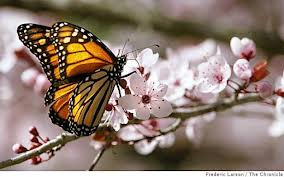
After more than twenty years, they still come to escape the winter cold of the Canadian Rockies and Southern Alaska, though in sharply diminished numbers, perhaps about 10,000, unlike the 50,000 plus in the halcyon days long gone.  The town seems attentive to its friends, even staging an annual parade (October), and why not, since they’ve built a thriving tourist industry around them and any further decline means diminished dollar intake as well.  There is a fine of $1000 for molesting a butterfly.

monarch2

Well-meaning, but on occasion, the city council can be dimwitted, opting in 2009 to prune the eucalyptus trees that the monarchs favor in their designated Monarch Grove Sanctuary, resulting in a precipitous drop shortly after to less than a thousand Monarchs.  Cutting a branch is like tearing down a house replete with its residents, since the larvae cocoon on these bare branches.  Today you’re  likely to see more Monarchs further down the coast toward Santa Cruz.  Some recent visitors report seeing just a couple of trees with butterflies, vastly changed from the swarms that blanketed the eucalyptus several decades ago.  What appalls is the council’s acting against the advice of environmental scientists.

pacificgroveThen, in November 2012,  the council was forced to make public its plan to revamp the Sanctuary, strikingly out of touch with California’s environmental recommendations.  In the past, the council has a history of foregoing environmental reviews.  As I write, I don’t know the outcome.

But I do need to be fair.  It used to be that the the principal Monarch habitat lay in the city’s George Washington Park, but urbanization, foot traffic and drought have taken their toll.  The city is trying to restore the habitat through tree planting, mulching and new trails.  The numbers are down to less than a hundred now.

The Monarchs are awesome in their intricacy of evolved pattern, suggesting aerial tigers.  They’re also, though infinitely delicate, intrepid pilgrims on their own hajj to a nesting place they’ve never been, and yet they somehow find their way in a journey consummating up to 2000 miles.

Central California is Steinbeck country and the Nobel laureate made Pacific Grove his home with his first wife, Carol, and visited it often in his later years as his own sanctuary providing renewal.  He would later tellingly write that “Pacific Grove benefits by one of those happy accidents of nature that gladden the heart, excite the imagination, and instruct the young” (Sweet Thursday).  I suspect the Monarchs had a great deal to do with that.

Be well,

rj

Intimations of Mortality: Keats revisited

75px-JohnKeats1819_hiresI have always been fond of the poet, John Keats.  Maybe it’s because he seems to have been down on his luck so early in life and I just happen to be drawn to underdogs.  When he was just eight, he lost his father, who died falling from a horse.  At fourteen, his mother succumbed to TB, a disease that would prey upon the family, taking his brother, Tom, at nineteen and himself at barely twenty-five.  Meanwhile, lawyers consumed the family inheritance.

Keats always had a premonition of an early death, not surprising given the family history, but he didn’t know he was already ailing with TB when he became engaged to the girl next door, the coquettish Fanny Brawne in the fall of 1818.

The following year saw Keats penning in a six week period  the masterpieces for which he is now famous, poems like “Ode to a Nightingale,” “Ode to Melancholy,” “Ode to a Grecian Urn,” “Ode to Psyche,” and “La Belle Dame Sans Merci.”

On February 3, 1820, he coughed up blood in his bedroom and with his typical courage, exclaimed:  “I cannot be deceived in that color; that drop of blood is my death warrant. I must die.”

He would travel to Italy in a last desperate attempt to recover his health, only to die a few weeks later, attended by a lone friend.  Today he lies in Rome’s Protestant Cemetery.  Engraved on his tombstone is Keats’ chosen epitaph:  “Here lies one whose name was writ in water.”

I have always been attentive to Keats, visiting his last London Home, Wentworth Place,  in lovely Hampton Heath, and his last abode abroad, a small apartment in Rome adjacent to the Spanish Steps, Rome’s gathering place for throngs of young people from across the globe, presumably oblivious in the “mackerel crowded seas” (Yeats) to the drama enacted next door eclipsed by time.  I have also been to the cemetery, moved and reflecting on what might have been a different outcome with a better shuffling of the cards of fate.

He had aimed to write the best poetry of which he was capable and though dying so young, achieved a poetry the world still marvels at.   No poet, not even Shakespeare, Milton, or Wordsworth achieved such mastery at so young an age, laboring against illness, family misfortune, financial duress, rejection by the critics, and the anguish of loving a flirtatious Fanny, who often provoked his jealousy.

Of all the Romantics, he strikes me as the most poignant, ever aware of life’s brevity, or how temporality colors all, testing the significance of human assertion itself.  Paradox always characterizes his poetry and centers in the conflict of dream vs. reality.  Unlike many Romantics, Keats ultimately opts for truth in the interplay of mind and feeling.

I have been thinking a lot about him lately in conjunction with the cancer hoops I’ve had to jump through these pastt several months.  I had gone to an osteopath seeking relief for my back pain only to be told xrays showed a lump adjacent to the left clavicle, which might be cancerous.  A subsequent CT scan, though it showed no malignancy, revealed a large thyroid nodule, and I was again cautioned it might be cancer.  They found me a surgeon and in the meantime I had an ultrasound guided fine needle aspiration biopsy, which indicated another, smaller nodule on the left side of the thyroid.  The pathology report came back negative.

By then I met with my surgeon, who surprised me in light of the biopsy:  “I can’t guarantee you don’t have cancer.  FNAs have false negatives up to 20% of the time.”

While waiting for surgery five days away, I visited my dermatologist to check on a knee sore, which turned out inconsequential,  Alas, however, she found a black mole that might be melanoma, the most aggressive of cancers.  And so I had to go into surgery facing the double whammy of two cancers at separate sites, metastasis a distinct possibility.

The surgery went well.  The surgeon didn’t find cancer, so only a partial thyroidectomy was done, allowing me to perhaps avoid medication.  But I still hadn’t gotten the lab results on that black mole.  I had to actually call to get the report.  It was a precursor dysplasia nevus, which can turn into melanoma if not removed.  Even though benign, having dysplasia nevi increases your chances of getting melanoma, so it means constant vigil to catch early changes.

And so now you know why my thoughts have been so filled with Keats, though in this medically sophisticated age I’ve come upon some luck this dear poet was denied.  Living with premonition of his own demise, Keats wrote what may be my favorite poem, and I mean of any poet,

When I have fears that I may ease to be
Before my pen has gleaned my teeming brain,
Before high-pilèd books, in charactery,
Hold like rich garners the full ripened grain;
When I behold, upon the night’s starred face,
Huge cloudy symbols of a high romance,
And think that I may never live to trace
Their shadows with the magic hand of chance;
And when I feel, fair creature of an hour,
That I shall never look upon thee more,
Never have relish in the faery power
Of unreflecting love—then on the shore
Of the wide world I stand alone, and think
Till love and fame to nothingness do sink.

If you look at this poem carefully, you’ll find it fascinating in its astute organization; for example, the poem actually consists of one sentence, or subordinate clauses coalescing into a main clause at poem end.  In turn, this lends an accumulative buttressing of the persona’s earlier mention of his “piled up hopes.”.So many hopes, teeming high, but cut off by mortality.

The poem’s structure also features an antithesis between thinking and feeling in its three quatrains prior to the closing couplet in this Shakespearian sonnet.

Strikingly in consort with its theme, each quatrain moves us closer to the reality of death, with a progressive abstraction in the imagery with each succeeding quatrain:

Increasing abstraction:

rich garners

cloudy symbols

faery power

nothingness

These quatrains also unleash inexorable transitory strictures of foreclosure, feeding into the “nothingness” of the closing couplet in which death renders all human dreams, whether of love or fame, insignificant.

Increasing transitoriness:

autumn

one night

one hour

The poem’s imagery is likewise supportive of the theme, with an imagery cluster featuring darkness, shadows and clouds,

For the poet, death represents closure on love and artistry and fame.  I remember reading one of Keats’s letters in which he called death “the great divorcer.”

The truth is that ultimately we all get our ticket punched; but for Keats, he was so young,  talented, and in love.  Sometimes life can be cruelly unfair.  Nonetheless, with the quiet courage that always characterized him, he accepted his fate.

There are lessons here for all of us: to pile up the nows, knowing the temporality that governs us all; to live quietly and simply, centered in the right values; to discern those issues that matter;  above all, to love amply those around us.

–rj

Finding centeredness and discovering peace the Tao way

yin

Whenever I fix lunch for myself, which is usually everyday other than weekends, I like to read something with it, since my spouse isn’t normally present to make lunch interesting.  The other day I found a book on the shelf I hadn’t read since it first came out in 1990, Diane Drehler’s The Tao of Peace, predicated on Lao Tsu’s monumental Tao Te Ching, deriving back to two and a half millennia ago.  Translated more than any other work except perhaps the Bible and the Koran, this brief work may just well be the wisest book ever written, though relatively brief in its 5000 words.

Rich in its gleanings of human experience, it teaches the Tao (pronounced with a d), a term difficult to translate but approximating something like Reality, or Nature, or the system of things.  I like to think of its as the Way, referring to “the way of things”.  You name what humans encounter, the Tao Te Ching deals with it, offering seekers an inner peace in an often troubled world through simple, balanced living that promotes a psychological equilibrium.

In its Chinese text, the Tao is essentially a poem replete with an ambiguity that actually enriches its capability for multiple interpretation.  Accordingly, you can find many texts that are hardly word-for-word translations, but adaptations of what seems the salient undergrowth of each verse or numbered section.  Some adaptations excel, capturing not only the essential simplicity of the original manifested through its economy, but also its rich resonance latent in its density.  The very best renderings are sheer poetry, mirroring the Tao’s intent in brilliant, often modern, metaphor.  Drehler’s readings constitute revisions, rather than translations, but are sumptuous and compelling in their summary eloquence.  Here are a sample few:

The Tao as enduring counsel:

Why did the ancients cherish the Tao?
Because through it
We may find a way of peace,
Leaving behind a world of cares,
And hold the greatest treasure under heaven (Tao 62).

The Tao as journey:

A tree that reaches past your embrace grows from
one small seed,
A structure over nine stories high begins with a handful
of earth.
A journey of a thousand miles starts with a single step ((Tao 64)

The Tao as synthesis:

All life embodies yin,
And embraces yang,
Through their union (Tao 42).

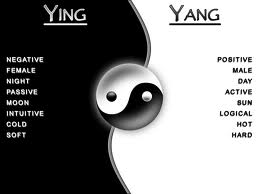
Yin and yang, by the way, are the composite opposites of natural phenomena that must blend to achieve an equilibrium that sustains rather than destroys.

Yin connotes the passive, creative entity associated with the earth, the feminine, valleys, streams and night (moon); yang, the assertive, or male element associated with mountains, the heavens, and the light (sun).. The Swiss psychiatrist Carl Jung drew heavily upon yin and yang for his concepts of anima and animus, the female and male, their synthesis necessary for humans to achieve individuation, or psychical unity,

One of my favorite Drehler renderings is Tao 76.

The Tao as flexibilty:

At birth all people are soft and yielding.
At death they are hard and stiff.
All green plants are tender and yielding.
At death they are brittle and dry.
When hard and rigid,
We consort with death.
When soft and flexible,
We affirm greater life.

But as I suggested at the outset, the Tao lends itself to varied readings encompassing the canopy of human experience.  I like, for example, Brian Browne Walker’s recent translation from the Chinese, Tao Te Ching of Lao Tsu.  It covers all the verses poetically and with a special capacity for capturing antithesis, ever at the core of Tao’s yin-yang approach to experiencing life wholly:

Tao’s warning to  Nature’s despoilers:

Those who dominate nature
And seek to possess it
Will never succeed,
For nature is a living system, so sacred
That those who use it profanely
Will surely lose it;
And to lose nature
Is to lose ourselves (Tao 29).

In closing, I’m absolutely in love with Walker’s verse tribute, here in bold, to the tenor of this great work, which I think you’ll like as well:

        I

       gratefully acknowledge

the wind and the rain,

the snow and the sun,

each and everyone,

the  trees, the water

singing beneath the

ice of frozen rivers,

the mountains

and valleys,

the cold ground

and warm grass

the light and the darkness,

the creatures, poetry,

music, family,

friends,

the gift and

mystery of my life,

the eternal

Tao.

————

May life always find you blessed with peace, centered in the wisdom of the abiding Tao!

rj

One brave poet: Osip Mandelstam

I’ve always hankered after Russian literature since first imbibing Tolstoy and Dostoevsky as a teenager, supplemented by later readings in Chekhov and Pasternak.  For a while, I even took up Russian and can still read the cyrillic script.  On several occasions, I’ve taught Russian literature:  Anna Karenina, The Brothers Karamazov, and The Cherry Orchard.  In 1986, I was offered a government stipend for an advanced seminar in Russian literature, though I turned it down because of other interests at the time.

Tolstoy House
Tolstoy House

In 2000, I took a group of students to Russia in the cruel month of January.  We saw where Chekhov composed most of his plays and stories during his short life.  One of my students was allowed to play his piano.  In St. Petersburg, we visited the apartment in which Dostoevsky spent his final years and saw the desk on which he wrote his masterpiece, The Brothers Karamazov.  My own big moment came when we traveled 120 miles southwest of Moscow, traversing cratered roads of an unraveling post-Soviet nation, to Tula and nearby Nastaya Polyana, Tolstoy’s lovingly preserved residence.

Osip Mandelstam
Osip Mandelstam

Though the triad of Tolstoy, Dostoevsky and Chekhov spring to mind when we think of Russian literary prowess, the truth is that poetry may be its greatest legacy, beginning with Pushkin and continuing into our modern era with poets like Akhmatova, Pasternak, Brodsky and Mandelstam.  I think it was Mandelstam who said that Russia is the only country that takes poetry seriously enough that you can get killed for it, which is just what happened to Mandelstam in the Stalin purge of 1937.

I started up again about Russian poetry after reading a 2011 GuernicaNadezhda Mandelstam interview with my favorite contemporary American poet, W. S. Merwin, in which Osip Mandelstam’s name came up in connection with the complexities of translation.  Initially exiled, Mandelstam  covertly composed subsequent poetry in his head, repeating his verse to his wife, the remarkable Nadezhda Mandelstam, who committed them to school exercise notebooks and then to memory in the event of police seizures, preserving his legacy following his death in the Gulag in 1938.

She would later write two remarkable books (Against All Hope and Hope Revived) in the late 1960s, detailing the sordid story of Stalinist repression of the arts and her efforts to preserve her husband’s mature legacy.  It was thought that his work was done after 1928 prior to his initial exile to Voronezh, but thanks to Nadezhda, 200 of his exile poems have survived. Today, Mandelstam is largely regarded as Russia’s principal twentieth century poet, though he died at just 47.

Here is his most famous poem, clearly an attack on Joseph Stalin, that began his troubles.  Mandelstam never cowered defending freedom.  At the outset, you should be aware that poetry generally suffers greatly in translation.  In Russian, it packs a wallop with its density of nuance that the average reader would pick-up on immediately.  (See notes.)

We live without feeling the country beneath our feet,
our words are inaudible from ten steps away. (1)
Any conversation, however brief,
gravitates, gratingly, toward the Kremlin’s mountain man. (2)
His greasy fingers are thick as worms, (3)
his words weighty hammers slamming their target. (4)
His cockroach moustache seems to snicker, (5)
and the shafts of his high-topped boots gleam.
Amid a rabble of scrawny-necked chieftains,
he toys with the favors of such homunculi.
One hisses, the other mewls, one groans, the other weeps;
he prowls thunderously among them, showering them with scorn.
Forging decree after decree, like horseshoes,
he pitches one to the belly, another to the forehead,
a third to the eyebrow, a fourth in the eye.
Every execution is a carnival
that fills his broad Ossetian chest with delight.

 Notes:

1.    our words are inaudible from ten steps away:  Need to be judicious in conversation.  Stalin was reputed to use listening devices in the Kremlin to check on colleagues.

2.   mountain man:  allusion to Stalin’s coarse background.

3.   greasy fingers:  It was widely circulated that Stalin employed listening devices to keep tabs on his Kremlin colleagues.

4.   his words weighty hammers:  Stalin had a marked Georgian accent.

5.   cockroach mustache:  obviously refers to Stalin’s landmark mustache.  Derives from a Russian fairy tale in which a cockroach and a cat confront one another.

Mandelstam wasn’t your likely hero.  Frail with a weak-heart and clearly aware of the dangers of the Stalin regime, he nonetheless devoted his art, not only to beauty, but to human freedom.  Somehow I had missed out on him in my Russian pursuits.  Maybe now I can make amends.

–rj

How fear erodes love

Like many of you, I follow the news, only to come away frequently dismayed. For all our pretense to rationality, people often seem governed more by passion than reason.  History strikes me as repeated scenarios of human excess, or what Freud astutely called manifestations of the Id, or pleasure principle. I like to think of this inchoate anomaly as the Child within.

There are pretty much seven salient emotions that define and undergird human behavior:  love, hate, hurt, anger, joy, sadness and, last but not least, fear.  The latter generally takes several primary forms: the fear of abandonment, of ineffectualness, of future events, and of mortality.

We’re all afraid in different ways to different degrees, but often don’t realize it, since it’s deeply imbedded within the Unconscious, tracing back to the loss of our hammocked security within our mother’s womb.  We carry no memory of those halcyon days of dependency, but the psyche remembers its glory and the anguish of its loss; so much so that we spend a good deal of our lives seeking commensurate bliss.

I’ve always relished the Edenic garden myth of Genesis with its several resonances of Man’s true estate.  In that story we learn that God made a woman to be a companion for the man he had made, for it wasn’t good for him to dwell alone.  In essence, we’re social creatures and need others to complete ourselves. But I wonder if there’s more going on here, say the underlying, primordial fear in whoever wrote this story of loneliness. Was the writer reflecting his own wrestlings with abandonment?

Such fear may lie behind the quest of so many for validation, whether through achievement, wealth, or power.  We want badly  to be esteemed. We want to draw the crowd.

This fear of abandonment doubtless explains a good deal of romantic love–a quest to find the parental surrogate with us “till death do us part.” Unfortunately, it may also fuel the often failure of this kind of love, since ultimately our happiness derives from within.  Sadly, it perpetuates relationships that frequently denigrate Self.  For a few, death is even preferable to rejection or desertion.

Our world is filled with children who never experienced kinship with an ideal mother in the first place, intensifying their adult quest and making them doubly vulnerable to masquerades of affection.  It may also explain, though inexcusable, much of the misogyny that still abounds expressed in myriad ways, sometimes brutally, by men who project their mother-loss on all women.

Fear of abandonment may lead to a need to control others, as if by putting them on a leash you can prevent their straying.

It also feeds jealousy, that brooding insecurity that suspicions a consort may be enamored away by someone more attractive.

It may likewise accentuate the need for young people to seek the crowded weekend bar, for what’s more hell for a single than a Saturday night alone?

Certainly, it factors into misbehavior and criminality, the need to gain attention or be confined and thus taken care of.

In the public realm, our insecurity renders politics manipulative, with appeals to our fears rather than the public good.  Government becomes a public parent, taking care of all, increasing our dependency, minimizing our self-sufficiency.  We now face an unprecedented federal debt that may do us all in.

Finding our way past this fear is problematic, since we tend to conflate all our fears with thoughts, and thus resort to rationalizations for what we do.  Fears like those of abandonment give rise to a sordid array of  compulsions and resultant follies

But back to where I began.  Properly motivated, love’s the grandest gig in town when conducted rationally in loving another for their individuality and not as some kind of throw pillow. Similarly, finding good friends enhances our lives, not because they cushion our loneliness, but because it makes good sense to bind with those with whom you share commonalty of interest.

Ultimately, our deliverance from anxiety over abandonment comes from diminishing the dominion of feelings; it begins with identifying them and uprooting them as our motivators: What am I really seeking in this relationship? Why am I not seeing the red flags?  Why this person?  Love must be built on more than a therapy for loneliness.  Love is marvelous.  For the right reasons!

Character: Passport to Destiny

English: Virgil Reading the Aeneid to Augustus...
English: Virgil Reading the Aeneid to Augustus, Octavia, and Livia (Photo credit: Wikipedia)

I’ve read a lot of books across the years, not surprising I suppose for someone who’s invested more than forty-years in academia.  Of those many books, there are a chosen few I’d take with me into island exile.  Let me list them.  I’d add some poets, too, but not right now:

David Copperfield
Walden
The Varieties of Religious Experience
On Liberty.
Mill’s Autobiography
The Odyssey
To Have or To Be
How to Find Freedom in an Unfree World
Ulysses
The Aeneid

I fashioned this list in less than a minute, since each of the items triggers easily recalled memories of excited discovery, awe, and insight.  David Copperfield, for example, I read in eighth grade. From the very beginning I loved it, identifying with David, whose childhood, in good measure, mirrored my own as well as that of Dickens.

Walden, with its eloquence, gave sanctuary not only in wilderness, but in its verbal tranquility.

And there’s John Stuart Mill, that proverbial “saint of rationalism,” two of his books here.  On Liberty taught me to hold out against censorship for the rest of my days; how to discern between just and unjust laws; the importance of protecting minority voices in a democratic society.

His Autobiography demonstrated a first rate humanity, a life of balanced thought and feeling, a passion for social justice. There isn’t any person I’d like to imitate more.

I could go on about the remaining works, too, as each of them has constituted a grace upon my life–a favoring of wisdom and influence.  Of all of them, the one I esteem most is surely Vergil‘s The Aeneid, which I chose to teach in my literature classes for a good many years.

Now I’m not about to launch a book review here.  I simply offer that this ancient, extended poem, ostensibly a tribute to his patron, Augustus Octavian, whom some historians rank as among the wisest of rulers, ultimately deals with what the Romans regarded as pietas, or the ability to rule one’s passions.  As such it mirrors the civic code for good leaders everywhere, sadly forfeited by most.

But The Aeneid is good for you and me as well in its call for balanced living in the stasis of mind and heart, thought and emotion, logos and pathos.  To conquer yourself is to conquer a world.

When I studied in Europe on two occasions, England and France, I came upon an important word, character, something I find rarely talked about in America.  Europeans would often talk of someone’s character, encompassing integrity markers like dependability, perseverance, equanimity, fairness, empathy, all adding up to a fundamental decency. It’s what Vergil advocated. It’s what Mill is all about. It’s what I’d like, when all things are said and done, people to say of me:  “I like his character.”  I think it’s what you want too.

Our schools need to inculcate character along with academics. What helps assure success isn’t so much raw intelligence or mastery of a discipline, but the ability to govern oneself exemplified in channeling our emotions into riverbeds of altruism that foster others even as it nurtures our best selves in well-doing.

I like how Daniel Goleman summed it up in his best selling Emotional Intelligence (1995):

Much evidence testifies that people who are emotionally adept–who know and manage their own feelings well, and who read and deal effectively with other people’s feelings–are at an advantage in any domain of life, whether romance and intimate relationships or picking up the unspoken rules that govern success in organizational politics.  People with well-developed emotional skills are also more likely to be content and effective in their lives, mastering the habits of mind that foster their own productivity (p. 36).

Life doesn’t just happen.  We make it happen, for good or bad. We do it best when we learn pietas, or character, with its legacy of decency and discipline fostering empowerment and destiny..

Be well,

rj

The Smile that Hides the Soul

I have a number of books that supposedly clue you into discerning the personalities of people based on their physical gestures, things like hands on hips,  the turned up corners of the mouth, the wrinkling of the forehead or lifting of the eyebrows,  etc.  The problem is that body language can differ from one culture to another.  While close spatial contact with lots of touching may convey caring in, say, a Hispanic culture, it’s apt to raise the specter of territorial invasion among white North Americans.  I know families, for example, that simply don’t touch.

My take on kinetics, or body language, is to approach the subject with caution.  But it’s more than this, too.  I’m simply suspicious of reductionist approaches that promise us a mirroring of the human psyche and, often as not, a means to its manipulation, if we just read the body cues right and fine-tune our approach.

No, we humans are offspring of eons of evolutionary survival stratagems that camouflage thoughts, and with good reason in a world that often cannot tolerate a baring of the soul with its sonar witness to salient distress as a life component we’re uncomfortable  acknowledging.  We feel safer behind walls.

Thus we’re prone to exercising considerable dissembling skills to avoid alienating our fellows and exacerbating our isolation, for no matter what form physical pain, anguish, and grief assume, there’s always the immense individuality of suffering which even the greatest empathy cannot transcend.

Emily Dickinson, like all gifted poets grounded in sensory acuity, knew this well, typically drawing upon Nature for analogies of  concealment, undermining the conflation of appearance with reality in “The Wounded Deer Leaps Highest” with its successive examples of a deer’s leap, a gashed rock, a sprung trap, and, in the human realm, flushed cheeks and even laughter, suggesting a dynamism masking covert wounding:

A wounded deer leaps highest
I’ve hunter the hunter tell;
Tis but the ecstasy of death,
And then the brake is still.

The smitten rock that gushes,
The trampled steel that springs;
A cheek is always redder
Just where the hectic stings!

Mirth is the mail of anguish,
In which it caution arms
Lest anybody spy the blood
And “You’re hurt exclaim.

As the closing stanza poignantly bears witness, we put on a brave act hiding our grief, as though expressing it were a weakness, with resulting pity simply reinforcing our isolated fate.  Culture has insisted men, in particular, should be very good at this.

We are complex in our emotions and body language.  In the space of three years, Dickinson  would lose 26 friends and relatives to death; but she also knew that life goes on and the game must still be played.

–rj


A Ph. D. Confesses to Education Gaps

indexI have a lot of catch-up work to do when it comes to my education.  This may sound surprising for someone to say with a Ph. D. from a good university, but it’s true.  Because of my specialization in English literature I know a lot about books and poetry and have a smattering of know-how when it comes to literary criticism.  When it comes to the social sciences like history, I do pretty well, probably because I keep up on current events and have always been a history buff.  I hold my own in the behavioral sciences when it comes to psychology and sociology.  I falter, however, in the natural and physical sciences, simply because I avoided subjects like biology, chemistry and physics, perhaps triggered by my apprehensions about the foundational math.

There isn’t a whole lot I can do about it now, given my age.  It’s just that if I could do my education over I would do better on filling the gaps.

You might say, “no big deal” and you’d probably be right.  I’ve had a successful career in my chosen vocation.  Still, I recognize we can get along even without our lower limbs, but how much better if we had them.

We need a core curriculum more than ever, not only to provide academic balance, but as means to social cohesion in a vast, growing population of diverse background.  While our national model may nobly be e pluribus unum (one out of many), we may be undermining assimilation by featuring cafeteria approaches to education that fragment cohesion.  Our nation’s unity is not only fostered by speaking English, but through the sharing of cultural experience.

Cultural informants change like language itself; still, there are essentials like grammar, syntax and spelling that keep it stable and facilitate communication.  Similarly, there are essentials that comprise the bedrock of our nation; for example, the Declaration of Independence, the Emancipation Proclamation; the Constitution;  political stalwarts like Washington, Jefferson, Lincoln and FDR; citizen advocates like Dr. Martin Luther King. Such elements and emissaries have provided the brick and mortar building our nation and forming its consensus.

Meanwhile, I wonder if today’s students can identify the following:

The Korean War

Date of the American Civil War

Walt Whitman

Davy Crockett

The Vice President of the USA

The two presidents during WWII

 I’ve deliberately chosen the non-science area.  I suspect it gets worse with the sciences, and we’re paying for that with the failure to produce the expertise needed to sustain our technology that empowers our economic prosperity.  Despite our many and varied attempts at educational reform across the years, we’re still lacking, and things may be getting even worse.

It’s dismaying that the National Assessment of Education Progress (NAEP) test (2011) that compared progress by fourth and eighth graders in twenty-one large cities showed little progress over a decade, despite billions invested.  Black and Hispanic students remain hugely behind White students who, in turn, are low science achievers in comparison to Asian students.  It doesn’t help when 22% of our students live in poverty.  Poverty means not only poor nutrition, but cultural segregation and thus lower achievement.

According to Sol Stern, New York Daily News (Dec. 9, 2011), the answer to improving scores is “more likely to be found in a group of 10 elementary schools participating in a pilot program testing the efficacy of the Core Knowledge reading program pioneered by the scholar and cognitive scientist E.D. Hirsch.

“Over a three-year period, the students in the schools using the Hirsch program outperformed their peers from a control group by a huge margin on K-2 reading tests. Amazingly, though the DOE conducted the Core Knowledge reading study, it has not moved to spread this success to other schools.”

As for me, I’ll just plod along with maybe just a bit more off-the-track reading so I can get-in on the conversation.  Maybe then I’ll at least know what thermodynamics is all about at long last; or understand better the changing chemistry of our oceans and its effects on all life; or the relationship of sugar maintenance to good health; or what makes my computer go and how to make it go better.  Just maybe I can then beat my wife at Trivial Pursuit.

Be well,

rj

Exploring the motives behind the Boston bombings

In Kentucky, this week brought news of a prisoner at the Eastern Kentucky Correctional Complex dead of stab wounds to his neck inflicted by another inmate.  Authorities are presently still investigating the incident, but what baffles even more is learning that the perpetrator was up for parole this June, or just two months from now.  Once again, human motives entice with their mystery and form the bedrock of modern psychology.

It was my wife who brought this anomaly to my attention, and I replied that maybe it was poor impulse control, which some experts have suggested lies behind a great deal of violence and criminality.  Having worked with juvenile youth in trouble with the law, I find much to support this view.  I also know that people, any of us, have different thresholds or breaking points, for acting out unconscious motives.

This leads to the great question as to whether human beings are fundamentally rational creatures.  The great Irish writer, Jonathan Swift, apparently didn’t think so, writing Gullivers Travels to debunk such pretense.  You’ll remember that in this precursor to Planet of the Apes,  the horses are invested with rationality in contrast to the Yahoos, or human kind, swayed by their passions.  Voltaire wasn’t far behind Swift in harboring a similar view in Candide, in which humanity’s misdeeds obliterate any claim to rationality.

In modern literature, Stevenson’s Dr Jekyll and Mr Hyde, Conrad’s The Heart of Darkness, and Golding’s Lord of the Flies continue in the same vein.  You might say it’s Thomas Hobbes’ philosophical dismissal of Man put to fiction:  “The source of every crime is some defect of the understanding; or some error in reasoning; or some sudden force of the passions.”

Freud and Jung, though perhaps relegated to the back burner these days, established that there lies in all of us powerful, unconscious dynamics motivating our behavior.  We are not always who we seem to be and, thus, may not always comprehend our own motivations.

Last week began with terror in Boston instigated by two brothers supposedly in their embrace of a militant, or jihadist, Islam.  I would quarrel with this, for their motives may again lie deeper in the quagmire of the psychological.  After their violence, the younger brother returned to campus and gave a lift in his car to another student.  Neighbors have commented on their surprise that these two could commit such mayhem.  The wife and in-laws of the older brother have expressed shock.

I think we’ve all seen this script before.  People can be masters of disguise, fooling neighbors, families and friends.  Now comes word from the New York police commissioner that the brothers may have been planning on skipping down to New York to party in the aftermath.  Such callousness, of course, reflects a total lack of conscience that made their savagery possible.

My point is that they may have been in denial of their true motivation, rooted in envy and personal ineffectuality and living primarily on welfare. Now the survivor is offering the conflicts in Iraq and Afghanistan as shallow justification, not radicalization by foreign sources.  More likely, in my mind, they were out to make headlines, buoying up their low self-esteem.  Humans, however, are frequently unable to deal with dissonant truths about themselves and thus will resort to rationalization.  As Sir Walter Scott aptly put it in Marmion, “Oh, what a tangled web we weave when first we practice to deceive.”

I haven’t read him, but Dr. Mark Leary of Duke University has written richly on the subject of motivation, twelve books in all.  One of the biggest motivators, according to Leary, seems to be our need to impress our fellows.  This helps explain the lust for social status–the big house, luxurious car, making big bucks, obtaining power.  But for those who can’t find entry, low self esteem may result in a murderous spite bent on inflicting pain.  Misdeeds like those of Aurora,  Virginia Tech,  or Newtown and, now Boston, are  wrought by losers seeking to get even.  As such, they will always constitute a clear and present danger.

Come to think of it, it was the Tsarnaev uncle in Maryland who publicly called his nephews “losers. ” He got that right!

–rj

Of Emily Dickinson and Spring Blooms

Foxgloves in the Homestead garden

The opening and the Close Of Being, are alike
Or differ, if they do,
As Bloom upon a Stalk–(1089)

I’ve always liked Emily Dickinson’s poetry.  She has this pithy way of putting things in a few, well-chosen words; a prism mind that turns things over for a thorough look; a quiet defiance that goes its own way with surprisingly modern skepticism;  a willingness to break free from fettering meter; best, a probing of the human heart in its pangs of love and grief.  I admire her honest wrestlings with God and matters of eternity.  She wanted to believe, but not by forfeiting her intelligence.

I  like how nature finds its way into virtually all the nearly 1800 poems she largely wrote in her upstairs bedroom at the Homestead, looking out on the main street of Amherst.  Every sort of plant and creature seemingly populates her poetry, including not only birds, flowers, butterflies and bees, but caterpillars and even snakes.  She kept an album of pressed plants and often slipped a flower in with her many letters.  While few Amherst villagers may have known the woman in white was a consummate poet, everyone knew she kept a great garden.

A holdout in that era’s high tide of Christian belief, she adopted her garden as her daily church, a  place of intimacy with the divinity of life:

Some keep the Sabbath going to church__
I keep it staying at home
With a Bobolink for a Chorister–
And an Orchard for a Dome–

Some keep the Sabbath in surplice–
I, just wear my Wings–
And insterad of tolling the Bell, for Church,
Our little Sexton–sings.

God preaches, a noted Clergyman–
And the sermon is never long,
So instead of getting to Heaven, at last–
I’m going, all along (236)

That garden and its seedlings had disappeared by 1915, when the Homestead’s attached conservatory, her father’s gift, was also dismantled.  Fortunately, beginning with 2005, that garden has been lovingly restored, based on diligent research, to its likely layout and, along with the Homestead, is now owned by Amherst College.

I bring up the subject of gardens because gardening is something I’m fond of as well. Every spring I re-thumb my garden magazines and books, looking for new ways to retool bloom and beauty.  This year, I thought of Emily Dickinson and my several visits to the Homestead.  Since it’s rare I can get back to Amherst in my birth state of Massachusetts, why not the next best thing and find room for a Dickinson look-a-like in my backyard, a space swimming in the flowers that Emily loved like violets and arbutus, daffodils, tulips and crocuses, daisies and roses.

Flowers, “Nature’s sentinels” (912), launched meditative moods in Dickinson, who drew upon metaphysical poets like Herbert and Vaughan for nuances of the Infinite.

For her, nature’s seasonal rounds resonated life’s own temporal rhythms with its undulations of joy and sadness; the immediacy of nowness and the anguish of letting go; the fact of mortality, and yet hints of something more.  That works for me as well. –rj