Why Memorize a Poem?

memory (1)I’ve been thinking about memorizing some of my favorite poems. I remember how in the fifth grade in Philly each of us had to take a chair beside our teacher’s desk when our time came and recite a poem of at least 28-lines.

I honesty can’t recall the purpose of the exercise and don’t even remember the poem I chose. I suspect Mrs. Hazlitt was trying to instill in us a kinship with poetry, allowing us to choose freely a poem that struck our fancy and have us, through memorizing it, engage it thoroughly.

Some of the boys I hung out with made quite a feat of it, putting away more than the minimal requirement in pursuit of bragging rights.

I wonder if some teachers still encourage memorizing an occasional poem. I was in education, if you count college teaching, for forty years and can’t remember any pedagogy recommendation or state mandated requirement. Except for my fifth grade teacher, I never bumped into a memorization stipulation again.

As it stands, I’m curious if poetry is given any serious attention in today’s public schools in our information age of sophisticated technology and pervasive teaching to the test, though I suspect it might still happen in the private sector, or prep schools.

I happen to think there’s value in memorizing poetry. Let me count the ways, pilfering a famous line from Elizabeth Barrett Browning’s sonnet, “How do I Love Thee,” certainly a poem widely loved by the Victorian middle classes and probably frequently memorized by bedazzled lovers.

It exercises my brain: Now don’t laugh. I’ve gathered quite a few years along the way, and I’d like to think, that just maybe, it’s something I can do to ward off dementia or Alzheimer’s. They say doing mind-things like crossword puzzles, chess, Sudoko, or learning a new language may possibly massage our gray matter. Why not add memorization to the list and, while at it, pursue some of the mellifluously expressed truths of human experience?

It helps me navigate stress: I think it much nicer to draw on a Shakespeare passage to relieve a bout with insomnia than count sheep or numbers backward. If you’re into the Bible, young David sang psalms to the troubled King Saul to relieve his anxiety. I can almost guarantee that not a few have found Psalm 23 (the shepherd’s psalm) a good fit for tight places.

It’s an accomplishment in its own right: Hey, how many people today, even among English majors–or profs like me–can strut their stuff with Hamlet’s famed soliloquy or pull off Keats’ glorious seasonal indulgence by reciting his sensory sonnet, ” To Autumn”?

By the way, when I was learning my trade, I was lucky to come across one of the most memorable teachers I would ever encounter, Dr Maddox, up there in years, but able, effortlessly, to take a poem or prose passage in our American Literature class and embellish it with effortless recall of kindred passages across the spectrum. In doing so, he resonated the beauty at the center of literary art.

It makes a poem a part of you:   I’m assuming some of you who read my posts enjoy poetry, since I write about poetry every so often or employ it in my blog. It can be hard work, but memorizing a poem has a way of getting into the sinew of your psyche, or what we used to call, soul.

But why bother with the memory stuff when you can just whip out your smartphone and google up your favorite poem?

Besides, poetry memorization was well-suited for times of isolation; but in our electronic age, no such thing. We’re all virtually connected–wherever, whenever. Ours is a noisy, busy, meddlesome world.

In rebuttal, I like how Brad Leithauser put it in his engaging New Yorker piece, “Why We Should Memorize” (2013): “The best argument for verse memorization may be that it provides us with knowledge of a qualitatively and physiologically different variety: you take the poem inside you, into your brain chemistry if not your blood, and you know it at a deeper, bodily level than if you simply read it off a screen.”

I like that! We wear wedding rings, collect CD’s and DVD’s, record on our VCR’s, store our photos, etc., so they can be with us whenever we want them, and often we do, for they represent life moments when we laughed or cried or were intrigued, spellbound, elated. and, of course, loved–wives, sweethearts, children, friends, pets. As such, they comprise our “spots of beauty” in a sea of flux, bequeathing ports of safety and solace defiant of time.

But when you memorize a poem, it transcends any material repository of recall. Indeed, I think of it as something akin to the communion service, the bread and wine becoming flesh.

I’m with Keats in all this. “A thing of beauty is a joy forever.” How much more so, when through memory it becomes a salient part of you and me!

–rj


Mindful Walking Brings Joy

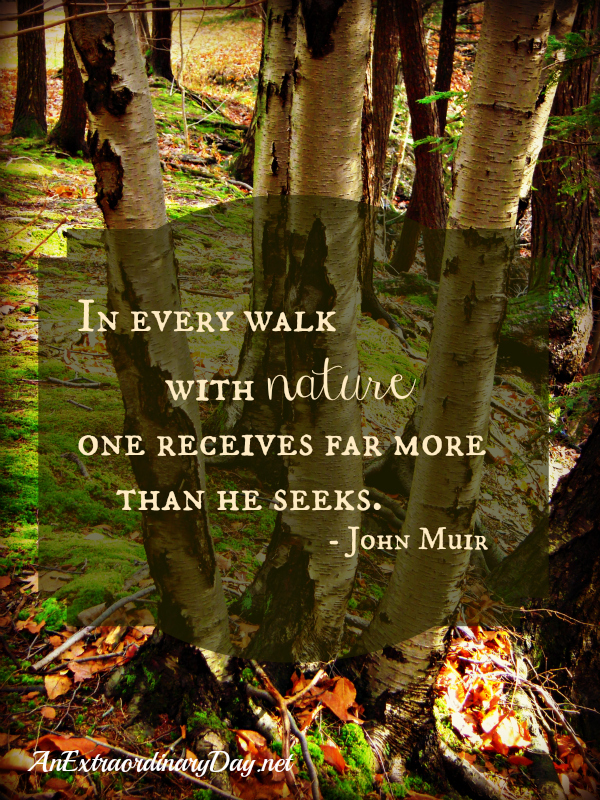
anextrarodinaryday-net-birches-in-the-woods-john-muir-quote-about-natureI just finished a two mile walk in a quiet, woody area close to where I live. I especially enjoy it because I keep company with a wide landscape of greenery, manicured gardens and, quite nice, I may see only one or two cars the whole way. Walking in the early morning makes me mindful of the gift of life and its cornucopia of sensory delights.

Even when you walk, I think you’ll find your mind keeps trolling, often in miscellanea you might miss in the course of your day heavy with things to do, choices to make and, not infrequently, problems to resolve. I haven’t any doubt about it–walking can unleash a spirit of meditation, leading to a stilling of troubled waters. Still more, it can endow us with a wisdom to discern between the wheat and the chaff, providing an equilibrium taking us through the hard places.

Of all things, as I was walking, appreciating the pristine beginnings of a new day with its abundant promise, my thoughts turned to a short poem that Tennyson wrote, called “Tears, Idle Tears,” a poem quite opposite in its mood to the joy I felt while walking this morning:

Tears, idle tears, I know not what they mean,
Tears from the depth of some divine despair
Rise in the heart, and gather to the eyes,
In looking on the happy autumn-fields,
And thinking of the days that are no more.

Fresh as the first beam glittering on a sail,
That brings our friends up from the underworld,
Sad as the last which reddens over one
That sinks with all we love below the verge;
So sad, so fresh, the days that are no more.

Ah, sad and strange as in dark summer dawns
The earliest pipe of half-awakened birds
To dying ears, when unto dying eyes
The casement slowly grows a glimmering square
So sad, so strange, the days that are no more.

Dear as remembered kisses after death,
And sweet as those by hopeless fancy feigned
On lips that are for others; deep as love,
Deep as first love, and wild with all regret;
O Death in Life, the days that are no more!

It isn’t my intent to give a full analysis of this poem, but simply to make several observations about the mindset that informs the poem and a lesson to be learned from it.

If the first stanza is thematic in its nostalgia, the next two stanzas clothe the poet’s lament in a series of similes that make for exquisite eloquence and a lingering pathos of melancholy.

The speaker’s unsolicited tears are as fresh as a ship’s sail that arises above the horizon, glittering in the first sunbeam of early dawn, tears elicited by recall of deceased friends now in the Underworld, who have suddenly sailed into his awareness. But they also vanish again into darkness similar to when the sun drops below the horizon, for memory can never render mortals corporeal again, given the finality of death. Tennyson, the great classicist, is drawing here, of course, upon legendary lore of the Underworld and the voyage of the dead.

But I like the third stanza best with its analogy to the last, sad day of a dying man, who in the early summer dawn awakes to hear the “earliest pipes of half-awakened birds” and sees for the final time the growing light upon the window casement. Ending with its consort of alienation from the vibrant world of the present–“so sad and strange”– is the import here, reinforcing the poem’s trenchant mood of nostalgia for happy days revoked by time and mortality.

All of this makes way for the final stanza where still more similes appear, the past being like remembering those we once kissed, now dead; or imagining kissing those we love, but who don’t reciprocate, underscoring yet again the irrevocability of the past and the frustration of human wish.

Tennyson had said his visit to Tintern Abbey near Wales had inspired this poem, as it had the great Romanticist poet, Wordsworth, who recalled the place in his famous “Tintern Abbey” poem. Wordsworth’s poem, however, recalls the past with joy, giving hope for future years.

While I appreciate Tennyson’s poem for its sincerity of lament and chiseled eloquence, I think we do better in light of the ephemerality of human experience to seize the day, or practice the wisdom of my favorite quotation from Helen Keller that I carried in my wallet for many years:

Use your eyes as if tomorrow you would be stricken blind. Hear the music of voices, the song of a bird, the mighty strains of an orchestra, as if you would be stricken deaf tomorrow. Touch each object as if tomorrow your tactile sense would fail. Smell the perfume of flowers, taste with relish each morsel, as if tomorrow you could never smell and taste again.

 Walking this morning, I celebrated the vibrancy of the present. Better, I took possession of it.

I think both Wordsworth and Keller would approve.

-rj


Internet Ghouls Among Us: The Robin Williams Aftermath

williamsI haven’t any doubt that the vast majority of us mourn the tragic death of Robin Williams, who brought laughter into our hearts and with it, wisdom too. And yet there are always a few, the ghouls  I call them, who surface in such tragedies to verbally vandalize our grief with mindless, and often, acerbic commentary.

Recently a bicyclist was killed here in Lexington KY by a speeding motorist, only to have one Facebook reader comment that bicyclists shouldn’t be on the streets. Pray then, where should they ride? On sidewalks?

But it gets worse than such obvious, and silly, over-generalization. We’ve all come across those who practice a calculated meanness in exploiting social media for personal whim. These ghouls cannot tolerate an opinion different from their own, particularly when it comes to religion or politics, subjects notorious for generating heat.

But ghouls also show up in Amazon book reviews, for instance, or even in discussion forums that, more often than not, are dominated by one perspective. Cross the line, and you get personal attack rather than reasoned argument. I saw this recently in a forum perusing the effectiveness of a low carb vs low fat diet. When one reader contended graciously for the low fat approach the forum became a piling on of verbal abuse. I dub this the cascading effect, or the tendency of one negative comment to generate others.

But returning to Robin Williams, his daughter Zelda has just closed her Twitter account. She had been receiving photo shop images of her father’s body along with obscene commentary.

What transforms otherwise ordinary folks we rub elbows with everyday into Internet ghouls?

It goes back to anonymity, or the disconnect effect. When we lose face-to-face contact replete with body language and verbal cues of tone, we drift perilously close to abandoning the etiquette of meaningful communication in losing connection with our readers. Mental short cuts take over and we say dumb things.  We forfeit empathy.

But in all fairness, the disconnect effect isn’t confined to the Internet. I have known this first hand as a English teacher at the college level. It’s the writing act itself that submits us to this danger, whether an email, a letter, or an opinion piece in a newspaper. Accordingly, the fundamental axiom of all effective communication, written or oral, is maintaining awareness of one’s audience, which should spill over into our selecting our words carefully, monitoring our tone, shaping our transitions, being open to a reader’s perspective. Mindfulness is the seasoning of all effective communication.

And yet my counsel hardly proves sufficient to hold off the myriad ghouls who troll the Internet, unleashing their venom abetted by anonymity, or what Stephen King once aptly called “the alligators resident within human nature.” Frustrated with their own lives, envious of others, low in self-esteem, they seek to empower themselves by verbally dismembering others

While the social media can be invaluable in consolidating humanity for good ends, by its very nature, it is not without risk, so best be careful where you tread and cautious in what you reveal about yourself.

The vast majority of Internet users are motivated with good intent; but it takes just a few to spoil things for the many.

–rj

Teach me….

oakTeach me to love all things, big and small; clean and dirty: the burr oak massive with age; the silent worm that threads the earth; my fellow beings, rich or poor, sung or unsung.

Teach me to be patient, learning first to forgive my own infidelities, that I may love others more.

Teach me the wisdom of the past, of hope invested in the future–but best, the gift of this new day.

Teach me to persevere up the mountain, to resist the stitch in my side that urges quitting and with it, forfeiture of the runner’s prize.

Teach me never to love anything so much that I cannot accept its loss; the inevitability of change and ending and, someday too, my own.

Teach me the right of others to discover themselves and walk a road different from my own; to listen that I may hear and not judge.

Teach me what true freedom means: to choose without the weights of culture or tradition; the courage to revoke what inhibits happiness; the right to self-knowledge and to live in accord with it; a resolve to accept the bottom line cost in living free

Teach me to discern between having and being; to know the folly of the former, the ecstasy of the latter.

Teach me courage in a world with dark valleys; boldness to speak for those who grieve, the excluded poor, oppressed minorities, women and children, and the animals too.

Teach me to love our wounded earth, to nourish it wherever I am as though it were my own garden.

–by rj


Poetry is Truth in Sunday Clothes

quietnessWe live busy lives and often it seems difficult to take time out, catch our breath, and maybe just reassess whether what we’re chasing is worth our time and worry.

In a frenetic world, we probably all have a favorite way of finding sanctuary–perhaps taking time off, or traveling to some idyllic spot, or just off to a meal out or a movie with sweetheart or family, or maybe indulging in a hobby or interest. Me, I like gardening.

I know one thing–we all need time-out, moments when we can drench ourselves in silence and apartness, returning renewed and, just maybe, wiser–the gift of self-reflection when we glimpse where we’ve been, and are, and where we need to go.

Cultivating quietness long term means we have to work at it, just like other good things in life. They say practice makes perfect. I don’t know about that, but I do know it makes things better.

Some find meditation important in gaining equilibrium, and I can endorse that, particularly the Zen kind with its focus on mindfulness that affords me access into myself without my need to control.

Lately, I’ve added poetry to ways I can augment my need to exit life’s speedway. I bathe in its wisdom, marvel at its concision, the depths of psyche it plums, its mellifluous stream of words, the cornucopia of  tumbling imagery that makes me see again things I’ve missed or erringly tossed or lost in my life’s journey.

We busy ourselves in a world often filled with self-centeredness and aggressiveness that, if we’re not careful, can dull our humanity and turn our hearts to stone. Poetry helps us keep the wolves at bay–the world’s and our own–and with our best self, love and hope again.

Poetry does it all so well.

As poet Joseph Roux marvelously puts it, “Poetry is truth in its Sunday clothes.”

I like that, and I think you will, too.

–rj


When Religion Strays too Far: The Hobby Lobby Aftermath

SpringArborIt’s sufficiently dismaying that the Supreme Court via its Hobby Lobby decision has further defined corporate entities as people, and thus with inherent individual rights.

Not only do corporations have unlimited spending rights when it comes to elections, but with the Hobby Lobby ruling, for-profit corporations can now refuse to observe government mandates under the ACA to provide birth control coverage in health coverage for their employees on religious grounds. (Religious non-profits were previously exempted under the law.)

Intriguingly, the majority decision that denigrates a woman’s sovereignty over her own body was made by five men, all of them Catholics.

We can only speculate the slippery slope the Court may have set in motion. In fact, it suggests that for-profit corporations with moral or religious scruples are now free to discriminate in hiring gays or even divorced people. They might even opt to dismiss those opting for abortion or living with a significant other, or terminating their marriage.

At the very least, the Court’s decision establishes a precedent for the expansion of exclusion rights, and not just with regard to corporations, since the underlying assumption is based upon the notion of a person’s right to his or her convictions and corporations are now people.

Historically, following upon a corporate scandal, Congress in 1907 passed a measure forbidding corporate investment in federal elections, which held until 1978 when the high court ruled that corporations have First Amendment rights to finance state ballot initiatives. Even then, only individuals or groups of individuals–political action committees–could do so.

Then came the Supreme Court’s 5-4 decision in 2010, granting corporations unlimited spending rights in all elections, federal, state or local.

In the Hobby Lobby case, the Supreme Court had never in any similar case ruled a for-profit corporation to be a religious entity for purpose of exclusion from federal law. The Justice Department, in fact, contended it would be unable to effectively enforce other laws affecting child labor, immunization, serving racial minorities, or income tax laws requiring universal compliance regardless of how government spends the money.

It’s bad enough as is that in the non-corporate sector, even though Title IX bars schools that receive federal funds (e.g, public student loans and Pell grants) from discriminating against transgender and gays, there exists a specific exemption for religious colleges who find such mandates incompatible with their religious beliefs.

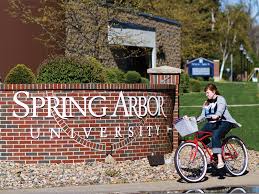
Consequently, the Department of Education has recently granted exemptions to George Fox University, Simpson University, and Spring Arbor University. Since there are a good number of evangelical colleges that fall under the religious umbrella, it’s likely there will be many more exemptions.

Unfortunately, the dark side of religion is often one of imposing beliefs on others, and its history continues stained with violence and intolerance.

We know that majorities can constitute their own tyranny, but so can minorities. Hence Congress needs to review the laws governing these exemptions and narrow their scope.

–rj


A Court decision with deadly consequences

pigsWe should all be concerned about Thursday’s 2-1 decision by the U.S. Court of Appeals for the 2nd District that the FDA needn’t consider the banning of antibiotics in healthy food producing animals.

Given the growing menace of antibiotic resistant infections among humans and the inveterate use of antibiotics in the meat industry to promote weight gain or combat disease, we draw closer to a pandemic in which even a minor wound or infection could prove deadly.

As is, the Centers for Disease Control and Prevention (CDC) informs us that at least two million Americans are sickened with anti-resistant pathogens annually

I may have been one of them, having just recently recovered from an extended bout with a staph infection that ultimately required daily IV.

I naively had told my infectious disease physician that I didn’t really want to leave the hospital until I was over the infection. His rejoinder was that a hospital wasn’t the safest place to be, given the infection rate incurred among patients (one out of three).

The Centers for Disease Control and Prevention comments that “much of antibiotic use in animals is unnecessary and inappropriate and makes everyone less safe.”

More than 70% of all antibiotics are administered to animals, even when healthy.

To be fair, I can’t say what all the factors were in the court’s split decision, except that it imperils all of us.

I do know that according to the World Health Organization (April 2014), antimicrobial bacteria resistance increasingly threatens public health worldwide, “a problem so serious that it threatens the achievements of modern medicine. A post-antibiotic era, in which common infections and minor injuries can kill, far from being an apocalyptic fantasy, is instead a very real possibility for the 21st century.”

Consider that Carbapenem antibiotics used as a fallback in treating life-threatening infections from a common intestinal bacterium are now ineffective for nearly half of those treated in some countries. This bacterium is a major source of hospital acquired infections such as pneumonia, bloodstream infections and infections among newborns and intensive care patients.

Likewise, our best antibiotics for treating urinary tract infections caused by E. coli are now ineffective in more than half the cases.

Ten countries are now reporting that their last resort antibiotic for gonorrhea no longer works.

Unfortunately, while the FDA did ask pharmaceuticals, animal producers and vets to  exercise restraint in employing antibiotics that are also used for humans, the FDA appealed an earlier court ruling banning penicillin and two kinds of tetracyclides promoting growth, unless users can provide evidence it won’t produce drug resistant microbes. Thus, the Court’s decision in favor of the FDA’s appeal.

Overseas, the EU has banned the use of antibiotics in animal feed (2006) and now South Korea has done the same. In China, however, the use of antibiotics in animal production is widespread.

That animal and human health are linked was decisively demonstrated in outbreaks of multi resistant Salmonella in 2011, 2012 and 2013, traced back to ground beef and poultry sources (National Antimicrobial Resistance Monitoring System).

As physician David Angus admonishes in his best selling The End of Illness (2011),

Wealthy countries take for granted the triumph of science over bacteria, but increasingly doctors are battling infections that can only be quelled by the most powerful antibiotics known to medicine–or, at worst, by none of them at all. In the United States alone, antibiotic-resistant infections cause roughly 100,000 deaths a year. Imagine a world in which antibiotics produce toxic effects and unpredictable outcomes instead of the guaranteed cures we have come to expect–and you can understand what keeps epidemiologists awake at night (298-99).

 The Court’s decision brings that day much closer.

–rj


Reminiscence: And I could wish it were 1949 again

The other day, I had a solicitation in the mail from a magazine called Reminiscence. Apparently, a lot of folks like to engage in nostalgia. I confess I occasionally do the same, though I’m aware of how time can soften the contours of the past.

Lit Brothers
Lit Brothers

Still, I like to muse on past events that were really quite wonderful and that I wish I could relive again. After all, why are we given memory if we’re simply meant to forget? If I had to pick a year in which to indulge, it would be 1949. It was a good year for me and for America, too.


Collectively, it was a simpler time, relatively free from the frenetic pace, complexity and stress of today.

To be sure, segregation was still a factor in denying Blacks their portion of the American dream and women were still largely subservient to men. China had just fallen to the Communists. At the Kremlin, Stalin ruled with an iron fist and Russia had just tested the A-bomb. The Cold War was on in earnest and so we resorted to an ongoing airlift to save Berlin.

Nonetheless, we had a decisive president in Harry S. Truman, who never skirted making the hard choices like dropping the A-bomb to shorten a savage war or later dismissing a popular, but unruly general. In short, we felt safe.

Four years after World War II, we were at peace, with no protracted conflicts like Korea, Vietnam, Iraq and Afghanistan. We weren’t saddled with mind-boggling national debt, Congressional deadlock, inflationary pressures, the loss of our manufacturing base, or economic recession.

There weren’t any urban riots, decaying cities, or the threat of climate change that imperils our existence. We could never have imagined a 9/11 or the pervasiveness of terrorism.

Here are a few economic facts that put things into perspective about 1949:

Unemployment stood at just 3.8%.

Inflation, a mind-boggling 0.95%.

You could buy a house for an average $7500.

A car for $1400.

Gas, 17 cents for regular.

Let’s put it another way: $100 in 1949 now comes to $967.01 in 2014, with an average 3.5 inflation rate annually since that remarkable year (Bureau of Labor Statistics).

Most items were still made here in America, including TVs and cars. Cars had turned into long finned gargantuans replete with white wall tires and, with pent up demand, we couldn’t make them fast enough.

We were kings in forging steel and cities like Akron, Youngstown, Pittsburgh, Bethlehem and Lehigh lit up the night sky.

In New England, the textile mills of Lawrence, Lowell and North Adams hummed on.

We were good at making shoes and my father toiled in a neighborhood leather factory.

I was then a street urchin, much like Tom Sawyer, exploring the thoroughfares of Philadelphia, curious and, sometimes, mischievous. Occasionally, I played hooky, skipping school to walk downtown and visually rummage the big, many floor stores like Gimbels, Lit Brothers and Wanamaker’s, bustling with goods and replete with escalator stairs.

Yes, American cities once possessed vibrant downtowns that provided cohesion before the onset of suburban box stores and strip malls. Downtown was the place to be–shopping, movies, eateries.

Baseball was truly our national game, with many of the contests played in the afternoons. It was the era of greats like Williams, DiMaggio, and Musial. They hadn’t lowered the mound to boost hitters. No free agency meant modest salaries. Stadiums were named for people, not corporations or banks. Franchises didn’t move. Players didn’t cheat with drugs. Sundays and holidays meant doubleheaders. What a deal!

We didn’t have playgrounds in Kensington, the ethnic blue collar stronghold, dubbed Fishtown, where I lived near the Delaware River, but that didn’t stop us from playing stick ball, smashing cut-in-half tennis balls against factory facades. You determined singles, doubles, triples and home runs by window level.

I liked venturing down to the wharves, where I could see the cargo ships unloading, waive to their crews, and study their flags to learn their origin. It was here I developed my addiction to visit far off lands.

TVs initially with 4 inch screens, were now selling madly, or at the rate of 100,000 weekly, sadly hinting at foreclosure of neighborhood enclaves where we’d gather nightly on the white marble steps of our row housing, chatting our humanity until late evening breezes whispered their coolness and launched our escape from the steamy heat of asphalt streets and we could at last renew ourselves with sleep. We never dreamed of air conditioning, though a good many of us lived in upstair flats.

Despite TV’s inroads, radio still loomed large with shows like The Shadow, Jack Benny, Suspense and the Lone Ranger. Daytime–Arthur Godfrey was all the rage.

As for TV, showslike Mama, Texaco Theater, The Ed Sullivan Show, The Life of Riley were our staples. At most, you’d be lucky to have three channels, and after the 11 pm news, stations would shut down, sometimes to the National Anthem. They gave you a test pattern to help you get your “rabbit-ear” antennas right.

The music revolution hadn’t begun. No Elvis Presley. No Beatles. No Rock n’ Roll. No heavy metal or hip hop. We had Dick Clark and American Bandstand. Not knowing anything else, we were content.

Lyrics still rhymed, making them easy to remember. No CDs. Just vinyl records that could scratch easily, but the risk worth the sound!

Sinatra and Crosby reigned along with new stars like Rosemary Clooney, Frankie Laine, the Ames Brothers, and Dinah Shore. And then there was the handsome Mario Lanza, whose baritone thunder captured women’s hearts.

In 1949, you could escape Philly’s summer heat with a day movie for only a dime or a quarter at night, and even get in on a double header that included the world news and Disney cartoons. Bogart, Gable, Wayne, Cooper, Grant–and, yes,–Bob Hope (number one) were the big draws. On Saturday afternoons, a special treat with serial showings of Superman!

Despite technicolor and Gone with the Wind, color was rare.

Comedy was big and I laughed till my sides hurt at the likes of the three stooges, and Abbott and Costello. And then there were those shoot ’em up Westerns with Roy Rogers and Gene Autry, adept in singing prowess as well as gun savvy. Why we even got to know their horses, Trigger and Champion, unlike the plods of other Westerns apart from the Lone Ranger’s Silver.

Telephones weren’t in abundance, so sometimes we resorted to a neighbor’s phone or a telephone booth to make a call. To call long distance could be expensive, even intimidating, and thus rare. Nice, however to be out of reach. Or on the streets, free of distracted drivers.

Magazines, often pictorial, like Look, Life, and Saturday Evening Post, caught your eye and provided quick reads. And they cost cents, not dollars.

Yes, many doctors still made house calls and health costs were reasonable.

We didn’t have Interstates then. That would come with Eisenhower’s mandate. Main highways were mostly two lanes giving way occasionally to a third lane for passing. Crossing the Ben Franklin for the Jersey shore and fresh fruit took you through spacious countryside with luxuriant tomato farms. Mom and Pop cabins–no motel chains–offered accommodation for $3 a night.

There were only 150 million of us then and even California had ample elbow room. Worldwide, just under 2 billion people, meaning more manageable resources, less poverty, and a cleaner environment.

More of us began to fly–on noisy propeller contraptions that is. Passenger ships still plied the ocean like their ancient predecessors.

What I really liked were the trains and, especially, the sleek new diesel locomotives. Train stations were busy, exciting places, filled with shops, much the way it still is in Europe.

On a sadder note, I miss my once teeming family–my mother and father, brother, oodles of cousins, dear aunts and uncles, and childhood friends, in 1949, luxuriating in life’s bloom. As life stretches out, we mourn our losses as well as count our gains. We learn to appreciate what we cannot keep. I am glad for memory.

I could go on, but you get the picture, or at least my view of 1949–like a fine wine, a year of superbly good vintage. A time of innocence and simplicity, where less proved more, and thus possessed its own indulgent beauty.

But we can’t be Rip Van Winkles either. Time moves on, and we with it.

–rj

Technology and the shrinking of community

I just read Frank Somerville’s recent post (July 3) on Facebook. For the record, he’s the nightly news anchor on KTVU in Oakland, CA. I don’t live anywhere near the West Coast, so I don’t get to watch him, but Somerville keeps a page on Facebook that I read daily for its keen insights, sensitivity, and passion for social justice. Thank goodness he’s out there and how I wish there were more people like him, concerned about doing the right thing.

I say this because, quite frankly, I’m damned tired of running into people on a daily basis who, just the opposite, are full of themselves in their thoughtlessness towards others, and making matters worse, frequently mean and calculatingly offensive. Unfortunately, the downside of technology can be the marginalization of community, despite a plethora of social media.

10351899_743347829061880_8323386999323754107_nSomerville laments how many people use the Internet to get back at others. Case in point, a waitress posting the $69 dining bill of former Oakland Raider Warren Sapp, who hadn’t left her a tip. Clearly, she sought to embarrass and humiliate Sapp, who later said that he didn’t like the service and her calling him and his friends boys. I know that I’ve done the same thing as Sapp on rare occasions. Tipping is a way of saying thank you and, likewise, an incentive to serve the public well. In Europe, you don’t generally tip, since a service charge is included, and, believe me, the service can get pretty lousy.

Meanness, unfortunately, runs amuck on the Internet due to the anonymity it provides for angry types low on self-image seeking compensation. I remember Edgar Allen Poe writing in his goose-bumpy short story, “The Cask of Amontillado,” of that most perfect kind of vengeance that allows its perpetrator impunity, or escape from accountability.

I often see Poe’s maxim raise its ugly head in reader comments, especially in discussion forums, and of course, par excellence, Twitter and Facebook. I find myself aghast, not only at the repugnant foreclosure of other viewpoints, but the sheer cowardice it masks, latent with resentment and a need to enhance self by controlling others or turning them into punching bags. Sadly, there have been instances where such verbal pugilism has taken on fatal consequences.

More often, I see the pervasive fallout of anonymity virtually daily when, like Somerville (more below), I’m driving, motorists who think rules are for other people–deliberately running traffic lights, stop signs, or not yielding right of way, or pulling out in front of you, or not signaling, or slowing traffic to a snail’s pace while on their cell phone or texting in public mastabatory self-indulgence.

My wife came home the other day, telling me of a woman who turned in front of her at a three way stop. She gave her the horn, getting the one finger salute in return. I’ve counseled her to not let such ilk spoil her day. You also just don’t know who you’re up against. Stats tell us an estimated 1500 die in road rage incidents every year. Anyway, I sometimes think there really is a bit of karma going around and that the chickens ultimately come home to roost.

Somerville ends his blog with his account of a guy with a mounted camera on his dash who comes up behind him “for no apparent reason” as he is on his way to work. Turns out, he can’t get rid of him. Pulling over, the guy draws along side of him, and Somerville, not wanting the incident to escalate, calmly asks, “What are you doing?, only to have the guy grin and keep videotaping him. Speeding off, Somerville finally loses him.

Hey, so creepy! You just never know what kind of oddball that anonymity may confront you with next.

–rj


Why some writers succeed and others don’t

I’ve learned that people will forget what you said, people will forget what you do, but people will never forget how you made them feel (Maya Angelou).

 Writing

I like to read and I read omnivorously, whether fiction or non-fiction. I marvel at the talent and effort that lies behind all good writing, the courage of writers to pursue their craft, given the minuscule few who get published, or receive pecuniary recompense, or the public’s accolades.

I marvel at their discipline in fending off that great tempter, procrastination, for writing well doesn’t come easily and what’s tedious we most always avoid.

And then there is the ephemerality of all success that mocks their efforts, that no matter how well crafted, compelling, or discerning, that best part of a writer’s self, succumbs, inevitably, to a world busy with its own pursuits, forgotten, no longer in print, to be given away, or tossed out.

I was reminded of this when I downloaded a Gutenberg ebook freebie from more than fifty years ago with its reading recommendations of many authors I’d never heard of, though I have graduate degrees in English and taught for forty years at the college level. The list of recommended classics in our schools today is, likewise, considerably different from those I pursued, studied and taught across the years. Taste changes, fame fades, and life moves on.

Writers, nonetheless, pursue their craft against all odds and sucking sweets elsewhere for varied reasons, foremost to find acceptance and, in that best of all possible worlds, the convergence, like two mighty streams, of avocation and vocation.

Whatever, successful fiction writers must be good at seduction, alluring us with suspense, well-crafted plot embedded with conflict, intriguing characters, good dialog, an accessible style; nonfiction writers must also prove themselves good at seduction, appealing to reader interests, their quest for information and know-how, their need to feel smart. Writing is all about closing the deal. Giving readers what they want.

As readers, we like cosying up. We like being wooed.

Successful writers know this!

–rj