The Discipline of Kindness

Anger has become one of the easiest responses to modern life.

What troubles me most is not anger itself, but how easily my emotions can be manipulated—by discourtesy, by noise, by global politics, by the ambient insensitivity of others. That reactive state isn’t who I really am, yet it’s one I’m repeatedly invited into.

I want to be kind, not reactionary; deliberate, not pushed into negativity. I want to remain self-governing. As Marcus Aurelius put it, “Be tolerant with others and strict with yourself.”

Years ago, I came upon a short piece in Reader’s Digest titled “Do I Act or React?” I read it at exactly the right moment. Why should a discourteous store employee spoil my day? Or a waiter serving me something I never ordered? Or a driver that cuts me off?

These moments are trivial in isolation, yet corrosive in accumulation. As the Stoic writer Ryan Holiday reminds us, “Jerks abound everywhere. That’s their business, not yours.”

My wife once shared an encounter she had with a rude bank teller. Instead of meeting rudeness with rudeness, she simply said, “I hope your day gets better.” It was disarming—not passive, not superior, just humane. Too often, we carry our moods like open containers, spilling them onto others without noticing.

The distinguished novelist and essayist George Saunders suggests that literature can help us cultivate tolerance—not all at once, but incrementally, and therefore cumulatively. A practicing Buddhist, Saunders believes that reading fiction trains us in three essential truths:

You’re not permanent.
You’re not the most important thing.
You’re not separate.

Literature slows judgment. It places us inside other consciousnesses. It rehearses moral humility. In doing so, it loosens the grip of the ego—the very thing that insists on being offended.

Kindness, after all, isn’t mere niceness, which can look away from cruelty. Kindness sees clearly. It chooses understanding over reflex, restraint over retaliation.

So many of our perceived hurts come down to our desire to control others: their tone, their behavior, their awareness of us. When that control fails—as it inevitably does—we suffer. The antidote is not indifference, but proportion. We need to take ourselves less seriously.

Saunders doesn’t offer a list of recommended books, though he has often spoken admiringly of Grace Paley.

I return often to Marcus Aurelius’ Meditations, a slender volume that rewards endless rereading.

One line, in particular, feels endlessly applicable:

“Is a world without shameless people possible? No. So this person you’ve just met is one of them. Get over it.”

Not resignation—clarity. Not bitterness—freedom.

The Shouting Silence

D.G. Chapman, Upsplash

Silence has always allured me, most often when it is bound to expanses empty of people—though not always. I can find it just as readily in a library, or even in my own home when left to myself.

It is not, I believe, a resistance to an oppressive environment—work, academics, trauma, peer pressure, or the quotidian churn of human caprice—what psychiatry terms “psychological reactance.” It goes deeper than that, perhaps rooted in my introversion, which inclines me away from crowds and constant social encounter.

I carry memories of three landscapes that produced instant rapture: a sense of detachment, of absence from time itself—something larger than me, and yet intimately felt.

The first occurred when I was a graduate student in North Carolina, visiting the hillside at Kitty Hawk where the Wright brothers first achieved sustained flight in their ungainly aerial contraption. I had gone with friends, who wandered along the beachfront below, leaving me alone atop the hill. There, history seemed to recede. The wind moved through the grass, the sky stretched open and unmarked, and for a moment the present dissolved, as though time itself had paused in reverence.

Then there was Arlington National Cemetery, its vast rows of symmetrical white grave markers extending beyond easy comprehension. The stillness there was not empty but weighted, a silence shaped by collective sacrifice. For a brief moment, the eternal peace of America’s fallen became my own.

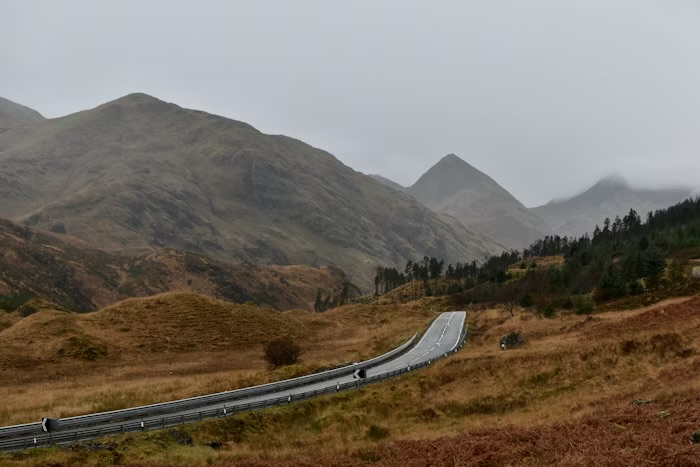
Most memorable of all were Scotland’s Highlands. Driving eastward from Edinburgh, they rose suddenly and unexpectedly across the horizon—rugged, green, and seemingly untouched by human intrusion. I pulled over, stepped out, tested the firmness of their verdure beneath my feet, and listened to what I can only call their shouting silence. That moment remains my most cherished travel memory.

As an English major in college, I once took a course devoted entirely to Wordsworth—England’s great poet of landscape. I am, perhaps, a rarity in having read all of his several hundred poems. Among them, “Tintern Abbey” most fully captures my response to those landscapes:

“…that serene and blessed mood,
In which the affections gently lead us on,—
Until, the breath of this corporeal frame
And even the motion of our human blood
Almost suspended, we are laid asleep
In body, and become a living soul…”

Literary scholars describe this response under the notion of the sublime: the experience of being overwhelmed through intimacy with nature, a flash of clarity in which one intuits a larger coherence behind nature’s mystery. Wordsworth gives it further voice:

“And I have felt
A presence that disturbs me with the joy
Of elevated thoughts; a sense sublime
Of something far more deeply interfused,
Whose dwelling is the light of setting suns,
And the round ocean and the living air,
And the blue sky, and in the mind of man….”

Psychology approaches the experience from another angle. One theory frames it as a sensory reset—the mind’s need to unburden itself from obligation and affliction, a release from the cognitive overload of daily life.

I am especially drawn to E. O. Wilson’s Biophilia Hypothesis, which proposes that humans evolved in constant contact with nature, calibrating the nervous system through millennia of hunter-gatherer life. In that context, a deserted landscape could signal safety—the absence of predators, permission to rest.

Another perspective, the Default Mode Network, suggests that quiet environments can trigger awe by suspending habitual rumination. Freed from constant external demands, the mind drifts toward reflection, memory, and imaginative connection. In such moments, the brain is allowed to hear the rhythms it evolved to monitor.

This makes intuitive sense. We live in a world saturated with anthropophonic noise—human-made sound without pause or mercy. Though nature is never truly silent—wind, water, and the subtle movements of life persist—these sounds soothe rather than assault. They restore rather than demand.

Wordsworth seems to anticipate this longing even in the heart of the city. In “Composed upon Westminster Bridge, September 3, 1802,” he finds London redeemed by a rare moment of stillness:

“Earth has not any thing to show more fair:
Dull would he be of soul who could pass by
A sight so touching in its majesty:
This City now doth, like a garment, wear
The beauty of the morning; silent, bare,
Ships, towers, domes, theatres, and temples lie
Open unto the fields, and to the sky;
All bright and glittering in the smokeless air.
Never did sun more beautifully steep
In his first splendour, valley, rock, or hill;
Ne’er saw I, never felt, a calm so deep!
The river glideth at his own sweet will:
Dear God! the very houses seem asleep;
And all that mighty heart is lying still!”

Perhaps silence, then, is not an absence but a presence—one that returns us to ourselves, quiets the mind’s noise, and restores a way of listening we once possessed, and have not entirely forgotten.

On being an introvert in a noisy world


Do you really want to go to that party, or would you prefer a quiet evening at home?

Like a library over meeting new people?

Don’t like being the center of attention?

If may be you’re what’s known as an introvert.

It was psychiatrist Carl Jung who coined the terms introvert and extrovert for primary personality modes. In fact, he wrote a book about it, The Psychology of Types (1921), that made him famous.

Introverts shy from crowds; extroverts prefer them.

Introverts like alone-time; extroverts, where the action is.

Neither is superior to the other, both featuring strengths and liabilities.

How do these modes bottom out? Research suggests just a third of us are introverts.

That can make things difficult for introverts in a world that tends to pass them by.

I’ve done several personalty tests. No doubt about it, I’m classic introvert, the good and bad of it—shy, moody, distant, but also sensitive and caring, lover of all things beautiful like music, art, poetry, an intellectual read and, of course, nature’s solitude.

I prefer space.

It isn’t I don’t value companionship. I’ve cherished salient friendships across the years and, though it seems contradictory for an introvert, I experience nostalgia for friends who can never be retrieved, annulled by time’s entropy and mortality’s specter.

If you’re introverted, you’re likely in a good place.

Introverts often display not only keen sensitivity, but above average intelligence. If you believe the statistics, 70% of those excelling in art, music or math, i.e., the gifted, are introverts.

They include Bill Gates, Barack Obama, Elon Musk, Meryl Streep, and J.K Rowling.

Warren Buffett did a Dale Carnegie course to overcome his shyness.

Dr. Seuss, that master of children’s books, was afraid to meet the children who read his books for fear they’d be taken back by his quietness,

Is it nature or environment that fashions who we are?

Psychologists think it mostly genetic.

But it can get complicated.

Some of us, seeking balance, become omniverts, or combinations of both dispositions, depending on the situation we find ourselves in.

On the other hand, ambiverts, and that’s many of us, while displaying a personality mix, still lean one way or the other.

If you want a good read on being an introvert, I highly recommend Susan Cain’s Quiet: The Power of Introverts in a World That Can’t Stop Talking:

The highly sensitive tend to be philosophical or spiritual in their orientation, rather than materialistic or hedonistic. They dislike small talk. They often describe themselves as creative or intuitive. They dream vividly, and can often recall their dreams the next day. They love music, nature, art, physical beauty. They feel exceptionally strong emotions–sometimes acute bouts of joy, but also sorrow, melancholy, and fear.

That’s me and it may be you! And that’s not a bad thing at all.

–rj


Compassion: What It Really Means and How to Cultivate It

In a needy, often dark world, there thankfully exist compassionate people, going the last mile, thinking always of others, their sufferings and needs.

I think of Doctors Without Borders, for example, a French organization of physicians and nurses, working not only in Third World Countries, but often in war zones such as Somalia, South Sudan, and Gaza at considerable risk, their starting pay, a mere $2600 a month.

This ability to feel another’s pain and taking it on, where does it come from? I know that personal suffering can trigger it, perhaps a bad childhood, an abusive relationship, a betrayal by one we trusted, the death of a close friend or relative, unemployment, poverty, or personal illness.

Some just seem endowed with it from birth. I think of the poet Percy Bysshe Shelley and his wife Mary, author of Frankenstein, keenly sensitive to the social ills of their time; Tolstoy, rich and famous, but disclaiming it all, in sympathy with the poor; John Stuart Mill, champion of the minority’s right to be heard.

Empathy’s great, putting yourself in the shoes of another, but I think of compassion as going beyond sympathy as with these individuals committed to helping others.

I would offer what’s been called emotional intelligence” (EQ) as a principal starting point in generating compassion. Pioneered by psychologist and behavioral science journalist Dr. Daniel Goleman in his 1995 book, Emotional Intelligence: Why it May be More Important Than IQ, it offers potential for amelioration of intrapersonal relationships across a wide spectrum.

Its hallmarks are several:

An ability to intuit what others are feeling.

A calmness in contexts of stress.

An ability to accept change.

An ability to defuse highly charged situations

An awareness of your own feelings.

We often conceive IQ as a denominator of ultimate academic and professional success, but I’d posit emotional intelligence as far more consequential for your happiness in everyday life.

Like to know if you possess this wonderful attribute? Well, the good news is that there are tests to measure it.

But don’t fret if you fall short. You can cultivate it, something I’ve been trying to do.

Some of these measuring tools are popular self-response tests. You’re asked to respond to conflict scenarios and select from multiple choices you’re likely response. This takes a lot of honesty, however.

More formally, a psychological test, [the Mayer-Salovey-Caruso Emotional Intelligence Test (MSCEIT)], has you do performance tasks assessing your ability to perceive, identify, understand, and manage emotions. These comprise the generally recognized four aspects of emotional intelligence. I confess I’ve work to do.

A salient element of emotional intelligence is learning to listen and getting at the cause behind someone’s feelings. Not interrupting them is crucial, signaling not only politeness, but your regard for them and taking their narrative seriously.

Emotional intelligence has helped me especially in contexts of social tension. Seeing things from the African-American perspective, for example, has afforded me an understanding of black rage: enslaved, lynched, denied the vote, profiled by police, overly imprisoned, discriminated against in housing and employment, their rage and distrust of white authority is symptomatic. Those with high EQ don’t react with condemnation. They address the milieu of that disconnect.

In summary, EQ people think things out before they react.

They’re sensitive to their own feelings and willing to objectively assess their origin.

In considering the perspectives and emotions of others, they understand motivating factors behind their behavior, moving to address them.

If you ask me for contemporary models of EQ, I would include former president Jimmy Carter, superb negotiator associated with Habitat for Humanity; Nelson Mandela, imprisoned 27 years, but advocate of reconciliation; Jane Goodall, redefining our relationship with animals and spokesperson for both the environment and the African poor. Each of these individuals, teeming with awareness, translated their EQ into activism. Beyond empathy, it’s compassion.

As Indian sage Amit Ray has eloquently expressed it, “Compassion is all inclusive. It knows no boundaries. Compassion comes with awareness, and awareness breaks all narrow territories.”

By the way, if people tell you you’re too sensitive or emotional, it just may be you have high EQ. I think that’s a good thing!

—rj

You can be free: How fear holds you back

I’ve been reading Ryan Holiday’s inspiring Courage is Calling. Holliday practices Stoicism, a way of life that’s become my life credo, though I confess my frequent failure to live up to its tenets of courage, temperance, justice and wisdom.

Stoicism is a discipline requiring daily practice. It’s taught me how much fear lies behind our modern anxiety and behavior. As Holliday writes, “This is how it goes, whether you’re a billionaire or an ordinary person, no matter how physically tough or brilliant you are. Fear determines what is or isn’t possible. If you think something is too scary, it’s too scary for you. If you don’t think you have any power . . . you don’t. If you aren’t the captain of your fate . . . then fate is the captain of you.”

Anxiety with its burden of worries culminates in stress, and we know its harsh consequences for our mental and physical health.

Worry teaches you that the future is happening now.

It falsely tells you that worry will make it go away.

Worry makes you care more about what others think.

It inhibits your boldly attempting new things like falling in love again, having children, resuming your education, investing your money, traveling to new places, changing your residence, trying a new doctor. Maybe even quitting your job for something, even if for less money, but more fulfilling.

It says you can’t ever escape your past, whether a bad childhood or failed marriage, a hurtful friendship or demeaning rejection.

Fear anchors you to what’s familiar, seemingly safe. It forfeits possibility and, with it, the future.

The truth is life is inherent with risk. Loss, illness, grief, death embrace every nook and cranny of life. Its remedy is to step up and step out, doing what you can.

Paradoxically, mastering anxiety begins with acceptance of what you can’t change. Uncertainty is inherent with life. In his book, The Liberated Mind, psychologist Steven Hayes writes that “people like to think the world is ‘happy happy joy joy,’ but if you live long enough, you start running into pain and illness and loss and tragedies of all sorts. It’s just part of it. That’s part of life.”

But there are things you can change. Yes, you can master living in a temporal world of vicissitude, but you must be willing to sign the bottom line.

Take inventory of what inhibits your resolve.

It may cost you money, even estrangement, but how much better to walk away free. One of life’s caveats is knowing when and how to jettison habits and worries weighing you down.

You can be courageous in every day life in so many ways.

It takes bravery to ask for a pay raise, confront injustice, leave a demeaning relationship, find a new hobby.

Don’t let fear bully you.

Don’t let routine dictate your everyday doings.

Happiness doesn’t just happen. It requires flexibility, resilience and daily practice. Frequently, it’s a life of sips more than gulps to get there.

So much of life is living in the moment. You do what you can, attempt what you’ve wanted. You act to realize yourself, becoming agent of your own destiny.

Mastering your fears begins a new portal. Yes, you can find freedom in an unfree world.

–rj

Morning Thoughts

I begin my day daily, reading the news, the wrong way to commence a new day, heavy with humanity’s burdens I can do little about.

I would do better in rising with the sun, to set my day’s course like a compass pointing to true North on what matters, enriches, and contributes to well-being, not only for myself but, more importantly, for others.

I remember lines from one of Mary Oliver’s last poems: “Wherever I am, /the world comes after me. /It offers me its busyness. /It does not believe that I do not want it.”

We think of ourselves as separate from the main. Prisoners of self-interest, we’ve relinquished poet John Donne’s maxim, “No man is an island.“

As humans we crave togetherness.

We abhor loneliness.

We require bonding and the cohesion it brings.

I’ve traveled to many places, often alone, but the trips I remember most were those I’ve shared with others. To experience something awesome, but with no one to share it, somehow bottoms out its delight.

Like leaves on a tree, individual in their shape and shimmering on their branches, we feed into a trunk that flourishes when its leaves work collectively. We are citizenry of a greater Self.

We live in a time of electronic fellowship. Billions turn to Facebook, Twitter, Instagram, ad infinitum, in a desire to connect, ample evidence we need one another to complete ourselves.

We find the relational in other, more meaningful ways. We love, we marry, we have children, we make friends, we frat with those sharing like interests, we bond with our pets. And yes, we write books—and even do blogs!

Unfortunately, since Descartes with his “I think, therefore I am,” we’ve weighed our lives down with ego indulgence, mindless of that greater entity of collective humanity and of Nature that grants us being and sustains.

In Victorian times, Bentham’s notion of utilitarianism was in vogue, its thesis that what promotes happiness is good; what promotes pain is bad. Essentially hedonistic, it was vehemently satirized by Dickens in Hard Times as serving the wealthy at the expense of the working class.

Modern psychology hasn’t helped mend our ways. Self-validation defines its focus. Witness the plethora of books on self-improvement. I was schooled in behaviorism at the grad level with its notion that humans are little more than pigeons, subject to stimulus response, driven by self-interest. Accordingly, prescribed behavior can be reenforced through operant conditioning that awards the positive; conversely, extinguishing the negative via the punitive. Anthony Burgess, whom I met briefly many years ago, deciphered it rightly in Clockwork Orange (1962), one of the 20th century’s most profound books.

In economics, capitalism is founded upon the same a priori of what’s in it for me, ushering in the Adam Smith credo of self-interest and competition as prerequisites to prosperity. Its consequences are with us daily, the one percent owning half the wealth, the exponential decline of the middle class, the continuous emphasis on growth despite diminishing natural resources.

In his widely published The Selfish Gene (1976), evolutionary biologist Richard Dawkins tells us that genes act to preserve their self-interest, with altruism, when it does exist, functionally symbiotic as in bees and ants. In fairness, Dawkins does propose that humans have potential capacity with growth in moral intelligence to modify evolution’s predilection for self-interest. Harvard’s eminent psychologist Stephen Pinker, who sets out in The Angels of Our Better Nature (2011) to statistically validate the decline of violence, should be pleased.

On a human scale, I think of Japan, unique in its protocol of collective behavior in the interest of public welfare that critics might disdainfully dismiss as herd mentality or, essentially, a vestige of Hobbes’ “enlightened self-interest.” Nonetheless, Japan is one of our few stable nations, high in economic equality, rare homelessness, and little crime. When the tsunami struck in 2011, unlike in other nations, there were few reports of looting. No need to send in the National Guard. My own memories of Japan confirm a pervasive politeness and honesty I’ve found unequaled in my travels.

In contrast, I think of what took place with the COVID outbreak, nearly a third of Americans not getting vaccinated and, even more, refusing to mask. As one business man told me, “It’s a personal choice.” But then this isn’t confined to America. In France, Belgium, and Germany gargantuan anti COVID protocol demonstrations, some of them violent, have occurred. Theirs is the right to infect others and continue the pandemic. By the way, Japan’s COVID mortality rate was 14.52 versus 233.8 in the U.S. as of Nov. 21, 2021, according to Johns Hopkins University stats.

Reading the news reminds me of the human folly behind the headlines, whether of individuals or nations, in pursuing self-interest. Sowing greed, we have reaped social dissonance with high crime, economic disparity, and homelessness among its results.

Frost wrote a renowned poem, “Mending Wall” in which the persona tells us of his neighbor, who advocates “Good fences make good neighbors.” I’m for tearing down walls that separate us.

In mutuality we find our common denominator, making for a better world.
In discovering the Other, we find ourselves.

–rj

Tom Brady’s Finest Moment

Yesterday’s Tampa Bay come-back win, led by legendary Tom Brady in the final two minutes over the Jets, highlights Brady’s remarkable career. His greatest moment, however, may have come with his compassion for troubled teammate Antonio Brown, who quit the team in the third quarter, tossing his shirt into the crowd and running into the exit tunnel. “I think everybody should do what they can to help him in ways that he really needs it. We all love him, we care about him deeply. We want to see him be at his best, and unfortunately it won’t be with our team.” Johns Hopkins Medicine reports that 26% of AmerIcans over 18 suffer from some form of mental illness, including anxiety disorders; of our homeless, an estimated 25% from mental illness. Obviously a troubled man, Brown, needs professional help, like so many others in these stressful times. “I think everyone should be very compassionate and empathetic toward some very difficult things that are happening,” Brady added. Thank you, Tom, for showing us the way. —rj

The Vanishing World of Touch

Not long ago I celebrated in my brimmings blog the realm of touch, so wonderfully depicted by my favorite nature writer, Diane Ackerman, in A Natural History of the Senses. What she doesn’t touch upon is the increasing loss of that tactile dimension in a virtual age powered by Artificial Intelligence now pushed to the forefront by the corona pandemic. Nearly a third of us now work from our homes. Fewer of us are needed. Sadly, we are probably witnessing the loss of a way of life to which we won’t fully return: fewer teachers, doctors, etc. , increased surveillance, a cadre of workers, many of color, working as grocery clerks, industrial farm laborers, or from remote warehouses.

The loss of a tactile world undermines the human enterprise for which social media becomes a poor substitute. And then the outcome for families, the stress of uncertainty and limited horizons of opportunity in a touchless society where we no longer shake hands, give hugs, or bestow a kiss upon the cheek, airport embraces of coming and going reduced to impalpable memory.

As never before in a world such as ours, we are children in the night needing to be held and to be loved. We cannot live happily in a world of reduced signifiers of human belonging. Touch is the lingua franca fundamental to our destiny.

—rj

Touching Matters

We cannot thrive without touch. Of the five senses, it’s the one we can’t do without. And oddly, the most underrated. Through touch we are known and make ourselves known. Without touch, we’d not be here at all.

Recently I viewed a TV episode of long-running Doctor Who (Season 2, Episode 2, “New Earth”), whose eponymous protagonist lands on a remote planet in a distant future. Confined to multi-tiered isolation cells in a hospital setting, underclass humans are reduced to abstract entities, or guinea pigs, serving the health needs of a privileged oligarchy of feline nurses. Doctor Who to their dynamic rescue, their cells spring open, unleashing a meandering human stream.  Bewildered in a strange freedom, they wander into a coterie of fellow feeling and mutual touching, conferring healing.

I knew a family well where touching was remote, not even a hug, and a handshake at best. The children, five of them, turned into adults, responsible, hard-working, charitable—yet each lacking self-regard, competing for love, but never finding enough, questing inevitably for a validity always elusive. The father rebuked me on one occasion: “Don’t talk to me about love. Isn’t it enough that I feed and clothe them and provide a place for them to sleep?”

I came from a working class Irish family, my mother absent; my father, a quick-tempered alcoholic who boozed away income, often leaving us nibbling on tawdry white bread salt and pepper sandwiches. And yet we, four children, found love in each other over the years bonded by childhood memories, visiting, confiding—yes, in that time unlike our own—transcending space, exchanging letters. In person, we greeted each other with hugs, kissed cheeks, slapped backs, conversing into the night’s meandering hours, reechoing childhood venues.

Numberless animal experiments exhibit the dismal results of tactile neglect. In a Duke experiment with rats, neurologist Saul Schanberg found that rat offspring, deprived of maternal licking and grooming, experienced a loss in growth hormones. Even though hormone secretion increased on return to their mothers, an incessant need for stroking to return normalcy was required.

In parallel, we’ve found that neglected children sometimes stop growing and that children not sufficiently touched often grow-up reluctant to touch others, or what I call an inability to show love.

Diane Ackerman reminds us in her voluptuous exploration of our sensory dimension (A Natural History of the Senses) how densely populated our language is with references to touching: “Language is steeped in metaphors of touch. We call our emotions feelings, and we care most deeply when something “touches” us. Problems can be thorny, ticklish, sticky, or need to be handled with kid gloves. Touchy people, especially if they’re coarse, really get on our nerves.”

Similarly, one reason why I find novelist D. H. Lawrence’s work so appealing over a lifetime is its pervasive reiteration of the centrality of touch to our well-being, or at the core of what defines our essence; in Lawrencian parlance, what titillates the solar plexus. It was why art patron Mabel Dodge Sterne invited him to Taos, New Mexico, this artisan sage with “the feel and touch and smell of places.”

I’m point man now, my siblings vanished into that perennial Night all of us must inevitably embrace and yet, as though it were yesterday, they remain presences, gifting me with their palpable love.

–rj

And a Child Shall Lead Them: Healing What Ails Us

Image result for and a child shall lead themI was talking just a few minutes ago with my better half, wondering just how I used to spend my idle hours before the Internet came into vogue. As is, I’m cuffed to a binary lodestone, whether smart phone, iPad, or desktop, dulling awareness, squandering time, exponentially addictive.

Generally, my dawns begin not with photographing sunrises or heading to the gym, but grabbing my tablet, which accompanies me even to bed, for a wakeup breakfast of The Guardian, BBC, CNN, and NPR.

Unsatiated, I imbibe local news back home where I lived for 41 years before moving this past summer, all of this consuming at least an hour. I check for updates several times throughout the day.

I comb Facebook for friend posts, get off text messages as day tumbles into noon.

One of the inveterate things I do is to google this and google that. If curiosity killed the cat, it’s stuffed my brain into info overload.

According to a recent report in Ofcom featured in The Guardian, I’m not alone by any means. 78% of us now have smartphones, rising to 95% of young people, 16-24. Returning from work, we grab a fast meal, throw ourselves into a comfy chair, turning on, say, Netflix, for a few hours more of wasteful indulgence.

Bored and stressed, we moderns seek distraction. We have difficulty keeping company with ourselves.

Addicted, each day becomes a round of what Buddhists term Samsara, or the unenlightened repetition of daily round, captured famously in Bill Murray’s stellar performance in Groundhog Day.

And we pay a steep price for all of this in a lifespan never really long enough, missing out on the miracle of life that´s not only ourselves, and won’t happen again, but of those around us enveloped in a cosmos, earthly and heavenly, infinite, yet temporal.

It was Wordsworth, nature poet of a quieter time, who told us “the child is father of the man” in the ¨Rainbow.” What he probably meant is that what we are as children we become as adults in the maturation of habits and sensibilities acquired when children, particularly an early fondness for nature.

I’d extend its meaning to include a child’s sometimes extraordinary ability to show us the way as adults in their frequent exemplar of sensory delight in the nowness of things, each day a renewed cornucopia, at least before the advent of video games.

Maybe you’re getting my drift—that one way out of our electronic matrix is to rethink what we loved to do as children and rediscover it again. I loved studying languages, playing and watching baseball, walking to the library and the adventure of new book, traveling to new places, meeting new people, learning new things, the smell of country air, the touch of bare feet on cool earth in early morning in our garden.

Children teach us not to fret about tomorrow.
To stop if it isn’t fun.
To be curious.
Honest.
Passionate.
Hopeful.
Forgiving.
To savor the moment.
To forgive.
To love.

I hold to action over prayer, but were I a praying guy, I’d surely pray, “Lord, give me the mind of a child again!”

–rj