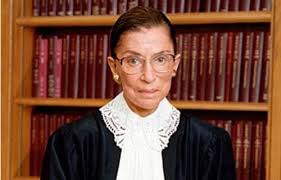
A Woman for all Seasons: Ruth Bader Ginsberg

ginsbergI’ve been thinking a lot about her these days, surprising myself, since I knew her simply as a fact stored away in my memory for so many years.   Diminutive at just five feet and weighing only one hundred pounds, her small face accentuated by her landmark over sized glasses, there isn’t anything visible to recommend her apart from a flinty chin suggesting determination.  Just goes to tell me how short-sighted I  am when slipping into judging by appearances.  I guess that’s a topic for a follow-up blog.  Anyway, small packages  sometimes pack a wallop.

Ruth Bader Ginsberg hails from Brooklyn, the child of Jewish immigrants from Russia.  Think about how wonderful that is, the promise of America, that in a second generation, children of immigrants or an immigrant parent can weave their way into the American success story.  Think Steve Jobs (Syria), Walt Disney (Canada), Gloria Estefan (Cuba).  Nikki Haley and Nora Jones (India).  Think Barak Obama (Kenya).  Did you know that a good number of our biggest firms owe their existence to immigrants?  Think Boeing (Germany), 3M ( Canada), Home Depot (Russia) for just a few examples.

Now most of us know who Ginsberg is, though she doesn’t command the headlines like some of her U. S. Supreme Court colleagues such as Justices Roberts and Scalia.  Doubtless this stems from her minority position in a long-dominated conservative court, despite her frequent dissents always highlighted by their precocious acuity.

I’m not about to launch a verbose listing of salient background details about Kiki (her nickname), save to note her appointment by President Clinton to the bench in 1993.  I’m frankly more interested here in her character traits lending her the individuality for which she’s noted. 

Although she’s an ardent liberal (former ACLU litigator), she pals with the Scalias, sharing in their mutual love for opera.  Her favorites, Verdi and Puccini.  On the fun side, she’s been an extra in two operas.

Much of her early life was spent in fighting off sexism.  Just out of Columbia Law School in a time of very few female lawyers, justice Felix Frankfurter refused to interview her for a clerkship:  “Does she wear skirts?  I can’t stand girls in pants.”

Combatting injustice of any kind has always motivated Ginsberg throughout her legal career:  “I thought, well maybe the law could catch up with changes in society, and that was an empowering idea.”

By any measure, I admire Ginsberg for her spunky witticism.  On one occasion, Justice William Rehnquist queried her as to why she was making an issue out of gender equality.  Wasn’t having Susan B. Anthony on the dollar coin enough for her?  Famously, she quipped back, “No, your honor, tokens won’t do.”

I also find her very brave.  Twice she’s survived cancer:  colon (1999) and pancreatic  (2009).  With the colon diagnosis she didn’t miss a day on the bench, despite chemo and radiation regimens.  Twelve days after her Whipple surgery to remove a portion of her pancreas, she was hearing oral arguments.  Pancreatic cancer has very few survivors and apparently they got it early through a routine cat scan.  It was the pancreatic cancer taking the life of one of my icons, Steve Jobs, that aroused my curiosity about this angry organ, the pancreas, that led to my researching Ginsberg.

Though she’s given up water skiing and horseback riding, she works out with a trainer two times a week and is up to twenty no cheat pushups.

She’s fluent in Swedish, acquired from two summers there and says she can watch Ingmar Bergman films without subtitles.

Some liberals want her to retire so that President Obama can appoint another liberal as deterrent against a subsequent Republican presidency.  Ginsberg refuses to budge, saying she’ll remain on the bench unless health issues interfere.  Though she’s known more for championing equality issues affecting women, it’s clear she’s also an exemplum of the senior citizen’s ability to continue contributing to the workplace and society as a whole.

I’m glad she’s there, offering rational balance in a time of deepening national division.

–rj

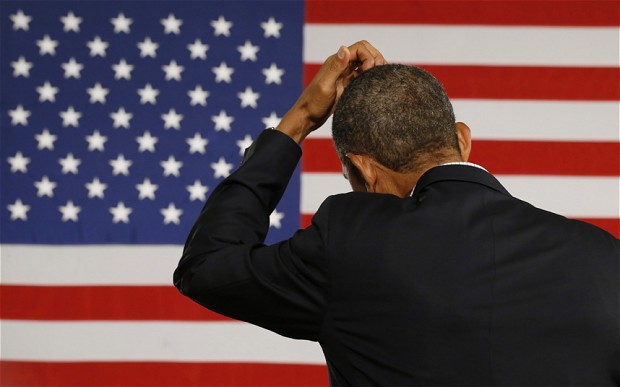
Hamlet in the White House: Obama Blinks

obama_2652642b

I had tuned in on Friday to President Obama’s Rose Garden appearance before the media, expecting an updating of data justifying a response to the alleged use of chemical weapons by the Assad regime in Syria.  After all, Secretary of State John Kerry had spoken forcefully to the issue, calling it an act of “thieves and murderers.”  How preternatural it seemed for someone who had so vociferously opposed the Vietnam War, throwing his own medals away, to now be advocating a military strike.  There must be something here.

What I hadn’t counted on was the residue from the UK Parliament rejection of Prime Minister David Cameron’s plea for a military option.  Cameron hadn’t originally planned on asking for Parliament’s permission, only to yield to the reality of low public support in the polls and vociferous objection among even his Labor Party cohorts. He simply wanted to protect his hide, an idea that’s proven to be contagious.

Casting a dark specter over everything was doubtless the protracted war in Iraq, now largely deemed the folly of unreliable intelligence and an understandable passion for taking action following the terrorism of September 11, 2001.  While it’s often been remarked how history repeats itself, it’s not a given that we must repeat its madness.

The psychology in Obama’s turnaround in imitating Cameron fascinates me.  Sometimes we say too much and get ourselves into tight places, with anticipated fall out  locking us into responses our better judgment, tempered by time and reason, tells us are wrong.  From this angle Progressives seem justified in calling Obama’s new mindset courageous.

I see it differently, however, as a failure in will, abetted by a compliant media and a war- weary public.  We have a president who has difficulty making decisions.  For six months he knew the location of Osama bin Laden before taking action.  We’re still awaiting the Keystone decision.  Just the day before, we had heard a horrific litany of the deaths of 1400 civilians, more than 400 of them children, by the Assad regime’s use of chemical agents on its own people.  British, French and Israeli intelligence also corroborate the culpability of the Assad government.

Oddly, the President in his Rose Garden appearance told us he had determined to strike Syria, yet wanted to put it up to the Congress.  I think it unlikely that Congress will approve a strike, perhaps the Senate, but not the Republican House with its contingent of Tea Party isolationists.  This may even play into Obama’s hands, giving him an opportunity to extricate himself, or to climb down the ladder as it were.

But he isn’t going to do so without impunity or a severe loss in credibility.  Even more serious, he’s placed our nation in danger, emboldening aggression abroad by rogue governments.  No one’s talked about it, but the present imbroglio is really about Iran.  His paralysis can only encourage Iran’s efforts to achieve a nuclear arsenal.  If I were the Israelis, I would be deeply troubled.  It’s conceivable that Israel may now see itself as needing to launch a preemptive strike on its own, given the unreliability of the U. S.

Given Obama’s hesitancy towards Syria, what’s the script for Iran?  Do you tip your hand, asking Congress for its permission for a preemptive strike?  Or is it you do nothing, accepting the reality of a nuclear Iran with whom we must learn to live with as we do with North Korea?  Meanwhile, a hostile Iran that sponsors terrorism develops a delivery system potentially targeting Tel Aviv and, ultimately, America.  Let’s face it, as a corollary of the President’s pattern, the odds are that Iran gets its Bomb, despite our stringent embargo.

In the present circumstances, Obama has set a dangerous precedent.  Presidents must be free to act in dealing with contingencies that may arise, and this is what the War Powers Act allows with its 90 day allowance before Congressional oversight kicks-in.  A limited strike on Syria does not violate the Constitution, contrary to what some liberals say.

Mr. Obama is known to admire Lincoln.  But maybe he’s forgotten his history.  Lincoln didn’t ask Congress for permission to war against the eleven successionist states.  In fact, the legality of succession wasn’t allowed to be presented before the Supreme Court.  Lincoln rightly knew he couldn’t win in either the Congress or before the Supreme Court.  My point is, strong presidents lead.

A very good argument can be made that any response now planned would be ineffectual and inflammatory anyway, since the strike is so limited and considerable time has elapsed for Assad to move his military assets into the mountains and his troops into   exempted civilian areas such as schools.  Even more important, the Syrian civil war has now largely turned sectarian, with Sunnis vs Shiites, compounded with the entrance of Hezbollah and al Qaeda insurgents, both of whom target Christians, who comprise 10% of the population.

But this gets us back to square one and our ineffectual president.  Obama created this morass with his dilly-dallying over the last two years, giving extremists time to move in.   His red lines mean nothing, as seen in Assad’s emboldened aggression.  While Syrian dissidents lamented the absence of international outcry following the chemical attack of August 21, Obama was silent for 72 hours.  Later,  he played his usual rhetorical slight of hand, stating the situation defied easy answers.

Mr. President, if we’re reduced to this scenario, then you are its creator, having squandered your options and not acted on your own warnings.  Awful as these deaths from chemical weapons are, they’re minuscule in a sea of 100,000 deaths, most of which could have been prevented had you armed the rebels from the outset.  By the UN’s own estimates, we now have 2 million refugees, 1 million of them children.

Playing Hamlet–to act or not to act–is unbefitting a commander-in-chief and poses grave dangers for America.  As Hisham Melhem, Washington bureau chief of Al Arabiya news channel comments, “He seems unable to make difficult decisions. This will embolden Assad and the opposition jihadis and demoralize the secular, moderate Syrian opposition. Obama is gambling with his reputation at home and abroad.”

With one utterance, Obama has inaugurated a template for disaster, diminishing the powers of the Presidency, making a mockery of American credibility, abandoning Syria’s freedom-fighters, and putting  America and Israel under increased threat from a belligerent Iran ultimately armed with nuclear weaponry.

–rj

Intolerance: Medicine’s Nemesis

Medical Statue at Semmelweiss Medical Museum
Medical Statue at Semmelweiss Medical Museum (Photo credit: Curious Expeditions)

I had grown up thinking medicine was free of the prejudices, if not sheer ignorance, rampant in the everyday world where resistance to anything new seems a given.  Let’s face it:  we humans don’t like having the security of our assumptions challenged.  The truth is that the history of medicine shows the same proclivity for stubbornness or subordination to the weight of custom as elsewhere.

In his riveting study, Doctors: The Biography of Medicine, physician Sherwin Nulan recounts the story of Ignac Semmelweiss, a young Viennese physician in the 1840s, who observed that women delivering their babies in hospitals died of puerperal, or bed fever, considerably more frequently than those delivering at home.  He did his own research to find out why, ultimately discovering a link between medical student routine and maternal deaths.

Each day,  students and profs would examine cadavers in between visiting patients. Although they didn’t have any notion of germs back then, Semmelweiss ultimately concluded that “invisible cadaver particles” on the hands of students and attending physicians was the source.  In short, he had discovered the role of infection in promoting illness.  

Instituting a protocol of his students’ washing their hands in a chlorine solution, he saw a dramatic drop-off in mortality.  His colleagues, however weren’t amused by this young upstart, whose research implicated them in so many deaths.  Consequently, Semmelweiss didn’t publish his research for fifteen years.

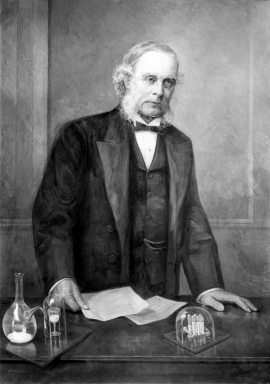
Dr. Joseph Lister
Dr. Joseph Lister

By the 1860s,  Louis Pasteur’s germ theory had entered into medicine, though it initially wasn’t widely accepted.  In Britain, Dr. Joseph Lister decided to apply the notion to post surgical infections, which were nearly always fatal.  Discovering that a neighbor city had poured carbolic acid down its drains to eliminate a potent sewer stench, he concluded that the acid had killed microorganisms similar to those Pasteur had identified.  Applying this concept to surgery, he employed wound dressings saturated in carbolic acid.  Later, he added spraying the entire surgical area with the solution.  Ultimately, he expanded the solution to washing his hands and instruments.  Lister published his successful results in 1867, inaugurating the formal beginnings of antisepsis.  It would be another generation, however, before Lister’s innovations became universal.

It was only in the 1880s that doctors had finally moved beyond a solely antiseptic solution to changing their clothes and boiling their instruments, sutures, towels, and sponges and adopting a ritual of vigorous hand washing.  In 1893,  Dr. William Halsted  became the first surgeon to wear a surgical mask.  In the 1920s, white garments and linens became universal, though the former now seems to be giving way to darker shades again.

Infection still remains a serious threat and the shorter your hospital stay, the better your odds.  Each year, nearly 2 million patients experience infection and 100,000 die.

Even with today’s antibiotics, infection looms as a serious menace, complicated by the increasing rise of resistant, highly contagious bacteria strains.

The bottom line in medicine is that what we don’t know often governs more than what we know.   After several thousand years, we overwhelmingly treat symptoms, not causes.  Now and then, however, a Semmelweiss or Lister appears like some new Columbus, charting a vastly different terrain leading to a New World.  Thus, it behooves medicine to be open to self-scrutiny, forfeit vested authority, tradition, and prejudice.  Only in this way can we find the breakthroughs that advance our safety, promote our healing, and perhaps offer sovereignty over some of our most chronic diseases like cancer.

–rj

.

An American Treasure: Reflections on Donald Hall

donald-hall-baseball
Lately, I’ve been thinking a lot about poet Donald Hall, now in his 84th year, and an American treasure. I came upon him early as a teaching assistant at the University of North Carolina at  Chapel Hill, where we used his Writing Well as our principal text in our composition courses.   Written in Hall’s typical plain-language, no nonsense style, I learned a lot from it at this early stage of my teaching career.

The other day I happened to tap into Daniel Giola’s blog with its invaluable essays he’s written on a good number of American poets, including Hall, and I liked what I read.  Giola is himself a talented poet, who formerly was head of the National Endowment for the Arts and currently teaches at Stanford.

Truth is, I hadn’t read Hall, the poet, who served as our Poet Laureate in 2006.  Until I read Giola, I was also unaware of Hall’s prowess in writing memoirs.  I downloaded his Life Work this morning from Amazon and am eager to get into it, seeing the critical accolades its drawn, which doesn’t surprise me.  Educated at Exeter Academy, Harvard, and Oxford, he’s written more than fifty books of poetry, prose and children’s stories;  been awarded two Guggenheim fellowships; the National book Critics Circle Award for Poetry, and twice nominated for the nation’s foremost literary honor, the National Book Award.  I’m embarrassed it’s taken me so long to catch-up.

I started this draft yesterday and am now a good way into Life Work, which he had initially published in 1993, or just after surgery for colon cancer (originally diagnosed in 1989) that had now metastasized to his liver, giving him a dismal prognosis of 1 in 3 odds he’d be around another year.  Ironically,  he beat the odds, only to lose his much beloved wife, Jane Kenyon, a former student and poet he had married twenty years earlier while teaching at the University of Michigan.  She had seemed so healthy, only to suddenly be diagnosed with leukemia and passing in 1995.  As Hall candidly remarks,  “The worst day is the day when grief or sorrow overcome you.  Your wife has cancer; you have cancer.”

It would take some six years for Hall to right himself again.  Jane’s presence permeated the house.  Giving her clothes away turned into an ordeal:

He emptied the dead woman’s dresser and closets,
stacking rings and bracelets, pendants and necklaces.
He bundled sweaters and jeans, brassieres and blouses, 
scarves
and nightgowns and suits and summer dresses
and mailed them to Rosie’s Place for indigent women.
For decades a man and a woman living together
learned each other for pleasure, giving and taking,
studying every other day predictable ecstasy
secure without secrecy or advenmre, without romance,
without anxiety or jealousy, without content 
….
(from “Kill the Day”)

Each new day reopened the wounds of loss–of lovers in communication, always together, mutual artists sharing creative ecstasy.  The gnawing loneliness. The unfairness of it all.  She was just 47.

All of this is part of the undertone of sadness to this work I sometimes think intrinsic to the acute sensibility common to artistry and especially poets.  As Hall reminds us, poetry is fundamentally about time and mortality.  This has been my own observation across the years in reading, teaching and occasionally writing poetry.  We may think of music as the most affective of the arts, but I have found poetry more so, sometimes reminding me of the way a drug works, bringing potential healing, but with it, too, a risk for side effects and a wish one hadn’t dosed.  But then I think of the greater risk of sensory, if not spiritual poverty, in refusing to let its potential for insight, empathy, and catharsis to work its grace and make me whole.  Poetry is latent with a sacramentalism that wraps around the soul.

One of the big draws of Life Work lies in its repertoire of Hall’s daily ritual that has made his prodigious artistry possible.  Mornings, he rises at 5; better, leaps out of bed, eager to resume yesterday’s unfinished tasks following a cream cheese bagel washed down by coffee.  A consummate craftsman, he revises poems sometimes a hundred times and even more.  Mornings are filled with creation.  Afternoons, with well-deserved indulgence.

I like the human side to Hall.  He tells us he’s installed satellite TV.  He loves his Red Sox and Celtics, never missing a game.  With New England in my own blood, I relish these teams, too, though I’ve lived away from the place for many years.  Reading a work like this alleviates my guilt in often violating the Puritan ethic of duty in my sometimes preferring  play over work.

You won’t find this in Life Work, but in a recent NPR Fresh Air interview (February 8, 2012), Hall tells us he’s given up on writing poetry, since the ideas, words and images don’t spring up with their former ease.  He continues to write, however, focusing on prose:  “As long as I can do my work and continue to enjoy myself, I feel fulfilled.  My body causes me trouble when I cross the room, but when I am writing, I am in my
heaven–my old heaven.”

–rj

A great talent: Patrick Leigh Fermor’s A Time of Gifts

fermorI’m always eager for a good read and get ecstatic when I find one.  There are so many possibilities out there that I try to choose wisely, usually from several sources such as NPR, The Times Literary Supplement, and my favorite with its nearly 200 reprints of notable works, The New York Review of Books.

The latter is the source for my newest read, Patrick Leigh Fermor’s standout travel saga, A Time of Gifts (1977).  I’m embarrassed at missing out on Fermor these many years, liking travel narratives as I do, but then that’s why I keep the NYRB close-by.

Fermor was just an amazing guy in explorer Sir Richard Burton mold, fiercely independent, assertive and bold; linguistically gifted, courageous and cunning.  Joining the Irish Guards In World War II, he fought in Greece and served with a guerrilla unit on the isle of Crete, where he disguised himself as a shepherd for 18 months, living in mountain caves, while successfully master-minding the abduction of a German general.  He was knighted in 1994, for his service to literature and promotion of British-Greek relations.

In A Time of Gifts, Fermor begins his recall years later (age 62), of his three year walk across Europe to Constantinople as a 19-year with little more than a backpack in 1933. He actually only gets half-way by the close, and so there’s a sequel, Between the Woods and the Water, but even then, you don’t get to the Bosphorus.  It little matters, for what we have is splendid, as we follow this young man hobnobbing with rich and poor, gypsies and priests, occasionally sleeping in ancient monasteries.  His account of Germany in 1933, which saw Hitler becoming Chancellor, fascinates.  On one occasion, he strays into a beer hall filled with Nazis.

What attracted me to A Time of Gifts amid a plethora of can’t go wrong choices were multiple reviewer comments on Fermor’s stylistic talent, one reviewer likening him to Sir Thomas Browne as the best of the best prose masters across the several centuries. As a former teacher of English for some forty years, I’m an aficionado of style, or the mastery of the cadence of the English sentence.  Talented writers know the weave of sentences spun into art, exemplary in the literary world, especially in the 19th century in the likes of Newman, Ruskin, and Pater.

Of course, I’ve only begun A Time of Gifts, but his writing already excites me with its prowess, not only in its trenchant rhythms, but through its sensory capacity for total awareness.  To possess such talent for minutiae down to a grain of sand like this would make Flaubert (le mot juste) proud.  Let me try out a passage on you:

The gables of the Rhine-quays were gliding past and, as we gathered speed and sailed under one of these spans of the first bridge, the lamps of Cologne all went on simultaneously. In a flash the fading city soared out of the dark and expanded in a geometrical infinity of electric bulbs. Diminishing skeletons of yellow dots leaped into being along the banks and joined hands across the flood in a sequence of lamp-strung bridges. Cologne was sliding astern. The spires were the last of the city to survive  and as they too began to dwindle, a dark red sun dropped through bars of amber into a vague Abendland that rolled glimmering away towards the Ardennes.

Informed mastery like this, housed in rhythmic sentences acute with colorful detail, sets Fermor apart as one of our greatest travel writers since John Ruskin.

You can read more about him in Artemis Cooper’s magnificent biography (2012).  Having full access to his papers, she tells us that Fermor left behind a completed draft that gets him to Constantinople and that it will be published soon.

Despite losing some of his sight and hearing, he remained active almost up to the day of his death at age 96 in 2011.

In a book he had been reading, he wrote:  “Love to all and kindness to all friends, and thank you for a life of great happiness.”  Now that’s an epitaph we can only envy.

–rj

Happy Days are here again: and the banks roll on

obama

If you’ve been watching the headlines on the economic front, you may have seen the news about record bank profits in the first quarter of the year to the tune of $40.3 billion, an all time high.  In fact, profits surged 15.8% over the same quarter a year ago. This marks the 14th straight quarter of bank gains. In short, the bailed out banks (you and I paid for that), are making money hand-over-fist.  Not so, mainstream America.

Meanwhile, in the past 12 months, scandal- ridden JP Morgan has garnered $24.4 billion in net profit, evidencing once again that banks could evade laws with impunity.  The precedent, after all, had been the release of the 2000 page examiner’s report on Lehman Brothers in 2010,  suggesting fraud had brought about its bankruptcy, yet nothing was done.

You’d never have expected hand-outs from the Obama administration, given their campaign pledges to look out for us po’folk and their left of center politics.  Their hand-outs, not loans, to banks and other fiscal institutions, are shockingly in the trillions, with $85 billion dished out every month from the Federal Reserve.

But then again, we can better understand the forces in play when we look at the cohorts Obama gathered about himself:  Jacob Lew, former Citigroup executive, appointed deputy secretary of state, with a cool $900,000 bonus in his pocket from Citigroup;  Mark Patterson, Goldman Sachs lobbyist, made chief of staff at the Treasury, despite a ban on lobbyists;  Timothy Geithner, who became the architect of the bailouts, appointed as Treasury secretary, even after it was discovered he hadn’t fully paid his taxes;  Larry Summers, who authored many of the pro-bank policies of the nineties, recruited as a mainstay economic advisor; and Rahm Emmanuel, appointed Chief of Staff, after gleaning $16.5 million as a Chicago investment banker in just 30 months in-between government jobs. All of them Democrats.  All of them with dirty hands.  

At the present moment, Larry Summers is being touted as the next Federal Reserve Chairman, replacing the retiring Ben Bernanke.  A long time Goldman Sachs executive and trader, he played a primary role in deregulating Wall Street in the Clinton administration.

So far, and probably never will happen, not a single bank or CEO has been brought to account for their criminal mismanagement of the people’s money, leading to the 2008 meltdown and consequent suffering for millions of Americans. Their suffering continues.

Now you would think from the President’s major address on the economy this month that happy days are here again for you and me, what with his boast of 7.2 million new jobs created in the business sector in the last four years.  But politicians do prevaricate, and it’s up to you and me to hold their feet to the fire.  Fact is, long term unemployment is at its highest level since the Great Depression, and of the newly minted jobs, most are low wage (often in the service sector), temporary, or part-time.

Curiously, nowhere did the President mention the plight of Detroit facing bankruptcy and the possible erosion of pension and health benefits for the city’s workers, including police and fire personnel.

To give him his due, he did allude to the growing income disparity between the rich and the majority of Americans:

Even though our businesses are creating new jobs and have broken record profits, nearly all the income gains of the past ten years have continued to flow to the top 1 percent. The average CEO has gotten a raise of nearly 40 percent since 2009, but the average American earns less than he or she did in 1999. And companies continue to hold back on hiring those who have been out of work for some time.

But how did this happen?  He didn’t mention government’s largesse to the wealthy through bank bail outs, corporate tax breaks, and reduced wages for autoworkers.  In the first two years of the President’s tenure, or after the downturn of 2008, the richest one percent enjoyed an 11% increase in income, unlike the rest of Americans whose incomes declined.

Again, nobody’s been minding the store.  In 2011, the Senate Permanent Subcommittee  noted Wall Street’s culpability just prior to the 2008 market collapse as “a financial snakepit rife with greed, conflicts of interest and wrongdoing.”

While it may appear that things are humming along nicely, the banks booming, the real estate market up, stocks at their peak, the reality is that more than 3 million of us can’t find work.  Those who do, work for less, often part-time.  Many, particularly those 50 and over, may never work again.  Black youth unemployment is currently at 42 %.

Several million Americans have been foreclosed upon by the banks, losing their biggest investment stake and, sometimes, a whole lot more.  Many others owe the banks for houses purchased at inflated prices, now worth considerably less.

But the banks roll on, too big to take on, as Attorney General Eric Holder recently let slip. What’s more, their lobbyist legions do their work well, busy button-holing members of Congress.  It’s a game of money, always has been, money spelling influence.  It’s America, you know.

This just  in:  The President remains committed to slashing Medicare by $400 billion and Social Security by $130 billion in his projected 2014 budget.  (In 2008, candidate Obama had pledged, reiterated by Biden in 2012, that he wouldn’t cut Social Security.)  Apparently, the bankers are a privileged class; the people, expendable to the exigencies  of  power and influence.

-rj

My favorite speeches

Winston Churchill, Prime Minister of the Unite...

I’ve always liked a good speech.  If you asked me to make a list of favorite speeches I’d be hard pressed.  In fact, what I’d worry about most was leaving out some real gems simply because of memory lapse or not having been exposed to them.  It’s complicated, too, because there are countless good speeches to be had across the years, even centuries, like Socrates’ defense before the Athenean court.

Probably the best way to go about it would be to catalogue speeches by genre; for example, political, social, and historical, though the categories might occasionally overlap.  I think of “Washington’s Farewell Address,”  despite it’s now quaint formalism, one of the standout American speeches in our history with its warning of the dangers of political parties turning into self-centered warring factions.  A historical classic, it surely falls under the political canopy as well like Lincoln’s “Gettysburg Address.”

By the way, commencement addresses offer a rich source of substantive speeches before limited audiences.  I think of Steve Job’s address to the Stanford student body (2006) as the finest of its kind with its counsel on living in the context of mortality.

But what makes for a great speech?  I’d offer things like appropriateness, wisdom, counsel, candor, caring, inspiration and eloquence.  The best speeches not only inform and persuade, they move us to take action.  I think of Martin Luther’s King’s “I Have a Dream” speech (1963) as such a speech, perhaps rivaling Lincoln’s”Gettysburg Address” in its moving majesty.

As Americans, I think many of us would include Patrick Henry’s “Give me Liberty or Give me Death” (1775) and John F. Kennedy’s “Inaugural Address” as among the foremost of American speeches as well.

If you pinned me down, however, to a list of five personal favorites, I’d complain about how unfair you are.  Still, with apologies to the likes of Socrates, Cicero, Frederick Douglas, Susan B. Anthony, and even Patrick Henry and Kennedy, I’d offer the following personal favorites:

  1.  Lincoln:  “Gettysburg Address”
  2.  King:  “I Have a Dream”
  3.  Churchill:  “We Will Fight on the Beaches” (1940)
  4.  Washington:   “Farewell Address”
  5.  MacArthur:  “West Point Address”

I think of Winston Churchill, a Renaissance man living in the Twentieth Century, as the finest orator I’ve come upon with his ebullient, yet disciplined pathos as in “We Will Fight On the Beaches” (1940).  I think, too, of “Blood, Toil, Tears and Sweat” and “This was their Finest Hour” as speeches transcending any I’ve encountered.

I included General Douglas MacArthur here as a supreme orator.  The rhythmic cadence and rich metaphor of his farewell West Point Address to the Corps”(1962), delivered while in his eighties and without notes,  still moves me:

The shadows are lengthening for me. The twilight is here. My days of old have vanished. They have gone glimmering through the dreams of things that were. Their memory is one of wondrous beauty, watered by tears and coaxed and caressed by the smiles of yesterday. I listen then, but with thirsty ear, for the witching melody of faint bugles blowing reveille, of far drums beating the long roll. In my dreams I hear again the crash of guns, the rattle of musketry, the strange, mournful mutter of the battlefield. But in the evening of my memory always I come back to West Point. Always there echoes and re-echoes: Duty, Honor, Country.

I should mention as a kind of postscript, my liking for the compassion and eloquence typifying President Obama’s speeches.  It hasn’t anything to do with politics.  Not since Ronald Reagan “the great communicator,” has any President done it so well.

Before I leave off, there’s one speech, this by Eisenhower, that didn’t make my list, since  you squeezed me down to five picks.  It’s the speech in which he warned of “the military-industrial complex.”  Often quoted, Eisenhower had originally drafted “the military-industrial-congressional complex,” but then blinked.  No longer idealists, we now know the dismal reality of vested Congressional pecuniary self-interests in shaping today’s Realpolitik.   Had he kept it in, wow!

–rj

Courage: life’s highest elegance

One who becomes agitated
sacrifices his mastery (Lao Tsu)

The astute Jane Austen wrote a book called Sense and Sensibility in the early 19th century.  By sense, Austen meant qualities like reason, good judgment, self-control; in contrast, sensibility dealt with feelings, impulsiveness, and passions.

In our own time, I would include under sense that consummate affinity some few people possess as social observer Joseph Epstein wonderfully put it for “unerringly true taste–with perfect manners, easy elegance of dress, an eye for the beautiful in nature and art, a penetrating instinct for judgment of people, and an independent spirit that accepts only those opinions learned in one’s own heart” (Snobbery:  The American Version, p. 81).

I can’t say I’ve met anyone completely encompassing this kind of daily venue of social grace, call it class, fitted seemingly for every season.  I know I’ve always wanted it, but failed miserably pursuing what often has seemed a retreating horizon.  I’d like to know the right wine; sauté like a Chelsea Hotel chef; be up-to-date on timely, important things; be fun, but not silly; empathetic; compassionate; forgiving.  And even more.

But I also ask myself how well does all this pan out when life rears up, hurling impediments across our way, suddenly, unexpectedly, as in contexts of distress or suffering.  In a letter to F. Scott Fitzgerald, Hemingway famously dubbed such raw courage that defies circumstance as “grace under pressure.”  Musing about this, my memory retrieves just now a photo I had seen somewhere, featuring a rugged Hemingway, his fingers entwined around a rose.

I saw it last night, a beautiful thing, watching on cable a handsome young man with buoyant smile, in a wheelchair, legs severed in Boston’s marathon bombing, throw the first pitch at Fenway to loud cheers, an inspiration.  So young and such transcendence!

I think this is what Hemingway meant in calling such courage grace.  For me, it’s life’s crowned jewel.  Better, its highest elegance.

Be well and do good,

rj

One brave poet: Osip Mandelstam

I’ve always hankered after Russian literature since first imbibing Tolstoy and Dostoevsky as a teenager, supplemented by later readings in Chekhov and Pasternak.  For a while, I even took up Russian and can still read the cyrillic script.  On several occasions, I’ve taught Russian literature:  Anna Karenina, The Brothers Karamazov, and The Cherry Orchard.  In 1986, I was offered a government stipend for an advanced seminar in Russian literature, though I turned it down because of other interests at the time.

Tolstoy House
Tolstoy House

In 2000, I took a group of students to Russia in the cruel month of January.  We saw where Chekhov composed most of his plays and stories during his short life.  One of my students was allowed to play his piano.  In St. Petersburg, we visited the apartment in which Dostoevsky spent his final years and saw the desk on which he wrote his masterpiece, The Brothers Karamazov.  My own big moment came when we traveled 120 miles southwest of Moscow, traversing cratered roads of an unraveling post-Soviet nation, to Tula and nearby Nastaya Polyana, Tolstoy’s lovingly preserved residence.

Osip Mandelstam
Osip Mandelstam

Though the triad of Tolstoy, Dostoevsky and Chekhov spring to mind when we think of Russian literary prowess, the truth is that poetry may be its greatest legacy, beginning with Pushkin and continuing into our modern era with poets like Akhmatova, Pasternak, Brodsky and Mandelstam.  I think it was Mandelstam who said that Russia is the only country that takes poetry seriously enough that you can get killed for it, which is just what happened to Mandelstam in the Stalin purge of 1937.

I started up again about Russian poetry after reading a 2011 GuernicaNadezhda Mandelstam interview with my favorite contemporary American poet, W. S. Merwin, in which Osip Mandelstam’s name came up in connection with the complexities of translation.  Initially exiled, Mandelstam  covertly composed subsequent poetry in his head, repeating his verse to his wife, the remarkable Nadezhda Mandelstam, who committed them to school exercise notebooks and then to memory in the event of police seizures, preserving his legacy following his death in the Gulag in 1938.

She would later write two remarkable books (Against All Hope and Hope Revived) in the late 1960s, detailing the sordid story of Stalinist repression of the arts and her efforts to preserve her husband’s mature legacy.  It was thought that his work was done after 1928 prior to his initial exile to Voronezh, but thanks to Nadezhda, 200 of his exile poems have survived. Today, Mandelstam is largely regarded as Russia’s principal twentieth century poet, though he died at just 47.

Here is his most famous poem, clearly an attack on Joseph Stalin, that began his troubles.  Mandelstam never cowered defending freedom.  At the outset, you should be aware that poetry generally suffers greatly in translation.  In Russian, it packs a wallop with its density of nuance that the average reader would pick-up on immediately.  (See notes.)

We live without feeling the country beneath our feet,
our words are inaudible from ten steps away. (1)
Any conversation, however brief,
gravitates, gratingly, toward the Kremlin’s mountain man. (2)
His greasy fingers are thick as worms, (3)
his words weighty hammers slamming their target. (4)
His cockroach moustache seems to snicker, (5)
and the shafts of his high-topped boots gleam.
Amid a rabble of scrawny-necked chieftains,
he toys with the favors of such homunculi.
One hisses, the other mewls, one groans, the other weeps;
he prowls thunderously among them, showering them with scorn.
Forging decree after decree, like horseshoes,
he pitches one to the belly, another to the forehead,
a third to the eyebrow, a fourth in the eye.
Every execution is a carnival
that fills his broad Ossetian chest with delight.

 Notes:

1.    our words are inaudible from ten steps away:  Need to be judicious in conversation.  Stalin was reputed to use listening devices in the Kremlin to check on colleagues.

2.   mountain man:  allusion to Stalin’s coarse background.

3.   greasy fingers:  It was widely circulated that Stalin employed listening devices to keep tabs on his Kremlin colleagues.

4.   his words weighty hammers:  Stalin had a marked Georgian accent.

5.   cockroach mustache:  obviously refers to Stalin’s landmark mustache.  Derives from a Russian fairy tale in which a cockroach and a cat confront one another.

Mandelstam wasn’t your likely hero.  Frail with a weak-heart and clearly aware of the dangers of the Stalin regime, he nonetheless devoted his art, not only to beauty, but to human freedom.  Somehow I had missed out on him in my Russian pursuits.  Maybe now I can make amends.

–rj

The Smile that Hides the Soul

I have a number of books that supposedly clue you into discerning the personalities of people based on their physical gestures, things like hands on hips,  the turned up corners of the mouth, the wrinkling of the forehead or lifting of the eyebrows,  etc.  The problem is that body language can differ from one culture to another.  While close spatial contact with lots of touching may convey caring in, say, a Hispanic culture, it’s apt to raise the specter of territorial invasion among white North Americans.  I know families, for example, that simply don’t touch.

My take on kinetics, or body language, is to approach the subject with caution.  But it’s more than this, too.  I’m simply suspicious of reductionist approaches that promise us a mirroring of the human psyche and, often as not, a means to its manipulation, if we just read the body cues right and fine-tune our approach.

No, we humans are offspring of eons of evolutionary survival stratagems that camouflage thoughts, and with good reason in a world that often cannot tolerate a baring of the soul with its sonar witness to salient distress as a life component we’re uncomfortable  acknowledging.  We feel safer behind walls.

Thus we’re prone to exercising considerable dissembling skills to avoid alienating our fellows and exacerbating our isolation, for no matter what form physical pain, anguish, and grief assume, there’s always the immense individuality of suffering which even the greatest empathy cannot transcend.

Emily Dickinson, like all gifted poets grounded in sensory acuity, knew this well, typically drawing upon Nature for analogies of  concealment, undermining the conflation of appearance with reality in “The Wounded Deer Leaps Highest” with its successive examples of a deer’s leap, a gashed rock, a sprung trap, and, in the human realm, flushed cheeks and even laughter, suggesting a dynamism masking covert wounding:

A wounded deer leaps highest
I’ve hunter the hunter tell;
Tis but the ecstasy of death,
And then the brake is still.

The smitten rock that gushes,
The trampled steel that springs;
A cheek is always redder
Just where the hectic stings!

Mirth is the mail of anguish,
In which it caution arms
Lest anybody spy the blood
And “You’re hurt exclaim.

As the closing stanza poignantly bears witness, we put on a brave act hiding our grief, as though expressing it were a weakness, with resulting pity simply reinforcing our isolated fate.  Culture has insisted men, in particular, should be very good at this.

We are complex in our emotions and body language.  In the space of three years, Dickinson  would lose 26 friends and relatives to death; but she also knew that life goes on and the game must still be played.

–rj