The George Zimmerman aftermath and my gut feelings

zimmerman

The trial of George Zimmerman ended on Saturday with the jury’s verdict of acquittal, based on reasonable doubt.  I had thought that surely with the late allowance of manslaughter consideration, Zimmerman would be convicted.  In my mind, along with many others, he was clearly engaged in profiling.  Florida’s Stand Your Ground law seemed inappropriate in a circumstance in which the defendant provoked the confrontation by pursuing the subject, ignoring the dispatcher’s counsel to let the police handle it.  How hard is that?  Besides, it was a specially appointed state prosecutor who found him culpable.

The entire incident with its racial undertones made me almost nauseous.   The panel pile-ups on MSNBC with its inveterate ideologues that rival, if not often outdo, Fox’s often castigated commitment to slant the truth, proved disturbing.  I changed the channel quickly when it promised Rev. Al Sharpton would appear following the break.  I’ve been long aware of his track history of imposing guilt simply based on race, only to be proven wrong.  Make no mistake.  Sharpton is no Mandela.

I have also disliked media’s repeated references to Zimmerman as a “white Hispanic” (by the way, false), serving only to fan the flames. It’s the race thing again, ironic since racism has been a primary plaintiff argument in alleging the defendant engaged in profiling.

I’m likewise appalled by the aftermath attacks on the jury, composed of six women, five of them White, though I think  an equal mix would have been better.  Talk about profiling?  What hypocrisy!

At the same time, I found the defense insensitive to the social history of Blacks, which informs so much of their suspicion they can’t find justice in White dominated courts.  In its close before the jury, it had the gall to quote slave-owning Thomas Jefferson, who we now know sexually exploited them.

There are no winners here. Trayvon Martin, a 17-year old, returning from a convenience store where he had bought candy and a soft drink, is dead.

Zimmerman, who will now have to always be looking over his shoulder, will need to go into hiding.

Fortunately, at least I hope, the jury’s identities are being protected.  They had a courage all their own in not being stampeded into judgment, though I think manslaughter was a legitimate option.  Mistakes were made on both sides.  Testimony often got cancelled out in the stream of many witnesses.  An honest jury doesn’t convict when there’s reasonable doubt.  The prosecution needed to prove its case.  It did not.  We can never know what really happened; only that it shouldn’t have happened.

The best way to honor Trayvon is to respond peaceably, though not passively.  As I write, the Department of Justice has announced it’s looking into whether civil right violations have occurred.

I had thought we had come along way in healing our racial wounds, but the trial with its undertones was like ripping off the scab.  We’ve still much work to do.

I’m concerned about much of racism’s breeding ground: abject poverty with its legacy of drugs, gangs, drive-by shootings; its fostering feelings of abandonment and exclusion; the harboring of resentment against the Man; in turn, the counter-resistance of Whites feeling themselves besieged,  often suspicious, reacting to symptoms rather than sources. In it ugliest vein, it leads to the often repeated American scenario of the White community thinking that Blacks must be sometimes killed or locked-up to keep their communities  safe.

Reconciliation must be our pursuit and it begins with understanding the Black malaise and its history.  Fellow Americans,  they are my brothers and sisters.  They are family.

–rj

Two sides of a coin: conservative politics and militant Islam

I think all of us would like to take our yesterdays back, correct our missteps and, with the lucidity afforded by hindsight, retake the high ground.  In fact, our nostalgia for what’s past defines the tragedy of our present, manifesting itself in the emergence in the last 50-years of two primary forces, political and religious, warring on the present in the guise of conservatism.

Ironically, their genesis began at about the same time, with the return of Ayatollah Khomeini to Iran (1979) and the political ascendancy of Britain’s Margaret Thatcher and America’s Ronald Reagan.  Most revolutions soften, or give way to human inertia, or to inherent entropy that characterizes Natural Law as with the collapse of the Soviet hegemony and the transition of Mao’s China into a market economy.

In America, the vestiges of the past are prominent in the rise of Tea Party and neo-conservative Republicans advocating reduced government in a slashing of taxes, sealing our borders, deregulating the market place, and a bent toward imperialism in foreign policy.  It too has a religious scent in its hostility to gays, embrace of creationism in the classroom, and strident opposition to abortion and death with dignity legislation.  While it has no Sharia law it can impose, it finds its corollary in pursuing legislative edict.  It hasn’t any qualms about imposing its views on others.

Thankfully, in most places, it can’t muster a majority, although evangelicals and catholics turned out in record numbers to oppose Obama (78% and 67% respectively) in last November’s election.  Unfortunately, this faction has seized the reins of the party of Lincoln and Theodore Roosevelt, driving its agenda, making it easy to forget that it was a Republican president, Richard Nixon, who founded the Occupational Safety  & Health Administration, and the Food and Drug Administration.  It’s conceivable that even Reagan couldn’t muster the Republican nomination were he running today.

As for conservative religion, militant Islam has replaced communism as the new global threat, with tension and violence often in play, not only in the Middle East, but universally:  Africa (Nigeria, Mali, Egypt, Sudan, Somalia); Asia (Sri Lanka, Thailand, Philippines, Indonesia, India).  Terrorism has been its weapon of choice, with bombings and assassinations even in Britain, France and the Netherlands.

As for my own America, I had placed my bet on our legacy of assimilation to keep us safe from the tribalism of places like Afghanistan, Pakistan, and Iraq where it isn’t sufficient to make Jihad against the Infidel, but Sunni and Shiite must slaughter one another.  I have been wrong, as scarcely a day passes that I don’t hear of immigrant Muslim youth conspiring violence here at home.  While their numbers are few, their threat is palpable, as witness the Boston’s Patriot’s Day bombings and the Ft. Hood massacre by a member of our own armed forces.

But I’m also aware of media hype and its distorting perspective and its conflict with my own experience.  I studied in France in 1985.  My dearest friends, all of them, we’re Muslim.  They came from Morocco, Jordan, Syria, Iraq, Iran and Palestine.  They rejoiced in finding a rare American supporting the right of Palestinians to a homeland.  “C’est historique,” one of them delightfully said.

Not once did the subject of religion intrude.  Humanity and justice were our priorities, melting away creed and origin.  I have memories here at home of Muslim immigrants in my classes.  Again, the same: an abounding rapport and absence of religion’s strictures.

In short, Muslims, the vast majority, abhor the violence of a fundamentalist segment that does injury to Islam, “the religion of peace.”  Let me offer the following:

As American Muslims and scholars of Islam, we wish to restate our conviction that peace and justice constitute the basic principles of the Muslim faith.  We wish again to state unequivocally that neither the al-Qaeda organization nor Usama bin Laden represents Islam or reflects Muslim beliefs and practice. Rather, groups like al-Qaeda have misused and abused Islam in order to fit their own radical and indeed anti-Islamic agenda.  Usama bin Laden and al-Qaeda’s actions are criminal, misguided and counter to the true teachings of Islam (Statement Rejecting Terrorism, 57 leaders of North American Islamic organizations, September 9, 2002),

The truth is that conservative politics and religion are forces latent with danger when employing divisive appeals to self-interest rather than the collective good or utilizing scape-goating, straw-men methodologies designed to manipulate and secure power.  Such modalities, on the increase, mark a return to the volatile past with its animosities fostered by fear.

Politics should be about human community and addressing its needs; religion, about abandoning the barriers of distrust for the balm of love.

The earmarks of an unhealthy conservatism, whether political or religious, is one of parochial or ethnocentric interest, fueled by distrust and unthinking servility to the past, adumbrated by insecurity posed by change.

Sometimes I want to throw my arms up in despair.  I muse on how better a world devoid of the heat of political and religious passions; but as a devotee of the Enlightenment with its predication on Reason as the future’s arbitrator of a better world, I retain faith we can do better to reduce the disparity between entrenched custom and social amelioration.

I also know that the way of progress is sometimes in feet, not miles, and that injustices like slavery weren’t conquered quickly.  I believe there exists a resident Good in most people that will ultimately prevail.

In the interval, conserving those best values of the past while embracing the promise of the future’s kinder, more tolerant dispensation to humanity, is the proper synthesis for abounding peace and good will.

–rj

Wal-Mart: an anatomy of a colossus

walmart

You see them everywhere now, spreading like a fungus, invasive, unstoppable, a contagion blighting main street America.  What we used to call downtown is a pale shade of what once gave vitality and lent identity to our cities and towns, now reduced to a town hall, a few restaurants, maybe a police station, a bank or two, perhaps a post office and a motley of lawyer offices.

While the rise of the shopping mall, geared to a modern, mobile consumer, has played a significant role in emptying our town centers, the rise of box stores has accentuated the trend, with Wal-Mart foremost among them.

In the U.S., Wal-Mart is our largest retail employer, with 1.2 million workers; worldwide, more than 2 million.  It’s also the richest, with 2012 sales of $444 billion.  Each week, an estimated 200 million visit a Wal-Mart, at last count, some 10,700 stores located in 69 countries.  There are also ten web sites internationally for those finding it more convenient to shop at home.

Wal-Mart has its vociferous critics who malign its resistance to unions, poverty scrapping wages, marginal health benefits, and harsh impacting of local commerce.  Defending itself, Wal-Mart takes pride in pledging $2 billion through 2015 to combat hunger in America.  It gave 17 million to needy Gulf communities in the aftermath of Katrina.

Wal-Mart claims it’s done much to help small farmers by its increasing emphasis on local produce with $1 billion in purchases.  In countries such as Brazil, it has confined its meat sources to those farms not engaging in deforestation.

It has pioneered in garnering healthier foodstuffs in a commitment to reduce sodium by 25%% and added sugar by 10% and the elimination of transfats over the next two years at no price increase.  Last February, it introduced “It’s Great For You icons” to suggest healthier food items.  Along the same lines, it has contributed $26 million to programs promoting better nutrition.

In the sustainability area, Wal-Mart is a leader in transitioning to solar for 5 to 20% of the energy needs of its stores.  Last week, it announced immediate solar implementation for ten of its stores in Maryland.

But much of what Wal-Mart does is all about public relations, or polishing its image, a shellac concealing inequities.  Were it done for its own sake, or from compassion, or a sense of social need, such altruism would doubtless be received warmly.  It continues, however,  to advance itself by marginalizing worker wages and benefits.

In 2002, there were the revelations in Mexico, where bribery was used to purchase land sites and contracts. Initially, Bentonville, AR headquarters hushed up the scandal, only to sense media’s gaining on them and the fact of declining stock value.  Its response, as nearly always with Wal-Mart, was damage control.  Appointing its own investigators, it ultimately sent its findings back to the very authorities in Mexico tainted by the scandal, resulting in exoneration of the accused.

There is also no denying Wal-Mart has been fiercely anti-union.  In Canada, for example, it closed a store just after it had been unionized.  In late 2012, organized union boycotts were staged against Wal-Mart on Black Friday, though few “associates,” about 50 nationwide, took part and consumers virtually nil.  In fairness, unions were a principal factor behind the collapse of Hostess Brands following last November’s strike and have often exacerbated costs elsewhere in a marketplace keenly sensitive to foreign competition.  In Kentucky, where I live, Toyota workers have repeatedly turned down unionization by large pluralities.  My point is that when employees are treated well they have little relish for unions.  The lack of participation by Wal-Mart employees smacks of fear of reprisal, given their meager earnings yet need for income.

In those industries represented by unions, businesses in general have responded to decreased profitability by increasingly resorting to contract labor, reduced hours, reduction in workers hired, layoffs, elimination of stores and factories, or by simply packing-up and leaving the U. S.  Hostess Brands, makers of Twinkies I grew up on,  had already been struggling with indebtedness and sagging profits, and yet one of its several union called a fatal strike.  But it’s one thing to work for Toyota that treats workers like family and quite another working for parsimonious Wal-Mart, which has increasingly been turning to the same cost limiting measures.

It may come as a surprise, but nearly a third of Wal-Mart’s hires come from heavily unionized grocery stores and fast food enterprises that actually paid their workers less in wages and benefits than Wal-Mart.  According to the Bureau of Labor Statistics, the average pay of a Wal-Mart associate is $21,744 (2012) compared with $20,200 for grocery store workers.  The anomaly is that Wal-Mart prospers while retailers like Montgomery Ward have bellied-up, and chains like JC Penney and Sears may be about to follow.  It seems obvious consumers have been voting with their feet.  Sam Walton’s philosophy was to sell cheap and reap volume.  He seems to have gotten  the message, but for self-advantage rather than entering into the ethics good stewardship of wealth demands.

Turnover at Wal-Mart is high, with half of hires quitting after only a year. Still, it’s less than the 65% average in the retail industry at large, which merely demonstrates worker discontent is intrinsic in a market place defined by low wages and marginal benefits generally.

Recent headlines have focused on alleged discrimination against women in areas of  pay and promotion with several class action suits underway.  Though two-thirds of Wal-Mart’s workers are women, only a third are in management.  Wal-Mart’s argument is that the statistical disparity doesn’t reflect context, with many women preferring part-time employment or lacking in prerequisite skills.  Pay and promotion are decided by local stores anyway, not Bentonville.  In a 2011 High Court decision, the Court ruled by a 5-4 vote in Wal-Mart’s favor, based on local determination rather than national policy.  To Wal-Mart’s credit, two years ago it launched a support program to assist women in acquiring management skills.

Walmart has also been taken to task for relying on imports, especially from China, resulting in decimation of the manufacturing sector.  For me, this is reliable criticism, though I would argue America’s manufacturing exodus had begun before Wal-Mart’s emergence as a retail colossus.  I also ask, Where is this not happening and how likely its rebirth?  Still, Wal-Mart has pedaled foreign goods with unabated alacrity from the outset in consort with low wages to maximize profitability.

I started out with the given of the decimated local community; it’s a fact, much of it caused by Wal-Mart, but not solely.  What about Lowes and Home Depot, Best Buy and Macy’s among a plethora of entrepreneurial empires that have increasingly homogenized America’s look and short circuited the mom & pop stores of our childhood?  Will they also go away?

But there’s a good side, too.  Consider Vermont.  I’d gladly live there if it weren’t so cold and costly.  Vermont has only four Wal-Marts!  This comes about largely through small town pressure to maintain community cohesiveness.  Yet in Burlington, Vermont’s largest city, you’ll find the same crowded Wal-Mart aisles as anywhere else.  What’s more, it’s proved a spinoff as an anchor for other chain stores like Lowe’s.  Nonetheless, it comes at a price and I remember popular writer Bill Bryson commenting on his adopted Hanover, NH town how much he enjoyed the intactness of the town  center not yet impacted by suburban malls.

In today’s troubled economy, at least more than a million Americans have found work at Wal-Mart unlike many millions more who want to work and are open to even lower paying jobs, but cannot.  But this speaks to me of desperation and not free, and first, choice. Personally, I don’t like to shop at Wal-Mart’s and avoid doing so in favor of cleaner, less-crowded aisles; that special intimacy I find at my local drug store where they know me by name; foods that somehow look fresher and less picked-over.

I do sometimes think the Wal-Mart criticism, at times justified, borders on an unceasing venom fostered by some of my fellow Progressives yearning to restore us to a pristine world, which I doubt ever existed except in the weave of human myth, proving again Idealism’s too frequent folly in pursuing a salient, but unhelpful, simplicity. Bottom line, Wal-Mart is not some rude renegade in the business commune. They’re simply the largest and thus most visible target and hardly the sole sinner.

I suspect my fellows resent as I do the oligarchy of the rich, particularly when its comes to the money pinching Sam Walton who became America’s first billionaire, $2.8 billion, in the mid 80s.  Even then, parsimony came easily to Sam, who had a vogue for $5.00 haircuts and never left a tip.  He made sure his family, Helen and the four children, were  well-provided for, however, bequeathing a net worth of $23 billion.  Six of the surviving Walton offspring ultimately had as much money as the bottom 30% of Americans.  But money talks.  In 1992, he was awarded the Presidential Medal of Freedom by President Bush and his wife, who came to Bentonville for the occasion.

I’m chagrined at the $23 million executive salary paid to Wal-Mart CEO Michael Duke this year.  According to the Huffington Post, at an average pay of $12.67 an hour, it would take 785 years for an “associate” to earn Duke’s one year salary.  But maybe this is an unfair gripe or poor sense of what makes for injustice,  After all, Apple’s Tim Cook gets just under $400 million per annum, exhibiting capitalism’s vulgarity at its worst.

What I also fervently dislike about Wal-Mart is its intrusion into virtually every nook and cranny, not just textiles and food.  Not only do they sell gas, they now feature inside banks, subway and McDonalds outlets.  Medicine is currently all the rage, having begun with optometric services.  Now Walmart wants to be your physician, too, with thousands of clinics offering an array of services.

But I’m being unfair again, since Wal-Mart currently lags behind CVC and Walgreens in this market dash to offer such services.  But my insistent defiance leads to my confessing I now shop at a Kroger superstore for our groceries, another box store in other words, where I can also buy furniture, kitchen utensils, even jewelry.  New Yorker writer George Packer eloquently captures my mood in his acute analysis of America’s fall from grace (Unwinding [2013]) in writing of fellow resistant types:

… in parts of the country that were getting richer, on the coasts and in some big cities, many consumers regarded Wal-Mart and its vast aisles full of crappy, if not dangerous, Chinese-made goods with horror, and instead purchased their shoes and meat in expensive boutiques as if overpaying might inoculate them against the spread of cheapness, while stores like Macy’s, the bastions of a former middle-class economy, faded out, and America began to look once more like the country Mr. Sam had grown up in.

Like it or not, we’re all caught in the net. Wal-Mart has coalesced with the landscape, ubiquitous and with many imitators.  We can never, no matter what we do, get quite free again.  We can never go home again.

–rj

Declining bee numbers: we know not what we do

bees

 “The road we have long been traveling is deceptively easy,
a smooth superhighway on which we progress with great
speed, but at its end lies disaster” (Rachel Carson)

 It was ecologist Rachel Carson who put environmental awareness on the radar screen with her sobering classic, Silent Spring (1962), drawing the attention of President John F. Kennedy in its precise detailing of the havoc posed by toxic spraying on wildlife and ultimate danger to ourselves:  “It is ironic to think that man might determine his own future by something so seemingly trivial as the choice of an insect spray.”

Decades later, we seem to have tossed her warning aside.  For example, there was the recent killing of thousands of bumblebees in Wilsonville, OR.  Man-made, it shouldn’t have occurred.  Investigation showed that flowering trees adjacent to a Target store had been sprayed with the pesticide, Dinoteferan (trade name Safari) to control aphids.  It isn’t supposed to be applied to flowering trees.  According to the Xerces Society for Invertebrae Conservation, the incident is being taken seriously and the trees will be covered with nets next year to prevent access to bumblebees and other pollinators.  I ask, Why spray at all?  If you don’t like getting the sticky aphid residue on your car, then don’t park under a tree.

Perhaps the worst of spray induced bee killing occurred on September 11, 2011, when an estimated 12 million bees died within 24-hours following aerial spraying to combat mosquitos in Brevard County, Florida.  Again, is it worth it?

As is, the plight of bees is worldwide, threatening our food supply.  Since 2005, Colony Collapse Disorder (CCD) has wreaked havoc on bees, largely through the  widespread use of neonicotinoids.  In the U.S., genetically produced corn is sprayed with neonicotinoids, with residues found even in adjacent fields.  Two recent studies show possible effects on short and long term bee memory, resulting in bees not returning to their hives, the tell-tale sign of CCD.

In Europe, neonicotinoids have now been recently banned for two years by the European Union to stem a decline in bee colonies.  We know they are devastating to amphibians and bat populations as well, which have also experienced sharp population declines.

The plight of honey bees goes beyond spraying, however, with extensive mite and viral infestation occurring.  As of yet, we haven’t found a remedy.

I know people who are horrified of bees and will resort to canned sprays.  Me, I’m a gardener and I’ve put countless hours in my garden working side-by- side with bees without consequence.  I respect them and give them room.  I know their preferred hours as busy laborers as well.

I confess I used to resort to sprays often, especially to control fungus and summer’s ubiquitous Japanese beetles in my rose garden.  I know better now and use nothing more than soaps, if anything at all.  I am considering replacing my roses with more tolerant, bee friendly plants like hydrangeas.

Spraying can kill birds as well as bees, by the way, and long term, increases the risk of cancer in human beings.  As is, nearly all of us have toxic residues from years of exposure to chemical substances, many of them sprays.  Again, Carson has warned us that we continue at our own peril: “A Who’s Who of pesticides is therefore of concern to us all. If we are going to live so intimately with these chemicals eating and drinking them, taking them into the very marrow of our bones – we had better know something about their nature and their power.”

But back to bees per se.  What would a world without them be like?  Last week, my wife and I were in northern California, driving through vast groves of almond trees adjacent to both sides of the highway, neatly geometric phalanxes of greenery stretching as far as the eye can see.  Sadly, their vastness may fade into memory like the omnipresent American elm of my New England boyhood that graced our commons.  These almond orchids, spread across 800,000 acres, are in trouble.  Dependent on bees for pollination, last winter saw a decline of up to 50% in hives.

To keep things going, these groves require up to 1.6 million domestic bees annually, resulting in emergency importing of bees.  With bee declines elsewhere, the future is problematical.  Almonds are critical to California’s troubled economy, constituting its largest agricultural export, and its demise would be devastating.

Worldwide, some 100 crops require insect pollination.  Given the earth’s burgeoning population, fewer bees could mean famine for many and inflated food prices.  Meanwhile, in the U.S., neonicotinoids continue to be used widely, particularly on vegetable and fruit crops.  Ironically, they were developed as a safer alternative to pesticides like DDT.  Unfortunately, their danger goes beyond spraying, since they’re systemic, or incorporated into the growing plant.

Like global warming, the threat of declining insect pollinators may seem benign, or far off in its consequences, lulling us into denial or indifference.  The reality is that, again like global warming, the effects of declining bee populations are exponentially happening now.  Incidents like those in Oregon and Florida only make matter worse.  We are intricately linked with all earth’s creatures and their demise hastens our own.

–rj

On living with ambiguity

Those of you familiar with the Myers-Briggs Type Indicator will recall that its end letter comes down to either a P or a J, denoting perception vs judgment modalities.  P types can tolerate, if not thrive on, open-ended movies.  Conversely, J’s like their movies to end with all the pieces in place.  As essentially an everyday existentialist, I’ve always found bonafide certainty elusive.  Thus, I generally come out in the wash as a P, with speculation often more fun for its U-Turn potential than the dead end of the J alternative.

But hold your horses. This doesn’t mean I’m closed to fixed verities and the closure they provide.  Who wants to cast his fate with an ambiguous lover, or speculate about whether he’ll have his job next month or, omigod, is it cancer?  Like the next guy, I want the bad guys rounded-up and justice meted out.  What a wonderful world it’d be if we could truly accept things as they appear, knowing nobody practices deceit, a world with no need for lawyers to protect us from the fraudulent.  No need for the clergy either to put right God’s way of doing things.  And so with psychiatrists, since there’d be nothing to be anxious about in a world absent of unknowns.  But as Voltaire’s Candide discovered the hard way, we don’t live in the best of all possible worlds.

I wouldn’t even be writing this entry if it hadn’t been for coming, serendipity fashion, upon Emily Dickinson’s powerful poem, “We Grow Accustomed to the Dark” with its blunt rendering of our stumbling angst in a cosmos devoid of moon and stars to light our journey through the metaphysical night, reminding me again of ambiguity’s pervasiveness and our struggles to find our way:

We grow accustomed to the Dark—
When light is put away—
As when the Neighbor holds the Lamp
To witness her Goodbye—
A Moment—We uncertain step
For newness of the night—
Then—fit our Vision to the Dark—
And meet the Road—erect—
And so of larger—Darkness—
Those Evenings of the Brain—
When not a Moon disclose a sign—
Or Star—come out—within—
The Bravest—grope a little—
And sometimes hit a Tree
Directly in the Forehead—
But as they learn to see—
Either the Darkness alters—
Or something in the sight
Adjusts itself to Midnight—
And Life steps almost straight.

Here Dickinson fashions the poem’s edifice by way of analogy from everyday life of our initial difficulty seeing things when suddenly plunged into darkness until our vision adjusts and we find our way, or think we do (“And life seems almost straight”).  The equivocation comes in the persona’s almost, which we mustn’t miss in Dickinson’s typical closet subtlety, perhaps mirroring the metaphysical poets Donne and Herbert she read avidly.

When the narrator tells “Of something in the sight/Adjusts itself to Midnight,” we come to the bottom line of how we manage our journey through the psyche’s dark night (“Those Evenings of the Brain”), perhaps through religious faith, a mainstream fixture for many in the Calvinist Amherst of her time.

My point, and I think Dickinson’s as well, is that in a cosmos absent of Divine revelation and explicit meaning, our need for closure–to abolish life’s curves and set its steps straight, exerts itself in human constructs, epistemologically, whether done through provisos of faith or artist metaphor.

It isn’t just nature that abhors a vacuum.  We despise it too.  In the end, Jung is wrong, for we are all J’s at heart!  Life is very often a search for meaning and, if tenuous in its ambiguity, compels us to define it, however vulnerable its artifice.

–rj

Pop language: America’s fountain of youth

The English language never ceases to amaze me with its huge word hoard; peculiarities such as abundant homonyms; virtual absence of inflection; large number of users, even more as a second language; and non-phonetic script. I adore its vast sentence repertoire, or what I call capacity for putting spin on a sentence through skillful modifier placement and syntactical expansion via participial and appositional phrases that, reverberating off one another, unleash a lyricism of mesmerizing tidal rhythms.

Lately, I’ve been delightfully indulging in American English with its colorful idiom, or expletives, that say it all, often with a punch lending sparkle, crackle and pop (or verbal Rice Krispies) to our daily discourse.  Like the French language with its argot, we Americans practice a unique bilingualism all our own. One thing is certain: you ain’t in till you master the dance.

I’ve posted some of the more common of these flash phrases below, though I know there are a good many more out there. Their sources are many, including media ads, movies, TV, technology, politics, music and our rich ethnic and racial mix.

Do you remember “rip off,” via the Watergate scandal?

Did you know that “chill” “cool” and “hip” are among countless African-American contributions that give sparkle to our daily lingo?

I know there are purists out there who trash pop verbiage as tawdry slang, or filler language, forfeiting precision in a numbing truncation of language reminiscent of telegrams, an aspect of verbal hurry symptomatic of being out-of-touch with the richer dividends of more imaginative language.  Pop words assume context savvy, relying on something akin to mental telepathy.

But I remember, too, one of our greatest poets, Walt Whitman, calling slang “the breath of life.” In the same vein, I’d say it’s wittier and more alive and a tribal ID that gets you in.  Witness the rush of media to use it to spice up columns; politicians to render themselves folksy; TV programming (especially for children) to connect; and, of course, the rest of us to sound in.  Like it or not, it serves a context and it’s not going away.

It’s the language of youth that keeps us young; the badge of democracy surmounting social barrier.  A cornucopia of resonance, it’s America’s medley, waxing and waning, yet always abiding.

Pop lingo:

Yeah, right!
Let’s not go there.
Hello?
You’re history.
I don’t think so.
No way, Jose.
It’s showtime!
Get a life!
Go for it!
Get real!
Thinking outside the block.
Excuse me?
Phone tag
On the same page
I hate when that happens
Who’s your daddy?
I’ll be your worst nightmare.
Day job.
Chill!
Lighten up!
Make my day!
I’m outta here!
Best case scenario
Omigod!
Kick some butt
Put his ass on the line
I’m feelin’ it.
Your comfort zone
Takes no prisoners
I can’t believe we’re having this conversation.
Walks the talk
It’s a no brainer.
You don’t have to be a rocket scientist.
And I was like
He just doesn’t get it.
Kicks ass
Yank his chain
Rattle his cage
Not a happy camper
It takes two
Twist slowly in the wind
What part of no don’t you understand?
Bad hair day.
Wiggle room
Are we having fun?
If he so much as asks
I won’t mince words
In-your-face
Crunch time
No way!
Here’s the deal.
Are you dissing me?
Bring it on!
Buzz off!
It ain’t happenin’
Get over it!
Not ready for prime time.
Not even close!
It’s a slam dunk!
Heads up!
Been there. Done that.
Whatever
Let’s bounce.
It’s like,
You know?
Up in his grill
How we roll

Dodging puddles: Things we avoid

As a college freshman, there was one essay we had to read in composition class that made an indelible impression on me that lingers still: George Orwell’s “Hanging,” with its vivid irony in observing the curious behavior of an about to be executed criminal in Burma, where Orwell had served in the British imperial police for six years years.  The narrator takes no part, except to observe:

It is curious, but till that moment I had never realised what it means to destroy a healthy, conscious man. When I saw the prisoner step aside to avoid the puddle I saw the mystery, the unspeakable wrongness, of cutting a life short when it is in full tide. This man was not dying, he was alive just as we are alive. All the organs of his body were working – bowels digesting food, skin renewing itself, nails growing, tissues forming – all toiling away in solemn foolery. His nails would still be growing when he stood on the drop, when he was falling through the air with a tenth of a second to live. His eyes saw the yellow gravel and the grey walls, and his brain still remembered, foresaw, reasoned – even about puddles. He and we were a party of men walking together, seeing, hearing, feeling, understanding the same world; and in two minutes, with a sudden snap, one of us would be gone – one mind less, one world less.

While the essay surely delivers a right upper cut to capital punishment, its underbelly embraces that instinctual element in all of us for well-being, or the comfort zone, or as the behaviorists tell us, the quest for pleasure and the avoidance of pain.

This got me thinking just now of the myriad ways we try avoiding life’s stressors, or dodging puddles, and so this brief list to which I’m sure you can add your own items:

Accepting personal responsibility:  Beginning with Adam blaming Eve, it’s been a human tendency to fault others for our often self-inflicted wounds or make excuses for bad behavior.  Rationalization, like a subterranean stream, lies embedded in the psyche, seemingly dormant, only to spring to the surface in moments of duress.

In baseball, the sport I passionately love, I see it all the time, the batter striking out, jawing with the ump about a wrong call; the pitcher disgruntled with a strike zone, scowling menacingly at the call-maker.

In the legal realm, even in the most heinous crimes, defendants rarely plead guilty, buttressed by lawyers resorting to context.

Unfortunately, evasion rewards wrong conduct and encourages its repetition, often alienating our fellows, and even those we love; in worse case scenarios, severing relationships.  Its remedy lies in keeping our temper hosted, maybe counting to ten.  What really helps is learning from our shame  and wanting to do better to be our best selves.

Confronting fear:   No one lives without anxiety.  It’s simply a matter to what degree.   We can either face up to our fears or let them take charge, minimizing our happiness.   Unfortunately, many of us resort to escapism, often through excessive indulgence in diversions such as TV, movies, net surfing and video games.  When we take hold of our worries we often discover their baseless origins, making it easier to give them the toss.

This isn’t easy, of course, and often takes practice or determined resolve to see it through.  Small steps count, particularly in desensitizing  ourselves to chronically embedded fears such as public speaking or phobias that make us dread high places, narrow spaces, and social gatherings.

Running away doesn’t solve anything and, worse, may feed our anxiety and exacerbate our escapism.  The bottom line is, Who is in charge:  you or your fears?

Avoiding exercise:   Along with making changes in your diet, namely, cutting back on fats, sugar and salt, exercising vigorously minimally five days a week fosters good health, significantly reducing your risks for heart attack, stroke, diabetes, and even cancer.  But it’s easier said than done.  Who likes coming home from work having to exercise?  For many of us it’s simply a good idea we’d like to go away, since it gnaws at our conscience knowing its importance, yet our seeming inability to get it done.

The trick is setting up a time and place; for me, it’s first thing shortly after breakfast that’s now a fixed habit.  For some, going right to a gym before coming home works best. The good thing is that it takes only about six weeks to establish the habit and it’s self-reinforcing in its dividends, reducing weight and stress while increasing energy and improving our mood.

Giving-up cravings:  Bad habits inevitably lead to bad consequences. The problem is that they can be pleasurable, not only to the senses, but psychologically as modes of escape.  Consequently, indulgences in eating, smoking and alcohol dominate a good many and, unresolved, become addictions affecting personal health, wallets, daily focus, and even those we love.

Alas, even the best counsel often falls short of remedy, for their resolution depends on motivation, which sometimes comes only as things worsen and we don’t like our excesses and what they do.  And even this is sometimes not enough.

But there are exercises psychologists often miss that can strengthen our resolve.  Try focusing, for example, on your goal.  Visualize it.  Post pictures on your mirror or wall that capture it.  See yourself as thin, muscular, photogenic. Or family amazed and delighted that you no longer smoke or drink.

Meditation with its centering on a mantra to reinforce focus provides yet another formidable exercise in strengthening will power and fostering self-realization.  Replace bad choices with positive alternatives: carrot sticks coated in hummus instead of potato chips;  fruit replacing candy and baked goods.  You can do this!

Unpleasant tasks:  There are things we don’t like to do and wish they would go away like paying bills, writing a paper, household tasks, running errands, etc.  Accordingly, we procrastinate, with the inevitable result the list grows longer and guilt accumulates.  I like to schedule things, a thing here or a thing there, making keeping-up more manageable.  It also helps to think of what happens if I don’t follow through.

And then there are the good vibes that always come when I follow through.  Having said this, there are some things that may need elimination, if possible, from your list if the payoff doesn’t justify the effort. The more what we do fulfills ourselves, the less difficult it becomes to do them and the more joy leftover to spend on others.

Truth facing:  There are things we don’t want to hear, since they make us  uncomfortable.  I’m as guilty as the next fellow.  Yesterday, my doctor asked me if I’d been checking my blood pressure and I had to confess I’ve been afraid to.  It’s silly behavior on my part, for it changes nothing and can make things worse.  Similarly, it’s sometimes not fun turning on the news, but again, we live in a real world where, yes, bad things happen, injustice occurs, people suffer.

I believe global warming exists and we’re the primary factor, but I know good people who don’t share this view.  They have every right, of course, though sometimes we filter what makes us feel insecure.  It helps to have someone you can talk to who really listens and can provide context, or a larger view of things.

Don’t flagellate yourself because you have anxieties.  We all have them sometime or other.  Just don’t hide behind them.  As for personal beliefs distilled into unthinking habit, better a mindset that follows truth than hugs deception.

Change:  Time often brings new outcomes and altered perspective.  It keeps company with sadness, for in forfeiting our past we often leave behind something of ourselves.  Memory may help us revisit, but the reality is we can’t go home again.  Transitory creatures in an ephemeral world, we wish for permanence of life’s good things: experiences that gave joy and provided purpose and vitality; family and friendships that made for laughter and sharing and assured our acceptance; eagerness with each dawn to make good on the new day’s promise.

Though, understandably, we like to structure our security, we often find our best made dikes prove puny against time’s flow.  But change also has its recompense:  a fresh start and a maturity that refines our goals, separating the wheat from the chaff; a way of atoning for past shortcomings; a means to resolving festering resentments with new found forgiveness nourished by time’s insights.

Change teaches us to cherish now what we must ultimately let go.  Although change demands adaptation, it also makes room for new possibilities trekking unexplored roads and discovering fresh vistas that soften our losses.  The poet Tennyson had it right, “Ring out the old.  Ring in the new.”

Be well.  Do well!

rj

Lexington Garden Tour (2013): Highlights

And I shall have some peace there, for peace comes dropping slow,
Dropping from the veils of the morning to where the cricket sings;
There midnight’s all a glimmer, and noon a purple glow,
And evening full of the linnet’s wings.  (William Butler Yeats)

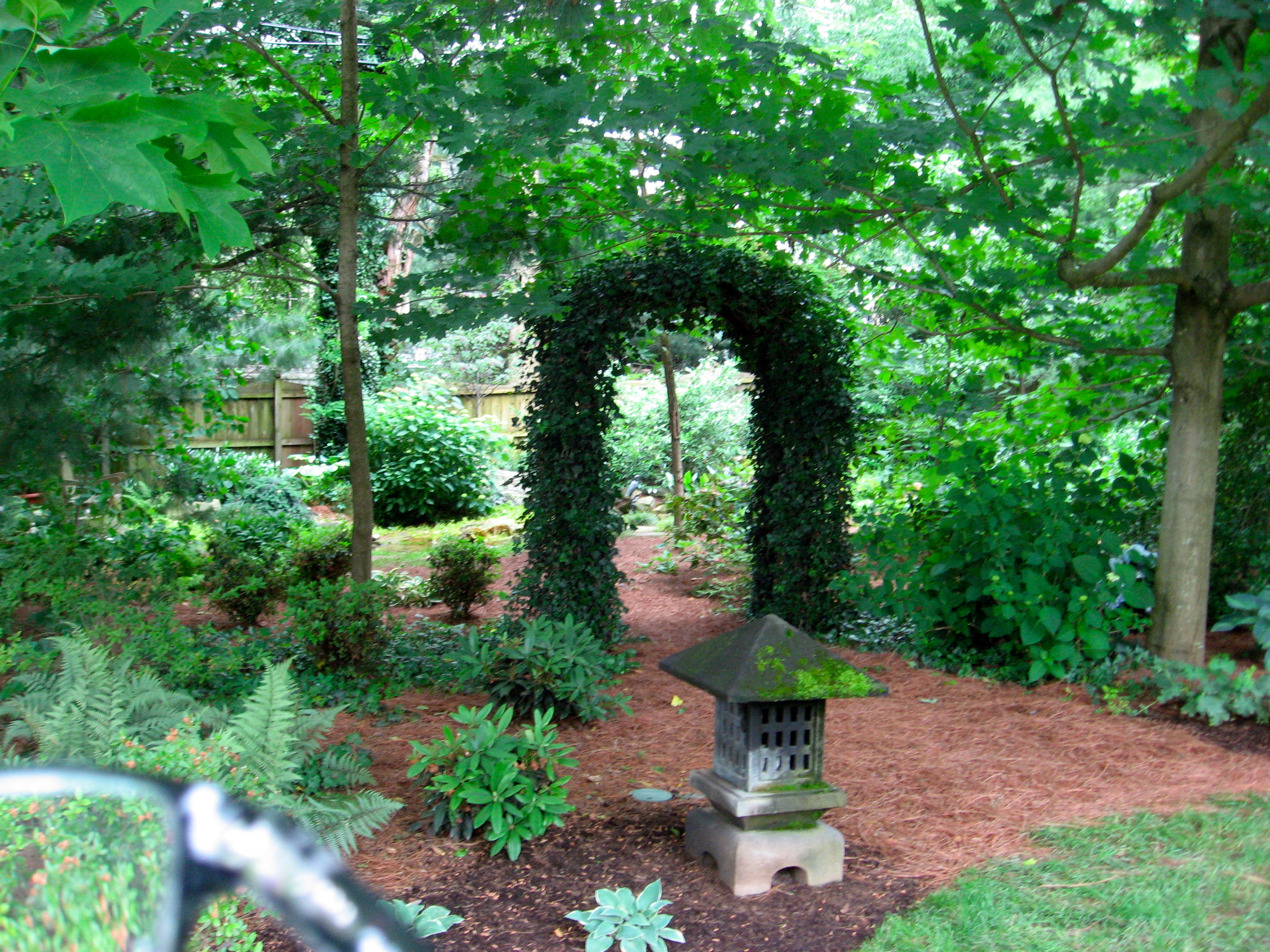
Had a great time yesterday taking-in the annual Lexington, KY garden show, with ten city gardens on display at a bargain price of $12.00.  I also got glimpses  of  Lexington’s urban beauty, rare among American cities.  It simply amazes me how much creativity,  care and passion for nature went into each of these gardens.  Any of them would be just a pleasure to retire to at the end of a stressful day at work or as diversion from life’s daily anxieties, a place which Yeats sumptuously offered “peace comes dropping slow.”  A few highlights:

2013-06-01 11.06.27

2013-06-01 10.44.00

2013-06-01 07.44.35

2013-06-01 10.38.16

2013-06-01 10.41.05

Courage: life’s highest elegance

One who becomes agitated
sacrifices his mastery (Lao Tsu)

The astute Jane Austen wrote a book called Sense and Sensibility in the early 19th century.  By sense, Austen meant qualities like reason, good judgment, self-control; in contrast, sensibility dealt with feelings, impulsiveness, and passions.

In our own time, I would include under sense that consummate affinity some few people possess as social observer Joseph Epstein wonderfully put it for “unerringly true taste–with perfect manners, easy elegance of dress, an eye for the beautiful in nature and art, a penetrating instinct for judgment of people, and an independent spirit that accepts only those opinions learned in one’s own heart” (Snobbery:  The American Version, p. 81).

I can’t say I’ve met anyone completely encompassing this kind of daily venue of social grace, call it class, fitted seemingly for every season.  I know I’ve always wanted it, but failed miserably pursuing what often has seemed a retreating horizon.  I’d like to know the right wine; sauté like a Chelsea Hotel chef; be up-to-date on timely, important things; be fun, but not silly; empathetic; compassionate; forgiving.  And even more.

But I also ask myself how well does all this pan out when life rears up, hurling impediments across our way, suddenly, unexpectedly, as in contexts of distress or suffering.  In a letter to F. Scott Fitzgerald, Hemingway famously dubbed such raw courage that defies circumstance as “grace under pressure.”  Musing about this, my memory retrieves just now a photo I had seen somewhere, featuring a rugged Hemingway, his fingers entwined around a rose.

I saw it last night, a beautiful thing, watching on cable a handsome young man with buoyant smile, in a wheelchair, legs severed in Boston’s marathon bombing, throw the first pitch at Fenway to loud cheers, an inspiration.  So young and such transcendence!

I think this is what Hemingway meant in calling such courage grace.  For me, it’s life’s crowned jewel.  Better, its highest elegance.

Be well and do good,

rj

Pacific Grove and its Monarch butterflies

monarch

For all its ever burgeoning population and high cost of living, I think California still offers a lot of good living away from the crowds in small towns hugging its pristine coast, offering the surf swish of blue Pacific ocean, cradling mountains that often walk down to the sea like in Big Sur country and, of course, the soothing warmth of year-round sunny days with low humidity.  To me, California is like going into one of those specialty ice cream outlets and finding yourself overwhelmed by a dazzling array of choices.  I just love the place!

Pacific Grove, however, stands out for me, located on the Monterey peninsula not far from ritzy Pebble Beach, rugged Big Sur, and charming Carmel-by-the Sea.  This area, in particular, means a lot to me, for Karen and I spent fun honeymoon days taking in its varied tapestry twenty years ago.  I’m all about regaining paradise.

Pacific Grove wasn’t even on my radar map until several weeks ago when I happened to find it mentioned in a book off my shelf that I hadn’t read in over two decades and started reading again.  While noting the town is famous for its annual influx of migrating Monarch butterflies each November, the writer laments their declining numbers, probably due to a shrinking habitat as housing construction continues to expand. I would add the increasing loss of milkweed, a principal food supply for the larvae.

Now this was way back in 1990 and thus my curiosity was aroused as to the plight of the Monarchs since, and so I did the research and came up both buckets full with info on Pacific Grove and its wintering Monarchs.  The news is good, though it could be better.

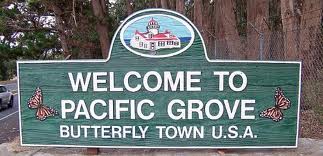
After more than twenty years, they still come to escape the winter cold of the Canadian Rockies and Southern Alaska, though in sharply diminished numbers, perhaps about 10,000, unlike the 50,000 plus in the halcyon days long gone.  The town seems attentive to its friends, even staging an annual parade (October), and why not, since they’ve built a thriving tourist industry around them and any further decline means diminished dollar intake as well.  There is a fine of $1000 for molesting a butterfly.

monarch2

Well-meaning, but on occasion, the city council can be dimwitted, opting in 2009 to prune the eucalyptus trees that the monarchs favor in their designated Monarch Grove Sanctuary, resulting in a precipitous drop shortly after to less than a thousand Monarchs.  Cutting a branch is like tearing down a house replete with its residents, since the larvae cocoon on these bare branches.  Today you’re  likely to see more Monarchs further down the coast toward Santa Cruz.  Some recent visitors report seeing just a couple of trees with butterflies, vastly changed from the swarms that blanketed the eucalyptus several decades ago.  What appalls is the council’s acting against the advice of environmental scientists.

pacificgroveThen, in November 2012,  the council was forced to make public its plan to revamp the Sanctuary, strikingly out of touch with California’s environmental recommendations.  In the past, the council has a history of foregoing environmental reviews.  As I write, I don’t know the outcome.

But I do need to be fair.  It used to be that the the principal Monarch habitat lay in the city’s George Washington Park, but urbanization, foot traffic and drought have taken their toll.  The city is trying to restore the habitat through tree planting, mulching and new trails.  The numbers are down to less than a hundred now.

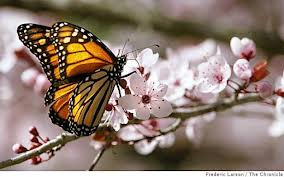
The Monarchs are awesome in their intricacy of evolved pattern, suggesting aerial tigers.  They’re also, though infinitely delicate, intrepid pilgrims on their own hajj to a nesting place they’ve never been, and yet they somehow find their way in a journey consummating up to 2000 miles.

Central California is Steinbeck country and the Nobel laureate made Pacific Grove his home with his first wife, Carol, and visited it often in his later years as his own sanctuary providing renewal.  He would later tellingly write that “Pacific Grove benefits by one of those happy accidents of nature that gladden the heart, excite the imagination, and instruct the young” (Sweet Thursday).  I suspect the Monarchs had a great deal to do with that.

Be well,

rj