
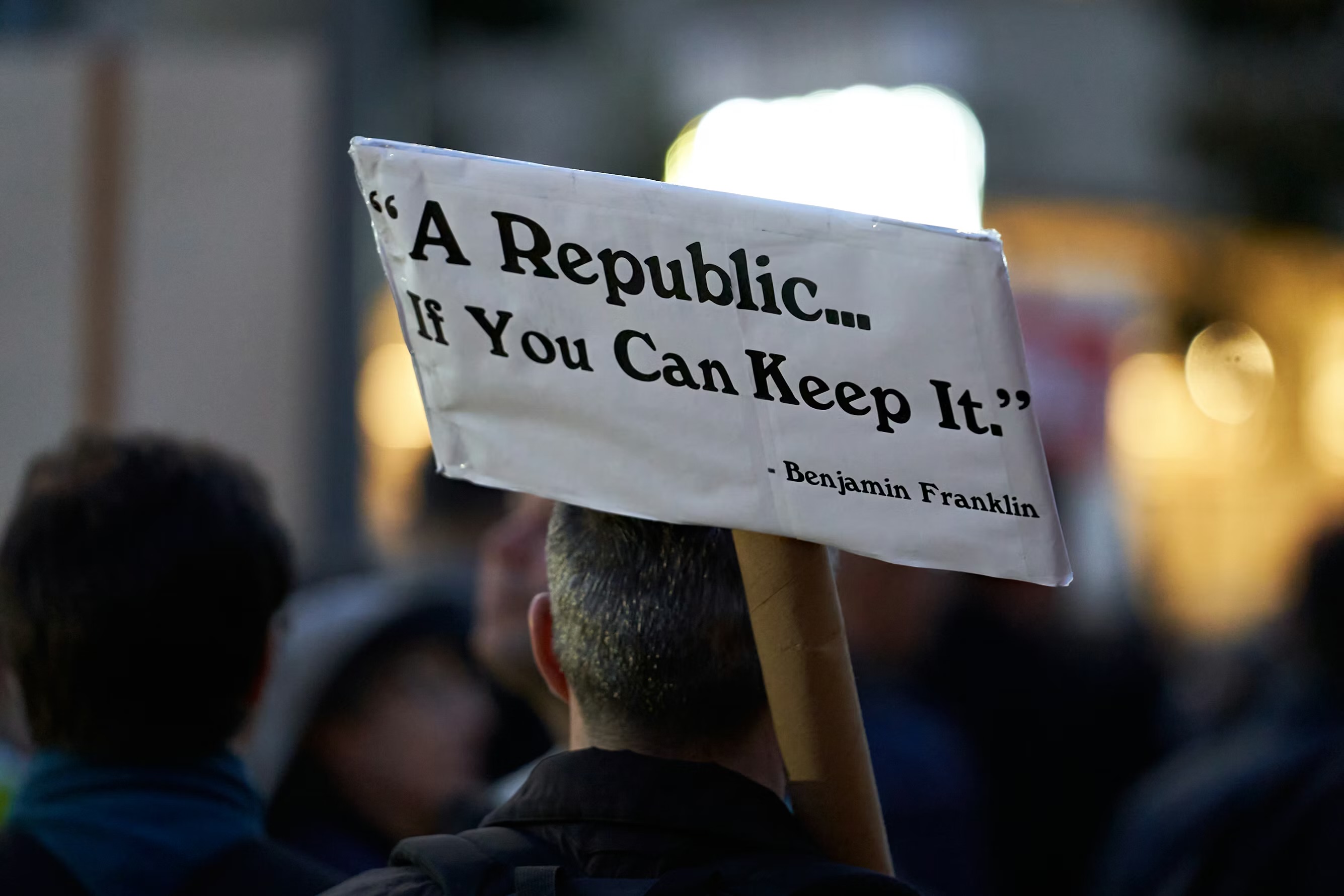
It is now 2026, with the midterm elections approaching in November. My New Year’s wish is straightforward: the impeachment of Donald Trump—assuming Democrats regain a decisive House majority—followed by a Senate trial resulting in his removal from office.
The Framers of the Constitution were not naïve about power. They were steeped in history’s lessons about its corrupting tendencies and had lived, in their own time, under the despotism of a foreign monarch. Their revolution was not merely against a man, but against unchecked executive authority.
Accordingly, the 55 delegates to the Constitutional Convention of 1787 chose to create a president, not a king. Crucially, they did not rely solely on periodic elections as a safeguard. Recognizing that elections alone might prove insufficient in moments of grave danger, they embedded in the Constitution a remedy for removing a corrupt or dangerous chief executive.
Those impeachment provisions are found in Articles I and II. Article I grants the House of Representatives the sole power of impeachment by majority vote and assigns the Senate the sole power to try impeachments, requiring a two-thirds vote of members present for conviction. Article II, Section 4 defines the standard:
“The President, Vice President and all civil Officers of the United States, shall be removed from Office on Impeachment for, and Conviction of, Treason, Bribery, or other high Crimes and Misdemeanors.”
Impeachment, it bears emphasis, is an accusation; removal requires conviction.
Presidential impeachment trials are exceedingly rare. In more than two centuries of constitutional government, only four have occurred:
Andrew Johnson (1868)
Bill Clinton (1999)
Donald Trump (2019 and 2021)
All four trials ended in acquittal. Richard Nixon almost certainly would have been removed, but he resigned before the House could vote on impeachment—the first presidential resignation in American history.
The rarity of impeachment trials reflects not restraint alone, but the gravity of the remedy. As Alexander Hamilton explained, impeachable offenses are those that violate the public trust—abuses of power that strike at the constitutional order itself.
Measured against that standard, there should be little ambiguity regarding Donald Trump’s “high crimes and misdemeanors.” They include conduct that betrays the nation’s best interests and undermines the rule of law: defiance of judicial orders; the use of the Department of Justice to shield allies and punish perceived enemies; and the deployment of violent rhetoric that incites threats against judges and congressional critics, including calls for the execution of former public servants from the military and intelligence communities.
To these may be added the consistent placation of authoritarian foreign leaders and the initiation of military actions—such as attacks on Venezuela and vessels at sea—without clear congressional authorization.
Conviction in the Senate requires 67 votes. Given political realities, Republicans alone are unlikely to supply them. That leaves responsibility where it has always rested in a constitutional democracy: with the electorate.
If the Constitution is to function as intended—if law is to prevail over personal power—then it falls to citizens to vote in numbers sufficient to make accountability possible. The midterms present such a moment.
Whether the nation seizes it will determine not merely the fate of one presidency, but the durability of the constitutional order itself.
–RJ
Discover more from Brimmings: up from the well
Subscribe to get the latest posts sent to your email.

 Brimmings: up from the well
It’s that Supreme Court judgement on allowing a sitting president virtually free reign.
Need to get some top legal minds behind it, interpret it back to reality.
LikeLike