A Seat at the Table: Why Economic Rights Must Transcend Identity Politics

In a recent Brimmings post, I cautioned Democrats to avoid identity politics: “While minority rights matter, they musn’t be set against the economic rights of all Americans to a fair share. Otherwise, we reap continuing resentment, social fissure, and exploitation.”

To blame working class white males for Harris’ defeat isn’t where it’s at. Truth is America’s working class transcends race and ethnicity. 15% of Blacks voted for Trump; 41% of Hispanic voters did the same. Collectively, they provided the margin of victory in the battleground states.

Perceiving themselves as marginalized while others jumped the queue, they voted their resentment. Trump masterfully exploited that resentment, focusing on unchecked immigration (8 million) at the southern border under four years of Biden.

America’s healing lies in addressing their grievances; if not, we’ll continue to be prey to demagoguery and its selfish interests.

Everyone needs to feel they’ve a place at the table, regardless of race, origin, or background.

—rj

Trump’s Madison Square Garden Debacle: Is This the End?

Trump’s Madison Square Garden rally last Sunday may very well have alienated Latinos across the country and cost him the election.

The wound was inflicted not by Trump, but by comedian Tony Hinchcliffe, who appeared as a warm-up act before Trump took the stage.

Drawing from a barrage of stereotypes targeting Black, Jewish, Muslim, and Latino communities, Hinchcliffe described Puerto Rico as “a floating isle of garbage,” adding that Latinos “love making babies.”

Welcome to the October surprise!

Although the Republican campaign attempted immediate damage control, the fallout of rage was immediate and widespread.

Pivotal state Pennsylvania has a 427,000 Puerto Rican population. Then there’s North Carolina (115,000), Georgia (101,000), and Arizona (65,000), all of them battleground states essential for a Trump victory.

Nationally, 36 million Latinos are eligible to vote next week, up from 32 million in 2020, according to the Pew Research Center.

Trump’s been on shaky ground from the beginning, many Puerto Ricans still nursing a grudge over the former President’s reluctance to grant islanders $20bn in aid in the aftermath of hurricane Maria in September 2017 in which 3000 died. Puerto Rico went without power for 181 days.

His acting Homeland Security secretary, Elaine Duke, reported to the NYT Trump proposed selling or divesting the entire island of Puerto Rico. following the disaster.

In the meantime, Democrats have made it a priority to grant Puerto Rico statehood, an obvious political maneuver giving them two more senators and, with the probable inclusion of Washington, DC, two more.

As for the Puerto Rico commonwealth, its voters on election day will again be deciding on statehood. The 2024 plebiscite differs, however, the previous six allowing voters the popular option of remaining a commonwealth, exempt from federal taxes. This year’s plebiscite omits that option. It’s simply statehood, independence, or independence with free association, virtually assuring statehood approval.

Critics claim that House Democrats, in collaboration with Puerto Rico’s Popular Democratic Party (PPD), rigged the plebiscite by passing the Puerto Rico Passage Act (2022), which established the current plebiscite with its limited options (Plebiscite).

Meanwhile, Puerto Rican voters on the mainland are not unappreciative of Democrat overtures on their behalf, nationally and in Puerto Rico. “We are not garbage and we are not lazy and we’re all American citizens ready to vote in this election,” said Luis Miranda, founding president of the Hispanic Federation and chairperson of the Latino Victory Fund (Puerto Rican Jokes).

Statehood, nevertheless, remains an uphill climb. To achieve congressional approval of statehood, Democrats will need to control both chambers. Although a simple majority vote is all that’s needed in each, in the way looms the Senate’s filibuster with its sixty vote threshold.

Kamala Harris has pledged to temporally suspend it in any vote to restore Roe v. Wade, a move opponents argue could make the filibuster obsolete.

There have been two attempts on Trump’s life, possibly a third. Fortunately, these efforts failed. However, the fiasco at Madison Square Garden may have dealt a fatal blow to Trump’s chances of returning to office in a close election.

–rj

Beyond Identity Politics: The Case for Economic Unity

Two weeks to go until America decides!

I’m with those who believe Kamala Harris will win. Even so, America will remain deeply divided, unless the grievances of America’s working class, transcending race and ethnicity, are addressed.

Healing lies in abandoning the separation of the political and the economic.

While minority rights matter, they musn’t be set against the economic rights of all Americans to a fair share. Otherwise, we reap continuing resentment, social fissure, and exploitation.

What matters isn’t who you are, or where you’re from, but what you believe. Identity politics conversely promote discord.

Unions have shown us the way, promoting shared economic interests transcending identity factions of Left and Right.

Achieving class unity, America secures a vibrant future, true to its promise of shared equality in the pursuit of happiness.

As distinguished economist Robert Reich rightly observes, unless the new administration enlarges the economic franchise, “future demagogues like Vance will almost surely exploit the same bitterness for their own selfish ends.”

“The strongest defense we have against a future of Trumpist fascism is a large and growing middle class comprised of people who, although they may have supported Trump, come to feel they have a stake in America.”

—rj

Sending the Wrong Signal: The Obamas

We have an economy that is out of balance. It’s one in which most of the people in this room have benefited enormously over the last decade — and I include myself in that group. But it is an economy that has left millions of Americans behind” (Obama, political.com).

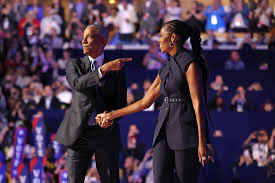
It’s the DNC, August 20, 2024: A crestfallen Michelle Obama, dressed in a belted, sleeveless, navy blue pant suit costing $3000 plus, shares lessons she’s learned from her family legacy, her audience, mesmerized and adoring:

…they were suspicious of folks who took more than they needed. They understood that it wasn’t enough for their kids to thrive if everyone else wanted around us was drowning.

Her words trigger flashback, a former president, his trademark poise and eloquence, exhorting the wealthy to give back.

As she speaks, millions of Americans struggle daily with making ends meet. Thirty-eight percent of Gen Zers, born since 1997, think themselves less secure than their parents at the same point, their living expenses ceasingly escalating (cnbc.com)—groceries, housing, transportation, clothing, their jobs tentative or inadequately remunerated. Even with a college degree, obtained at considerable debt, the American dream eludes their quest.

In a CNN poll conducted earlier this year, 71% of Americans rated the economy “poor”; another 38%, “very poor.”

Millennials (born 1981-1996), find themselves burdened with crushing debt, subjecting them to losing it all if another financial crisis occurs like that of 2008.

Since 2022, house prices alone have mushroomed 20 to 30% and interest rates jumped from 3% to nearly 8%. It’s become cheaper to rent than own.

Having children is a luxury (“What Broke the American Dream,” CNN, 2024).

The tab for childcare at a day care center runs an average $800-$900 monthly per child (care.com).

A family’s outlay for a health insurance policy reimbursing 70% of medical expenses averages $3,682 as of August, 2024 (kff.org).

While Michelle speaks, 132,232 homeless seek nightly shelter in NYC, 45, 745 of them children (June, 2024; coalition forthehomeless.com).

They’re the lucky ones. Thousands more sleep in subways, in parks, on the streets, or in cars.

Across America, you see them on city street corners with their cardboard signs, begging help.

As for racial demographics, 52% of heads of households in NYC shelters are disproportionately black; 32% hispanic (coalition for the homeless).

In 2021, an estimated 300,000 of all races and ethnicities in NY state lived doubled up with relatives and friends.

HUD reports an estimated 653,100 people across America are homeless, up 12% since 2022. Their numbers include not only the mentally ill and drug addicts, but the unemployed and underemployed.

Those numbers include 200,000 veterans, suffering post-traumatic stress from conflicts in Iraq and Afghanistan, sleeping nightly on city streets (National Coalition for Homeless Veterans).

All too often, we’ve this tendency to compartmentalize: it’s them, not us.

Truth be told, millions of Americans are separated from homelessness by a thin thread of tentative circumstance in a market economy where jobs can vanish in an inkling amid economic flux.

Meanwhile, the Obamas have financially estranged themselves from the the middle class they claim ro champion, their estimated net worth between $70 and $135 million, and climbing (NY Post, September 26, 2024).

Why shouldn’t the Obamas, having decried greed on many occasions, not be scrutinized, their feet held to the fire?

Let’s take a closer look.

After leaving the White House, the Obamas purchased a home in D. C.’s plush Kalorama neighborhood of diplomats, the wealthy, and the famous, for $8.1 million (2017). At 8,200 sq. feet, it features 8 bedrooms and 9 1/2 bathrooms. They’ve since made extensive revisions, adding a pool and a brick wall surrounding the property. Parking is available for ten cars.

Not long after (2020), they purchased a 29.3 acre property on exclusive Martha’s Vineyard with pristine water views and a dedicated pathway to the ocean beach. At 6,892 sq. feet, it has 7 bedrooms and 8 bathrooms and special design features. Cost: $11.5 million.

In 2000, the Obamas purchased a residence in Kenwood, a suburb adjacent to Chicago, featuring six bedrooms and six baths for a modest $1.65 million. They lived there from 2004-2008, or until Barack Obama became president. Frequented by tourists and blocked off, the Obamas are seldom there.

In 2015 Obama’s close friend, financier Marty Nesbitt, purchased a three acre Oahu property for the Obamas in a proxy deal for $8.7 million. Its $15 million dollar mansion, formerly home to Magnum PI TV series, has been leveled to accommodate something more grandiose, a compound consisting of three homes, one of them presumably for Secret Service. 

It hasn’t hasn’t been without controversy. Despite state and county laws protecting the coastal environment against the intrusion of sea walls, believed to inhibit beach migration inward, loopholes were exploited and exemptions granted to build a 70 foot seawall.

Obama, the environmental president, is keeping silent, deferring any comments to Nesbitt’s office.

Setting the record straight, the Ivy League Obamas have never been absent from privilege, victims of white bias or corporate exclusion—or bluntly, unemployed.

While a Senator, Barack and Michelle collectively earned $1.6 million.

As President, he made $400,000 along with a $50,000 expense account, a $100,000 tax free travel account, and $19,000 entertainment account (afrotech.com).

In retirement, former presidents receive $1 million in travel expenses yearly; their spouses, $500,000 (ntu.org).

There’s also a generous allowance for office space and staff.

According to Business Insider, Obama garnered $15.6 million in book royalties from 2005-2016.

He presently receives a $246,424 pension, indexed to inflation (National Tax Union Foundation).

With more than five years in Federal office, medical care at the nation’s best hospitals, is free, unlike for millions of retired Americans paying up to $200 monthly for Medicare that excludes vision, hearing and dental benefits and makes it necessary for seniors to fill in the gaps for deductibles and copays with supplemental insurance and a drug plan.

Their social security is likely to be taxed.

Longterm care for a dehabilitating illness or injury is out-of-reach for most middle class Americans, averaging $35,000 to $108,000 annually (National Council on Aging).

Since leaving the White House, Obama reportedly received $850,000 for two speeches and $2 million for three talks in 2017.

In 2018, the Obamas entered into an estimated $50 million production deal with Netflix.

Business Insider estimates the Obamas will ultimately earn $250 million in post White House earnings for books, speeches, tours, and movie productions.

As for Michelle, last year saw her walk away with $750,000 for a one hour speech in Germany before the Bits and Pretzels forum in Munich associated with the annual Oktoberfest (NY Post, September 26, 2024).

Her normal speaking fee starts at $200,000. Barack commands a minimal $400,000, matching Joe Biden’s annual presidential salary in every speech.

For her memoir, Becoming (2018), Michelle received a $65 million advance.

In Becoming, Michelle wrote, “When you’re president of the United States, words matter.” They do, but doing matters more.

Exemplary leadership seeks not its own gain, but the welfare of the many. It sets precedent for a new politics that eschews platitude, the ethereal, and the partisan. Centering on doing, it knows its limits. Simplicity and restraint govern its personal conduct in daily life. In its moral construct, it sets an example that inspires and achieves a democratic altruism transcending the factional.

On the other hand, economic advisor and Huffington columnist Zachary Carter writes, “Obama isn’t running for office again, but his sellout sends even uglier signals to the electorate.”

As for the Democratic Party, dominated by managers, venture capitalists, Hollywood and media celebs, it can no longer boast being the party of Franklin D. Roosevelt: “The test of our progress is not whether we add to the abundance of those who have much; it is whether we provide enough for those who have so little.”

–rj

 

Let’s not change horses in midstream: The case for another Biden term


The news hadn’t bode well for Joe Biden even before his disastrous debate with Trump.

The NYT, tracking 47 polls, shows Biden trailing Democratic senate candidates in the upcoming election in all, but one poll, where he’s tied.

His low polling doesn’t come as a rebuke of his policies, at least among Democrats. If one rightly judges the merits of a presidency by its ability to promote change bettering America, Biden outpaces his predecessors, including Obama, putting him in good company with Abraham Lincoln, Franklin Roosevelt, and Lyndon Johnson.

The problem is that most voters view Biden as lacking the physical and mental capacity to carry out the duties of office for another four years.

His ninety minute confrontation with Trump simply buttressed the public’s hesitancy.

Watching the debate was painful for me. Biden seemed laboring to reach the podium, stuttering repeatedly, losing his train of thought on one occasion, digressing in several of his responses, and looking down repeatedly as if searching for a response prepared by his handlers.

It was like watching a boxer, trapped in the ring corner, staggered by repeated blows.

Trump’s best line nailed it: “I really don’t know what he said at the end of that sentence. I don’t think he knows what he said, either.”

A healthy, nimble candidate would have atomized Trump quickly in fact-checking rebuttal. Trump was his usual self, hyperbolizing and mendacious, though to his credit, he exercised discipline in not interrupting his opponent.

Though just four years younger than Biden at 77, Trump came across as consistently energetic. “It seemed like a thirty year difference,” one reporter said.

So where do we go from here?

Despite a groundswell of party cohorts urging his withdrawal from the race, seconded by formerly friendly media, Biden is unlikely to heed their counsel—that is, unless there occurs another stumble, both literally and figuratively.

But here’s my take: With six weeks to the Democratic National Convention, August 19-21, an open convention would produce political chaos with a rush of candidates, inadequately assessed.

Kamala Harris is the likely designee. Biden, of course, could immediately resign, allowing Harris to assume the presidency. Any other choice, say a white male replacement at the convention, would spell unmitigated disaster, and assure a Trump victory.

Black and brown voters would abandon ship. As Areva Martin, a California convention delegate pledged to Biden, put it: “If you pick a white man over Kamala Harris, black women, I can tell you this, we gon’ walk away, we gon’ blow the party up.”

The caveat, however, is the improbability of Harris winning in November, polls indicating she enjoys even less favorability than the president.

I say, better not to panic. I believe Biden can still win. Twenty percent of Republicans distain Trump. In a close election, they could provide the margin of victory for Biden, whether by crossing over or not voting a presidential preference. I think it reasonable they’ll do just that.

As for a future four years, if Biden can’t carry out his duties, he can either resign, with Harris succeeding to office, or the Congress can implement the 25th Amendment, Section Four:

“Whenever the Vice President and a majority of either the principal officers of the executive departments or of such other body as Congress may by law provide, transmit to the President pro tempore of the Senate and the Speaker of the House of Representatives their written declaration that the President is unable to discharge the powers and duties of his office, the Vice President shall immediately assume the powers and duties of the office as Acting President.”

Let’s not change horses in midstream. We can still win and smooth out any winkles. The alternative is unthinkable.

—rj

Oh, my god! The Political Morass Confronting Americans

Oh, my god! We’re all in trouble. Here we are, facing a presidential election, caught in a catch-22 situation, the choice between a president clearly showing incipient symptoms of mental decline, and an ex-President promising revenge and demagoguery. Biden’s lapses have been widely reported in the press for some time: tumbling on aircraft steps, lingering pauses in speech delivery, mix-up in identifying political leaders, befuddled recall of events.

Now comes the President’s frantically called press gathering, just 23 minutes warning in the aftermath of special prosecutor Robert Hur’s devastating findings on Biden’s alleged national security lapses: storage of top secret files in his Delaware home and sharing of classified information with the ghostwriter of his memoirs, Mark Zwonitzer.

Hur’s office considered charging Zwoniker, who has been cooperative, but the ghostwriter had previously destroyed the interview tapes with Biden when he learned of the special counsel probe, resulting in the improbability of a conviction for lack of evidence.

Hur found the president’s recall of how the classified documents ended-up in his basement as “hazy.” He had said he found them in his then rented house in Virginia.

What really instigated Biden’s frenetic press appearance was probably Hur’s reporting the President’s inability to recall when his son Beau died of brain cancer: “I don’t need anyone, I don’t need anyone to remind me when he passed away,” the President angrily retorted.-

Biden couldn’t even recall the dates he’d been vice-president.

The reality is that his combative press conference only seems to lend credence to Hur’s allegations of a President of “diminished faculties in advancing age.”

About to leave the room, Biden returned to the lectern to respond to a reporter’s belated question on the Gaza crisis. Committing yet another gaffe of mistaken identity, piling up in recent days to the chagrin of his staff, Biden confused Egyptian leader Abdel Fatah al-Sisi as “the president of Mexico.”

Several days earlier in Nevada, he confused deceased French president Francois Mitterand with current French president Emmanuel Macron. Mitterand died in 2015.

This past Wednesday, Biden said he had interviewed Germany’s chancellor Helmut Kohl in 2021. Kohl died in 2017.

I think of Ronald Reagan in his second term, then America’s oldest president, falling asleep in cabinet meetings. A few years later, 1994, Reagan announced his Alzheimer diagnosis. The signs, however, of its progression had already been evident while in office.

I wish our President well, but I fear the fallout of mental facility in a nuclear age, the challenge of climate warming, the looming threat of a Russia-China-Iran alliance, and still more, to nightmare my sleep.

Hiding presidential infirmity has a long history, embracing Woodrow Wilson, Franklin Roosevelt, Dwight Eisenhower, John Kennedy, and Ronald Reagan. We’ve mustered through so far, but why take the risk?

Faulting Republican Robert Hur constitutes its own partisanship.

As Democratic strategist James Carville candidly put it, “I don’t know how you get out of this.”

–rj

I Want an America Better Than This


We normally think of gurus in connection with individuals claiming transcendental wisdom, often as emissaries of the Divine. I needn’t recite a roll call of their prodigious presence, past and present, in American life, drawing into their loop numerous devotees, hanging on their every word, willing to drink the Kool-Aid.

But gurus can be political, too, like Hitler, Stalin, and Mao. I see danger in my beloved America in the likes of Trump and DeSantis and their “true believer” followers, bent on banning books, subverting free inquiry, racial justice, a woman’s right to choose; its ubiquitous gay-bashing, xenophobia, restricting voter access, and denial of climate change. Unhinged, some are willing to employ violence to achieve their ends.

I want a better America than this. I want America to live up to its promise as a bastion of hope and guardian of liberty. I think you want that too. Indifference won’t win out. We must advocate. We must resist. The liberty you defend is your own. —rj

Scrubbing George Washington from History: Who’s Next?

Just a few days ago comes news that a San Francisco school district is mulling getting rid of a series of murals honoring our first president because a commissioned working group alleges it’s traumatizing students.

Imagine my surprise that founding father George Washington is now under attack by politically enlightened, self-lacerating guardians of the public interest, bent on scrubbing the pantheon of American heroes clean in writing a revisionist history:

We come to these recommendations due to the continued historical and current trauma of Native Americans and African Americans with these depictions in the mural that glorifies slavery, genocide, colonization, manifest destiny, white supremacy, oppression, etc.

Seems our anointed censors will neither forgive nor forget that George was a slave owner and killed Native Americans in the French and Indian War. And, of course, we have to take into account its psychological fallout for students exposed daily to the murals.

Ironically, these murals were painstakingly done in 1936 by communist Victor Arnautoff, who simply wanted in his own words “to provoke a nuanced view of Washington’s legacy,” which the San Francisco United School District (SFUSD) has obviously misconstrued in its literalist approach.

Wonder what Dolly Madison would say about all of this.

But it doesn’t stop here. There’s Christ Church that Washington and his family attended in Alexandria, Virginia. Washington had purchased a family pew, marked by a plaque. Well, no more!

The plaques in our sanctuary make some in our presence feel unsafe or unwelcome. Some visitors and guests who worship with us choose not to return because they receive an unintended message from the prominent presence of the plaques.

Washington was a founding and contributing member of the congregation. Ironically, the church is located on North Washington Street. Y’uh thinking maybe they should move?

Last, but not least, comes this news from academia: Washington and Lee University board of trustees has decided on replacing portraits of Washington and Lee in military uniform with portraits of them in civilian garb.

In a formal statement, J. Donald Childress, rector of the board of trustees, and William C. Dudley, university president, said, “We appreciate the seriousness and thoughtfulness with which our fellow trustees have approached these matters. On behalf of the board, we want to express our gratitude to all of those members of the community who contributed to our deliberations, through countless letters and conversations over the summer and on campus this weekend. We are fortunate to be part of a community that cares deeply about this institution and is so dedicated to its continued success.”

Seems the leader of the Continental Army has been relieved of command.

I prefer distinguished American historian Fergus M. Bordewich’s take on these things in exclaiming it’s “a deeply wrongheaded habit to project today’s norms, values, ideals backwards in time to find our ancestors inevitably falling short. It betrays a very troubling intolerance of art and the ambiguity of art and the aspirations of art. It’s incredibly stupid if we try to erase history. It still happened, and you should argue about its meanings.”

–rj

Snobbery’s Menace

0f42ae99-9c8e-38c1-96bd-8806ca19dd1d

Politics can be a mean way of life, filled with scurrilous attacks on opponents, replete with prevarication, and downright lying. I stay away from it, as much as possible.

Case in point, just the other day former Vermont governor and one time seeker of the Oval Office, Howard Dean, took a shot at Wisconsin governor, Scott Walker, commenting on MSNBC’s Morning Joe: “The issue is, how well-educated is this guy?”

Walker, who may throw his hat into the ring for the Republican nomination in 2016, dropped out of college almost at the finish line in the spring of his senior year to join the Red Cross.

Our Constitution, however, lists only three prerequisites for our nation’s highest office: natural born citizen, at least 35 years old, and a minimum of 14 years lived in the United States.

Maybe Dean and others of his stripe might want to try amending our Constitution to secure their elitist government.

I would contend our government is just too elitist as it is, an oligarchy of power interests distanced from the vast majority of working Americans, three quarters of whom don’t sport a college degree.

I would also question the underlying assumption that a college degree automatically confers knowledgeability on anyone for any job.

I was a prof for 40 years and I can tell you first hand my students learned best, not from books or lecture, but hands-on. That’s what internships are all about, Dean, and you of all people, a medical doctor, should know this, since M. D.’s do a year of internship followed by several years of residency.

I have to confess I made a lot of dumb mistakes as a young prof despite 10 years of college before I was really fit to step into the classroom.

I would like to ask Dean how it was, judging by his own maxim, he was suddenly fit to be governor having trained to be a physician. That’s a huge gap. Maybe Rand Paul can help us out here.

My father had only an elementary school education, dropping out of the public schools like so many of his generation in the pre-World War I years. Like several of my uncles, he worked as a leather tacker for all of his working life in a brutal environment of body-sapping humidity and toxic fumes in one of the most deprived areas of Philly.

But for all his lack of schooling, he was one of the wisest men I’ve known across a life time, intuitive, and possessed of a healthy dose of skepticism whenever the facts didn’t seem to line up.

Not only do I owe my love of baseball to him, but the importance of being aware of what’s going on the world. The TV evening news with John Cameron Swayze or Douglas Edwards was time out and you’d better not be talking while they were on.

Every Sunday morning, he’d send me up the block for the Philadelphia Inquirer, just a dime then (imagine!) and split the newspaper with me on my return, which I’d eagerly devour, sprawled out on the floor. At 10, I was fully aware of a new war in a far off place called Korea, and spell bound by the firing of MacArthur not long after.

I remember his love for Winston Churchill, who had warned the West in the early thirties of the menace of Joseph Stalin.

My father was always slow to swallow the government line, speculating that we might never really know the facts behind that “surprise” attack on Pearl Harbor, a surmise that historian John Toland’s recent book. Infamy: Pearl Harbor and Its Aftermath, lends credence to.

I take offense when the snobs start wagging their tongues, the privileged lording it over the common herd, whether in the political area or anywhere else

Money, celebrity and, unfortunately, education–one of the most rampant bastions of elitism– can become divisive weaponry in putting down others to boost yourself up.

Or to efface those opinions you don’t like. Dummies!

Snobs always want to impress. As Virginia Woolf put it, herself a snob, “The essence of snobbery is that you wish to impress other people.”

I like best how one of my favorite authors, D. H. Lawrence, who came from miner stock, defined it: “[Snobbery] is the desire for what divides men and the inability to value what unites them.”

Ah, let me call to mind just a few names of those from a humble way of life, without college diplomas, who have made a positive mark upon the world. You just may be surprised:

In Science:

Thomas Edison

George Washington Carver

In Business:

Henry Ford

John D. Rockefeller

Steve Jobs

Mark Zuckerberg

In the Arts

Thomas Hardy

Mark Twain

William Faulkner

Vincent Van Gogh

William Shakespeare

In Politics

Andrew Jackson

John Glenn

Winston Churchill

Abraham Lincoln

These are my heroes.

These are my greats!

My favorite people also spring from everyday people I’ve known who never did a mean social thing in their lives like dismissing others for their lack of money, possessions, or the right diploma; or practicing a trade; or for being Black, Asian, Hispanic, Muslim, or gay; or because their political beliefs don’t mesh.

I measure people by a different yardstick: people who inspire with their kindness and compassion, from every walk of life, whose praise comes from the mouths of others and not their own; whose intelligence makes room for them to lead; who, to go back to Lawrence, unite rather than divide.

I like Shaw’s wisdom in his play Pygmalion, where he has Professor Henry Higgins put his finger on what makes for good manners–not whether what you do is in itself good or bad, but that you behave the same way towards everyone.

I must warn, however of another kind of elitism that has taken vogue, of a pride in defiance, or smashing icons for its own sake; a snobbery of rebellion where even norms that have given life grace, and with it, expectancy, are trampled upon in a frenzied allegiance to a vulgarity of self-indulgence of antinomian hue.

Snobbery is a way of life that will always be with us, but you and I, forewarned, needn’t embrace it and, by doing so, gain so much more.

–rj


Happy Days are here again: and the banks roll on

obama

If you’ve been watching the headlines on the economic front, you may have seen the news about record bank profits in the first quarter of the year to the tune of $40.3 billion, an all time high.  In fact, profits surged 15.8% over the same quarter a year ago. This marks the 14th straight quarter of bank gains. In short, the bailed out banks (you and I paid for that), are making money hand-over-fist.  Not so, mainstream America.

Meanwhile, in the past 12 months, scandal- ridden JP Morgan has garnered $24.4 billion in net profit, evidencing once again that banks could evade laws with impunity.  The precedent, after all, had been the release of the 2000 page examiner’s report on Lehman Brothers in 2010,  suggesting fraud had brought about its bankruptcy, yet nothing was done.

You’d never have expected hand-outs from the Obama administration, given their campaign pledges to look out for us po’folk and their left of center politics.  Their hand-outs, not loans, to banks and other fiscal institutions, are shockingly in the trillions, with $85 billion dished out every month from the Federal Reserve.

But then again, we can better understand the forces in play when we look at the cohorts Obama gathered about himself:  Jacob Lew, former Citigroup executive, appointed deputy secretary of state, with a cool $900,000 bonus in his pocket from Citigroup;  Mark Patterson, Goldman Sachs lobbyist, made chief of staff at the Treasury, despite a ban on lobbyists;  Timothy Geithner, who became the architect of the bailouts, appointed as Treasury secretary, even after it was discovered he hadn’t fully paid his taxes;  Larry Summers, who authored many of the pro-bank policies of the nineties, recruited as a mainstay economic advisor; and Rahm Emmanuel, appointed Chief of Staff, after gleaning $16.5 million as a Chicago investment banker in just 30 months in-between government jobs. All of them Democrats.  All of them with dirty hands.  

At the present moment, Larry Summers is being touted as the next Federal Reserve Chairman, replacing the retiring Ben Bernanke.  A long time Goldman Sachs executive and trader, he played a primary role in deregulating Wall Street in the Clinton administration.

So far, and probably never will happen, not a single bank or CEO has been brought to account for their criminal mismanagement of the people’s money, leading to the 2008 meltdown and consequent suffering for millions of Americans. Their suffering continues.

Now you would think from the President’s major address on the economy this month that happy days are here again for you and me, what with his boast of 7.2 million new jobs created in the business sector in the last four years.  But politicians do prevaricate, and it’s up to you and me to hold their feet to the fire.  Fact is, long term unemployment is at its highest level since the Great Depression, and of the newly minted jobs, most are low wage (often in the service sector), temporary, or part-time.

Curiously, nowhere did the President mention the plight of Detroit facing bankruptcy and the possible erosion of pension and health benefits for the city’s workers, including police and fire personnel.

To give him his due, he did allude to the growing income disparity between the rich and the majority of Americans:

Even though our businesses are creating new jobs and have broken record profits, nearly all the income gains of the past ten years have continued to flow to the top 1 percent. The average CEO has gotten a raise of nearly 40 percent since 2009, but the average American earns less than he or she did in 1999. And companies continue to hold back on hiring those who have been out of work for some time.

But how did this happen?  He didn’t mention government’s largesse to the wealthy through bank bail outs, corporate tax breaks, and reduced wages for autoworkers.  In the first two years of the President’s tenure, or after the downturn of 2008, the richest one percent enjoyed an 11% increase in income, unlike the rest of Americans whose incomes declined.

Again, nobody’s been minding the store.  In 2011, the Senate Permanent Subcommittee  noted Wall Street’s culpability just prior to the 2008 market collapse as “a financial snakepit rife with greed, conflicts of interest and wrongdoing.”

While it may appear that things are humming along nicely, the banks booming, the real estate market up, stocks at their peak, the reality is that more than 3 million of us can’t find work.  Those who do, work for less, often part-time.  Many, particularly those 50 and over, may never work again.  Black youth unemployment is currently at 42 %.

Several million Americans have been foreclosed upon by the banks, losing their biggest investment stake and, sometimes, a whole lot more.  Many others owe the banks for houses purchased at inflated prices, now worth considerably less.

But the banks roll on, too big to take on, as Attorney General Eric Holder recently let slip. What’s more, their lobbyist legions do their work well, busy button-holing members of Congress.  It’s a game of money, always has been, money spelling influence.  It’s America, you know.

This just  in:  The President remains committed to slashing Medicare by $400 billion and Social Security by $130 billion in his projected 2014 budget.  (In 2008, candidate Obama had pledged, reiterated by Biden in 2012, that he wouldn’t cut Social Security.)  Apparently, the bankers are a privileged class; the people, expendable to the exigencies  of  power and influence.

-rj