
Trump Environmental Rollbacks: Travesty in the Making

The Trump administration is accelerating its broad assault on environmental protections and climate change mitigation, putting both public health and the planet at risk. It began with the U.S. withdrawal from the Paris Climate Agreement, a pact signed by 200 nations.

Dismantling Biden’s Inflation Reduction Act, Trump has rolled back roughly 125 environmental policies in just two months, issuing executive orders to expand oil and gas drilling on public lands and increase logging in national forests.

Meanwhile, 1,600 workers have been cut from the National Oceanic and Atmospheric Administration (NOAA), undermining critical weather forecasting and public safety.

Aid to developing countries for green initiatives, once provided through the International Partners Group, has been halted.

FEMA, responsible for disaster relief, is under review.

The Environmental Protection Agency (EPA)—established by Richard Nixon in response to Rachel Carson’s Silent Spring—has pivoted to pro-fossil fuel advocacy. Forget about EVs, charging stations, or clean energy incentives.

It doesn’t stop there. Reuters reports today that the Department of Energy is considering slashing millions in funding for two major carbon capture projects in Louisiana and Texas. These projects, once fully operational, could remove an estimated two million metric tons of carbon annually.

Long standing congressional mandated legislation such as the Clean Air Act, the National Environmental Policy Act, the Clean Air Act, the Endangered Species Act, the Noise Reduction Act, and the Endangered Species Act face Trump’s bludgeoning. The courts must act to stop the carnage.

All of this comes as the world falls short of its pledge to limit warming to 3.6°F (1.5°C) above pre-industrial levels.

Trump, of course, remains unbothered. He has long dismissed climate change as a “hoax.”

Unfortunately, we will all pay an incalculable price for electing a renegade despot, mindlessly sabotaging the public’s welfare and our children’s future.

—rj
The Inflation Reduction Act: Fossil Fuels Become Law

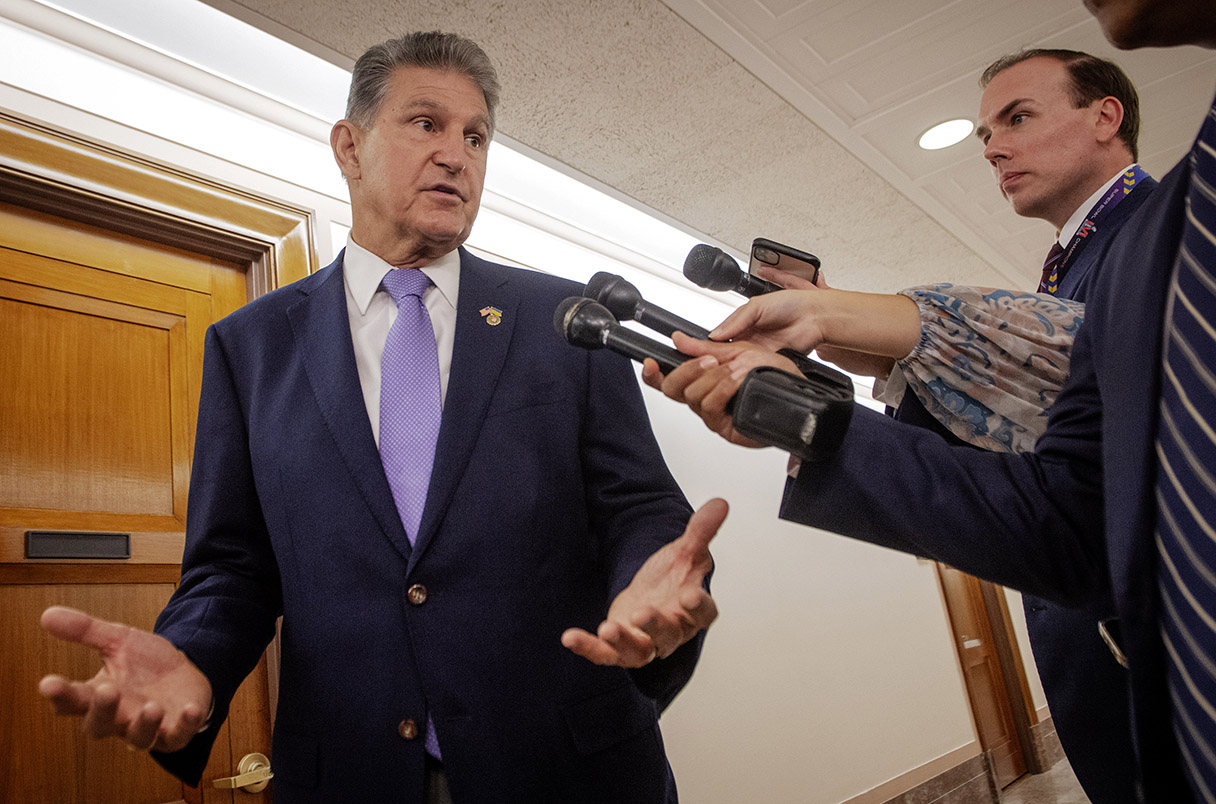
WASHINGTON, DC – JULY 21: Sen. Joe Manchin(D-WV) faces reporters as he arrives at a hearing of the Senate Energy and Natural Resources committee at the Dirksen S.O.B. at the U.S. Capitol, in Washington, DC. (Photo by Bill O’Leary/The Washington Post via Getty Images)

The so-called Inflation Reduction Act of 2022 promises much, but better read the fine print in this massive 700 page proposal.

A patchwork compromise with coal baron Senator Joe Manchin, its motivation is the Democratic Party leadership’s desperate need for a legislative victory in addressing escalating inflation, the primary concern of American voters, as the mid-term elections loom. Thus the bill’s name. (The previous version was called Build Back Better).

With close analysis, you’ll discover it isn’t up to the hype. While an unprecedented $369bn is dedicated to mitigating climate change, it locks in reliance on fossil fuel expansion by hamstringing the Interior Department: no renewable energy development on public lands unless drilling leases are also offered to oil and gas entities.

As such, this bill is pure political charade. Fossil fuels cause climate change, yet they’re locked into the bill’s provisions. There is no mechanism to phase them out.

What we get is the loosening of regulations regarding environmental review and, horribly, mandated drilling leases in Alaska’s Cook Inlet and the Gulf of Mexico. The result? More pipelines, oil leaks, methane leaks, wilderness lost, species endangered, and continuing temperature rise. In 2016, the U.S. averaged one crude oil spill every other day (undark.org).

There are no caps on carbon admissions!

While the legislation features tax credits for carbon capture and sequestration, the fallout is that this could extend the life of polluting coal plants, exposing the public to toxic fumes, and making it difficult to achieve clean power goals.

Not talked about is an ominous separate agreement to move a bill in September that could potentially weaken protections under the Environmental Policy Act, which grants communities a say in what happens to their local environment. This is subterfuge, pure and simple.

You’re told the legislation will reduce greenhouse gas admissions 40% by 2030 (Rhodium Group, rpg.com). Considering the pressing problems we have with securing energy resources, it’s dangerously possible that fossil fuels will gain the upper hand over renewables, upsetting any trajectory of even-handedness. As is, the Biden administration in early July held its first onshore lease auction, releasing a proposed plan for off shore drilling, despite Biden’s campaign pledge to cease new oil and gas development on federal lands and waters (insideclimatenews.org).

In short, the Inflation Reduction Act takes back what it gives out, a Faustian wager that forfeits the future for a short-sighted political shell game in the present.

I’m not saying there aren’t good things in the bill. And, yes, there are groups like Nature Conservancy, the Sierra Club, and Earth Justice, urging speedy passage of the legislation. They may be willing to drink the Kool-Aid, but not me, nor should you.

I go by the late E. O. Wilson, “Darwin’s heir,” my icon in environmental matters, who repeatedly denounced such organizations for their compromises, perpetuating environmental demise. They’ve thrown in the towel, their credo, Nature is already gone. We live in the Anthropocene. Wilderness must serve human needs (Wilson, HalfEarth: Our Planet’s Fight for Life).

This is a climate suicide pact,” comments Brett Hartl, government affairs director for the Center for Biological Diversity (CBD). “It’s self-defeating to handcuff renewable energy development to massive new oil and gas extraction.”

–rj