Not Without Consequences: Trump Rolls Back Biden’s Gasoline Mandate

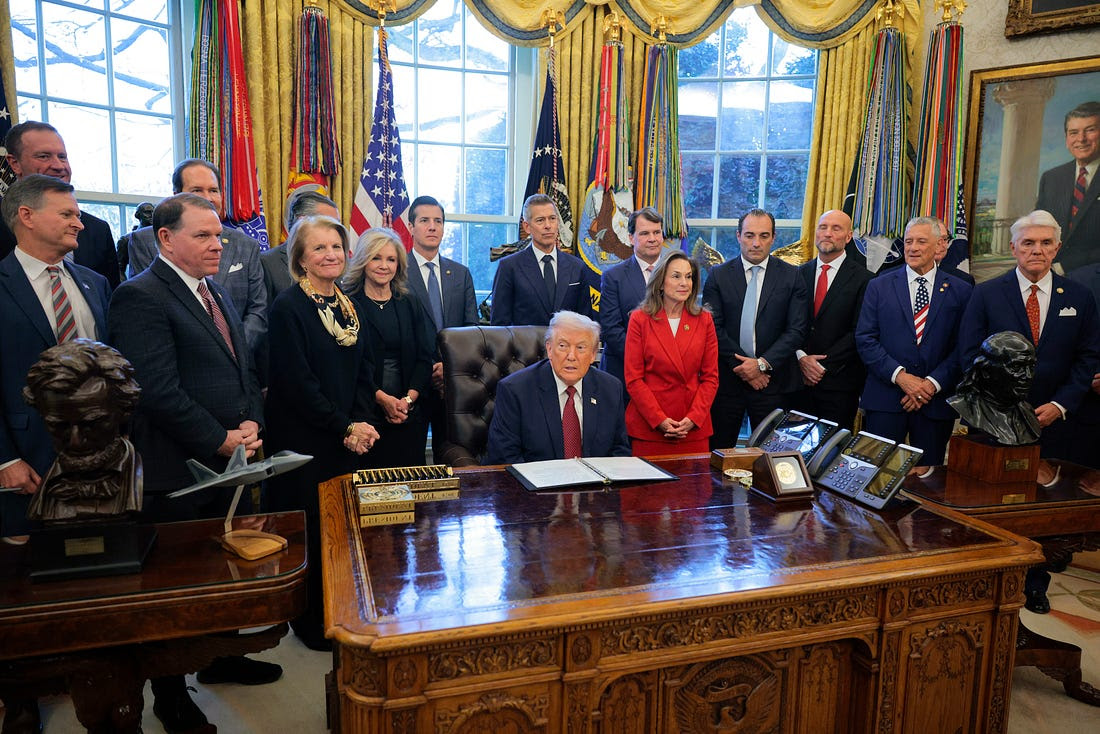
One of Trump’s ugliest moments as President, and there have been far too many, occurred yesterday when, surrounded by applauding auto executives, he rolled back Biden’s 50 mpg gasoline mandate to 35 mpg by 2031, assuring along with suspension of tax credits, the death of electric vehicles in the U.S.

This can only mean more trucks, more SUVs. And—yes—more carbon discharge, escalating ocean temperatures already soaring, the disruption of marine life, and rising seas as the Alaskan Arctic and Antarctica glaciers continue to melt.

In the meantime, what a boon all of this is to China’s burgeoning EV sales in world markets that includes Europe as well as Africa, Asia and Oceania, some models selling in the $10,000 dollar range. China now is a majority stock holder in Volvo.

But Trump thinks climate change is just a hoax, despite overwhelming scientific evidence to the contrary, declaring on signing the bill into law that climate change is “the greatest scam in American history, the Green New Scam a quest to end the gasoline powered car. This is what they wanted to do even though we have more gasoline than any other country by far.”

What Trump has just done will have its consequences, the best estimates of media and environmental groups informing us that under the earlier standards, gasoline consumption would have been reduced by 14 billion gallons by 2050: Long term, more drought, more forest fires and, ominously, the dissolution of ocean currents fundamental to mammal well-being, which includes ourselves.

Trump’s lackeys argue the president’s bill is a boon to consumers, reducing car prices by a projected $1000, as if that’s going to dent a stagnant auto market, the average vehicle price now $50,000 and faulting on auto loans at a record high.

Mind you, this is just empty rhetoric when it comes to curbing inflation, The truth is the president’s tariffs potentially increase builder costs from $7,500 to $10,000 per home, with every $1,000 increase in the median price of a new home pricing out roughly 106,000 potential buyers, according to the National Home Builders Association.

Along with rising home prices, this president’s hysteria when it comes to renewables is costing you monthly electric bills averaging 12% over those of 2024, all of which means less disposable income, and fated to impact low wage households the most.

But back to CO₂, pollutants from tailpipe emissions like nitrogen oxides (NO), volatile organic compounds (VOC), and particulate matter hasten poor air quality and generate respiratory health issues as well.

Trump gets none of this. He runs government as a business, reaping profits for himself and family members. A derelict president, he’s more absent than present in the Oval Office, this fiscal year thus far, spending $371 million dollars on flights at tax payer expense to play golf at his Florida haven, Mar-a-Lago.

Off message as usual, he used the occasion to assault Minnesota’s Somali community whom, the day before, he called “garbage.” Today, it was “they had “destroyed Minnesota” and “destroyed our country.” The “Somalians should be out of here.”

If I asked you what was the fastest warming area of the U.S. outside of Alaska, would it surprise you that it’s New England, where I was born and raised in my early years? The winters I knew as a child are filled with memories of frequent snow fall, frozen lakes, hockey, sledding, skiing, and maple syrup.

Weather experts report New England “has heated up by 2.5C (4.5F) on average from 1900 to 2024, far in excess of the global average, with the world warming by around 1.3C due to the release of heat-trapping gases from burning fossil fuels” (The Guardian, 4 December 2025).

That’s a shocking increase and may prove a portent of what lies ahead. The UN and climate experts have set a maximum goal of 1.5°C (2.7°F) of warming above pre-industrial levels as the threshold, above which we reach the tipping point of near impossible reversal.

Meanwhile, Trump ignores the coming apocalyptic fallout of unrestrained fossil fuel policy, eco systems destroyed, famine common, forest fires ubiquitous, unbearable heat, polluted air, whales and elephants reduced to children’s picture books.

In sum, the Trump administration’s assault on the environment in the context of exponential climate change exhibits all too well the earmarks of corporate denial in the pursuit of monetary gain, whose consequences none of us will escape.

A nation can survive incompetence; what it cannot survive is deliberate blindness to the world burning at its door.

–RJ

Blame Corporations, Not Consumers: Why Inflation Persists

The Federal Reserve keeps upping the interest rate in a concerted effort to reduce inflation. This risks inducing a recession, meaning fewer jobs and economic misery just in time for the 2024 election and Trump, either even or ahead of Biden, in current polling surveys.

Do you really like paying an extra thousand monthly on your anticipated new mortgage than a year ago or paying 84 months on your new vehicle?

Sadly, the Federal Reserve is operating on a false premise, pummeling consumers. The truth is that the major responsibility for inflation lies with corporate greed, using the cover of inflation to raise prices and augment profits.

According to the Economic Policy Institute (2023), corporate profits normally contribute 13% to prices. Currently, that figure has risen to twice that amount.

Plain evidence stares you in the face with every trip you make to your grocery store or opt for dining out and witness markups twice or more the rate of current inflation. Tyson Foods, our largest meat supplier, reported a doubling of profits from first quarter 2021 to first quarter 2022.

Chipotle Mexican Grill, has just announced it expects to increase its menu prices 15% by the end of 2023, despite reporting $257.1 million in profit in the latest quarter, a nearly 26 percent jump from a year earlier (NYT).

Sometimes, you’ll see wily corporations do the “shrinkflation” gambit: higher price, less content. They think you won’t notice. Gatorade, for example, redesigned its bottles, same height, but fewer ounces, 28 oz. vs. 32 oz, or a 14% content reduction.

Albertsons bought out Safeway, and now Kroger wants to buy Albertsons. Include Walmart, and you’ve got three firms controlling 72% of the market! (The Guardian).

No, it’s neither consumers nor unions fueling inflation, but corporate conglomerates that lie at the root of stubborn inflation, against which even the Federal Reserve’s raising interest rates have proven inadequate, ironically making it more difficult for consumers.

Lamentably, the corporate sector wields too much influence, lobbying in the Congress, and meddling in our elections. They shouldn’t enjoy the status of persons, as ruled by SCOTUS {2010), free to spend on candidates of their choice.

It’s time to play hardball: Impose a windfall profits tax on corporate profit above a reasonable margin.

Let government be suspicious of proposed mergers, with their inherent layoffs and reduced competition, heating the economy still further.

Break-up corporate monopolies too big for their britches!

—rj

Corporate Gauging and Rising Prices

The U.S. Federal Reserve continues to raise interest rates to slow raging inflation. The root culprit isn’t the consumer, but the greedy corporate sector, which is using inflation as cover to maximize its profit margins. We know this every time we shop and see goods priced double, or more, the rate of inflation. What’s needed immediately is a windfall profit tax.

Meantime, the average worker faces an insufferable erosion in purchasing power, and the plight of those living on fixed incomes exacts the ultimate cruelty.

Three principal parameters to assess market expense are labor costs, nonlabor inputs, and the “mark-up” of profits beyond the first two. Recent measurements (economic policy institute.org) reveal record profit margins over the former two, or plus 53.9% growth in corporate profits, as opposed to 38.3% for non-labor cost, which includes the supply chain crisis induced by the pandemic, and just 7.9% for labor costs.

Certain sectors of the economy have especially profited, averaging above 20% in profit margins such as information technology and fossil fuels. Exxon, for example, has just published a record profit of $17.9 bn for the second quarter (NYT).

Fueling inflation is the accelerating corporate buy outs, lessening competition. You’re aghast at rising meat prices? That happens because just four meat conglomerates now control the market. Since 1990, some 75% of corporations have consolidated and control as much as 80% of the market, reports the Official Monetary and Financial Forum (OMFIF).

And things may likely get worse as a looming recession makes itself felt and corporations cut expenses to stabilize profitability. Amazon has laid off 100,000 workers, even as profits bulge. Others include Twitter, Google, Netflix, Peloton, Best Buy, Tesla, Ford, General Motors and Exxon Mobil.

Corporations aren’t by nature altruistic. They exist to reap maximum profit for their CEOs and investors. They think in numbers, not individuals.

–rj