
The Lethal Consequences for Women of Trump’s Suspending Foreign Aid

Waist up portrait of young African American doctor consulting female patient using digital tablet in clinic setting

Yesterday, in a 6-3 vote, liberal members of the court dissenting, the US Supreme Court granted an emergency stay of a lower court decision mandating that the Trump administration disburse the $4 billion dollars in foreign aid approved by Congress.

While the Court’s decision isn’t a final one, the funds must be spent before the end of the fiscal year, endangering their being ever dispensed.

The Court’s decision violates the right of Congress to legislate the nation’s purse, as granted by the Constitution.

The consequences from the holdup are lethal, especially for women in developing nations.

In Uganda, 88 teachers have been dismissed and thousands of students have dropped out, the majority of them girls. In Uganda, only a quarter of remaining students are females.

Early sell off of daughters as young as thirteen is increasingly common, as families seek to buttress income through dowries, consequent with the government’s reduction in food subsidies.

As is, numerous African women have been raped by warring militants, especially in South Sudan and the Democratic Republic of Congo. Rape victims face social stigma and diminished prospects of marriage. The
administration’s policies only add to their plight.

Let me tell you what’s happened in Lesotho, whose primary industry is textiles, its workforce 80% female. Due to Trump’s tariffs and a decrease in aid, orders have dried-up, resulting in mass layoffs.

Across Africa, reduced employment impacts health, imperiling the progress made against AIDS/STD. Most health care workers are women. It used to be that women could access an HIV test, averaging 12 cents a test. With suspension of aid, that option has virtually disappeared.

Pap smears are now largely unavailable; the fallout, cervical cancer rivals maternal mortality.

African children, many of them already undernourished, stunted in growth and suffering mental retardation, face the bleakest of futures.

Some women may resort to transactional sex as means to economic survival, increasing health risk.

With the pervasive suspension of birth control assistance, women lose the ability to limit family size. The average family size in Africa is 4.5. Still more in the Sahel. By the century’s turn, Nigeria alone will have a projected 750 million population.

Poverty is an enemy of the social fabric, contributing to domestic violence.

Poverty contributes to crime, much of it food theft.

Poverty increases migration pressures and with dislocation, still more violence, as is occurring in South Africa, migrants resented as competitors.

Menaced by climate warming, which Trump calls a hoax, Africans are confronted with daily survival made worse by prolonged droughts and tropical diseases.

Trump, however, dismisses developing nations as “shithole countries,” his racism creating a vast milieu of unprecedented suffering.

I’ve largely centered on Africa, but its experience is reenacted in other developing countries as well.

Women, tragically, are Trump’s primary victims.

rj
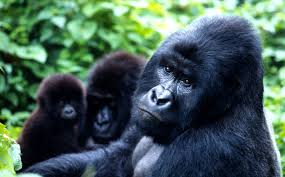
And Then There Were None: Mountain Gorillas in Imminent Danger

gorillas1

In this central African park.
Desperate refugees crowd park boundaries.
Charcoal producers strip forests.
Then, last summer [2007], someone killed seven of these magnificent creatures in cold blood.
  (National Geographic)


Yet another species, this time one of our closest relatives, faces a grave threat of extinction– mountain apes, of whom only 700-800 remain.

The Democratic Republic of Congo (DRC) reportedly has asked UNESCO to redraw the boundaries of one of Africa’s largest wildlife sanctuaries, Virunga Park, to facilitate oil drilling.

Consisting of 300 square miles, or 7800 square kilometers, the park shelters not only the gorillas, but other wildlife and Lake Edward, a key fishing resource.

In 2010, the DRC signed a contract with British firm, Soco, to begin exploration, despite its designation as a World Heritage Site, in violation of international law.

Such scenarios inevitably occur whenever economic interests are pitted against environmental concerns. In Africa, however, grinding poverty is so widespread that nations like the DRC must prioritize developing income resources.

On the other hand, much of that poverty is rooted in Africa’s post colonial history of chronic civil strife and kleptomaniac leadership.

Properly developed in a context of political stability, the DRC is rich in natural resources that could vastly improve the well being of its people.

In the DRC, the resultant instability and economic fallout has created anarchy, as rival militias composed of M23, Hutus, Tutsis and Congolese Revolutionary Army deserters roam the country, raping, plundering and killing.

Virunga National Park has, unfortunately, turned into a quagmire of lawlessness as a hideaway for militants, who use the Park’s wildlife and forest for subsistence.

Additionally, nearly 100,000 refugees live on the Park’s fringes, leading to deforestation and poaching.

In 2004, 1,500 hectares of prime mountain gorilla habitat were cleared by illegal settlers in Virunga National Park, according to evidence uncovered by the Congolese Institute for the Conservation of Nature.

What we know is that at least 40 mountain gorillas have been killed in the last several years.

As is, only 480 mountain gorillas remain in the Park’s confines, with no place to go.

Now the oil interests have moved in.

It’s a tragedy in the making.

Gorillas are gentle herbivores, who seek isolation.

As you might suspect, they have a lot in common with you and me.

Gestation is 8.5 months, approximating our own.

Births are nearly always singular.

Mating, unlike that of many animals, can take place anytime.

Helpless at birth, gorillas crawl at two months and walk at about nine months.

They are very intelligent and live in organized troops, governed by a dominant male known as a Silverback.

Diseases like ebola and those acquired from proximity to humans increasingly pose an additional threat.

In northern Gabon, for example, the entire protected population of gorillas and chimpanzees succumbed to ebola in 1994.

There’s also the bush meat trade along with lustful trophy seekers.

While international wildlife groups have contributed funding to shore up anti-poaching patrols, there are simply too few rangers, given the park’s vastness. Inadequately equipped, they’re no match for the often superior armed militia factions. Sadly, 140 rangers have lost their lives defending wildlife.

Their great champion, Dian Fossey, the world’s preeminent primatologist, was brutally murdered in 1985.

As a child I’d lie at night, thinking of Africa, teeming with wildlife, vast herds of elephants, rhino, hippopotami, zebras, antelopes, wildebeests, giraffes and, of course, isolated savannas and mountains abundant in gorillas, chimps and monkeys.

But that was a child’s imagining.

The adult vista, on the contrary, confronts us with vanishing wildlife and the likely soon extinction of these gentle creatures, our human cousins,

When I think of today’s Democratic Republic of Congo, flashes of Joseph Conrad’s The Heart of Darkness with its rampant savagery flood my thoughts and of Kurtz’s agonized lament when confronted with human culpability, “The horror! The horror!”

–rj