ANTIGUA: TOURIST PARADISE:
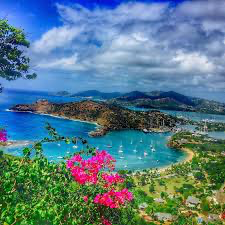
A mere 264 miles from US shores lies the sovereign Caribbean island nation of Antigua and Barbuda, a tourist’s paradise blessed with stable, year round temperatures; several hundred pristine beaches; lush lagoons; and hideaway natural harbors. It has mountains, too, offering scenic views of a vast mangrove forest. 80% of Antigua’s GDP derives from tourism.
But Antigua, like other island nations, faces immense challenges in the maelstrom of climate change: increase in hurricane intensity and frequency, rising sea levels, erosion, salt water intrusion, and ground water depletion.
2017 saw Antigua devastated by Category 5 Irma, destroying 97% of
Barbuda’s infrastructure, rendering it nearly uninhabitable.
Often dubbed “the Switzerland of the Caribbean,” Antigua finds itself lacking the financial resources to sustain its economic viability in the context of climate change and yielded to Chinese overtures: a 2 percent interest loan, with a 5-year moratorium on repayment.
Antigua’s prime minister, Gaston Browne, views China as a friend: “I see China, though, as a country that stands on truth, and a country that, you know, at least has some level of empathy for small states, and generally for poor and dispossessed persons globally” (Newsweek. May 5, 2024).
ENVIRONMENTAL THREATS POSED BY CHINA IN ANTIGUA:
Newsweek’s recent study of leaked documents indicates 1000 acres of forest will be razed to accommodate a Chinese Economic Free Zone juggernaut, ultimately consuming 2000 acres for housing and businesses. It includes an airport, up to seven resorts, a shipping port, and Antigua’s first four lane highway. Construction has begun.
Bearing all the earmarks of a Chinese enclave, the completed project confers independent immigration and customs formalities for the enclave and a license to issue passports. It will not pay income taxes, unlike native Antiguans, sales taxes, or import duties. Anyone investing $400,000 or more will be eligible for Antiguan citizenship
Browne touts his Chinese venture as an investment in the future, creating hundreds of jobs.
Browne sweetens the deal by promising environmentalists a 70 acre mangrove reserve and a 60 acre nursery for growing 100,000 trees.
This hasn’t pacified the island’s environmentalists, however, who contend the free zone transverses the island’s largest marine reserve, under legal protection since 2005, and destroys most of its mangrove forests, a haven for migrating birds.
They point out the area’s “nesting ground for critically endangered sea turtles, the threatened West Indian whistling duck and the Antiguan racer, once dubbed the world’s rarest snake, brought back from the brink of extinction by efforts from local environmentalists” (Newsweek).
Browne angrily brands his critics “ecoterrorists.”
AIR AND WATER POLLUTION:
China has a history of contributing to pollution through industrial production and waste processing. Enforcement of environmental protections is often ignored when it comes to garbage, water, atmospheric, and excrement pollution, undermining economic development and investment.
Opponents insist the Antiguan government adequately address these issues, which could have deleterious effects on soil ecology, agricultural production, and water supply.
Antigua’s first environmental report by the government’s environmental management authority, issued in 1992, proved alarming in terms of pollution, waste disposal, deforestation, and entrepreneurial nonchalance.
As for the accommodation sector, the study noted that the water supply for the bankrupt Grand Royal Hotel was found inadequate, singling out Chinese businesses for dumping.
OVERFISHING AND MARINE ECOSYSTEM DEGRADATION:
Chinese nationals also have a legacy of illegal and unregulated logging of parrotfish in the coral reefs, which are important to the marine environment of Antigua’s Marina Bay. As such, not only are the food chain and the environment in peril as acres of mangroves fall to chainsaws, but its fisheries as well
China’s relentless pursuit of high-quality fish (apex predators in the ocean communities), and the destruction of the ecosystems that consistently produce these creatures, have been implicated as the main culprits in extensive ecosystem degradation when applied at galactic scales to Africa, the American Pacific coast, and now the Eastern Caribbean.
Buying seafood from China, which will be allowed to operate a fish farm, has negative consequences for both the environment and Antiguan fishers. Chinese vessel owners profit greatly from buying or leasing fishing rights from over 60 countries, including Antigua and Barbuda. While this provides a trillion meals per year, it causes damage to the ocean.
HISTORY OF CHINESE CARIBBEAN INVESTMENT:
The major Chinese enterprises in Antigua mainly involve construction, infrastructure, real estate, and hotels. The total value of China’s FDI in the seven countries of the Organization of Eastern Caribbean States (OECS) was estimated at almost 300 million US at the end of 2011. Chinese financing came in the form of concessional loans. In the Eastern Caribbean, it funded the construction of the national stadium, the American University of Antigua, and the Lyndhurst Road Development Project. China has also engaged in a number of technical cooperation projects in capacity building and training and granted subsidies to the Tropical Storm Grant Program.
The bottom line is that China’s growing influence on Antigua’s politics and economy comes at a cost, primarily to the environment and the United States. Air and water pollution in Antigua are predominantly caused by Chinese firms.
The challenges deriving from air pollution and inadequate addressing of such concerns leave open the question of whether a distinction should be made in Antigua between government policies attracting investment contributing to the economy while exacerbating the country’s environmental problems and those policies that mitigate polluting.
Antigua’s economic growth in the last decade has been due to investments and loans from China, which reflect China’s strategic objective in the Caribbean. Smaller island nations have been overly enthusiastic in embracing China’s support since they have been relegated, as well as stigmatized, by powerful global financial institutions in times of crisis. The Chinese have presented their assistance with no condition of policy or regime change, thus undermining the frequent dictates of the Washington Consensus.
China has been exploiting the vulnerability of developing nations. If Beijing can increase its investments in countries that are dependent on tourism and other single export industries, it can anticipate predictable returns. Focusing on countries that rely on imports, not on natural resources, China is now the second largest trading partner with some Caribbean countries.
POTENTIAL FOR ESPIONAGE AND CYBERSECURITY RISK:
Given its proximity to US shores, Antigua obviously has strategic significance.
On August 17th, 2020, former Trump administration Chief of Staff Mick Mulvaney warned that China’s post-crisis economic policy, including investment in impoverished Caribbean nations like Antigua and Barbuda, jeopardizes US security.
Historically, the Monroe Doctrine (1823), was strictly enforced to keep foreign interests from interference in the Americas. Among its provisions, further colonizations in the Americas would be viewed as threatening US interests.
In 1861, France attempted creating an empire in Mexico, encountering protest.
In 1962, Russian missile intrusion in Cuba nearly launched WWIII.
In 1983, President Reagan committed troops to expel Cuban military from pro-Soviet Union Granada.
Will Antigua become an espionage base like Cuba?
While the U.S. military’s Southern Command (SOUTHCOM) has issued concerns about China’s growing presence in Antigua and the Caribbean region, the Biden administration has been silent.
–rj
 Brimmings: up from the well