America’s Emissary: Walt Whitman

I’ve never formally studied Walt Whitman’s poetry, despite a graduate degree in English. That’s because I made Victorian Literature my major interest, with modern American and British Literature secondary. Still, I’ve read his landmark Leaves of Grass many times, America’s psalmody in its pioneering free verse; in its robustness, an encomium of America were it doing more than lip service to the American dream.

It says much about Whitman, out-of-joint with his generation much like contemporary Emily Dickinson, uncomfortable with the cultural shibboleths of middle class Amherst. Perhaps influenced by his father’s radical views on politics and religion, Whitman emerges an essential element of America’s constant of progressive rebellion, resistant to mercenary interests that gave us slavery, wealth inequality, desecration of nature, racial injustice, and imperialism.

If you’re looking for a summation of Leaves of Grass, nothing excels his “Credo” in the poem’s Preface. Conscious of America’s failure to live up to its promise, “Credo” exemplifies its gulf and champions its realization:

“This is what you shall do; Love the earth and sun and the animals, despise riches, give alms to everyone that asks, stand up for the stupid and crazy, devote your income and labor to others, hate tyrants, argue not concerning God, have patience and indulgence toward the people, take off your hat to nothing known or unknown or to any man or number of men, go freely with powerful uneducated persons and with the young and with the mothers of families, read these leaves in the open air every season of every year of your life, re-examine all you have been told at school or church or in any book, dismiss whatever insults your own soul, and your very flesh shall be a great poem and have the richest fluency not only in its words but in the silent lines of its lips and face and between the lashes of your eyes and in every motion and joint of your body.”

—rj

We Are Losing Earth on Our Watch: The Unfolding Crisis of a Warming Planet


I wanted to walk my two miles this morning, but stepping outside, blasted by the double whammy of humidity and a temperature already at 83 F and rising fast, I thought better of it.

It’s like this virtually everywhere these days. Our children, vacationing in Palm Desert, CA, relayed it reached 118 F there yesterday.

2016 was the hottest year on record. This year is likely to be hotter still.

Some suffer grievously. There’s Phoenix, AZ, with its 27 straight days of 110 F plus temperatures, its denizens reliant on air conditioning to get them through. I ponder the city’s fate were the electric grid to give way. Fifteen percent of Phoenix’s population lives in poverty, many on the streets, exacerbating the heat’s impact. Last year’s heat waves killed 425 residents of Maricopa County, 56 percent of them homeless.

Duluth, MN, looks better everyday. It doesn’t surprise me that a growing number of families, sensing what’s likely to get a lot worse, are moving to this Lake Superior city known for its cool days even as the Twin Cities, to the South, bake. North Dakota, anyone?

Along with record-breaking heat, come the inevitable forest fires. Everyone’s holding their breath in California, despite its recent heavy downpours and filling of depleted reservoirs, as soaring temperatures eclipse records.

Canada has fared badly, many fires still burning as plumes of toxic fumes drift southward to the US. 4200 fires, a record number, have occurred this year in Canada.

You’ve heard about the raging heat and accompanying fires in Italy, Greece, Algeria, and Crete fueled by spiraling heat waves, with many killed, thousands displaced, livelihoods gone, and animal habitats decimated.

It’s so much worse among developing countries, climate change not only bringing higher temperatures, but change in rainfall patterns, resulting in widespread famine and malnutrition as crops wilt in parched fields and cattle perish for lack of feed and water. This is especially true of Africa’s Central Sahel (Burkina Faso, Mali, and Niger), where temperatures are rising 1.5 faster than in the rest of the world. Privileged Western nations in their addiction to fossil fuels bear heavy responsibility for their plight. Unless we mend our ways, their desperation may be tomorrow’s world for our children, our spiraling heat waves and droughts the preface of things to come.


All of this isn’t unanticipated, as our sophisticated attribution science has consistently confirmed the likelihood of a warming world. It’s just that it’s happening sooner and with greater intensity than projected.

But let’s not simply blame this year’s El Niño, which does make for hotter weather. We humans have been engaged in a reckless plundering of our planet’s resources since the beginning of the industrial revolution in the late 18th century, accompanied by increasing reliance on fossil fuels, the consequence that we’re now 1.2 C warmer than in pre-industrial times.

75 percent of global greenhouse gases and 90 percent of carbon dioxide emissions come from burning fossil fuels. They trap heat and with their exponential increase now pose humanity’s greatest challenge in their dire consequences for life on earth.

Under the 2015, Paris Agreement, we’ve pledged a concerted effort to hold at 1.5 C.

That’s unlikely. The World Meteorological Organization (WMO) forecasts its breach as early as 2027, despite climatologists’ warning that any rise above that level would unleash irreversible catastrophic consequences.

Meanwhile, the fossil industry yesterday released its 2022 earnings report, announcing $200b in profits, surely an obscenity, given their primary contribution to the existential crisis that confronts us.

Shell says it will issue $3b to stock investors over the next three years through stock buybacks.

ExxonMobil, BP, and Shell not only boasted record profits, but gleefully announced they’ll be rolling back earlier plans to invest in low emissions ventures. It’s follow-the-money.

Concurrently, GOP congressional members lie-in-wait to ambush existing climate change mitigation efforts, should Trump—God help us—be reelected.

It’s urgent that Biden declare a climate emergency, joining the UK, New Zealand, and Japan. There’s much we could do under such a declaration to halt the fossil industry tycoons who prioritize profit over the welfare of the human community and our beleaguered earth, but don’t bet on it.

Unfortunately, he’s initiated policies contrary to his campaign pledge to fight fossil fuel emissions, pushing new pipelines, lifting taxes on gasoline and half-emptying the Strategic Petroleum Reserve to cushion consumers at the pump, removed sanctions on American involvement in Venezuelan oil, obsequiously begged the Saudis to increase oil production, opened northern Alaska wilderness to massive oil drilling, sold oil and gas leases in the Gulf of Mexico. All of this from a candidate pursuing the presidency, pledging to young people, “no more drilling on federal lands, period, period!”

Climate expert Peter Kalmus sums up our dilemma bluntly: “Mark my words: it’s all still just getting started. So long as we burn fossil fuels, far, far worse is on the way; and I take zero satisfaction in knowing that this will be proven right, too, with a certainty as non-negotiable and merciless as the physics behind fossil-fueled global heating. Instead, I only feel fury at those in power, and bottomless grief for all that I love. We are losing Earth on our watch. The Amazon rainforest may already be past its tipping point. Coral reefs as we know them will be gone from our planet by mid-century, and possibly much earlier given this surge in sea-surface temperatures. These are cosmic losses. And as a father, I grieve for my children.”

And I, along with many of you, grieve with him.

—rj

When the Japanese Don’t Look Japanese

I remember Japan fondly, falling in love at first sight. It was twelve years after WWII and a place remarkably different from anywhere else and, in large measure, it has remained so.

It had been a long flight from Travis AFB in California, a brief stop in Honolulu for a crew change, then on to Wake Island, where President Truman had a few years before confronted a defiant General MacArthur, then on to Yamoto Air Station, 23 miles from Tokyo.

I was 17, an airman headed for Korea for the next 12 months. Yamoto meant processing before continuing on a C-47 for Osan AFB near Seoul.

Japan was then this kaleidoscope of sensuous bombast—human drawn rickshaws, coolies in straw conical hats, buckets suspended on long poles between their shoulders, and everywhere, women garbed in flowery kimonos on densely packed streets.

I would return to Japan twice on rest leave, the first time centering on Tokyo and its Ginza, even then, bustling with elegant department stores, game shops, restaurants, art galleries, theaters and night clubs, illuminated at night by a swarm of neon lights rivaling those of Vegas and New York. I would visit the grounds of the Imperial Palace, the Great Kanto Earthquake Memorial, and the Great Buddha of Kamakura bronze statue originally cast in 1252.

One of the supreme highlights was keeping company with American Quaker friends in Tokyo, who arranged a get-together with university students, fluent in English. They gave me a different war vista in narrating the American fire bombing of Tokyo, March 9-10, 1945, killing 100,000 civilians and leaving 1,000,000 homeless. I learned that it’s the victors who write the history we imbibe and I remain moved by their civility to me, an American serviceman.

A few days later, I journeyed by car with my friends, laboring up twisting mountain roads to the shrine city of Nikko 97 miles from Tokyo, where I lived several days in traditional Japanese manner, sleeping in minimalist fashion on a tatami soft mat made with rice straw fill, rolled out on the floor, then layered with a Shikifuton, or thin mattress, and a buckwheat hull pillow. To keep warm, an added Kakefuton , or soft quilt.

Following a hot bath, dressed in kimono, served a fish-seaweed meal, no links to an external world, I slept soundly.

I’m not certain how prevalent this ancient sleeping mode survives in modern Japan, though I know traditional inns abound in Kyoto, that magical city of April cherry blossom.

On my second visit, I took a long distance train from Tokyo to Fukuoka, one of Japan’s most populated cities on the southern island of Kyushu. I wish I could remember what I took in there, but I draw a blank, though I recall being dazzled by its department store elevators, on each floor, a young girl, often giggling at this lanky Westerner, helping you get on and off the escalator, and from my train window a passing landscape of brick houses contrasting with the fragile wooden structures dominant in central Honshu, Japan’s largest island.

There’s much I admire in the Japanese culture, still unique in spite of the cultural leveling you see in other nations, or what can be called Americanization, hastened by film and TV.

They’re surely the most hygienic-centered people I’ve known, indulging nearly daily in the hot bath and painstaking to remove their shoes before entering your home.

Streets are free of trash, yet you won’t find trash cans.

Politeness is the hallmark of Japanese culture, san often added to to a surname to render respect. It extends even to the language’s several pronouns, a tier gauged approach to courtesy.

Some of the customs are especially endearing. If given a gift with the donator present, you don’t open it, lest you hurt their feelings or, worse, feel pressured to masquerade your dislike on unwrapping it.

You reciprocate by sending a gift, usually candies.

Etiquette extends to not eating on a train or while walking.

Not interrupting

Not talking loud.

Not bragging.

Then there’s the ubiquitous honesty. Unlike in many countries, you don’t have to safeguard your pockets in a train station, not even on a packed commuter train.

Leave a camera on checking out of your hotel, housekeepers will see it to the registration desk.

You don’t shake hands or hug, bowing instead as a way of modesty and respect.

Sample your rice first, before nibbling other dishes, then go back to the rice, viewed as a palate cleanser.

Japanese gardens obsess me. I’ve always wanted one. With their emphasis on simplicity, harmony, and verisimilitude with nature, they confer sanctuary from everyday bustle and induce an inner calm. Many Japanese homes feature their own courtyard garden, bringing nature close.

Then there’s the tea ceremony, derived from Zen Buddhism, emphasizing mindfulness and bonding between host and guest. Thankfully, it remains a revered ceremony.

As for crime, it’s rare in Japan, mass shootings virtually unknown. Contrast with this, the 400 mass killings (4 or more dead per incident) in the U.S. in the first six months of 2023.

Unlike America, it’s not about doing your own thing. It’s thinking about others and not bringing shame to your family.

But Japan’s changing, inevitably because unless it does, it will simply vanish in several generations. The Japanese aren’t replacing themselves and unless they do, its present population of 124 million will dwindle to 87 million by 2070.

Consequently, traditionally xenophobic and homogeneous Japan has turned to immigration to solve its labor needs and sustain its population. 3,000,000 immigrants now call Japan home, triple the number in 1990. They come from not only Asia, the Philippines, Vietnam, and Indonesia especially, but from Africa and the Middle East. There are cities where 10-15% are foreign born.
Today, you’ll find 113 mosques across Shinto-Buddhist Japan. In 1999, there were 15.

Will Japan’s new citizens bring their resentments with them, as in France, England, and Sweden?

Will they end-up in ghettoes of the unassimilated?

As their numbers swell with immigration and higher birthrates, will they overwhelm the world’s most exemplary society?

Will the Japanese fade like countless fauna and flora into memory, their substantial contributions to civilization relegated to history books like those of the fabled Pharaohs’ Egypt or Nebuchadnezzar’s Hanging Gardens of Babylonia?

In sum, what happens when the Japanese don’t look Japanese?

–rj

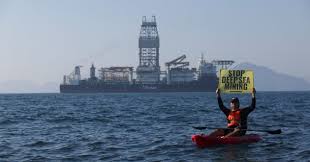
Mining the Ocean: The New Gold Rush

Mankind’s invasive footprint appears deplete of boundary, whether of earth, sky, or ocean depth, and not without consequences for an already shrinking biodiversity and a burning planet and, therefore, for ourselves.

Today, July 9, 2023, marks an incipient crisis for our oceans, already menaced by rising temperatures, accelerating acidity and melting glaciers, all of it human induced. Applications to mine the sea can now begin.

It all goes back to 1982 when the United Nations negotiated The Convention on the Law of the Sea (Unclos), mandating a vast area of the ocean, a designated 53m sq. mile coastal economic zone, be excluded from seabed mining until the adoption of a code safeguarding the environment. Meanwhile, it approved an area of 1,700,000 sq. miles (half the size of Canada) known as the Clarion-Clipperton Zone, for seabed mining.

To this end, the International Seabed Authority was founded in 1994, with a current 167 subscribing members along with the European Union. After 28 years of negotiating, it has been unable to agree upon a code. It administers the Clarion-Clipperton Zone.

A clause in Unclos, however, provided an escape mechanism allowing any application for seabed mining be allowed should no code be adopted. Today, that moratorium ends.

We are caught in a catch 22 dilemma, compounded by both need and greed.

We rely upon nickel, cobalt and manganese, along with lithium from land resources, to propel our wind farms and electric vehicles. Potentially, the ocean seabeds offer us tons of needed minerals.

Even if there were a code, I seriously doubt it would be meaningfully implemented and mitigate environmental degradation to sea life.

The ISA has always been poorly funded and many of its negotiators have fishery interests. It has yet to deny any application for exploration, granting 31 of them. Five of them are by China. It lacks empowerment and resources to mandate candid environmental impact appraisals, leaving that up to the corporate sector.

We need to be doubly painstaking in assessing opening up our last earthly frontier for exploitation.

As environmental writer, Guy Standing (The Blue Commons: Rescuing the Economy of the Sea), cautions, “All of us should be deeply alarmed. The environmental impact of deep-sea mining could be catastrophic. Massive machines will scour the ocean bed to pick up polymetallic nodules, destroying everything in their path and creating sediment plumes that can suffocate coral reefs and other organisms hundreds of miles from the mining site. Mining will damage the ocean’s ability to act as a carbon sink, accelerating global warming. And new research suggests the polymetallic nodules could contain radioactive substances, endangering human health cautions.”

And what about noise, vibration and light pollution, or fuel leaks and chemical spills? The list is long and the unplanned for has a way of happening.

In June, the European Academies Science Advisory Council spoke of the dismal impacting on marine ecosystems and denounced “the misleading narrative” that deep-sea mining is necessary to harvesting the metals vital to a green economy. Lithium, not a pervasive ocean element, and other minerals vital to EV technology, are presently land-based. Further, technology constantly changes.

Our oceans comprise a vast cornucopia of biodiversity yet to be discovered. Consider the recent finding of 5,000 new species living on the seabed of the Clarion-Clipperton zone, open to deep-sea mining firms.

I fear where we’re about to tread.

I fear for ourselves.

And for our oceans, from whence we come.

–rj

Electric Vehicles Aren’t the Answer

Tesla Model 3

I’ve been doing a lot of research on electric cars, now being pushed by the government to mitigate carbon discharge. As I see it, it’s a technology not ready for prime time.

Initially, you pay several thousand dollars extra to own one, pay higher car insurance, and face a limited mileage range.

Charge stations? If you can find one, a long wait, not only to recharge, but maybe just to access.

As for the environment, I think EV’s make things worse: Let me count the ways:

Ok, EV’s don’t emit carbon when they’re moving. But not so in their manufacture. It takes a lot of fossil fuel to make them and even when you’re charging them, there’s the fossil fuel powering that electric grid.

I’ll be more specific: Before you even drive off the lot, your EV has emitted 10-20 tons of carbon in its manufacture.

How ironic! A technology hyped as a breakthrough in reducing climate change acceleration actually contributes to its continuance.

Your EV battery was likely mined in a third world country, exploiting laborers paid a minuscule wage, using heavy machinery powered by fossil fuels. Then comes the shipping of materials—trucks, ships, planes. Still more trucks on arrival to get to the manufacturing plant!

Battery plants are sprouting up in GA, KS, KY, NC, OH and TN. But these plants consume acreage, much of it forest and farmland, impacting biodiversity loss or causing degradation. Inevitably, more housing development for an influx of new workers, more roads, more traffic, more strip malls and, yes, more CO2 emission.

Mind you, this isn’t happening just in the USA. American entrepreneur Elon Musk’s new gigafactory in Germany is now open for business, designed to produce Teslas and batteries in mind-boggling numbers. Presently employing 3,000 workers, that number will swell to 12,000 workers at full production. Built in the heart of a dense forest, it comes at an enormous cost to the environment, particularly for wildlife with 365 acres/160 hectares already cleared and a water conservation area confronted by potential industrial waste contamination.

This epitomizes the slip-shod attention state and local governments often give to environment impact studies, fast-tracking as in the German scenario what salivates public approval and political longevity.

But there’s a sweet spot in all of this with the incipient promise of transportation powered by hydrogen. It’s decades away for full implementation, but it’s already begun with Toyota’s 2023 Mirai that generates power by combining hydrogen with oxygen from the outside air.

You never have to charge the car. That means you don’t have to fret about accessing a charging station in that long distance trip and time lost in lengthy recharging.

It takes five minutes to fill your tank at a local gas station offering hydrogen.

They also have better driving ranges, generally around 300-400 miles to a tank of hydrogen.

Hydrogen cars are lighter and faster.

If I were an investor, I’d place my bet on hydrogen powered transportation as a viable solution to the carbon discharging menace that EV technology cannot resolve.

For sure, it’s currently prohibitively expensive, with 98% of hydrogen produced through steam methane reforming technology with its obvious carbon dioxide consequence.

But scientists are working on cutting costs and achieving versatility, not just cars, but trains and planes. As I write, news comes of the first hydrogen train in North America—Canada’s French Alstom train running from Montmorency Falls in Quebec City to Baie-Saint-Paul. Experimental, it features two railcars, carrying up to 120 passengers and uses 50 kilograms of hydrogen daily, replacing 500 liters of diesel fuel that would have otherwise been used for the two-hour route.

Imagine a train that emits only water vapor!


And hats off to Toyota again for resisting the EV wave. Its hydrogen fueled Mirai XL gets 71 mpg and sells at a starting $49,500 (within the average price ballpark for a new car). Fully fueled with hydrogen, it has a 402 mile driving range.

But like EV vehicles, it’s not ready for prime time either, a fill-up costing you $80.00 for your 5.5 kg tank.

Unfortunately, US government involvement hasn’t been there, unlike Canada and Europe.

As for ourselves, our RAV lease is up in another year and we intend to purchase it, since it’s been so reliable and has low miles. If we were opting for a new car purchase, we’d choose a hybrid plug-in as the most sensible option until the non-polluting hydrogen car becomes more cost efficient.

Long term, I’m optimistic.

–rj

Why The Writers Guild of America Deserves Support

If you’ve been keeping-up with the Writers Guild of America strike, ongoing since May 2, 2023, you know it’s still a long ways from resolution. The Guild is seeking a fairer share of streaming residuals. They also want AI such as ChatGPT limited to research or facilitating ideas and not as a means to replacing them.

But just how big a threat does AI pose for WGA writers? Many members think AI has its limitations but, nonetheless, could make inroads on some of their tasks.

While AI may pose a greater threat longterm as it progresses in sophistication (Paul McCartney reports he recently used AI to compose his latest song), I view AI as assisting, not replacing writers. It simply can’t replace the subtleties of the human mind, or what I like to call emotive intelligence.

New technologies like AI, however, do require adaptation, those using it replacing writers who don’t. It’s like calculators. They abound, but so do mathematicians. Fields requiring deep, often intuitive, knowledge, like psychology, sociology, etc, and most fields of medicine, will remain valid. I seriously doubt AI will replace engineers, or for that matter, your local plumber.

But back to the WGA. They deserve fair payment for what they do, providing the texts without which TV, movie, and theater couldn’t exist. Residuals are already paid to actors and, of course, the streaming moguls reap the far greater share of remuneration.

I’ve always felt that writers, in general, suffer a dismal fate when it comes to earnings. We hear about the 2% who make it to the highest tier. The vast majority of writers don’t give-up their day jobs.

Did you know that the average annual earnings by a New Yorker staff writer is a mere $54,000 annually?

I admire empathetic actors like Vincent D’Onofrio who see the unfairness and are lending their full support to WGA members.

–rj

I Want an America Better Than This


We normally think of gurus in connection with individuals claiming transcendental wisdom, often as emissaries of the Divine. I needn’t recite a roll call of their prodigious presence, past and present, in American life, drawing into their loop numerous devotees, hanging on their every word, willing to drink the Kool-Aid.

But gurus can be political, too, like Hitler, Stalin, and Mao. I see danger in my beloved America in the likes of Trump and DeSantis and their “true believer” followers, bent on banning books, subverting free inquiry, racial justice, a woman’s right to choose; its ubiquitous gay-bashing, xenophobia, restricting voter access, and denial of climate change. Unhinged, some are willing to employ violence to achieve their ends.

I want a better America than this. I want America to live up to its promise as a bastion of hope and guardian of liberty. I think you want that too. Indifference won’t win out. We must advocate. We must resist. The liberty you defend is your own. —rj

It Isn’t What I Know

It isn’t what I know, but what I don’t know that subdues my ego’s pretense. All life is flow and to be happy is to bend, like a willow in the wind, to its rhythms:

“Those who know they do not know gain wisdom.
Those who pretend they know
Remain ignorant.

“Those who acknowledge their weakness
Become strong.
Those who flaunt their power will lose it.” —Tao Te Ching 71.

Blame Corporations, Not Consumers: Why Inflation Persists

The Federal Reserve keeps upping the interest rate in a concerted effort to reduce inflation. This risks inducing a recession, meaning fewer jobs and economic misery just in time for the 2024 election and Trump, either even or ahead of Biden, in current polling surveys.

Do you really like paying an extra thousand monthly on your anticipated new mortgage than a year ago or paying 84 months on your new vehicle?

Sadly, the Federal Reserve is operating on a false premise, pummeling consumers. The truth is that the major responsibility for inflation lies with corporate greed, using the cover of inflation to raise prices and augment profits.

According to the Economic Policy Institute (2023), corporate profits normally contribute 13% to prices. Currently, that figure has risen to twice that amount.

Plain evidence stares you in the face with every trip you make to your grocery store or opt for dining out and witness markups twice or more the rate of current inflation. Tyson Foods, our largest meat supplier, reported a doubling of profits from first quarter 2021 to first quarter 2022.

Chipotle Mexican Grill, has just announced it expects to increase its menu prices 15% by the end of 2023, despite reporting $257.1 million in profit in the latest quarter, a nearly 26 percent jump from a year earlier (NYT).

Sometimes, you’ll see wily corporations do the “shrinkflation” gambit: higher price, less content. They think you won’t notice. Gatorade, for example, redesigned its bottles, same height, but fewer ounces, 28 oz. vs. 32 oz, or a 14% content reduction.

Albertsons bought out Safeway, and now Kroger wants to buy Albertsons. Include Walmart, and you’ve got three firms controlling 72% of the market! (The Guardian).

No, it’s neither consumers nor unions fueling inflation, but corporate conglomerates that lie at the root of stubborn inflation, against which even the Federal Reserve’s raising interest rates have proven inadequate, ironically making it more difficult for consumers.

Lamentably, the corporate sector wields too much influence, lobbying in the Congress, and meddling in our elections. They shouldn’t enjoy the status of persons, as ruled by SCOTUS {2010), free to spend on candidates of their choice.

It’s time to play hardball: Impose a windfall profits tax on corporate profit above a reasonable margin.

Let government be suspicious of proposed mergers, with their inherent layoffs and reduced competition, heating the economy still further.

Break-up corporate monopolies too big for their britches!

—rj

Tim Flannery: Voice in the Wilderness

Australian explorer and ecologist Tim Flannery is a remarkable man. Nearly twenty years ago have passed since I read his initial book on climate change, The Weather Makers: The History & Future Impact of Climate Change (2005).

It was my first extended read on the climate crisis impacting all of us, spelling out its corollary fallout for Australia—rising seas, changes in weather patterns, and species extinction. I remember its clarity, abundant research, and earnest plea for changing our destructive exploitation of nature in the name of progress and prosperity. The book made me a believer and I’ve never looked back.

Translated into twenty-three languages, it received international acclaim. The following year, Al Gore’s An Inconvenient Truth appeared. Both books gave landmark impetus to climate change awareness and promoting efforts to mitigate its worst effects. Flannery has now written 27 books along with publishing more than 140 peer-reviewed papers.

He helped found the Copenhagen Climate Council in 2007 and presently serves as head of Australia’s Climate Change Commission. In 2007, he was selected as Australia’s Man of the Year, a notable award, given Australia’s history of collusion with fossil fuel interests.

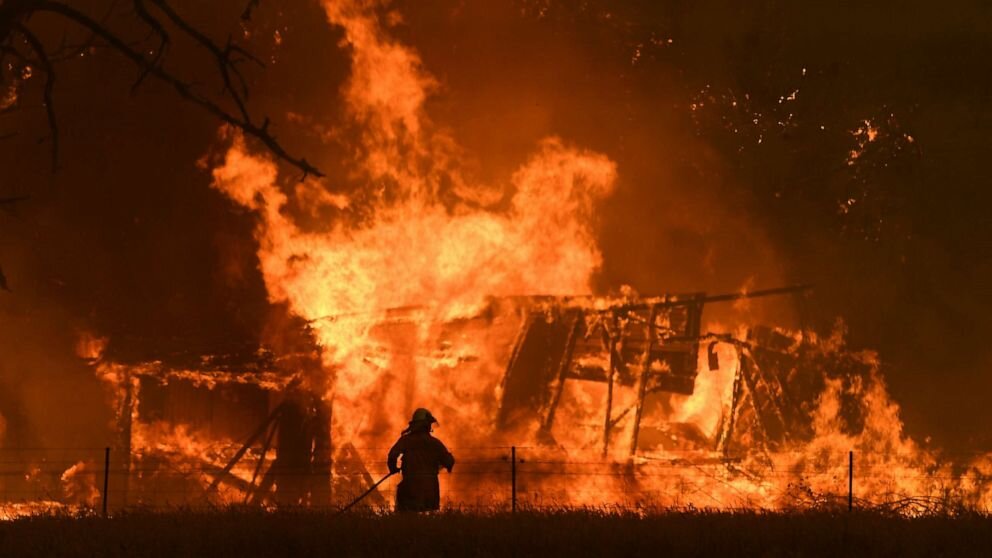
For years, Flannery has been a voice crying out in the wilderness, urging government interests to adopt measures to lessen the outbreak of bushfires Flannery’s Climate Council had filed 12 reports of looming danger. Then, on a continent where bushfires have historically ravaged Australia’s landscape, there occurred the bushfires of 2019-2020, with an estimated loss of 33 humans and 3 billion animals. Precipitated by two years of withering drought and searing temperatures, Sydney saw temperatures rise to 120 F.

Meanwhile, then prime minister, Scott Morrison, was on undisclosed vacation with his family at the height of the conflagration.

Earlier, in 2013, the incoming government of Tony Abbott ordered that the Climate Council, headed by Flannery, be shut down. The following year, the tax on carbon emissions was abolished.

Australia, based on head count,  is the world’s leading polluter. Currently, it ranks among the largest exporters of natural gas and second as an exporter of coal. “Were greenhouse gases at pre-industrial levels,” says Flannery, “natural factors alone would produce a year as hot as 2019 just once every 360 years. But add the effect of human-emitted greenhouse gases and the probability drops to one year in eight—a forty-five-fold increase in probability” (New York Review of Books, January 16, 2020).

Flannery’s love of nature is rooted in his boyhood, growing up in the Melbourne suburb of Sandringham, with remnants of its ancient woodlands not yet victim to Melbourne’s spilling over its boundaries:   

Our house lay just a few hundred metres from the most majestic part of its shoreline – the Red Bluff Cliffs. Sculpted from five-million-year-old sandstone, they stood as a great fluted rampart rising 80 metres above
the waves and running for half a kilometre or so along the foreshore before petering out into ti-tree covered slopes.

While the waters were safe from wholesale alteration, ‘progress’, unfortunately, could not let even this jewel of a place alone. Around half of the cliff had become a municipal garbage dump, and old cars, refrigerators and other rubbish cascaded down its slope to leak oil into the water below.

But this could not blight the life of the sea. If you searched among the rusting rubbish you might find a ribbed murex shell, or the white beauty of an angel’s wing clam. This place was my playground.” (Satish Kumar, ed., Small World, Big Ideas: Eco-Activists for Change).

Flannery did his undergraduate degree in English and history at La Trobe University before switching to an M.A. in geology at Monash University, followed by his Ph. D. at the University of South Wales.

For nearly twenty years, Flannery conducted extensive explorations of islands of the South Pacific, discovering and naming forty previously unknown species of mammals: 

It was during this work that I first encountered evidence of climate change: everywhere the tree line in New Guinea was rising, and the precious alpine habitats were shrinking. By 1999, I knew what I had to do: give up a life of adventure and become an activist for addressing the threat of climate change. I began researching a book, and in 2005 published The Weather Makers  (Kumar).

I like the way Flannery writes, a scientist conveying nature’s plight in layman’s idiom, articulate and convincing, insistent that we change our ways: “The brutal destruction of the natural environment I witnessed as a child, for example, has left me with an enduring belief that Nature is precious and vulnerable, and that humans can destroy beautiful things in an almost malicious manner” (Kumar).

Dr. Flannery continues, not only to be a strong voice for Australia’s environment, but for preserving what remains of vestigial rain forest and biodiversity in Micronesia. As for Flannery’s Climate Council, it continues to survive through public funding.

Sir David Attenborough deems Flannery as “in the league of the all-time great explorers like Dr David Livingstone” for documenting much of Australia’s earliest wildlife.

An articulator of nature’s gifts and of human assault, climaxing in the climate crisis that confronts us, none tells it better than Tim Flannery.

–rj