
Author: RJ
Retired English prof (Ph. D., UNC), who likes to garden, blog, pursue languages (especially Spanish) and to share in serious discussion on vital issues such as global warming, the role of government, energy alternatives, etc. Am a vegan and, yes, a tree hugger enthusiastically. If you write me, I'll answer.
Enough!
On the dilemmas of being a woman
You may have seen the recent news out of Bangladesh of the death of a 14-year old girl as a consequence of a public lashing meted out by community leaders applying Shakira law. Hena Begum had complained she had been raped by her 40-year old married cousin, who later fled. Collapsing at the 70th lash of the 120 designated. she died a short time later.
The UN Population Fund suggests that up to 5000 women are victims of honor killings annually, but doesn’t specify Muslim perpetrators. This is important because the truth is that violence against women transcends all ethnicities and economic denominators. In our own country, the FBI’s Expanded Homicide Data of 2008 records 14,180 murders in the U. S., of which 930 were women and girls murdered by a family member.
But let’s also talk about rape. Nearly 18 percent of American women have been raped or been victims of a rape attempt, 22 % of them under the age of 12 (Violence Against Women Survey, 2000). The numbers are actually much higher. Only 37 percent of victims report their rape to local police, according to the FBI. Shockingly, only 1 of 20 rapists serves even a day in jail (Victimization Survey, 2005).
Upwards of 50,000 women and children are trafficked into the U. S. annually for sexual exploitation or forced labor (CIA, 2000). Alas, slavery didn’t cease with the end of the Civil War, not for women at least. Worldwide, 1 million children , mostly girls, enter into the sex trade annually (UNICEF).
Internationally, there exist selective abortion, infanticide, and neglect, mostly in Asian nations, resulting in some 60 million females having been denied life (UN Study on the Status of Women, 2000).
Genital mutilation is common in Africa and there women suffer a much higher rated of HIV incidence than males (UNICEF and UNAIDS, 2007).
Genital mutilation is common in Africa and there women suffer a much higher rated of HIV incidence than males (UNICEF and UNAIDS, 2007).
In the undeveloped nations, many women are denied access to education and its corollaries: economic independence and smaller families. In Afghanistan, the Taliban have aggressively destroyed schools set up to provide education access to girls.
Economic discrimination against women, both in the U. S. and abroad, abounds. You can almost bet on it that whenever women are the majority work-force in places such as schools, fast food restaurants, and block stores, it will result in low wages. There are exceptions such as in nursing and auto plants, thanks to a critical shortage and/or strong unions. It’s going to be really interesting how the present Wal-Mart discrimination suit before the U. S. Supreme Court turns out.
I haven’t talked about the marriage and relationship sectors, where often as not, the woman performs double duty in holding-down a full-time job, then returning home to resume care of the children, cooking, and other domestic needs. I know too many men who see women as primarily bedmates, mommies, and cooks. Men tend to put looks high on their priority scale for a partner; women, less so, preferring sensitivity and intelligence. Is it any wonder?
Mistreating women has been an endemic feature of male cultural history, whether religious, political, economic, or domestic.. Unfortunately, we live in a world where those perceived as weak are continuously exploited: women, children and animals. For those of us who care, our challenge is to empower “earth’s disinherited” through protest, legislation, education, and economic sanction. The struggle isn’t easy and the road is long, but every journey begins with the first step.

Why I like Natalie Portman
I confess to being a fan of Natalie Portman, Academy Award winner for her performance in Black Swan. Let me count the reasons why:
She’s a very good actress: At age 13, she starred in the French film, Leon. In 1997, she played Anne Frank in the Broadway rendition. In 2005, she won a Golden Globe Award and was nominated for an Academy Award for Best Supporting Actress in Closer. This present year has seen spectacular successes: a Golden Globes Award, Screen Actors Guild Award, BAFTA Award, and Academy Award for her stellar role in Black Swan.
I admire her intelligence: After all, we’re talking about a Harvard graduate in psychology. I like how she put it in a New York Post interview: “I’d rather be smart than a movie star.” She been a guest lecturer at Columbia. A lover of languages, she’s fluent in English, French and Hebrew and has also studied Arabic, Japanese and German. She’s taken graduate courses at the Hebrew University of Jerusalem. She’s also published professional articles in leading science journals.
I like her political beliefs: She is a Democrat who campaigned for John Kerry in 2004, for Hillary Clinton in the New York primary, and Obama in 2008.
I admire her social activism: She’s devoted herself to helping eliminate poverty, traveling to Africa and Latin America to advocate micro-lending, a program to assist women in financing their own businesses. She’s also spoken for this cause at several leading American universities.
I identify with her religious views: In an interview with Rolling Stone (2006), She commented on whether there’s an afterlife, “I don’t believe in that. I believe this is it, and I believe it’s the best way to live.” Although committed to her Jewish heritage (she’s a dual citizen of the U. S. and Israel), she thinks that good character and partnership are the primary staples in a love relationship.
I’m enthusiastic about her views on animals and vegetarianism: Since childhood, she’s been committed to vegetarianism and became a vegan in 2009 after reading Safran Foer’s classic, Eating Animals. She doesn’t wear furs, feathers or leather. In 2007, she started her own franchise for vegan footwear and in the same year participated in the filming of the documentary, Gorillas on the Brink in Rwanda.
She’s just plain nice to look at: Need I say more?

A people set apart
“What doesn’t kill makes one stronger.”
–Japanese proverb
For two weeks now we’ve watched horrendous news footage on TV of Japanese suffering following the 9.0 earthquake and its tsunami aftermath of 30 foot water swirling into Sendai streets, bursting over banks, uprooting houses from their foundations, turning ships upside down, drowning everything within its mindless path; even then, in Job-like fashion, venues of more calamity and angst with the loss of electrical power necessary to cooling the six reactors of the nearby Fukushima nuclear plant and daily heroic efforts to limit radiation fallout and, worse case scenario, prevent meltdown.
But nightly we’ve also seen the Japanese people up close in their dignity and discipline. While sorrow abounds and mounts—at present count, 6700 dead and thousands more missing, whole towns and villages swamped by the sea, their inhabitants presumably dead__there isn’t any panic or looting. Soldiers are here to rescue, not impose order. In personal interviews the tenor is the same: a stoic acceptance of life’s engrained insecurity; the solace of being alive; the sense of dependency on each other. I shudder to think what might be the situation in our own country were we to experience a calamity on the scale of what’s befallen the Japanese.
I’m not surprised by their equanimity, orderly and quiet resolve, absence of rancor at the failure of government to react quickly and sufficiently, and refusal to politicize calamity by pointing fingers. (I think of our BP disaster in the Gulf last year, high in economic consequences, but low in fatalities.)
I first met the Japanese as a 17-year old serviceman enroute to Korea. Dakota Air Base outside Tokyo was my initial touch-down. Their cleanliness, kindness, and ubiquitous honesty lent a lasting impression. Leave something behind in a restaurant or train station, rest assured, they’ll keep the item for you. Theft, like most crime, is generally rare in Japan. Travel books abound with the good news that Japan’s a place where you don’t have to look over your shoulder. When I think of Japan, I associate several prominent characteristics unique to the country that help us see their present response in cultural perspective:
1. collective identity: The Japanese value the group more than the individual. They think as one. It’s not what’s in it for me, but how will it affect others—nation, family, friends. Westerners sometimes disparage this, finding it regimentation or group sanctioned inhibition of self-identity. But I think this a shallow view prejudiced by contrary cultural values. We have personal freedom to do pretty much what we like in the West, but at what cost? I lament our greatest loss and primary source of our national and personal fractiousness: the erosion of the communal ethic. That ethic remains salient in Japanese culture, particularly with regard to the primacy of family. Japanese find it difficult to fathom that parents might live 3,000 miles from their children or that children might seldom visit an aging parent. The Japanese language itself reflects the culture’s guardianship of the interiority of the family and its special intimacy and potential solace in a wider, impersonal world pursuing material values. There are separate vocabularies designating family members: one for family and one for outsiders.
2. Discipline: Perhaps it derives from Buddhism, reflected in Zen, that you have this sense of integration, or self-mastery, the ability to delay gratification, a sense of the goal and the patience to pursue it. Discipline was at the heart of the samurai warrior code and is embedded in today’s Japanese schools that are centered in more than the academic as repositories teaching pragmatic values: social etiquette, obeying the law, esteeming the nation. In the home, parents reenforce these values as well. Japanese children are well-behaved. Through self-discipline, the Japanese are often better able to master deprivation and pain. I’ve watched with fascination their patient queuing in line, accepting their beverage and bread stick in the crowded shelters.
3. Courtesy: related to discipline, it’s a fine art in Japan and another aspect of the primacy of the social fabric. When we think of Japan, we often notice the extended politeness on saying hello in its accompanying ritual of bowing. The lower you bow, the more respect you convey. Humorously, this ritual is so engrained that often you’ll see Japanese bowing as they converse on their cell phones. Rites of etiquette extend seemingly everywhere. There are conventions for entering and leaving trains, getting on and off an escalator. I remember my GI delight visiting a department store in Fukuoka (Kyushu) and being taken on and off escalators by the white gloved hands of dimpled, smiling Japanese girls.
4. artistry: I can’t think of any place I’ve been where the creative is so much a staple of daily life from flower arranging to public gardens and tea rituals. Westerners sometimes say that Japanese art is imitative rather than creative. This simply isn’t so; in fact, we’re more apt to imitate them as seen in our own penchant for Japanese gardens. One of Japan’s contemporary artistic legacies is its sophisticated anime and comic book genres, along with video games. We’re still catching-up.
5. Simplicity: There exists an understated elegance to Japanese culture in its advocacy of minimalism, whether in gardening, the haiku and tanka poetry genres, or its cuisine, a simplicity that seeks not to use, but reflect nature. Living on a crowded archipelago of islands, the Japanese are nonetheless able to bring nature into their very living rooms with bonsai renditions of pine and cypress.. Traditional Japanese homes are furnished lightly, tables and chairs low to the floor, beds that are futons folded and stored each morning in keeping with a spatial emphasis allowing, reconfiguration. Materials in a Japanese home are drawn directly from nature: fine woods, bamboo, silk, rice straw mats, and paper. Colors are always subdued, light diffused. I experienced all of this first hand when I stayed briefly in a mountain inn, or ryokan, in the vicinity of the Shinto shrine city of Nikko in northern Honshu, wearing the kimono, eating Japanese food, largely fresh from the sea, sleeping on the floor
It isn’t a perfect society. In recent years the economy has struggled as other Asian nations, principally China, compete with Japanese exports in the global market; women have yet to gain full equality; the population is aging, with 1 out of 4 Japanese over 65; vestiges of an ugly nationalism is on the increase; and there exists a defensive hostility towards other ethnicities (Japan remains a homogeneous society). While all nations have their freckles, the virtues of the Japanese nevertheless far exceed their blemishes, underscoring their likeliness to right themselves.
In its long history, Japan has faced many crises and always transcended. 1n 1730, an earthquake killed 130,000; nearly a century later, a tsunami killed 27,000; then, in 1923, in Japan’s greatest natural disaster, an earthquake striking the Kanto plain near Tokyo and subsequent fire took up to 200,000 lives. More recently (1995), an earthquake struck the Osaka area, taking 6,000 lives. The Japanese are a resilient people who will rebuild just as they have always done. They did it after WWII. If character is fate, then surely the Japanese are a people set apart.

I want it now!
In 1998, a U. S. president is impeached by the House of Representatives for sexual impropriety in the White House. In 2008, a New York governor and former state attorney general resigns in the wake of public censure for his involvement in a prostitution ring. The same year, banker greed unhinges the global economy. In 2009, a gifted golfer forfeits his marriage, perhaps his game, because of an ability to curb his sexual appetite and a Wall Street investment counselor pleads guilty to eleven federal felony charges, costing his clients billions. This year, 2011, an Italian prime minister faces trial for sexual and financial improprieties. In Egypt, a nation of impoverished millions, a ruler for nearly thirty years, is ousted by his people for misrule. Defining his nonchalance, he liked $25,000 suits with his name imprinted to form pinstripes.
For some thirty-five years as a university English prof, I taught courses several times a year called Western Classics I and II. I found it a privilege to teach these courses, even though their subject matter was more often outside the pale of traditional English literature: Homer, Sophocles, Vergil, Dante, Quixote, Voltaire. While I was enthusiastic about all these works, the one I liked best was Vergil’s The Aeneid. If I measure a book by its utilitarian value, then The Aeneid exceeds the norm.
Like epics generally, it’s an extended narrative poem, this one in Latin, consisting of twelve books. In the 19th century, school boys in the prep schools of Britain and America toiled with translating it. It’s seldom taught now, and when it is, largely as anthologized selections. In my enthusiasm, I required students read the poem in its entirety. Imagine their joy.
Like epics generally, it’s an extended narrative poem, this one in Latin, consisting of twelve books. In the 19th century, school boys in the prep schools of Britain and America toiled with translating it. It’s seldom taught now, and when it is, largely as anthologized selections. In my enthusiasm, I required students read the poem in its entirety. Imagine their joy.
Vergil was an interesting chap, to say the least, living in a turbulent political era which saw the assassination of Julius Caesar. Ultimately, his nephew Octavian (Augustus) would succeed after a protracted civil war. Many historians regard him as the greatest ruler the world has known. Vergil penned this work as a member of his coterie. In it, he offered his idea of the sound ruler by way of the poem’s protagonist, Aeneas, who’s modeled on Octavian. It might well have been written today, given its keen observations that still jell with contemporary life. For me, I also found it acutely practical at the personal level.
Central to its message is the concept of pietas, or balance. As such, it resembles the Greek notion of arête, often translated as “virtue.” The good leader avoids excess, not only in state matters, but more importantly, with regard to masterly over himself. The bad leader is characterized by furor, or imbalance. Pietas also connotes the idea of order or discipline. On the other hand, its opposite, furor, connotes disorder or lack of discipline. In The Aeneid, Dido, the Carthaginian queen, represents furor. In her passionate self-indulgence, she imperils Carthage and poses a temptation for Aeneas. While the poem surely is multi-faceted in its themes, it’s ultimately about having self-control.
I think about this work often, even after nearly six years in retirement. I suppose I’m fond of it because it expresses many of the issues I’ve faced in my own wrestlings to get a headlock on the meaningful life; it also confirms, for good or bad, character dimensions in myself and others, even friends; and, of course, it helps define much of what we observe in our public world. While the ancient world often emphasized the role of Fate in human affairs, it also held the individual responsible as a free agent of Reason to soften its consequences. As Aristotle argued in Poetics “character is fate.” In agreement, I would extend Aristotle’s insight to humans generally: what primarily ails us is precisely our frequent inability to master ourselves. I might even proffer that, in great measure, history is a legacy of excess.
Lately we’ve been reading and hearing a lot about the imbroglio between the Wisconsin Republican governor, Walter Scott, and public sector unions. While very few of us want to see collective bargaining abolished, neither do we admire union greed that increasingly threatens the welfare of all of us, mirrored in exponential budget deficits. Near where I live, Lexington, KY, the new mayor warns the city cannot adequately invest public employment pension funding. Layoffs are highly likely. (39% of firefighters have retired early on disability; police have worked excessive overtime.) What’s happening in Wisconsin and locally in Kentucky aren’t isolated scenarios. They are occurring in most states and even many countries.
Contributing to the financial morass nationally is the exponential cost of medical treatment, currently at the rate of 10% a year, far outstripping the cost-of-living index. Kentucky is now looking at cutting its Medicaid aid to the poor and reducing funding for education. How do doctors and hospitals justify such increases? Even the newly legislated Health Reform Bill will not help, since it lacks a mechanism for controlling costs.
In sports, entertainment, the media, and on Wall Street, we’re witnessing the continuing erosion of the middle class as oligarchy siphons money in enormous amounts for themselves. Does a news anchor warrant a 120 million dollar contract or a Yankees athlete 200 million? Movie stars often garner16 million or more for one film. Banking CEO’s, many of them arbiters of the worst economic meltdown since the Great Depression, aren’t prosecuted and are even bailed out. Their mind-boggling salaries and perks continue, even as they’re quick to foreclose on mortgages of those they’ve lured into financial jeopardy.
Nationally, our federal debt exceeds 14 trillion dollars. Net interest (2011) on that debt runs to 202 billion. Current federal spending stands at 3 ½ trillion, 1½ billion of that deficit spending.
At the state level, it doesn’t get any better. Consider these sobering figures: California’s deficit is now 25.4 billion; Illinois, 15 billion; Texas, 123 billion. In what should serve as a sobering warning to other states, California’s liability on unfunded public sector pensions stands at a staggering 240 billion dollar shortfall. See U.S. Debt Clock
What’s happening nationally reflects us as individuals. We simply find it difficult to distinguish between wishes and needs. More to the point, we’re unable to delay gratification. We want the single marshmallow now, not the hazy promise of two marshmallows if we simply wait a bit. Our appetites imperil us. Sadly, studies indicate we have something in common with criminals in this respect. Recent research abundantly indicates that most criminals are urge-driven.
Even our children increasingly reflect this syndrome, made all too easy by a pethora of technological distractions such as cellphones, videos, media games, and TV. Why do homework? The consequences, of course, are significant. As renowned researcher of self-control, Walter Mischel, inventor of the marshmallow test measuring self-discipline, confirms, there’s a huge gap in SAT performance between those children who can wait and those who can’t (Akst, We Have Met the Enemy, Kindle edition, 1662).
An inability to delay gratification can affect weight, with children who are able to delay gratification consistently thinner. Daniel Akst reports researchers have “found that self-discipline was correlated with school attendance, grades, standardized achievement test scores, and eventual admission to a competitive high school… School discipline turned out to be a vastly better predictor of grades than was IQ” (Kindle Edition, 1691). Just maybe the crux of our difficulties with our schools lies not with teacher incompetence and inadequate funding, but with the students themselves, comatosed by a culture of indulgence, often fostered by parents dulled to indifference in their own pursuit of the good life.
Individually, the consequences of our inability to cage our desires, the furor Aeneas talks about, are enormous. Lives shattered by financial excess, addiction to alcohol and drugs, poor health regimen by eating too much and wrong foods, smoking, lack of exercise, diminished futures in school dropout, quality goals unaccessed through wasted time. The list is endless. For the pleasure of the moment we forfeit the promise of tomorrow.

Spring cleaning

After a long winter, even for Kentucky, it feels good to awake to early eastern skies of long-fingered pink, harbinger of Spring’s seductive balms of radiant, yet gentle warmth, arousing the earth to new dress in verdant green, With nature’s facelift, browns and grays transmute into daffodil and tulip riot. My mind swirls excitedly as I anticipate grabbing a shovel, turning the yielding earth over, planting azaleas and rhododendrons, restoring pathways, adding mulch, pruning roses. I leap out of bed.
I wonder how many poems have been written about spring. Here’s a passage from a child’s poem that, simple as it is, resonates spring’s melancholic capacity to remind us of its temporal nature like all things in life and, by extension, our need to live in the Now.
“If spring lasted forever
I’d never have to say good-bye
to when summer ended
or when the fall leaves died.”
(James Meaney)
Yet despite the temporal nature of the seasons, the arrival of spring reassures us of a permanence amidst change or as Hal Borland reminds us: “No winter lasts forever; no spring skips its turn.” It’s one of the few assurances we have in life.
I think I like spring best for its ability to suggest we can redeem what’s been lost or made a mess of through cosmic caprice or our finite limitations. In this way, it represents the end of winter’s hiatus and rebirth of resolve to do better. While the traditional New Year on January 1 is synonymous with resolutions, ancient calendars often began the new year with the coming of spring, or season of rebirth. This makes sense to me. This archetypal notion of spring as an opportunity for a fresh start is embedded in our own language when we speak of “spring cleaning,” an undeclared domestic rite when we often toss relics of the past.
I Iike that kind of spring cleaningI

An empty spot
I finished Carl Safina’s The View from Lazy Point yesterday, and I’m feeling an empty spot, or something missing, after spending several weeks in silent discourse with this eloquent work. Safina, a MacArthur Prize recipient, is well known in the conservation movement. Recently, Audubon magazine listed him among the 100 leading conservationists of the last century. He’s the founder of the Blue Ocean Institute.
Safina could have been a poet, given his metaphoric penchant and passion for seeing what most of us miss in the delicate tapestry of nature and our role in its weave. If the book has a constant, it laments humanity’s increasing indifference to that world beyond itself, a callousness to its intrinsic connection with nature at large, and a harbinger of its penchant for self-destruction. With coal-fired power plants belching carbon in exponential quantities into the atmosphere, our insatiable appetite for material goods, our conflation of growth with well-being, the explosion in our numbers, we are depleting our resources, accelerating climate change, and imperiling our children and grandchildren. We live for today, impoverishing tomorrow
Every act has its consequence for good or bad, and now we live in a world where flora and fauna lie increasingly threatened, the seas emptied. Even our trees, those sentries protecting us from breathing carbon dioxide’s toxic fumes, are in decline, decimated by disease, drought and a chainsaw pursuit of material gain and comfort. Each year, the birds are fewer, the water tables of nations more contaminated or declining, the seas relentlessly rising.
At times, Safina nearly loses it, tongue-lashing market greed and political connivance. He’s traveled to all the world’s environmental hot spots and, universally, the message is the same: man’s degradation of the planet with its calamitous consequences.
Several scenarios standout in the book, one of which had all the earmarks of potential violence when Safina and a friend find themselves confronting a pick-up driver who’s come to the Long Island shore to shovel horseshoe crabs into the bed of his truck. Horseshoe crabs have been here for 450 million years, surviving even the extinction of the dinosaurs. Individuals can live up to twenty years. After all that, even these well-adapted creatures are facing depletion as a consequence of humans. They are now used for bait.
Shafira manages to drive him off, only to find he’s been replaced by scores of pick-ups in the early morning. New York state may have reduced its quotas, but who’s watching? As Safira remarks, “There is something in man that hates natural abundance, and something that clings to excess” (p. 196, Kindle edition). Without horseshoe crab eggs, migrating shore birds cannot find the sustenance to complete their journeys. We live in a world of delicate linkage. Destroying one entity in that linkage doesn’t confine its results.
This book isn’t for the faint-hearted. It gives you the trenchant truth; still, it also offers hope. After all, when man has cared, he has succeeded. Peregrines, bald eagles and red-tailed hawks show increased numbers. Once they were threatened species. But such successes are all too few. Between 199 and 2005, horseshoe crab eggs have declined 90 percent along Delaware Bay. Concurrently, Red Knots have declined 80 percent, or from 150,000 to around 30,000 (p. 138, Kindle edition), and here we’re considering just two species. By 2021, some two thirds of animal and plant species will be gone.
Safina sounds the alarms at the end of his book: “For twelve thousand years or so, humanity has lived in a period of very stable climate. That stability has been the climate envelope for all of civilization so far. Now we are committed to leaving that stable period for points unknown. It’s humanity’s most hazardous journey yet” (pp. 349-50, Kindle edition).
Not many seem to be listening.
Searching for Dad
Lately I‘ve seen Ron Reagan, son of the late president, on TV several times in conjunction with his new book about his father on the occasion of the centennial of his birth. Titled My Father at 100, it’s an interesting read, except we’ve been on this road before, familiar apart from several turnouts affording us new vistas such as Ron’s suspicion that his father may have already been displaying incipient Alzheimer’s disease when he fell into sudden, prolonged silence, fumbling for notes and looking confused, in the first presidential debate with Walter Mondale in 1984. Of course, he subsequently routed his opponent on the age issue in the second debate with his rejoinder that he would “not exploit, for political purposes, my opponent’s youth and inexperience.”
What we do know is that Howard Baker, the respected Tennessee senator who replaced Donald Regan as White House chief of staff, found the President mentally lucid and focused.
Much of what Ron says about Dad is speculative, as in the preceding. He offers that Reagan embroidered the facts when it came to his own father, hardly a profligate alcoholic heedless of his family: “If he was weak, he was also principled.” But how does Ron come by this knowledge?
Whatever one’s political persuasion, Reagan was hardly the “affable dunce,” as Clark Clifford dismissively remarked. During his tenure, the country prospered economically, regained its pride, halted inflation, and saw an end to the gas crisis. Perhaps his greatest accomplishment was negotiating a nuclear arms reduction with Gorbachev, ultimately moving the two Super Powers towards an ending of the Cold War to the chagrin of many conservatives and the surprise of most liberals. It can be argued that a revived economy and massive defense outlays ultimately weakened the competitive Soviet economy, precipitating communism’s collapse.
Yet the fact remains that, domestically, the Reagans had a strained relationship with their children. When Patti moved in with an Eagle rock singer, Reagan could not accept its morality. Nancy, not just Reagan, quarreled with Patti on other issues and the two did not reconcile until 1993, when Reagan’s Alzheimer’s affliction became known.
When Ron dropped out of Yale, opting to become a ballet dancer, his parents suspected homosexuality.
There had been bad moments, too, though with lesser fallout, with Maureen and Michael.
One of the book’s most fascinating passages recalls a supper time argument that many American families with teenagers will find familiar. Ron can’t recall what precipitated the uproar, accept that when he got up to leave, his father said, “You’re not going anywhere, Mister,” cocking his fist. They wouldn’t talk for several days.
At home, the Reagans represented old values in a new era, the incompatibility of old wine in new bottles. Well meaning, they got into controlling, reacting rather than listening. While they enjoyed an exceptional relationship as husband and wife, they unfortunately erected a firewall against intruders, including their own children, hungry for love, yearning to be heard, needing validation in their adolescent quest for emancipation from the shadow of extraordinary parents and the forging of their individual identities. In their denial, came resentment and rebellion.
Ron’s book isn’t unfriendly. He calls his father “Dad” throughout. and yet resentment lingers like smoke from a fire, reduced to blue embers, seeking exit:
“I could share an hour of warm camaraderie with Dad, then once I’d walked out the door, get the uncanny feeling I’d disappeared into the wings of his mind’s stage, like a character no longer necessary to the ongoing story line.”
Tolstoy wrote famously at the outset of Anna Karenina, “Happy families are all alike; every unhappy family is unhappy in its own way.” Ron recalls his father telling him, “You’re my son, so I have to love you. But sometimes you make it hard to like you.” This becomes painful reading. As parents, many of us have been there. Reagan’s domestic failures despite his public success as the Great Communicator, hint at our own private follies as parents, made wiser by time, yet remorseful that we might have done better.
But it’s never too late to learn how to listen; to love our children unconditionally; to undo past wrongs in the warm embrace of reconciliation.

Food for thought
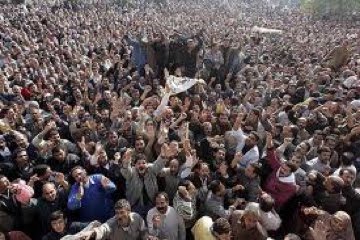
The news is quite predictable now, with its 24/7 coverage of unrest in the Middle East. And the contagion is swelling _initially, Tunisia, then Egypt, now Yemen, Bahrain, and just recently, Libya. Can Saudi Arabia, a critical source of the world’s oil, be far behind?
Most media report the unrest as an unprecedented quest for democratic government and the choices it provides to individuals. I argue that this over simplifies, not the first time media has done this, of course. The root causes rest in the economic and, more specifically, in sharply escalating costs for foodstuffs. To cut to the chase, these are food riots.
According to the United Nation’s Food and Agricultural Organization (FAQ), food prices on the world market have risen 30% over those of a year ago. In January, these increases reached their highest point in 20 years, plunging 44 million into the already swollen ranks of the impoverished. According to World Bank president Robert Zoellick, “It is poor people who are now facing incredible pressure to feed themselves and their families as more than half a family’s income goes just to buy foodstuffs.”
In Egypt, 56% of a person’s income is spent on food. In Yemen, prices for wheat and wheat products have doubled over the past year. Wheat dominates North African and Middle East imports of foodstuffs. Gulf countries import 100% of their foodstuffs, offset by oil revenues.
According to the FAQ, which traces monthly international prices of commodity products, including meat, dairy, cereals, oils, fats, and sugar, in just the last 3 months, sugar has risen 20%, oils 22%. It’s worse with corn, now priced 73% higher than in June, 2010.
The contributing sources to these ills are multiple and largely of human mischief.
1. natural calamities: 2010 saw wildfires in Russia due to record breaking temperatures and prolonged drought. Floods devastated Pakistan and Australia. In Sri Lanka, floods destroyed 30% of its wheat harvest. Drenching rains despoiled South Africa of much of its anticipated harvest. (I have written of the connection of volatile weather with global warming in an earlier post.)
2. escalating oil prices, driving up transportation costs.
3. diversion of cropland for production of biofuels to offset oil import costs. In the U.S., government grants oil companies a tax credit for each gallon of ethanol it produces, costing American taxpayers 6 billion dollars annually. This has resulted in a 40% rise in corn prices on the world market.
1. natural calamities: 2010 saw wildfires in Russia due to record breaking temperatures and prolonged drought. Floods devastated Pakistan and Australia. In Sri Lanka, floods destroyed 30% of its wheat harvest. Drenching rains despoiled South Africa of much of its anticipated harvest. (I have written of the connection of volatile weather with global warming in an earlier post.)
2. escalating oil prices, driving up transportation costs.
3. diversion of cropland for production of biofuels to offset oil import costs. In the U.S., government grants oil companies a tax credit for each gallon of ethanol it produces, costing American taxpayers 6 billion dollars annually. This has resulted in a 40% rise in corn prices on the world market.
To these factors, I would like to add another often missed: the exponential increase in human numbers and its corollary, increased demand. In the U. S,, one of the world’s fastest growing industrial nations, population increased from 130 million in 1940, to 150 million in 1950, and now doubled to a current 308 million.
The UN anticipates a 9 billion world population in 2050, up from just under 7 billion presently. To feed everybody will require more land and water use and decimate forests still further. Even if we were to succeed, many would remain malnourished and impoverished. 70 million, or two Californias, are added annually to the world’ s population. While some take solace in declining fertility, two thirds of Egypt’s population is under age 30.
And whatever happened to the Green Revolution with its high yield grain varieties, innovative pesticides and fertilizers? The grim reality is that its initial gains have been swamped by increases in human numbers. Initially, a catalyst to its early promise was an increasing reliance on irrigation, with unforseen consequences for all in dropping water tables. India, which became a food exporter, now imports rice, mostly from Australia, Unfortunately, that windfall may be drying up quite literally. Australia has cut its rice exports 90% because of prolonged droughts and more recent cyclones.
In China, the water tables are dropping 10 feet a year. In the U. S, it’s worse, with water levels over past decades dropping 100 feet in Kansas, Oklahoma, and Texas. By 2025, two thirds of the world’s people will live in locales lacking sufficient water. Water, not oil, may well mitigate future conflict between nations.
Meanwhile, upheaval in North Africa and the Middle East signals warning of history’s tendency to repeat itself. Tomorrow, the just returned exiled Muslim Brotherhood cleric Yusuf al-Qaradawi will address a mass rally in Cairo in Tahrir Square. A brilliant articulator of purist Islam (100 books), he despises the West and loathes Israel.
Food prices? More important than you thought: they can determine history, affecting us all.

 Brimmings: up from the well