Intolerance: Medicine’s Nemesis

Medical Statue at Semmelweiss Medical Museum
Medical Statue at Semmelweiss Medical Museum (Photo credit: Curious Expeditions)

I had grown up thinking medicine was free of the prejudices, if not sheer ignorance, rampant in the everyday world where resistance to anything new seems a given.  Let’s face it:  we humans don’t like having the security of our assumptions challenged.  The truth is that the history of medicine shows the same proclivity for stubbornness or subordination to the weight of custom as elsewhere.

In his riveting study, Doctors: The Biography of Medicine, physician Sherwin Nulan recounts the story of Ignac Semmelweiss, a young Viennese physician in the 1840s, who observed that women delivering their babies in hospitals died of puerperal, or bed fever, considerably more frequently than those delivering at home.  He did his own research to find out why, ultimately discovering a link between medical student routine and maternal deaths.

Each day,  students and profs would examine cadavers in between visiting patients. Although they didn’t have any notion of germs back then, Semmelweiss ultimately concluded that “invisible cadaver particles” on the hands of students and attending physicians was the source.  In short, he had discovered the role of infection in promoting illness.  

Instituting a protocol of his students’ washing their hands in a chlorine solution, he saw a dramatic drop-off in mortality.  His colleagues, however weren’t amused by this young upstart, whose research implicated them in so many deaths.  Consequently, Semmelweiss didn’t publish his research for fifteen years.
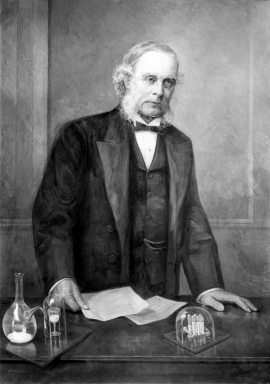
Dr. Joseph Lister
Dr. Joseph Lister

By the 1860s,  Louis Pasteur’s germ theory had entered into medicine, though it initially wasn’t widely accepted.  In Britain, Dr. Joseph Lister decided to apply the notion to post surgical infections, which were nearly always fatal.  Discovering that a neighbor city had poured carbolic acid down its drains to eliminate a potent sewer stench, he concluded that the acid had killed microorganisms similar to those Pasteur had identified.  Applying this concept to surgery, he employed wound dressings saturated in carbolic acid.  Later, he added spraying the entire surgical area with the solution.  Ultimately, he expanded the solution to washing his hands and instruments.  Lister published his successful results in 1867, inaugurating the formal beginnings of antisepsis.  It would be another generation, however, before Lister’s innovations became universal.

It was only in the 1880s that doctors had finally moved beyond a solely antiseptic solution to changing their clothes and boiling their instruments, sutures, towels, and sponges and adopting a ritual of vigorous hand washing.  In 1893,  Dr. William Halsted  became the first surgeon to wear a surgical mask.  In the 1920s, white garments and linens became universal, though the former now seems to be giving way to darker shades again.

Infection still remains a serious threat and the shorter your hospital stay, the better your odds.  Each year, nearly 2 million patients experience infection and 100,000 die.

Even with today’s antibiotics, infection looms as a serious menace, complicated by the increasing rise of resistant, highly contagious bacteria strains.

The bottom line in medicine is that what we don’t know often governs more than what we know.   After several thousand years, we overwhelmingly treat symptoms, not causes.  Now and then, however, a Semmelweiss or Lister appears like some new Columbus, charting a vastly different terrain leading to a New World.  Thus, it behooves medicine to be open to self-scrutiny, forfeit vested authority, tradition, and prejudice.  Only in this way can we find the breakthroughs that advance our safety, promote our healing, and perhaps offer sovereignty over some of our most chronic diseases like cancer.

–rj

.

Chemical Attack in Syria: Obama Looks the Other Way

SyriaThe videos from Syria are horrific and unprecedented, with row upon row of corpses, many of them children, in what now seems to indicate some kind of chemical agent, perhaps nerve gas, judging by the symptoms, also captured on camera, of the last gasps and spasms of the dying.  Presumably the attack was launched under the auspices of the Assad regime, since it’s well known they possess a huge stockpile of chemical weapons.  It maintains, however, that rebels are simply staging a scenario for Western consumption to provoke intervention.

But this isn’t the way Britain and France see it, the latter calling for possible force if there is verification.  Even, and this is a shocker, Vladimir Putin has called on the Syrian government to allow UN inspectors, already in the country and just twenty minutes away, to visit the scene, though Russia assumes the whole thing is a rebel ruse.  I don’t think for a minute Assad will allow such a thing, though logic would seem to compel it, if what’s happened is simply a rebel scheme.

It’s conceivable Hezbollah or non-government loyalists could have launched an attack like this using make-shift rockets, which they’ve done before, employing tear gas or industrial toxins fired into a confined space.  Bad as the videos are, we don’t see defecation, vomiting and tremors that usually go along with chemical agents.

Because we can’t pin down, at least for now, what precisely happened, we need to refrain from a rush to judgment.  In America we’ve seen enough of war, of thousands of our children killed and maimed, our treasury depleted, and those we’ve fought to liberate us not liking us one bit more.  We got rid of Saddam, Iran’s nemesis, and stoked  its friendship with largely Shiite Iraq.

If this turns out to have been a genuine chemical attack, then such barbarism should meet with a strong response.  It doesn’t require boots on the ground.  No one wants that.  Nor does it mean a no fly zone.   Cruise missiles fired off shore can take out the missile depots.  Give the beleaguered rebels the weaponry they need so that the Assad regime pays a lingering price and this never occurs again.  Include anti-tank missiles as well.

The truth is that the Obama administration has dilly-dallied too long, allowing extremist forces to enter the fray, al Quaeda fighting with the rebels; Hezbollah, for Assad.  Now the war’s momentum, taking a very dangerous turn, increasingly resembles the imbroglio of Sunni vs Shiite, or what we see in Iraq, spinning out of control.

Like an ugly cancer, it threatens to metastasize, drawing in Turkey, Iraq, Jordan and Lebanon, where 42 died in a Tripoli bomb blast today.  Iran, meanwhile has been sending in fighters.

The toll on civilians is immense:  100,000 dead;  two million refugees, one million of them children divested of a future.

Meanwhile, our government is clearly confused, self-contradictory, and plainly ineffectual.

Obama told us a year ago, August 20, 2012, that chemical weapons would be a “red line” and “a game-changer.”  Shortly after, he concluded that they had been used and pledged arms.  No weapons have arrived.  Nothing changed.

If we discover that chemical weapons were indeed deployed on this occasion, and substantially, will it make any difference this time?  Don’t bet on it.  Politicians often say things they don’t really mean, and that’s why we’re wise not to believe them when they do.

Ironic for a nation that owes its own liberation from the intervention of the French two centuries ago.

–rj

An American Treasure: Reflections on Donald Hall

donald-hall-baseball
Lately, I’ve been thinking a lot about poet Donald Hall, now in his 84th year, and an American treasure. I came upon him early as a teaching assistant at the University of North Carolina at  Chapel Hill, where we used his Writing Well as our principal text in our composition courses.   Written in Hall’s typical plain-language, no nonsense style, I learned a lot from it at this early stage of my teaching career.

The other day I happened to tap into Daniel Giola’s blog with its invaluable essays he’s written on a good number of American poets, including Hall, and I liked what I read.  Giola is himself a talented poet, who formerly was head of the National Endowment for the Arts and currently teaches at Stanford.

Truth is, I hadn’t read Hall, the poet, who served as our Poet Laureate in 2006.  Until I read Giola, I was also unaware of Hall’s prowess in writing memoirs.  I downloaded his Life Work this morning from Amazon and am eager to get into it, seeing the critical accolades its drawn, which doesn’t surprise me.  Educated at Exeter Academy, Harvard, and Oxford, he’s written more than fifty books of poetry, prose and children’s stories;  been awarded two Guggenheim fellowships; the National book Critics Circle Award for Poetry, and twice nominated for the nation’s foremost literary honor, the National Book Award.  I’m embarrassed it’s taken me so long to catch-up.

I started this draft yesterday and am now a good way into Life Work, which he had initially published in 1993, or just after surgery for colon cancer (originally diagnosed in 1989) that had now metastasized to his liver, giving him a dismal prognosis of 1 in 3 odds he’d be around another year.  Ironically,  he beat the odds, only to lose his much beloved wife, Jane Kenyon, a former student and poet he had married twenty years earlier while teaching at the University of Michigan.  She had seemed so healthy, only to suddenly be diagnosed with leukemia and passing in 1995.  As Hall candidly remarks,  “The worst day is the day when grief or sorrow overcome you.  Your wife has cancer; you have cancer.”

It would take some six years for Hall to right himself again.  Jane’s presence permeated the house.  Giving her clothes away turned into an ordeal:

He emptied the dead woman’s dresser and closets,
stacking rings and bracelets, pendants and necklaces.
He bundled sweaters and jeans, brassieres and blouses, 
scarves
and nightgowns and suits and summer dresses
and mailed them to Rosie’s Place for indigent women.
For decades a man and a woman living together
learned each other for pleasure, giving and taking,
studying every other day predictable ecstasy
secure without secrecy or advenmre, without romance,
without anxiety or jealousy, without content 
….
(from “Kill the Day”)

Each new day reopened the wounds of loss–of lovers in communication, always together, mutual artists sharing creative ecstasy.  The gnawing loneliness. The unfairness of it all.  She was just 47.

All of this is part of the undertone of sadness to this work I sometimes think intrinsic to the acute sensibility common to artistry and especially poets.  As Hall reminds us, poetry is fundamentally about time and mortality.  This has been my own observation across the years in reading, teaching and occasionally writing poetry.  We may think of music as the most affective of the arts, but I have found poetry more so, sometimes reminding me of the way a drug works, bringing potential healing, but with it, too, a risk for side effects and a wish one hadn’t dosed.  But then I think of the greater risk of sensory, if not spiritual poverty, in refusing to let its potential for insight, empathy, and catharsis to work its grace and make me whole.  Poetry is latent with a sacramentalism that wraps around the soul.

One of the big draws of Life Work lies in its repertoire of Hall’s daily ritual that has made his prodigious artistry possible.  Mornings, he rises at 5; better, leaps out of bed, eager to resume yesterday’s unfinished tasks following a cream cheese bagel washed down by coffee.  A consummate craftsman, he revises poems sometimes a hundred times and even more.  Mornings are filled with creation.  Afternoons, with well-deserved indulgence.

I like the human side to Hall.  He tells us he’s installed satellite TV.  He loves his Red Sox and Celtics, never missing a game.  With New England in my own blood, I relish these teams, too, though I’ve lived away from the place for many years.  Reading a work like this alleviates my guilt in often violating the Puritan ethic of duty in my sometimes preferring  play over work.

You won’t find this in Life Work, but in a recent NPR Fresh Air interview (February 8, 2012), Hall tells us he’s given up on writing poetry, since the ideas, words and images don’t spring up with their former ease.  He continues to write, however, focusing on prose:  “As long as I can do my work and continue to enjoy myself, I feel fulfilled.  My body causes me trouble when I cross the room, but when I am writing, I am in my
heaven–my old heaven.”

–rj

Looking, Thinking and Feeling Young

Nicoya Peninsula seen from space (false color)
Nicoya Peninsula seen from space (false color) (Photo credit: Wikipedia)

In my last post, “We are all Ponce de Leon” (August 13), I noted the robust euphoria increasingly prevalent in medical circles that perhaps in the next 25 years, given science’s increasing sophistication in manipulating the DNA’s genetic formulae, many of humanity’s worst diseases like cancer and arteriosclerosis will be harnessed, if not eliminated.  One of its principal advocates is Dr, David Augus, whose best selling book, auspiciously titled, The End of Illness, aggressively pursues this notion. In Hamlet mode, it’s something to be doubtfully wished, but unfortunately untrue.  Served up in a specious brew, it trivializes the idiosyncratic nature of disease, its pernicious fall out in anguish and grief; above all, the individuality of each victim.

We live continuously in a biological world fraught like life at large with unknowns, randomness and the onset of new specters replacing those we’ve vanquished.  While the incidence rates for heart attack and stroke have indeed lessened, high blood pressure and diabetes are way up and cancer abounds (Merck Institute of Aging and Health).  If longevity has increased, it’s primarily due to the drop in child mortality and not medical breakthroughs.

Children still get cancer, a disease that we usually associate with aging,  along with other afflictions.  I lost two siblings, mere babes, from heart disease.  I lost an older brother, doomed quickly by a brain tumor within a few months of his initial symptoms.  He was 47.  I love baseball.  My favorite player, Lou Gehrig, succumbed to ALS at 41.  I noted that Augus contradicts his own optimism in forecasting–“inevitable” is the word he uses–a pandemic that like the Spanish flu of 1918, will kill millions.

It’s good to dream, so long as it’s tempered by reality.  While we’ve made progress in some areas of medicine, our best bet is probably a preventative approach, especially through lifestyle changes such as giving up smoking, monitoring our calorie intake, and exercising more.  Ironically, though we live in an information age that staggers with its seeming infinitude, we still know relatively little as to the etiology of most of our diseases, treating symptoms, not causes.

All of us want to look, think, and feel young–the Ponce de Leon quest again–but let’s not promulgate nonsense.  Aging is a fact we must live with, but it doesn’t have to mean a cane, incontinence, dementia, cancer, heart disease or stroke.  The most recent research indicates that 70% of the ills of aging lies within our control.  We can learn to live with it and live well and for a very long time.

I have some pointers, though not a panacea, that can help us in preventing or delaying many of our ills.  They’re confirmed by recent studies of demographic specialists on longevity and you can find a succinct probing, in layman’s terminology, in Dan Buettner’s Blue Zones, 2nd ed., an analysis of five global hotspots for centenarians, places where men and women still toil in the fields though in their eighties and even nineties and cancer, heart disease and diabetes are rare.

The locales, by the way, are Sardinia, Okinawa, Loma Linda, CA (large Seventh Day Adventist population), the isle of Ikaria in Greece, and Costa Rica’s Nicoya Peninsula.  I should add that these biblical paradises are quickly succumbing to outsiders who bring fast foods and sedentary living with them, eroding aeons of life-enhancing routine and a quality of existence salient in simplicity and minimal stress.

Diet:  In all of these Blue Zones, little meat was consumed, usually once a week or just on a festival occasion due to economics rather than choice.  With Seventh Day Adventists, it was a conscious choice to exclude meat.  Beans, whole grains, garden vegetables, nuts and fruit characterize the several cuisines, not processed or refined food products.  I’ve always found it a good axiom:  “If it’s white, don’t take a bite.”  If giving-up meat isn’t a palatable option for you, then eat less of it and when you do, lean portions only, avoiding red meats in particular.  Or try cutting out meat altogether two days a week.  One other thing, but central: be careful about not only what you eat, but how much.  Centenarians are far and away thin people.

Movement:  People who work physically demanding jobs tend to live longer.  New studies show that sitting more than two hours regularly can shorten life expectancy.  For those of us whose lives are largely sedentary, it’s important to engage in aerobic exercise 30-minutes, 5 times a week, to lower bad LDL and raise HDL, the good kind.  But even brisk walking (3 miles in 45 minutes) counts.  Along with aerobic exercise, it’s wise to add weights to your regimen to protect and strengthen your muscles.  Walk more, sit less.  If space allows, do a garden.  When traveling, use the motel’s exercise room or bring along resistance bands.

Connection: Those who have friends and a support network such as religion can provide are consistently happier people living longer lives.  Pursue something you can commit yourself to.  Find a congregation, book club or lodge; discover a cause; volunteer.  Hang out with positive friends.  Find something that makes you want to jump out of bed each morning.

Serenity:  Those living long lives seem to have found mastery over stress.  It isn’t that they don’t suffer stress, but that they’re able to transcend it, living lives of daily, defined routine, with simplicity a cornerstone.  We help ourselves by reducing overload and unshackling ourselves from the wrenching worry synonymous with materialism, competition, and hurry.  Yoga, Tai Chi and meditation–traditional staples of the East–reduce tension and lower blood pressure, that silent source of many of our diseases.  Tranquil music muffles our pace; a good book provides timeout; a walk along a bubbling  brook restores.  Study quietness and discover peace and with it, longer life.

Family:   Most centenarians center their lives around their families, marrying young and having children.  There is a ritual of togetherness and mutual obligation that informs their lives.  The elderly usually live with their children and thus fare better in their physical and mental capabilities.  America, however, has been trending in the opposite direction, with active families finding quality time together difficult.  Shared activities and  a daily meal spent together are increasingly atypical now.  Mobility often spaces family members widely apart.  On the other hand, those living long, happy productive lives have made family a priority, live in proximity, and exhibit a we-ness in their interaction.

While there aren’t any guarantees, given life’s caprice, individuals mirroring these trademarks tend to fare much better in living long and healthy and productive lives.

–rj

The Fountain of Youth: We are all Ponce de Leon

medical-symbol1As a 12-year old Florida school boy, I was introduced early to the 16th century Spanish explorer Ponce de Leon, whom legend says came to Florida in quest of the Fountain of Youth.  Drink or bathe in its waters and you could be young again.  A story-line like this isn’t unique, finding its replay in myth and legend throughout the world. 

Its insistence  doesn’t surprise us at all, since it mirrors our consummate dream to stay young, not for its own sake, but because we associate youth with beauty, vigor, and libido, or from another angle, the absence of chronic ills like coronary disease, cancer, arthritis, and God only knows what, that often define our later years.  All the parts are new and they work well and at 25 we may sometimes think ourselves immortal.  We dream not just ordinary dreams, but visionary ones that say I can and I will.

Sooner or later, we are all Ponce de Leon, clutching to “the splendors in the grass” (Wordsworth).  Our ads promulgate our folly with promised effulgences of youth’s attributes, abolishing gray, dissolving winkles, restoring passion.

But even medicine itself increasingly wanders into the Ponce de Leon camp these days, some doctors proffering we may soon banish the ills of our human sojourn, advancing our life span dramatically into the 100 year range what with the promise of genetics making individualized therapies possible, perhaps a pill as it were targeting your specific ill, say cancer.

This is pretty much the message of Dr. David Agus’ fascinating The End of Illness, sort of what we do now at the car shop or electronics outlet, plugging into a computer that in seconds spits out solution.  He tells the story of 44-year old Bill Weir, host of ABC’s Nightline, who volunteered to go live, or cameras rolling in prime time, as the newest medical technology imputed his medical data at USC University Hospital.

It was the whole works, including not only blood tests and CT scans, but DNA analysis to assess his hereditary risk for illnesses such as heart disease, Alzheimer’s disease, colon cancer and about 32 other disease scenarios.  A CT uncovered substantial calcium build-up in Weir’s coronary arteries, narrowing his arteries and portending a possible heart attack in the next several years.  He had seemed a very healthy man until testing found him out.

The point is that we can increasingly predict and find impending diseases, and employing  intervention therapy, reduce if not eliminate, their threat.  Because of the high expense, sounds to me like you want to make sure you and your loved ones have the best possible medical coverage.  In the end, prevention may well be less costly than treating a patient with cancer, heart disease or diabetes.

Here I agree with those in Agus’ camp.  Take those prescribed pills, undergo the recommended testings, etc.  Consider pancreatic cancer, for example, a disease that takes no prisoners and recently killed actor Patrick Swayze, astronaut Sally Ride, and Apple’s Steve Jobs.  It’s an insidious illness that manifests its symptoms when it’s usually too late.  Still, you can undergo an annual complete abdominal ultrasound, MRI, or CT and gain a chance to nip the culprit in the bud.

But do I think medicine in the next 25 years will largely eliminate illness?  I will only say I think the jury’s still out on this one, though I’m doubtful. There is the expense; human inertia; new diseases in an increasingly global village appearing, impervious to our best antibiotics and the lengthy interval in developing new ones.  Even Agus contradicts his own optimism in predicting the inevitability of a pandemic:

The swine flu scare that occurred in 2009 will someday be dwarfed by a real epidemic that will spread rapidly through virgin immune systems and kill millions in its path (as happened, for example, in the flu epidemic of 1918, when an estimated 50 million to 100 million people died) (p. 277).

And I think the title of his book extravagant.  It may spawn sales, but little else, for fragile beings that we are, fraught with mortality, we share the fate of all living creatures, governed in the end by entropy.  We will never arrest illness completely, though we may at times lessen its impacting, and even its timing, by employing health enhancing strategies that will also lend quality to our lives.

At present, the American medical establishment is in breakdown mode.  While heart disease has shown a decrease, cancer continues to plague us.  Apart from disease, our doctors kill up to 200,000 patients yearly by way of medical mistakes; 50 million of us have no insurance; 25 million of us are underinsured.  Meanwhile, our unhealthy lifestyle continues to menace both our health and our wallets.  We have more diabetics than ever, for example.  Many of us are just plain fat.

I’d like to continue this subject in a later post and tell you things you can do specifically to help safeguard the health of yourself and loved ones, though I can’t promise you centenarian status.  Only 1 in 20,000 achieves that!

–rj

Confessions of a reluctant vegan

Food for Life distributes food on an internati...

I never thought I’d give-up meat.   Up to my mid fifties, I ate meat at virtually every meal, starting out with bacon and eggs in the morning; baloney sandwiches or a Big Mac for lunch; chicken or hamburger paddy at night.  Once a week I’d treat myself to a bucket of KFC chicken.  A steak was the right choice for special nights out.

Then it happened.  Karen shared an article she had just read in our local newspaper on the horrors of the turkey industry.  I’ll spare you the details, but it was pretty awful.

Both Karen and I then decided on switching to a veggie diet, though still including animal products such as eggs and cheese.  We made that decision the night before Thanksgiving Day, 1996, and we’ve been vegetarians now for close to 17-years and never looked back.

People choose vegetarianism for any of several reasons such as reducing weight, lowering heart risk, and promoting the environment.  We chose vegetarianism for ethical reasons, believing it wrong to inflict suffering on any sentient creature.  As the saying goes, always remember that the meat you eat once had a face.

The vegetarian diet, once you get past the meat cravings, is actually pretty good.  Sometimes it’s even too easy, what with all the veggie substitutes out there there for turkey, ham,  chicken and the like.  I can make a pasta dish complete with soy meatballs and fool people every time.  I can also fashion you a sumptuous veggie chili that tastes every bit like the original.  By the way, becoming a vegetarian doesn’t necessarily translate into a better diet than the ASD if you just gorge on junk foods like chips and sweets.

Transitioning to a vegan diet, however, has been a real challenge.  I chose to go this way about 15 months ago when a routine blood test showed my glucose at 108, meaning I was pre-diabetic.  It’s in this stage that you can make lifestyle changes that can prevent or delay the onset of diabetes.  I also found out I had high insulin resistance, meaning the insulin that the pancreas pumps out to handle blood sugar was having difficulty entering my cells, where it does its work.

I had to do two things in a hurry:  refine my diet even more by eliminating virtually all highly concentrated sugar foods such as soda, which I drank daily; candy, and baked goods.  I also needed to avoid refined, or processed, food products with their white flour, fructose, corn syrup and high sodium that are probably, along with meat and dairy, instigators of many of our health ills like obesity, coronary disease and, possibly, cancer.

I needed to eliminate foods having cholesterol content as well, which meant giving up cheese, one of my favorite foods.  Fatty foods clog the mitochondria, or cell gateways through which insulin accesses the cells, and obviously don’t do the arteries any good either.

Now I may surprise you when I say I don’t like going vegan–no more kitsch, or cheese, or morning fried eggs with buttered toast, or even pizza.  No more lovely potato salad.   No more sumptuous chocolate bars, cheese cake, apple pie.  Not even fruit juice.

It seems a diet made for hell, not heaven.  Frozen vegetables and mountains of lettuce just don’t cut it for me.  It’s like I’m turning into some kind of bunny.  It may have been ok for Gandhi, but hey, I’m not Gandhi.  Mexicans may love their beans, but day after day, it gets old for me.

What really makes things worse is that I’ve always been a slender guy not needing to lose weight.  On this diet over the past year, however, I’ve shed 15 pounds and have to cram nuts to steady my weight.  Weight loss may be great for most diabetics, who tend to be overweight, but not for yours truly.

At times I’m strongly tempted to compromise and resume the vegetarian diet, but then I remember it didn’t do anything for my insulin resistance, except maybe to encourage it.  Doing vegan, however, combined with aerobic exercise 5 times a week, I’ve cut my insulin resistance nearly in half, dropped my fasting glucose below 100, and have begun to transition from small LDL-p particles to the safer, large LDL-p particles.  Trigylcerides and bad cholesterol are way down;  HDL, the good cholesterol, is up sharply.  I think that’s where the second life style change kicks in.  You can’t just eat nutritionally dense foods.  You have to exercise vigorously 5 times a week for 30 minutes.  Even better, add resistance exercise 2 to 3 times a week.

But back to veganism.  Maybe it’s like being a baby again and Mama’s stand-by:  “Now eat up your veggies.  This bite’s for Mama.  This one for Papa.  This one for….

To put it frankly, I wish there were an easier, more appetizing route to good health.  But then again, all the studies that count show that diet matters and that a plant saturated diet does best for fostering good health.  The soundest dietary advice I ever got was put so simply by nutrition expert Michael Pollan in his fine book, In Defense of Food:  “Eat food. Not too much. Mostly plants.”  Though it isn’t easy, my own experience confirms its wisdom.

–rj

A great talent: Patrick Leigh Fermor’s A Time of Gifts

fermorI’m always eager for a good read and get ecstatic when I find one.  There are so many possibilities out there that I try to choose wisely, usually from several sources such as NPR, The Times Literary Supplement, and my favorite with its nearly 200 reprints of notable works, The New York Review of Books.

The latter is the source for my newest read, Patrick Leigh Fermor’s standout travel saga, A Time of Gifts (1977).  I’m embarrassed at missing out on Fermor these many years, liking travel narratives as I do, but then that’s why I keep the NYRB close-by.

Fermor was just an amazing guy in explorer Sir Richard Burton mold, fiercely independent, assertive and bold; linguistically gifted, courageous and cunning.  Joining the Irish Guards In World War II, he fought in Greece and served with a guerrilla unit on the isle of Crete, where he disguised himself as a shepherd for 18 months, living in mountain caves, while successfully master-minding the abduction of a German general.  He was knighted in 1994, for his service to literature and promotion of British-Greek relations.

In A Time of Gifts, Fermor begins his recall years later (age 62), of his three year walk across Europe to Constantinople as a 19-year with little more than a backpack in 1933. He actually only gets half-way by the close, and so there’s a sequel, Between the Woods and the Water, but even then, you don’t get to the Bosphorus.  It little matters, for what we have is splendid, as we follow this young man hobnobbing with rich and poor, gypsies and priests, occasionally sleeping in ancient monasteries.  His account of Germany in 1933, which saw Hitler becoming Chancellor, fascinates.  On one occasion, he strays into a beer hall filled with Nazis.

What attracted me to A Time of Gifts amid a plethora of can’t go wrong choices were multiple reviewer comments on Fermor’s stylistic talent, one reviewer likening him to Sir Thomas Browne as the best of the best prose masters across the several centuries. As a former teacher of English for some forty years, I’m an aficionado of style, or the mastery of the cadence of the English sentence.  Talented writers know the weave of sentences spun into art, exemplary in the literary world, especially in the 19th century in the likes of Newman, Ruskin, and Pater.

Of course, I’ve only begun A Time of Gifts, but his writing already excites me with its prowess, not only in its trenchant rhythms, but through its sensory capacity for total awareness.  To possess such talent for minutiae down to a grain of sand like this would make Flaubert (le mot juste) proud.  Let me try out a passage on you:

The gables of the Rhine-quays were gliding past and, as we gathered speed and sailed under one of these spans of the first bridge, the lamps of Cologne all went on simultaneously. In a flash the fading city soared out of the dark and expanded in a geometrical infinity of electric bulbs. Diminishing skeletons of yellow dots leaped into being along the banks and joined hands across the flood in a sequence of lamp-strung bridges. Cologne was sliding astern. The spires were the last of the city to survive  and as they too began to dwindle, a dark red sun dropped through bars of amber into a vague Abendland that rolled glimmering away towards the Ardennes.

Informed mastery like this, housed in rhythmic sentences acute with colorful detail, sets Fermor apart as one of our greatest travel writers since John Ruskin.

You can read more about him in Artemis Cooper’s magnificent biography (2012).  Having full access to his papers, she tells us that Fermor left behind a completed draft that gets him to Constantinople and that it will be published soon.

Despite losing some of his sight and hearing, he remained active almost up to the day of his death at age 96 in 2011.

In a book he had been reading, he wrote:  “Love to all and kindness to all friends, and thank you for a life of great happiness.”  Now that’s an epitaph we can only envy.

–rj

The Fading of the American Dream: a Tale of Two Nations

You may have seen this morning’s AP report on growing poverty in America.:

Four out of 5 U. S, adults struggle with joblessness, near-poverty or reliance on welfare for at least parts of their lives, a sign of deteriorating economic security and an elusive American dream.

I found the report disturbing, but not unexpected, as I’ve done a lot of reading on the subject over the last several years.  Things aren’t going well for us these days on so many fronts, but foremost, economically.  This isn’t the America I grew-up in.  Nothing is perfect, but I think of that world of the early 60s as just maybe our high water mark.

Take crime, for example: In 1963, there were only 18 arrests for drugs per 100,000 people.  Our jails held far fewer people, but if you were convicted, you went to jail.  We still had a lot of work to do when it came to civil rights and feminism was just coming into its genesis, but they were underway with their promise of inclusion into full citizenship.  The Cold War was almost palpable, and while none of us would wish its return,  ironically it may have fueled our energy,  propelling us into space.

What makes things hard to swallow in difficult times like these, however, is the growing gap between rich and poor.  What may surprise you is that, in sheer numbers, Whites are the majority poor, confirmed by the government’s own data, with 76% of Whites likely to experience economic insecurity (job-loss,  or a year or more of dependence on government aid, or income 15% below the poverty line) by age 60.  White-mother headed homes now equal those among Blacks.  Overall, the number of poor in America stands at a staggering 46.2 million. Things are still difficult for minorities, but the biggest jump in poverty is among Whites.

In contrast, the well-off are doing better than ever, with 1% possessing 50% of the nation’s wealth.  Since 1993, this 1% has seen a 58% increase in that wealth.  Following the downturn of 2008, it has experienced 93% of the income gains.  We are, in short, in danger of becoming two nations, or of those few who have, and have it abundantly, and the many who barely make ends meet, or are without work, or in danger of losing their work.

Increasingly, this confers not only economic disparity, but cultural dislocation in education, politics, and even social and intellectual values.  It decides where you live, the schools your children attend, and even your personal well-being, as poverty is the primary instigator of crime.  In this rare moment of American social history, many Whites now find themselves in the same realm of exclusion from opportunity as minorities.  When it comes to Affirmative Action, it strikes me that the new poverty calls for a redefining of its premises, or the consideration of economic disadvantage and not soley race.

Certainly, we live in a changing world where a global economy has shrunk the market for our domestic exports and we’ve experienced a sharp decline in our manufacturing base as a consequence.  When I grew up, you could reasonably expect to land a job with a steel mill, auto manufacturer, or in a coal mine for good wages, pensions, and the like, if you didn’t go to college.

Another factor exacerbating inequality is living in an information age that posits a market value on sophisticated skills that are often bred in a nurturing context of means, family stability, the right schools and colleges, and the cultivation of a network of those with influence.   We’re talking then about a wholly different lifestyle for those with means.

Like most of our family members, my father was a leather worker.  We weren’t well-off, but we had sufficient to make our way in a world without food stamps.  With the loss of domestic shoe manufacturing to other countries, it’s a world now relegated to the back recesses of memory.  I’ll not give you a litany of lost industries from textiles to furniture, for example, and their contribution to the retreating American dream.

Nobody puts the American economic malaise better than the New Yorker‘s George Packer in his must read, The Unwinding (2013):

If you were born around 1960 or afterward, you have spent your adult life in the vertigo of that unwinding. You watched structures that had been in place before your birth collapse like pillars of salt across the vast visible landscape—the farms of the Carolina Piedmont, the factories of the Mahoning Valley, Florida subdivisions, California schools.”

Lately the President has returned to emphasizing economic issues.  He envisions creating “a ladder of opportunity for all.” He wants to shrink the income gap.  I don’t doubt his sincerity, but is this simply a euphemism for government throwing more money at the problem, or perhaps an innuendo of Marxism with its inherent penchant to restructure the classes?

Money bailouts haven’t helped us before, though it did save the auto industry and the banks.  On the other hand, Libertarians favor deregulation.  Last time I looked, it got us into trouble and we’re still trying to right our balance following the Great Recession of 2008.  Some think focusing on equal opportunity rather than income redistribution is the ticket.  Good arguments can be had both ways.

But the President is surely right about closing the income gap, however it’s done, and most of us everyday folks are probably in lock-step with his goal, though we may differ as to method.   As Charles Murphy points out in his trenchant Coming Apart, we are witnessing America’s increasing bifurcation into two classes, rich and poor:  “…the divergence into these separate classes, if it continues, will end what has made America America.”  Murphy’s thesis is that America is being torn apart, not by race, but by class, and I agree.

The sad thing is, nobody really knows what to do.  In the meantime, what can be worse than to lose faith in your own future?

–rj

Happy Days are here again: and the banks roll on

obama

If you’ve been watching the headlines on the economic front, you may have seen the news about record bank profits in the first quarter of the year to the tune of $40.3 billion, an all time high.  In fact, profits surged 15.8% over the same quarter a year ago. This marks the 14th straight quarter of bank gains. In short, the bailed out banks (you and I paid for that), are making money hand-over-fist.  Not so, mainstream America.

Meanwhile, in the past 12 months, scandal- ridden JP Morgan has garnered $24.4 billion in net profit, evidencing once again that banks could evade laws with impunity.  The precedent, after all, had been the release of the 2000 page examiner’s report on Lehman Brothers in 2010,  suggesting fraud had brought about its bankruptcy, yet nothing was done.

You’d never have expected hand-outs from the Obama administration, given their campaign pledges to look out for us po’folk and their left of center politics.  Their hand-outs, not loans, to banks and other fiscal institutions, are shockingly in the trillions, with $85 billion dished out every month from the Federal Reserve.

But then again, we can better understand the forces in play when we look at the cohorts Obama gathered about himself:  Jacob Lew, former Citigroup executive, appointed deputy secretary of state, with a cool $900,000 bonus in his pocket from Citigroup;  Mark Patterson, Goldman Sachs lobbyist, made chief of staff at the Treasury, despite a ban on lobbyists;  Timothy Geithner, who became the architect of the bailouts, appointed as Treasury secretary, even after it was discovered he hadn’t fully paid his taxes;  Larry Summers, who authored many of the pro-bank policies of the nineties, recruited as a mainstay economic advisor; and Rahm Emmanuel, appointed Chief of Staff, after gleaning $16.5 million as a Chicago investment banker in just 30 months in-between government jobs. All of them Democrats.  All of them with dirty hands.  

At the present moment, Larry Summers is being touted as the next Federal Reserve Chairman, replacing the retiring Ben Bernanke.  A long time Goldman Sachs executive and trader, he played a primary role in deregulating Wall Street in the Clinton administration.

So far, and probably never will happen, not a single bank or CEO has been brought to account for their criminal mismanagement of the people’s money, leading to the 2008 meltdown and consequent suffering for millions of Americans. Their suffering continues.

Now you would think from the President’s major address on the economy this month that happy days are here again for you and me, what with his boast of 7.2 million new jobs created in the business sector in the last four years.  But politicians do prevaricate, and it’s up to you and me to hold their feet to the fire.  Fact is, long term unemployment is at its highest level since the Great Depression, and of the newly minted jobs, most are low wage (often in the service sector), temporary, or part-time.

Curiously, nowhere did the President mention the plight of Detroit facing bankruptcy and the possible erosion of pension and health benefits for the city’s workers, including police and fire personnel.

To give him his due, he did allude to the growing income disparity between the rich and the majority of Americans:

Even though our businesses are creating new jobs and have broken record profits, nearly all the income gains of the past ten years have continued to flow to the top 1 percent. The average CEO has gotten a raise of nearly 40 percent since 2009, but the average American earns less than he or she did in 1999. And companies continue to hold back on hiring those who have been out of work for some time.

But how did this happen?  He didn’t mention government’s largesse to the wealthy through bank bail outs, corporate tax breaks, and reduced wages for autoworkers.  In the first two years of the President’s tenure, or after the downturn of 2008, the richest one percent enjoyed an 11% increase in income, unlike the rest of Americans whose incomes declined.

Again, nobody’s been minding the store.  In 2011, the Senate Permanent Subcommittee  noted Wall Street’s culpability just prior to the 2008 market collapse as “a financial snakepit rife with greed, conflicts of interest and wrongdoing.”

While it may appear that things are humming along nicely, the banks booming, the real estate market up, stocks at their peak, the reality is that more than 3 million of us can’t find work.  Those who do, work for less, often part-time.  Many, particularly those 50 and over, may never work again.  Black youth unemployment is currently at 42 %.

Several million Americans have been foreclosed upon by the banks, losing their biggest investment stake and, sometimes, a whole lot more.  Many others owe the banks for houses purchased at inflated prices, now worth considerably less.

But the banks roll on, too big to take on, as Attorney General Eric Holder recently let slip. What’s more, their lobbyist legions do their work well, busy button-holing members of Congress.  It’s a game of money, always has been, money spelling influence.  It’s America, you know.

This just  in:  The President remains committed to slashing Medicare by $400 billion and Social Security by $130 billion in his projected 2014 budget.  (In 2008, candidate Obama had pledged, reiterated by Biden in 2012, that he wouldn’t cut Social Security.)  Apparently, the bankers are a privileged class; the people, expendable to the exigencies  of  power and influence.

-rj

My favorite speeches

Winston Churchill, Prime Minister of the Unite...

I’ve always liked a good speech.  If you asked me to make a list of favorite speeches I’d be hard pressed.  In fact, what I’d worry about most was leaving out some real gems simply because of memory lapse or not having been exposed to them.  It’s complicated, too, because there are countless good speeches to be had across the years, even centuries, like Socrates’ defense before the Athenean court.

Probably the best way to go about it would be to catalogue speeches by genre; for example, political, social, and historical, though the categories might occasionally overlap.  I think of “Washington’s Farewell Address,”  despite it’s now quaint formalism, one of the standout American speeches in our history with its warning of the dangers of political parties turning into self-centered warring factions.  A historical classic, it surely falls under the political canopy as well like Lincoln’s “Gettysburg Address.”

By the way, commencement addresses offer a rich source of substantive speeches before limited audiences.  I think of Steve Job’s address to the Stanford student body (2006) as the finest of its kind with its counsel on living in the context of mortality.

But what makes for a great speech?  I’d offer things like appropriateness, wisdom, counsel, candor, caring, inspiration and eloquence.  The best speeches not only inform and persuade, they move us to take action.  I think of Martin Luther’s King’s “I Have a Dream” speech (1963) as such a speech, perhaps rivaling Lincoln’s”Gettysburg Address” in its moving majesty.

As Americans, I think many of us would include Patrick Henry’s “Give me Liberty or Give me Death” (1775) and John F. Kennedy’s “Inaugural Address” as among the foremost of American speeches as well.

If you pinned me down, however, to a list of five personal favorites, I’d complain about how unfair you are.  Still, with apologies to the likes of Socrates, Cicero, Frederick Douglas, Susan B. Anthony, and even Patrick Henry and Kennedy, I’d offer the following personal favorites:

  1.  Lincoln:  “Gettysburg Address”
  2.  King:  “I Have a Dream”
  3.  Churchill:  “We Will Fight on the Beaches” (1940)
  4.  Washington:   “Farewell Address”
  5.  MacArthur:  “West Point Address”

I think of Winston Churchill, a Renaissance man living in the Twentieth Century, as the finest orator I’ve come upon with his ebullient, yet disciplined pathos as in “We Will Fight On the Beaches” (1940).  I think, too, of “Blood, Toil, Tears and Sweat” and “This was their Finest Hour” as speeches transcending any I’ve encountered.

I included General Douglas MacArthur here as a supreme orator.  The rhythmic cadence and rich metaphor of his farewell West Point Address to the Corps”(1962), delivered while in his eighties and without notes,  still moves me:

The shadows are lengthening for me. The twilight is here. My days of old have vanished. They have gone glimmering through the dreams of things that were. Their memory is one of wondrous beauty, watered by tears and coaxed and caressed by the smiles of yesterday. I listen then, but with thirsty ear, for the witching melody of faint bugles blowing reveille, of far drums beating the long roll. In my dreams I hear again the crash of guns, the rattle of musketry, the strange, mournful mutter of the battlefield. But in the evening of my memory always I come back to West Point. Always there echoes and re-echoes: Duty, Honor, Country.

I should mention as a kind of postscript, my liking for the compassion and eloquence typifying President Obama’s speeches.  It hasn’t anything to do with politics.  Not since Ronald Reagan “the great communicator,” has any President done it so well.

Before I leave off, there’s one speech, this by Eisenhower, that didn’t make my list, since  you squeezed me down to five picks.  It’s the speech in which he warned of “the military-industrial complex.”  Often quoted, Eisenhower had originally drafted “the military-industrial-congressional complex,” but then blinked.  No longer idealists, we now know the dismal reality of vested Congressional pecuniary self-interests in shaping today’s Realpolitik.   Had he kept it in, wow!

–rj