Salman Rushdie’s Home-Brewed Adversaries

Once again, fundamentalist Islam has shown its ugly side in the attempted slaying of Salman Rushdie for writing The Satanic Verses. After two decades in hiding, he thought he was safe from Ayatollah Khomeini’s fatwa (1989). He was wrong.

We expect secular regimes to impose imprisonment and death on those who quarrel with their governance. Think Stalin, Hitler, Mao, and, currently center stage, Kim Yong- un, the Myanmar military regime, Xi Jinping, Putin, Maduro, and Ortega.

But religion sponsoring terrorism? For the most part, no; but not when it comes to much of the Islamic world.

Ironically, Islam has remained a largely medieval faith, inimical to change. A PEW Center Analysis (2019) surveyed 198 countries and territories and found that 40% had laws prohibiting blasphemy, defined as irreverence against God and sacred objects. 11% had laws against apostasy. Most of these countries are Muslim.

In 2019, Pakistan sentenced seventeen individuals to death for blasphemy, though the sentences haven’t been carried out as I write.

Iran executes “blasphemers” regularly as public policy, often as means to quell dissent, i.e., to oppose the regime is to oppose Allah.

Iranian execution doesn’t exclude stoning, usually for adultery. Human rights groups report that between 1980 and 2009, 150 people have been stoned to death. Currently, leaked prison documents reveal 51 individuals slated for execution by stoning, 23 of them women, 28 of them, men (thesunco.uk).

We are, indeed, back to ancient ways.

The publisher, Penguin, kept a stiff upper lip in pursuing publication of The Satanic Verses, despite death threats to its executives. An anomaly in a film-dominated time, books still had power to move the needle!

In 1989, Iran’s supreme ruler, Ayatollah Ruhollah Khomeini, issued a fatwa and $3m award for killing Rushdie for blasphemy in writing The Satanic Verses (1988).

This is the same holy man who sanctioned the execution of up to 5,000 Iranians accused of conspiracy in 1988. He would die a natural death four months after his fatwa.

What followed the fatwa was a bloodbath, forcing Rushdie into hiding under protection of British intelligence. Though he would apologize, the current Ayatollah, Ali Khamenei, rejected his apology. (Rushdie has long since recanted his apology: “The worst thing I ever did.”)

Subsequent to the fatwa, thousands of Muslims assaulted bookstores, threatening to bomb those selling his book.

In 1991, the book’s Italian translator was knifed, but survived.

A few days later, Japanese translator Hitoshi Igarashi was stabbed to death.

In 1993, the novel’s Norwegian publisher, William Nygaard, was shot, fortunately surviving his wounds.

In Tunisia and Saudi Arabia, two clerics protesting the fatwa, were fatally shot.

Riots broke out in Iran, India, and Pakistan. An estmated sixty people died.

Then, as now, many of Rushdie’s writing cohorts came to his defense, among them, Martin Amis, Joan Didion, Ian McEwan, and Christopher Hitchens.

I like how Steven King took on J. B. Dalton, one of three book chains refusing to sell Rushdie’s novel: “You don’t sell The Satanic Verses, you don’t sell Stephen King.” It reversed course immediately (vanityfair.com).

There were holdouts, arguing we should refrain from offending the sensitivities of others, much like what we hear in today’s cancel culture.

Among the holdouts was John le Carré, who wrote in The Guardian that “nobody has a God-given right to insult a great world religion and be published with impunity.”

In similar vein was former American president, Jimmy Carter, who wrote an op-ed in the NYT: “While Rushdie’s First Amendment freedoms are important, we have tended to promote him and his book with little acknowledgment that it is a direct insult to those millions of Moslems whose sacred beliefs have been violated.”

Rather strange, I think, for someone who permitted the detested shah to enter America, commencing the seizure of embassy hostages and the bringing to power a theocracy of repression and terror that remains with us still.

They were not isolated cases. Children’s author Roald Dahl depicted Rushdie in a letter to the London Times as a “dangerous opportunist” who “must have been totally aware of the deep and violent feelings his book would stir up among devout Muslims.”

In a tear-down New York Review of Books piece, “The Salman Rushdie Case,” author Zoë Heller wrote that “a man living under threat of death for nine years is not to be blamed for occasionally characterizing his plight in grandiloquent terms. But one would hope that when recollecting his emotions in freedom and safety, he might bring some ironic detachment to bear on his own bombast” (NYRB, Dec. 12, 2012).

It seems a strange twist of fate that there should erupt a groundswell of sympathy for perpetrators of violence rather than for a fierce defender of freedom of speech. But such are the times in which we live, trolls abundant and thought police, both Left and Right, ready to pounce and, not infrequently, message death threats to those it deems adversaries.

The climax in sympathy for rampaging Muslims seen as victims occurred in the aftermath of the French satirical magazine Charlie Hebdo being awarded a freedom of expression courage award by PEN America. You may remember that eight of its staff and four other people, including two policemen, were murdered in Paris by Islamic terrorists (January 2015). Some 200 prominent writers wrote to PEN, criticising it for “valorising selectively offensive material” (“Observer Opinion”: The Guardian, 14 August, 2022).

Fatwas need not emanate from distant ayatollahs. They can be home-brewed.

Rushdie got it right in his 1990 essay “In Good Faith,” that “individuals shape their futures by arguing and challenging and questioning and saying the unsayable; not by bowing the knee whether to gods or to men.”

Let us hope that our wounded freedom warrior mends well and soon. Early medical reports say he will likely lose an eye, that nerves in his arm have been slashed, and his liver stabbed.

Freedom of speech defines a vital tenet of civilization as essential as the air we breathe, yet many of us take it for granted. We need voices like Rushdie’s to remind us that it can slip away and one day be gone if we forfeit being its sentries.

As for the repressive theocracy that prioritizes hate over love and its apologists, my sentiments lie with writer Jill Filopic’s eloquent summation:

Religion is a belief system. If yours cannot stand up to criticism, interrogation, and even mockery or insult – if you need to threaten or punish, up to the point of death, those who insult an idea you hold dear – it is perhaps worth asking if your beliefs are as strong as you believe they are. And this is the lesson of Salman Rushdie: it is courageous and necessary to stand up against tyrants and those who would use violence to suppress words and art – even when those tyrants claim to have God on their side” (The Guardian, 14 August, 2014).

The Inflation Reduction Act: Fossil Fuels Become Law

WASHINGTON, DC – JULY 21: Sen. Joe Manchin(D-WV) faces reporters as he arrives at a hearing of the Senate Energy and Natural Resources committee at the Dirksen S.O.B. at the U.S. Capitol, in Washington, DC. (Photo by Bill O’Leary/The Washington Post via Getty Images)

The so-called Inflation Reduction Act of 2022 promises much, but better read the fine print in this massive 700 page proposal.

A patchwork compromise with coal baron Senator Joe Manchin, its motivation is the Democratic Party leadership’s desperate need for a legislative victory in addressing escalating inflation, the primary concern of American voters, as the mid-term elections loom. Thus the bill’s name. (The previous version was called Build Back Better).

With close analysis, you’ll discover it isn’t up to the hype. While an unprecedented $369bn is dedicated to mitigating climate change, it locks in reliance on fossil fuel expansion by hamstringing the Interior Department: no renewable energy development on public lands unless drilling leases are also offered to oil and gas entities.

As such, this bill is pure political charade. Fossil fuels cause climate change, yet they’re locked into the bill’s provisions. There is no mechanism to phase them out.

What we get is the loosening of regulations regarding environmental review and, horribly, mandated drilling leases in Alaska’s Cook Inlet and the Gulf of Mexico. The result? More pipelines, oil leaks, methane leaks, wilderness lost, species endangered, and continuing temperature rise. In 2016, the U.S. averaged one crude oil spill every other day (undark.org).

There are no caps on carbon admissions!

While the legislation features tax credits for carbon capture and sequestration, the fallout is that this could extend the life of polluting coal plants, exposing the public to toxic fumes, and making it difficult to achieve clean power goals.

Not talked about is an ominous separate agreement to move a bill in September that could potentially weaken protections under the Environmental Policy Act, which grants communities a say in what happens to their local environment. This is subterfuge, pure and simple.

You’re told the legislation will reduce greenhouse gas admissions 40% by 2030 (Rhodium Group, rpg.com). Considering the pressing problems we have with securing energy resources, it’s dangerously possible that fossil fuels will gain the upper hand over renewables, upsetting any trajectory of even-handedness. As is, the Biden administration in early July held its first onshore lease auction, releasing a proposed plan for off shore drilling, despite Biden’s campaign pledge to cease new oil and gas development on federal lands and waters (insideclimatenews.org).

In short, the Inflation Reduction Act takes back what it gives out, a Faustian wager that forfeits the future for a short-sighted political shell game in the present.

I’m not saying there aren’t good things in the bill. And, yes, there are groups like Nature Conservancy, the Sierra Club, and Earth Justice, urging speedy passage of the legislation. They may be willing to drink the Kool-Aid, but not me, nor should you.

I go by the late E. O. Wilson, “Darwin’s heir,” my icon in environmental matters, who repeatedly denounced such organizations for their compromises, perpetuating environmental demise. They’ve thrown in the towel, their credo, Nature is already gone. We live in the Anthropocene. Wilderness must serve human needs (Wilson, HalfEarth: Our Planet’s Fight for Life).

This is a climate suicide pact,” comments Brett Hartl, government affairs director for the Center for Biological Diversity (CBD). “It’s self-defeating to handcuff renewable energy development to massive new oil and gas extraction.”

–rj

Corporate Gauging and Rising Prices

The U.S. Federal Reserve continues to raise interest rates to slow raging inflation. The root culprit isn’t the consumer, but the greedy corporate sector, which is using inflation as cover to maximize its profit margins. We know this every time we shop and see goods priced double, or more, the rate of inflation. What’s needed immediately is a windfall profit tax.

Meantime, the average worker faces an insufferable erosion in purchasing power, and the plight of those living on fixed incomes exacts the ultimate cruelty.

Three principal parameters to assess market expense are labor costs, nonlabor inputs, and the “mark-up” of profits beyond the first two. Recent measurements (economic policy institute.org) reveal record profit margins over the former two, or plus 53.9% growth in corporate profits, as opposed to 38.3% for non-labor cost, which includes the supply chain crisis induced by the pandemic, and just 7.9% for labor costs.

Certain sectors of the economy have especially profited, averaging above 20% in profit margins such as information technology and fossil fuels. Exxon, for example, has just published a record profit of $17.9 bn for the second quarter (NYT).

Fueling inflation is the accelerating corporate buy outs, lessening competition. You’re aghast at rising meat prices? That happens because just four meat conglomerates now control the market. Since 1990, some 75% of corporations have consolidated and control as much as 80% of the market, reports the Official Monetary and Financial Forum (OMFIF).

And things may likely get worse as a looming recession makes itself felt and corporations cut expenses to stabilize profitability. Amazon has laid off 100,000 workers, even as profits bulge. Others include Twitter, Google, Netflix, Peloton, Best Buy, Tesla, Ford, General Motors and Exxon Mobil.

Corporations aren’t by nature altruistic. They exist to reap maximum profit for their CEOs and investors. They think in numbers, not individuals.

–rj

Democratic Republic of Congo to Auction Oil Rights to Virunga Park

I’ve been watching Sir David Attenborough’s magnificent Our Planet series on Netflix, despite the pain it exacts as I witness the devastating plight of wildlife to survive in the context of climate change, largely the result of human exploitation and ubiquitous indifference.

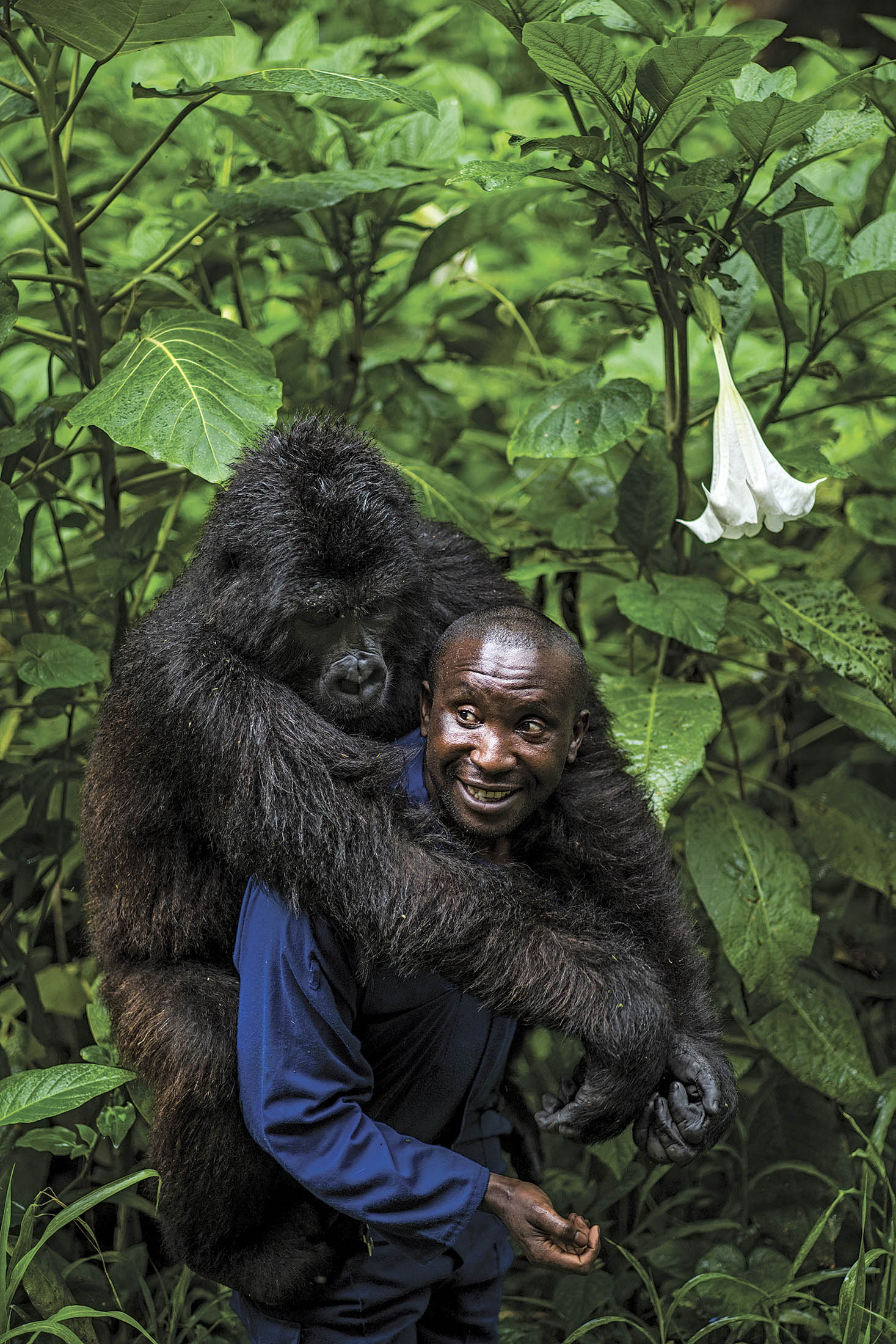
In and around the Bukima tented camp, located in Virunga National Park. Bukima camp is the base from which to see eight separate groups of mountain gorillas, including members of the Rugendo group, pictured here.

In the third episode exploring jungle habitat, Attenborough takes us to the Democratic Republic of Congo and its endangered Silverback gorillas, so strikingly like ourselves. Lamentably, their numbers have dropped by fifty percent, says Attenborough.

The good news is that their numbers have actually increased, according to methodical estimates by The World Life Conservation Society (May 2021). Previously around 600, they’re up to 1,000 due to concerted conservation efforts, a number still perilously low. Their principal habitat is the Democratic Republic of Congo’s Virunga National Park.

In and around Mikeno Lodge. Virunga Park Rangers work with hounds and a spaniel. The hounds help hunt poachers while the Spaniel helps to find weapons and ivory. Ranger Andre Bauma has been taking care of orphan gorillas for more than four years.

The bad news is that the DRC has just announced its intent to auction oil and gas permits in the park, which also features the world’s largest tropical peatlands, constituting the earth’s most extensive carbon sinks. These beautiful creatures have already endured grevious injury due to habitat loss, hunting, poaching, population encroachment, disease —and yes—human conflict, with splinter rebel groups hiding out in the park.

Virunga is a cornucopia of wildlife, both flora and fauna. Africa’s oldest reserve, its 1.2 million acres provide sanctuary for 700 types of birds and 220 species of mammals, including elephants, giraffes and chimpanzees. I shudder to think of the horrid consequences of its demise, wrought by human greed. In the last decade, more than 150 of the park’s rangers have been killed.

Were I younger and financially able, Virunga is where I’d be headed. I believe strongly in eco-tours. For the Congolese, it’s been a money maker, with $2 million in annual earnings.

Hats off to actor Leonardo DiCaprio for his 2014 Netflix documentary, Virunga, and commitment to the survival of the imperiled Silverbacks. It proved successful in halting oil exploration in the park at the time.

My hope is that we can exert pressure on oil corporations to refrain, as we successfully did in 2014. The best way is to discourage insurers and banks from financing the project. As I write, Congolese and international NGOs have submitted a petition of 100,000 signatures, requesting Congo’s President to halt new oil development

–rj

Wade Davis Defends the Indigenous

b1ca14e2-5ab5-4999-8ed8-4226ad6b373b

I’m a big fan of history, authentic history that’s unshackled from bias. I like knowing what really happened, when and how, and the lessons we can draw from history, lest we repeat its follies. Sometimes, though, history is like lining up for my morning cod liver oil as a child, good for me, but awful tasting stuff I want desperately to spit out, especially when learning of our continuing abuse of indigenous people, not only in America, but worldwide.

In North America, where I live, our crimes against native peoples comprise an unparalleled holocaust even by WWII’s blood-curdling horror show of 10 million Jews, Slavs, and Roma slaughtered in Nazi death camps. It began even before the notorious Indian Removal Act (1830), ordering Indians east of the Mississippi to move westward. Jefferson’s Declaration of Independence decries the Indians as “savages.”

Just how many indigenous people lived in North America, not including Mexico and Central America, prior to 1492, is a calculated estimate at best. The consensus, however, led by scholars Russell Thornton and David Stannard, poses a reasonable estimate of 7 million, with 75 million in the Western Hemisphere at large (see Russell Thornton, American Indian Holocaust and Survival: A Population History since 1492, Norman: University of Oklahoma Press, 1987; David E. Stannard, American Holocaust: The Conquest of the New World, (New York: Oxford University Press, 1992). 

Thornton thinks that of some 5 million indigenous peoples within today’s continental United States, the vast majority were decimated by disease, starvation, forced labor, relocation, alcoholism, declining birthrates, and genocide. By 1900, that number had dwindled to 250,000. Of the 75 million indigenous in the Western Hemisphere, an estimated 70 million have perished consequent with European colonization since 1492.

Anthropologist explorer and advocate of indigenous interests, Wade Davis, wrote a definitive account of their plight, worldwide, in his 2001 book, Light at the Edge of the World: a Journey Through the Realm of Vanishing Cultures. It navigates, in particular, the pressures of modern civilization on ancient ways of life, harboring unique wisdom acquired over thousands of years of living in close contact with the natural world.

Wade explores several cultures, among them, Borneo’s Penan, northern Kenya’s pastoral nomads, and, tragically, the fate of Tibet and the coerced extinction of an ancient way of life. His book concludes with a model of hope in Canada’s designated vast homeland for the Inuit, Nunavut.

Passionate and eloquent, Wade delivers a salient polemic for doing everything we can to preserve these ancient cultures with their unique ways of imagining the human experience.

In our ethnocentrism, we may dismiss these cultures devoid of modern amenities as anachronisms, their loss of no consequence, perhaps even desirable: cessation of inter-tribal violence, improved health, social equity, education and employment options, etc.

Wade argues persuasively that when these unique societies fade, their former constituents most frequently find themselves adrift, subject to discrimination and poverty. He gives many examples such as the sad aftermath of the 1956 evangelical missionary intrusion of the Waorani, or Auca, habitat in remote Ecuador, its culture vanquished and displaced tribespeople reduced to menial labor in a modern landscape.

Space is crucial in positing who we are. When lost or compromised, we become adrift, flotsam in a larger current, severed from what conferred identity. This has also been the fate of Native Americans at large.

Spatial encroachment seems everywhere now, accelerated by corporate interests, technology, and human indifference. 98.9% of historical indigenous lands in North America have been lost since 1492 (environment.yale.edu). It continues unabated worldwide: Central America, the Amazon forest, Africa, where logging, mining, dam construction, oil drilling, pipe line installation and agribusiness, the foremost instigator, exact their toll upon historically indigenous land.

An estimated 370 million indigenous live in 90 countries and are notoriously abused. They exist as 5,000 distinct peoples, speaking 4,000 languages. 70% percent of the indigenous live in Asia.

Did you know that indigenous life expectancy is 20 years less than the rest of us? Or that comprising five percent of the world’s population, they’re 15% of the world’s impoverished?

We do a lot of talking about climate change, but how many of us realize the environment’s greatest defenders are the indigenous?

Occupying 25% of the world’s surface, they are guardians of “80% of its remaining biodiversity and 40 per cent of all terrestrial protected areas and ecologically intact landscapes” (Amnesty International).

20% of the world’s tropical carbon forest is stored in indigenous lands: the Amazon, Central America, Indonesia, the Democratic Republic of Congo (worldbank.org).

What’s more, their demise poses a visceral loss to all of us in the forfeiture of a unique diversity, reducing the world to a “monochromatic world of monotony,” Wade writes.

Tragically, in the last fifty years we have witnessed not only the loss of 1 million species of inestimable value to the biosphere upon which our existence depends, but the uniqueness and wisdom of cultures from which we can learn much to ameliorate our own. The parallel fate of these cultures, despite the UN’s passage of the Indigenous Bill of Rights, poses one of the urgent issues of our time.

Worldwide, some 300 million people, roughly 5 per cent of the global population, still retain a strong identity as members of an indigenous culture, rooted in history and language, attached by myth an memory to a particular place on the planet. Though their populations are small, these cultures account for 60 per cent of the world’s languages and collectively represent over half of the intellectual legacy of humanity. Yet, increasingly, their voices are being silenced, their unique visions of life itself lost in a whirlwind of change and conflict.

Wade argues that the loss of language diversity, in particular, underscores the accelerating demise of ethnosphere diversity through loss of habitat, acculturation and assimilation:

Of the more than two thousand languages in New Guinea, five hundred are each spoken by fewer than five hundred people. Of the 175 Native languages still alive in the United States, 55 are spoken by fewer than ten individuals.

….each language is, in itself, an entire ecosystem of ideas. and intuitions, a watershed of thought, an old-growth forest of the mind. Each is a window into a world, a monument to the culture that gave it birth, and whose spirit it expresses.

I’m very receptive to Wade. I’ve long been a student of culture. Wade’s book continues that interest and I recommend it, and all his books, as a collective, informed defense of the right of indigenous communities to a way of life, often superior to our own; the interplay of gathered insight through intimacy with Nature in its many vicissitudes.

I believe strongly in the gifts diversity confers, every culture a contributing chapter in the human narrative. Any diminishment of the ethnosphere consequent with cultural leveling alarms me. I believe it constitutes cultural genocide, whether by intent or omission.

Climate change is today’s most ardent threat to indigenous peoples, their ecosystems, upon which they depend for subsistence, vanishing rapidly as increasing temperatures; a greater suspectability to illness via vector borne and water borne diseases; drought; forest fires; and desertification exponentially occur.

In Northern climes, the Inuit, for example, are now facing a potential hunger crisis consequent with melting glaciers, rising seas, and diminished wildlife; on tropical islands, storms of increasing velocity occurrence and rising seas menace as never before.

The UN High Commissioner for Refugees informs us that there presently exist 37 million climate refugees, a disproportionate 15% of whom are indigenous peoples.

I find this an unfolding tragedy. Indigenous tribes have been stalwart stewards of the biosphere from whom we can learn, but conversely set upon by agriculture expansion, logging, and mining interests. Activists have been murdered, most recently, journalist Dom Philips and indigenous advocate, Bruno Pereira in Brazil. Pereira had been investigating criminal activity within the Amazonian indigenous reserve of the Javari Valley. Philips was there to document.

In 2020, Frontline Defenders reported that at least 331 human rights activists, mostly in Central and South America were murdered, 69% of whom were defending indigenous lands. Between 2017 and 2020, 25% of those murdered were indigenous, who comprise only 5% of the world’s population. In 2021, a known 33 indigenous people were killed.

As I write, photos of many of indigenous victims lie before me, a good number of them women along with their children. I can give you country by country analysis of the continuing bloodbath, with governments such as Brazil’s Bolsonaro indifferent to the crisis and the perpetrators remaining free.

Unfortunately, the indigenous often live in areas most vulnerable to climate change: the Arctic’s Inuit, Scandinavia’s Swami, the Amazon’s Yanomami, for example. Thus, their ardent defense of their diminishing environment made worse by exploiters.

Their demise poses an incalculable loss for all of us. Wade, with his typical acuity, summarizes its meaning well:

The ultimate tragedy is not that archaic societies are disappearing but rather that vibrant, dynamic, living cultures and languages are being forced out of existence. At risk is a vast archive of knowledge and expertise, a catalogue of the imagination, an oral and written literature composed of the memories of countless elders and healers, warriors, farmers, fishermen, midwives, poets and saints. In short, the artistic, intellectual and spiritual expression of the full complexity and diversity of the human experience.

Indigenous People’s Day will be observed October 10, 2022 in the U.S. in 26 states as part of a growing movement to replace the traditional Columbus Day.  For me, it’s everyday I remember them, Earth’s guardians, beleaguered and increasingly vanishing along with their sacred habitat. They need your help.

—rj

Only the beginning…

Britain is experiencing an unprecedented heat wave today, with temperatures soaring to 104F over much of England. Scientists are apprehensive, their future model scenarios occurring faster than anticipated.

Meanwhile, we continue our dependency on fossil fuels, our president begging Saudi Crown Prince Mohammed bin Salman, yes, the same guy our intelligence names as ordering the killing of Washington Post Saudi critic, Jamal Khashoggi, to increase oil output.

Widespread reports have it that Biden is proposing to open up Alaska’s North Slope wilderness to drilling, despite the Interior Department’s initial draft supplemental impact statement, projecting a thirty year time bomb release of 284 metric tons of carbon into the atmosphere.

Under the proposal, ConocoPhillips would obtain drilling rights to five federal land sites, along with a processing facility, pipelines to transport oil, gravel roads, and at least one airstrip and a gravel mine site, according to the draft EIS.

The fallout would be consequential to wildlife as well, threatening caribou, polar bears and migratory birds.

Ominously, the Arctic and Antartica, which help cool the earth by reflecting sunlight back into space, are melting faster than other earth regions. Hence, the heat waves increasingly scorching the Earth. The proposal only increases the speed of melting ice, resulting in rising seas, release of methane, and alteration of sea currents such as the Gulf Stream

As I write, Alaska has been burning faster than in the last 80 years, with 500 fires since April of this year, the consequence of rising temperatures, increased vapor with accompanying lightning strikes, and accumulating kindle. 264 fires are currently burning across the state.

While I’m ashamed of Biden’s betrayal of his campaign pledges, what bothers me most is the public’s myopic indulgence to pursue life in a bubble, ignoring the ominous natural signatures to our coming doom.

Unless we amend our ways, our children will have no meaningful future.
—rj


The 10th Amendment: Roe vs Wade

The 10th Amendment is used by right to life advocates to justify the U.S. Supreme Court’s overturning Roe vs Wade. Implying two distinct legislative spheres, it reads, “The powers not delegated to the United States by the Constitution, nor prohibited by it to the States, are reserved to the States respectively, or to the people.”

This is the same Amendment that was used by SCOTUS to justfy the infamous Dred Scott decision (1857), defining slave/free state boundaries. Lincoln intuited its liabilities, leading to the Emancipation Proclamation (1863).

Its history is complex, Jefferson supporting it; Hamilton, opposed. It has been cited by local jurisdictions opposing federal Covid mandates.

I believe it needs revision, our founding Fathers not foreseeing the complexities of our present times. The Constitution must always give precedence to public welfare, not factional interest, whether left or right. How else could the government have rescinded segregation in the Little Rock school integration crisis of 1957, ending with Republican Dwight Eisenhower’s employment of federal troops?

I vigorously support John Stuart Mill’s principle of “disinterested benevolence,” i.e., the right of government to advocate policy conducive to society’s welfare, not factional interest: its right to impose environmental laws, construct highways, mandate taxes, allow unions, sanction military drafts, regulate commerce, provide medical access, govern immigration, ensure the liberties of marginalized entities, etc. The list is long.

Government’s true role is to ensure not only traditional freedoms, but to promote progressive policy implementation enhancing the citizenry’s collective well-being.

Simplistic, the 10th Amendment has historically proven an impediment across many fronts, seen again in the abrogation of a woman’s right to sovereignty over her own body. Contraception access may be next.

—rj

One Mistake at a Time: Our War on Nature

The  only biodiversity we’re going to have left is Coke versus Pepsi. We’re landscaping the whole world one stupid mistake at a time. —Chuck Palahnuk, Lullaby

The year is 2060. You are gone, but your grandchild reads to her children from a book filled with drawings of creatures once abundant and a source of wonder, now the stuff of children’s story books, only not of some fearsome Tyrannosaurus Rex, Megalodon, or Woolly Mammoth, but of elephants, giraffes, lions, tigers, rhinos, whales and monarch butterflies, now vanquished, never to grace our earth again.

Distressingly, largely due to the exponential increase in the human footprint, this is our grandchildren’s bleak future. No more condors, manatees; no more of our closest relatives, chimpanzees, orangutans, and mountain gorillas, natural selection’s vast repertoire of unique, splendid entities reaching back several million years, thoughtlessly extinguished by Homo sapiens.

Apart from the scientific community, the public appears largely unaware, perhaps even indifferent, to this unprecedented threat to species loss and the risks it imposes for its own welfare. This extends to climate change, largely human induced. A current PEW poll reveals only 41% of Americans regard it as a priority issue.

As to how many species exist, whether flora or fauna, we don’t really know. New species are continually being discovered, while others have recently become extinct or face extinction. What we do know is that many species have gone extinct even before their discovery. An estimated million others are likely to go extinct in the next several decades.

This leaves us in a quandary: do we attempt to preserve existing species for future generations or do we simply resort to preserving those serving immediate human interests? Unfortunately, our present trending indicates the latter with species everywhere in free fall.

A useful acronym for the specifics governing this decline is HIPPO: habitat loss, invasive species, pollution, population growth, over exploitation:

Habitat: Three quarters of the earth’s terrestrial environment has been altered by human activity; 66% of the marine environment.

Invasive species: Since 1970, invasive, alien species have increased 70% across 21 countries.

Pollution: 300-400 million tons of heavy metals, solvents, toxic sludge among other wastes from industrial facilities have been dumped into the world’s waters.

Population growth: The world’s population averaged an annual 1.7 increase between 1950 (2.5 billion) and 2010 (6.9 billion). In 2022, world population has reached 7. 6 billion. (Pew Research). While the growth rate has generally been plummeting, not so in Africa, averaging an annual 2.54 increase. By 2050, Nigeria will overtake the U.S. in population (The Economist); 800 million by 2300 (qz.com).

Over-exploitation: In 1930, an estimated 10 million elephants roamed Africa. Currently, that number has dwindled to 416,000, largely due to poaching and conflict (World Wildlife Federation). On the high seas, factory ships are removing fish faster than they can be replenished. Japan continues to hunt whales. Sharks are killed in the thousands for their fins (fin soup a Chinese delicacy), their carcasses thrown into the sea. Chimpanzees, our closest relatives, hunted for meat and increasingly suffering habitat loss, are now a threatened species.

Climate change needs to be added, giving us HIPPCO. It ranks second to habitat loss in imperiling biodiversity. Largely due to climate change, we are losing our polar bears, just 31,000 remaining; coral reefs with their independent ecosystem, nourishing myriad aquatic life, are dying as the sea warms and storm intensity and frequency increase. The speed of heat increase due to reliance on fossil fuels over the last 100 years now exceeds that of the previous 10,000 years.

Extinction isn’t new to earth’s history. Geologists have noted five principal occurrences, the most famous that of 65 million years ago, when a 12 kilometer wide asteroid crashed into the Yucatan, leaving a crater 10 kilometers deep and 180 kilometers wide, killing 70% of the earth species, including the dinosaurs, ending the Mesozoic Era, or Age of Reptiles, and ushering in the Cenozoic Era and the rise of mammals after 10 million years of evolution.

Humans came late on the scene. In the 1980s, aquatic biologist Eugene Stoermer coined the term Anthropocene to depict a new epoch, human dominated. In this epoch, the Earth faces a new menace, wrought not by an asteroid, but by Man. The massive extinction of this human-centered epoch has been popularized as the Sixth Extinction.

The fundamental source of our dilemma is our disconnect from nature. We have fostered Nature as something apart from ourselves. It exists, but it’s outside ourselves, an entity to be exploited for human needs.

The truth is we exist as constituents of a vast biosphere complex of interrelated life forms dependent on one another for well-being. Remove an element of this web and you potentially unleash a house of cards scenario of collapse.

Take, for example, the chestnut tree dominating the forests of Eastern North America before European settlement. Tall, fast growing, numbering an estimated four billion, their canopy housed millions of birds and their nuts provided food for many birds, insects and mammals. Then came the Asian pathogen fungus Cryphonectria parasitica of the early 20th century. With the loss of these magnificent trees came the demise of caterpillars metamorphosing into moth pollinators, along with the plunge into oblivion of the once prodigious passenger pigeon.

116D5F72-3B99-4C13-B7D8-FA23C1DD77E8

In our earth’s nearly 4 billion year history, we estimate that of the 4 billion species evolved by nature, 99% are extinct. But such extinctions resulted from natural antecedents apart from human causation. Increasingly, Man has become the arbiter of species decline, not evolution or cyclic climate change, or asteroid collision. In the last 500 years, 900 species have gone extinct and the pace quickens.

Currently, 35,000 species face extinction risk, according to the International Union for Conservation of Nature’s Red List of Threatened Species:

Among these, 1 in 7 bird species.

A quarter of the world’s mammals

40% of amphibians

34% of conifers

37% of sharks and rays

21% of reptiles

33% of reef corals

It gets worse than that. The latest UN IPBES Global Assessment report (2019) forecasts more than a million species are likely to go extinct in coming decades.

The biosphere, which includes ourselves, is Nature’s survival gift, complex and delicate, requiring balance of its constituents.  Safe-guarding it is crucial and its benefits not to be taken for granted. Healthy Plants convert the sun’s energy, making it available for other life forms. Bacteria and other living organisms convert organic matter into nutrients enriching the soil. Pollinators are essential to food production. Plants and oceans act as major carbon sinks.  Did you know that of the 50,000 known medicinal plants, up to a fifth face extinction from deforestation? Or that approximately 120 drugs derived from rainforest plants are used to treat cancer, leukaemia malaria, heart diseases, bronchitis, rheumatism, diabetes, arthritis or tuberculosis? 

As the late eminent biologist E. O. Wilson pleads in his compelling Half Earth,

The biosphere does not belong to us; we belong to it. The organisms that surround us in such beautiful profusion are the product of 3.8 billion years of evolution by natural selection. We are one of its present-day products, having arrived as a fortunate species of Old World primates. And it happened only a geological eyeblink ago. Our physiology and our minds are adapted for life in the biosphere, which we have only begun to understand. We are now able to protect the rest of life, but instead we remain recklessly prone to destroy and replace a large part of it.

Our Earth has taken ill and we are its cause. Paradoxically, we must be its healer.

—rj


A Reading of Jennifer Rahim’s Poem, “Wherever I go…”

Thomas Wolfe famously wrote “You can’t go home again.” On the flip side, we never leave. The latter defines the theme of Trinidad poet Jennifer Rahim’s “Wherever I go….”

I have a liking for poetry of surface simplicity, yet iceberg subtlety offering multiple nuance.

A good poem is when everything functions: structure, rhythm, diction, imagery, etc. In this sense, all worthy poetry is ecological, each element an integral contributor to the welfare of the whole.

Good poems suggest, lending them universality.

When done well, their texts rewrite themselves, speaking to us continually in varied ways beyond spatial and temporal boundaries.

In all these aspects, Rahim’s poem does not disappoint.

Wherever I go…

there will be an island,
and an ocean will be
what rings me.

We are to the very end
a naming not our own,
though we leave to find

what is left behind
and that holds us,
more than we know,

like a small beach
has the ear of the great sea

and a trillion ebbs
are never without returns.

This flow is the staying,
though we depart.

An oyster takes a single grain
and stores it in her heart’s muscle

like a lover’s memento;
she never lets us go …

I like the unusual way Rahim integrates the title, an adverbial clause, flowing like the poem’s ocean ambience, into the lines that follow, setting up the poem’s structural elements.

That this clause ends in ellipsis, is significant, suggesting still more to be said. Reflection lies at its core.

While not specified, this is a poem about leaving home and its consequences.
That Rahim is from Trinidad may lead readers to impose boundaries on its meaning, i.e., the diaspora. Yes, emigration has been a norm for Trinidadians, 400,000 of them living in the USA; another 80,000 in Canada and 23,000 in the UK. Trinidad’s most renowned writer, the late V.S. Naipaul, resided in the UK.

Two notable novels of our time depicting the immigrant mood superbly are Nigeria’s Chimamanda Ngozi Adiche’s Americanah and India’s Amit Chaudhuri’s Odysseus Abroad.

But the poem transcends restriction to migrants in its nuance.  A well made poem coalesces its formal elements into meaning.  It is its own text.

Read this way,  “Wherever I go…”  becomes universal, topophilia, or love of place, its theme.  As Alastair Bonnett comments in his Unruly Places, “Place is a protean and fundamental aspect of what it is to be human. We are a place-making and place-loving species.”

The poem’s structural elements are binary in their conception,
three introductory tercets, followed by couplets offering amplification through simile and metaphor. In both sections, sea referents prevail, unifying the poem.

Irony pervades the structural prelude: “we leave to find”

what is left behind
and that holds us,
more than we know.

“Ring” in l. 3 suggests encirclement or entrapment. We cannot elude our origins that birthed our identity.

The amplifying examples defining this sense of dislocation are embedded in specific sea imagery in the subsequent couplets, suggesting the tidal flow of remembrance: “This flow is the staying,/though we depart.”

The small beach and echoing of sea landscape hint at constancy and safety.

Then comes the poem’s magnificent concluding oyster analogy defining the enduring strength of remembrance:

An oyster takes a single grain
and stores it in her heart’s muscle
like a lover’s memento;
she never lets us go …

Intriguingly, ellipsis concludes the poem, mirroring the ellipsis of the opening and its thematic, “Wherever I go…”

A unified poem in all its informants, we now understand more fully the persona’s opening musing:

Wherever I go…
there will be an island,
and an ocean will be
what rings me.

Archetype abounds.  Islands often represent sanctuary; the sea, the timeless and maternal. Rahim’s poem is from her new poetry collection, Sanctuaries of Invention.

The oyster has a maternal aspect, pregnant as it were with a grain (seed) becoming a pearl.

The pearl referent, however, is double-edged. In mythology, looking back imperils. Memory can embellish, recalling Proust’s sober observation, “Remembrance of things past is not necessarily the remembrance of things as they were.”

And yet as Homer underscores in his epic saga of the archetypal migrant, each of us requires his Ithaca.

–rj