From Ally to Outlier: Türkiye’s Democratic Backslide

He is a weak ruler who needs religion to uphold his government; it is as if he would catch his people in a trap. My people are going to learn the principles of democracy, the dictates of truth, and the teachings of science.” — Mustafa Kemal Atatürk (Father of Modern Turkey)

If you’ve been reading the headlines, the 2024 BRICS assemblage of twenty heads of state has just concluded in Kansan, Russia. If you thought host Vladimir Putin lacks friends beyond China and North Korea, then you’re mistaken.

BRICS, in fact, is growing. This year’s consortium includes new members Egypt, Ethiopia, Iran, Saudi Arabia, and the United Arab Emirates in addition to its founding members: Brazil, Russia, India and South Africa (thus the acronym).

What you wouldn’t expect, being both a NATO member and EU candidate, is Türkiye’s applying for BRICS membership (September 2, 2024).

It would certainly surprise Mustafa Atatürk, Türkiye’s George Washington, who promoted Westernization, leading to the separation of religion and state, the ending of polygamy, the abolishing of the veil, the emancipation of women and the adoption of a Latinate script, replacing Arabic.

It’s past time to soft-pedal Türkiye, a subversive entity increasingly out-of-touch with the values of Western democracies.

Allow me to enumerate its transgressions:

1. Türkiye continues to discriminate against its 175,000 Christians in a country 95% Muslim. The primary lure of visitors to Istanbul is the famed Hagia Sophia cathedral, founded by Byzantine Emperor Justinian I in 537 CE. The conquering Sultan Mehmet II converted it into a mosque in 1453 CE. Atatürk, however, rescinded that action, designating it a museum. Türkiye’s high court annulled that decision in July 2020, a move hailed by Erdogan as “the second conquest of Istanbul.”

In the years 2018-2020, Türkiye deported more than fifty foreign Christian pastors on the pretext of constituting a threat to Turkish national security. As is, Christian ministers have no indigenous seminary, their future uncertain.

There was the notorious imprisonment of American Presbyterian pastor Robert Brunson, a 20-year resident of Türkiye on charges of  collusion with Kurds, undermining national security.  In response, Trump doubled tariffs in 2018 on Türkiye’s aluminum and steel, sending the lira into a steep decline. Brunson was released shortly after, having been imprisoned for two years  (Imprisonment).

Space does not allow for numerous other instances of religious intolerance
Middle East Forum

2. Türkiye continues to deny the Armenian Genocide (1915-1917) with its displacement, forced marches, compulsory Islamization, and mass murder of 1.1 million Armenians, along with expulsion and massacres of its Greek population. No serious historian denies its factuality.

3. It refuses to grant its sizable Kurdish minority a right to its culture and self-government.  In July, 2024, President Recep Erdogan made clear his plan to promote demographic change in Kurdish northern Syria by resettling three million Syrian Arab refugees there, along with building a city dedicated to their presence (Refugee Resettlement).

4. In Europe, Erdogan stubbornly resisted Finland and Sweden’s membership in NATO, holding out for fighter jets.

5. At home, Erdogan rules with a heavy hand, crushing political dissent, the right of free assembly and a free press. Scores of journalists, academics, judges, and civil servants have been imprisoned (Amnesty International).

6. As for Türkiye’s gifted literary community, intimidation has become ubiquitous, with some writers jailed or ostracized in the press. They include the journalist Can Dündar, poet Ilhan Sami Çomak, and politician Selahattin Demirtaş, who wrote three novels in jail. Nobel literary laureate Orhan Pamuk retains a security guard  (Dial World).

7. And then there is Türkiye’s most renowned writer, Elif Shafik, who has resided in London since 2013 and no longer writes in Turkish. Since 2010, fringe nationalists and Erdogan loyalists have confiscated her books and slandered her reputation.

As Shafak trenchantly observes, “It is tiring to be Turkish. The country is badly polarised, bitterly politicized. Every writer, journalist, poet knows that because of an article, a novel, an interview, a poem or a tweet you can be sued, put on trial, even arrested. Self-censorship is widespread”(Dial World).

8. Discrimination against the LGBTQ community is pervasive, extending to workplace, social settings, housing, and healthcare. Türkiye’s government officials, including Erdogan, have not been shy in disparaging gays. In Istanbul and Ankara, LGBTQ events have been frequently banned as affronts to public morality (RFI).

9. Türkiye has conducted an aggressive foreign policy, menacing its Mediterranean neighbors, pursuing illegal drilling that violates international maritime law. In response, the European Council has imposed sanctions.

It supported Azerbaijan with weaponry in the Nagornal-Karabakh conflict.

Türkiye has militarily intervened in Libya and Syria; in the latter, attacking Kurds aligned with U.S. forces opposing Syrian strongman Bashar al-Assad and a growing ISIS insurgence.

10. Of major concern is Erdogan’s brokering a $2.5 billion deal with Putin to purchase the Russian S-400 surface to air missile system, compromising American defense security, leading to previous president Trump’s curtailing shipment of F-35 jets to the country.

Unfortunately, efforts within Türkiye to check Erdogan’s growing powers have failed.

What can be done?

Not much, as no specific measure exists for expelling a NATO member. Such action would be unlikely anyway, pragmatists arguing the country’s considerable military strength and role as a buffer to Russian and Iranian interests in the Middle East.

As for the US embargo on jets, following Erdogan’s finally approving Sweden and Finland NATO membership, the Biden administration agreed to send Türkiye 40 F-16 fighter jets. The two nations have further set a goal of $100 billion in bilateral trade, up from $30 billion in 2023 (Reuters, September 23, 2024).

What remains a disciplinary possibility is that the EU may ultimately deny an intransigent Türkiye highly coveted EU membership. That’s probably wishful thinking, opponents arguing Türkiye formidable military as a necessary offset against Russian and Iranian hegemony in the region. Strategically, it controls the Bosporus Strait, linking the Black Sea to the Mediterranean .

It doesn’t help that there exists a lucrative tourism, grossing 40 million visitors in the first eight months of the current year, an increase of 7.1 % over the previous year.

Indeed, tourism is likely to increase, despite the US State Department’s issuing an advisory in October on traveling to the country. Terrorists have targeted tourist locations and the government has imprisoned thousands, including Americans, on scanty evidence of alleged ties with terrorists (Advisory).

Still, it isn’t all doom and gloom, Erdogan’s ruling party, the AKP, finishing second in the March 24, 2024 local elections.

Meanwhile, informed citizens committed to human rights will understandably refrain from traveling there.

–rj

America’s Fossil Fuel Addiction: A Call for Change

As another storm, Milton, churns its way in the Gulf toward FL, Americans continue their love affair with fossil fuels, reluctant to embrace habit change and the inconvenience it imposes. One of our candidates for the nation’s highest office, with PA in mind, now preaches fracking; the other wants to roll back all climate change regulation.

China puts us to shame, last year installing 57% of all new solar plants around the world.

Likewise, Singapore, its people on board, plans to be zero emissions free by 2050.

As is, expect more storms, more heat, more fires, more drought, more ecosystems on which our survival depends, compromised or destroyed. A recent Lancet Countdown analysis (2023) reports that 80% of the 86 governments assessed were subsidizing fossil fuels, providing a collective $400bn in 2019.

We are addicted, myopic about the myriad consequences of fossil fuel dependency we relegate to a remote future.

Presently, there’s not a single Earth System that doesn’t face collapse.

We need to be on a war footing, the environment our highest priority, if we’re to avoid apocalyptic scenarios like that of Appalachia emerging a salient headline of our daily lives.

If we stubbornly resist taking action to mitigate the situation, the ecological balance — a product of millions of years of evolution that sustains life on Earth — may soon collapse, leading to our eventual extinction.

—rjoly

Antigua’s Chinese Enclave: What it Means

ANTIGUA: TOURIST PARADISE:

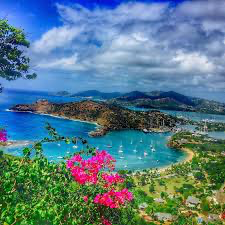
A mere 264 miles from US shores lies the sovereign Caribbean island nation of Antigua and Barbuda, a tourist’s paradise blessed with stable, year round temperatures; several hundred pristine beaches; lush lagoons; and hideaway natural harbors. It has mountains, too, offering scenic views of a vast mangrove forest. 80% of Antigua’s GDP derives from tourism.

But Antigua, like other island nations, faces immense challenges in the maelstrom of climate change: increase in hurricane intensity and frequency, rising sea levels, erosion, salt water intrusion, and ground water depletion.

2017 saw Antigua devastated by Category 5 Irma, destroying 97% of
Barbuda’s infrastructure, rendering it nearly uninhabitable.

Often dubbed “the Switzerland of the Caribbean,” Antigua finds itself lacking the financial resources to sustain its economic viability in the context of climate change and yielded to Chinese overtures: a 2 percent interest loan, with a 5-year moratorium on repayment.

Antigua’s prime minister, Gaston Browne, views China as a friend: “I see China, though, as a country that stands on truth, and a country that, you know, at least has some level of empathy for small states, and generally for poor and dispossessed persons globally” (Newsweek. May 5, 2024).

ENVIRONMENTAL THREATS POSED BY CHINA IN ANTIGUA:

Newsweek’s recent study of leaked documents indicates 1000 acres of forest will be razed to accommodate a Chinese Economic Free Zone juggernaut, ultimately consuming 2000 acres for housing and businesses. It includes an airport, up to seven resorts, a shipping port, and Antigua’s first four lane highway. Construction has begun.

Bearing all the earmarks of a Chinese enclave, the completed project confers independent immigration and customs formalities for the enclave and a license to issue passports. It will not pay income taxes, unlike native Antiguans, sales taxes, or import duties. Anyone investing $400,000 or more will be eligible for Antiguan citizenship

Browne touts his Chinese venture as an investment in the future, creating hundreds of jobs.

Browne sweetens the deal by promising environmentalists a 70 acre mangrove reserve and a 60 acre nursery for growing 100,000 trees.

This hasn’t pacified the island’s environmentalists, however, who contend the free zone transverses the island’s largest marine reserve, under legal protection since 2005, and destroys most of its mangrove forests, a haven for migrating birds.

They point out the area’s “nesting ground for critically endangered sea turtles, the threatened West Indian whistling duck and the Antiguan racer, once dubbed the world’s rarest snake, brought back from the brink of extinction by efforts from local environmentalists” (Newsweek).

Browne angrily brands his critics “ecoterrorists.”

AIR AND WATER POLLUTION:

China has a history of contributing to pollution through industrial production and waste processing. Enforcement of environmental protections is often ignored when it comes to garbage, water, atmospheric, and excrement pollution, undermining economic development and investment.

Opponents insist the Antiguan government adequately address these issues, which could have deleterious effects on soil ecology, agricultural production, and water supply.

Antigua’s first environmental report by the government’s environmental management authority, issued in 1992, proved alarming in terms of pollution, waste disposal, deforestation, and entrepreneurial nonchalance.

As for the accommodation sector, the study noted that the water supply for the bankrupt Grand Royal Hotel was found inadequate, singling out Chinese businesses for dumping.

OVERFISHING AND MARINE ECOSYSTEM DEGRADATION:

Chinese nationals also have a legacy of illegal and unregulated logging of parrotfish in the coral reefs, which are important to the marine environment of Antigua’s Marina Bay. As such, not only are the food chain and the environment in peril as acres of mangroves fall to chainsaws, but its fisheries as well

China’s relentless pursuit of high-quality fish (apex predators in the ocean communities), and the destruction of the ecosystems that consistently produce these creatures, have been implicated as the main culprits in extensive ecosystem degradation when applied at galactic scales to Africa, the American Pacific coast, and now the Eastern Caribbean.

Buying seafood from China, which will be allowed to operate a fish farm, has negative consequences for both the environment and Antiguan fishers. Chinese vessel owners profit greatly from buying or leasing fishing rights from over 60 countries, including Antigua and Barbuda. While this provides a trillion meals per year, it causes damage to the ocean.

HISTORY OF CHINESE CARIBBEAN INVESTMENT:

The major Chinese enterprises in Antigua mainly involve construction, infrastructure, real estate, and hotels. The total value of China’s FDI in the seven countries of the Organization of Eastern Caribbean States (OECS) was estimated at almost 300 million US at the end of 2011. Chinese financing came in the form of concessional loans. In the Eastern Caribbean, it funded the construction of the national stadium, the American University of Antigua, and the Lyndhurst Road Development Project. China has also engaged in a number of technical cooperation projects in capacity building and training and granted subsidies to the Tropical Storm Grant Program.

The bottom line is that China’s growing influence on Antigua’s politics and economy comes at a cost, primarily to the environment and the United States. Air and water pollution in Antigua are predominantly caused by Chinese firms.

The challenges deriving from air pollution and inadequate addressing of such concerns leave open the question of whether a distinction should be made in Antigua between government policies attracting investment contributing to the economy while exacerbating the country’s environmental problems and those policies that mitigate polluting.

Antigua’s economic growth in the last decade has been due to investments and loans from China, which reflect China’s strategic objective in the Caribbean. Smaller island nations have been overly enthusiastic in embracing China’s support since they have been relegated, as well as stigmatized, by powerful global financial institutions in times of crisis. The Chinese have presented their assistance with no condition of policy or regime change, thus undermining the frequent dictates of the Washington Consensus.

China has been exploiting the vulnerability of developing nations. If Beijing can increase its investments in countries that are dependent on tourism and other single export industries, it can anticipate predictable returns. Focusing on countries that rely on imports, not on natural resources, China is now the second largest trading partner with some Caribbean countries.

POTENTIAL FOR ESPIONAGE AND CYBERSECURITY RISK:

Given its proximity to US shores, Antigua obviously has strategic significance.

On August 17th, 2020, former Trump administration Chief of Staff Mick Mulvaney warned that China’s post-crisis economic policy, including investment in impoverished Caribbean nations like Antigua and Barbuda, jeopardizes US security.

Historically, the Monroe Doctrine (1823), was strictly enforced to keep foreign interests from interference in the Americas. Among its provisions, further colonizations in the Americas would be viewed as threatening US interests.

In 1861, France attempted creating an empire in Mexico, encountering protest.

In 1962, Russian missile intrusion in Cuba nearly launched WWIII.

In 1983, President Reagan committed troops to expel Cuban military from pro-Soviet Union Granada.

Will Antigua become an espionage base like Cuba?

While the U.S. military’s Southern Command (SOUTHCOM) has issued concerns about China’s growing presence in Antigua and the Caribbean region, the Biden administration has been silent.

–rj

Biden plays politics: The Gaza fiasco


On one hand, President Biden urges a ceasefire in the nearly six month Gaza conflict; on the other, he has stealthily authorized a potent new military aid package to Israel that includes jets, 1,800 MK84 2,000-pound bombs, and 500 MK82 500-pound bombs.

Although 2000 pound bombs are capable of taking out whole city blocks and have been abandoned by most Western militaries for employment in urban locales, they have dominated Israel’s aerial assault on Gaza, with the death toll currently estimated at 33,000, the vast majority of them civilians.

Anonymous Pentagon sources disclose the armament transfer includes transfer of 25 F-35A fighter jets and engines at a cost of 2.5 billion.
Biden isn’t mandated to disclose any of this to lawmakers since Congress had approved the transfer in 2008, presently unfulfilled.

Israel is currently the largest recipient of U.S. aid since the 1970s, receiving on average $1.8 billion in military and $1.2 billion in economic aid annually.

Such aid incentivizes documented Israeli violations of Palestinian rights by humane organizations such as Amnesty International and Human Rights Watch. They have included ongoing abusive detention practices (including the torture of prisoners), restrictions on freedom of movement of Palestinians, the targeting of medical personnel and facilities, and severe damage to infrastructure such as water and electricity to Palestinian civilians prior to Israel’s current Gaza incursion.

It does not move the needle to a two state solution.

All of this comes even as Biden expresses concern over a pending Israeli assault on the alleged remaining Hamas stronghold of Rafah along the Egyptian border and UN warnings of incipient mass starvation. 1.2 million Gaza refugees have sought refuge in this enclave.

Jewish pressure weighs heavily on the Biden administration in an election year with the American Israel Public Affairs Committee donating millions to unseat Democrats deemed unfriendly to Israel. A recent Pew Research survey indicates 80% of American Jews regard aid to Israel as essential.

Those constituencies calling for suspension of aid to Israel are branded as anti-Semite, with surging efforts to pass legislation abridging their First Amendment right to free speech.

Republicans, even more than Democrat leaning Jews, have vigorously supported aid to Israel, though increasingly resistant to approving aid to a besieged Ukraine.

Biden would do well to mind an increasingly assertive Muslim-American electorate that threatens to boycott him in November.

Meanwhile, any full scale attack on densely populated Rafah, gateway for food convoys, would conceivably result in thousands, not hundreds, of killed and maimed.

The morally compromised Biden administration has been complicit in Israel’s blitzkrieg that includes mosques, churches, hospitals and refugee camps, abetted by American armaments.

For this, the U.S. proves deserving of world condemnation.

The elephant in the room is Biden; but then again, endeavors to dislodge him by voting for his Republican adversary are surely non sequitur.

Conversely, efforts to encourage divestiture at home and abroad of Israel merit encouragement. They brought down South Africa’s apartheid regime.

America must do what is right, not what is easy.

–rj

US Complicity: A Lack of Political Will


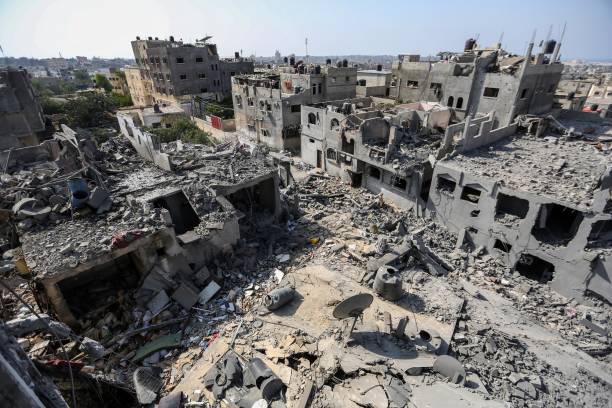
KHAN YUNIS, GAZA -t. (Photo by Ahmad Hasaballah/Getty Images)

If ever there’s been a clarion call for the United States to abandon its military support for Israel, it’s now. Prime Minister Natanyahu has made it clear to Washington that there will be no Palestinian state on the West Bank, rejecting Secretary of State Blinken’s recent plea for a two state resolution as Israel’s surest means to security.

Nor will the Prime Minister, a friend of Donald Trump since the 1980s, scale back Israel’s offensive in Gaza until total victory and return of remaining hostages is achieved.

As I write, nearly 25,000 Palestinians have been killed, two-thirds of them women and children; hospitals, mosques, churches and refugee camps bombed; and a frightened civilian population, 1.9 million of them, or 80% of the Gaza population, herded into a southern corridor, and confronted with disease and starvation.

This constitutes the true genocide, which South Africa has brought to the attention of the International Court of Justice (ICC), the UN’s highest court. Fifty-six other nations support the suit, but not the United States and UK. The European Union has chosen silence.

KHAN YUNIS, GAZA – General view of buildings which were destroyed during Israeli bombardment. Photo by Ahmad Hasaballah/Getty Images)

South Africa has also filed a referral to the International Criminal Court (ICC), not to be conflated with the ICJ, though both are located in the Hague. The ICJ can issue arrest warrants, as it did for Vladimir Putin, who must now avoid signatory countries that include South Africa.

What’s not received ample attention is the economic plight Palestinians face. Before Hamas’ October 7 incursion, 400,000 Palestinians were employed by Israel, largely in construction, agriculture and service sectors. I87,000 Gazans have had their work permits canceled; similarly, 167,000 Palestinians on the West Bank.

In the meanwhile, Israel has set up worker recruiting offices in India and Sri Lanka, with the goal of importing between 50,000 to 100,000 replacements.

This may be part of a long term stategy by Israeli nationalists to encourage Palestinians to leave Israel. Take, for example, Finance Minister Bezalel Smotrich’s call for Palestinian residents of Gaza to leave, replaced by Israelis, who could “make the desert bloom.”

Unfortunately, the Biden administration, despite its call for a cease fire and a two state solution, is unwilling to risk political capital and rebuff Netanyahu by suspending military aid to Israel.

By default, it’s rendered the US complicit in Israel’s criminality, angered Progressives, alienated the Muslim community, made the US a global atavar of hypocrisy, and risks dragging the country into a wider conflict, inflicting incalculable consequences, both home and abroad.

–rj

The Inflation Reduction Act: Fossil Fuels Become Law

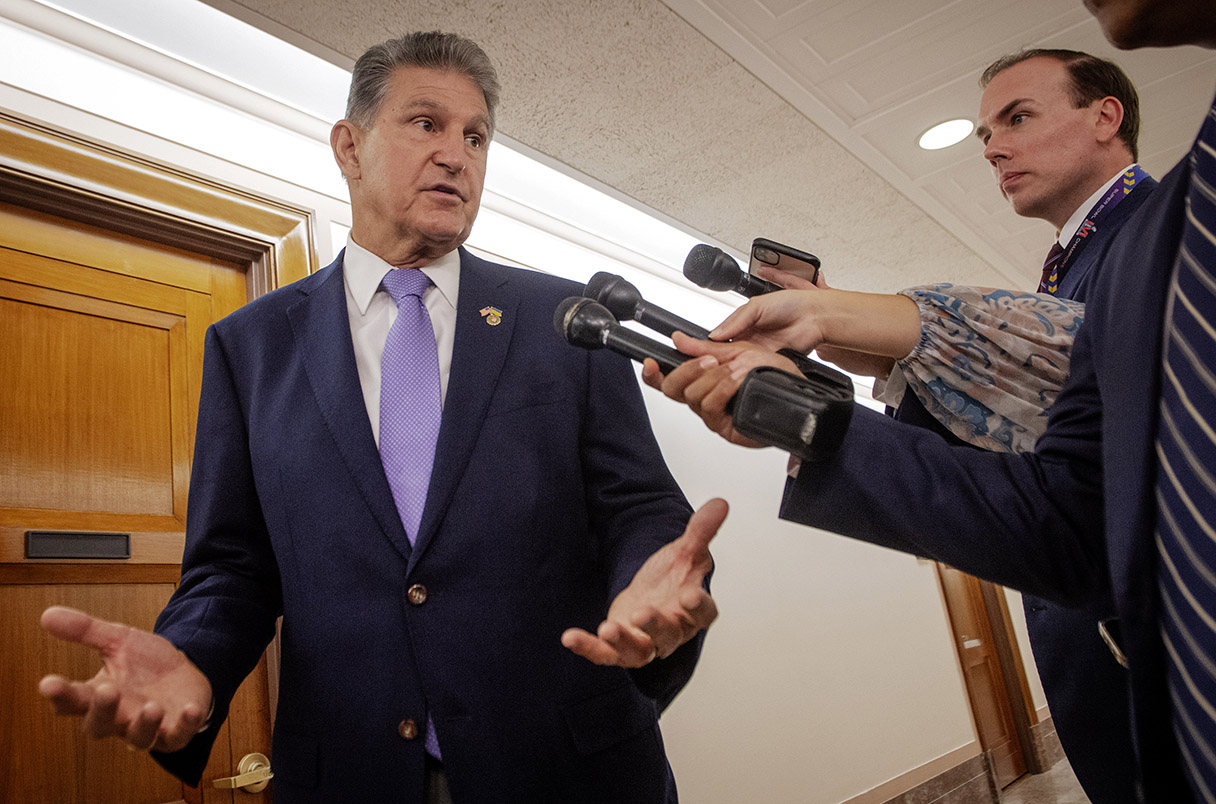
WASHINGTON, DC – JULY 21: Sen. Joe Manchin(D-WV) faces reporters as he arrives at a hearing of the Senate Energy and Natural Resources committee at the Dirksen S.O.B. at the U.S. Capitol, in Washington, DC. (Photo by Bill O’Leary/The Washington Post via Getty Images)

The so-called Inflation Reduction Act of 2022 promises much, but better read the fine print in this massive 700 page proposal.

A patchwork compromise with coal baron Senator Joe Manchin, its motivation is the Democratic Party leadership’s desperate need for a legislative victory in addressing escalating inflation, the primary concern of American voters, as the mid-term elections loom. Thus the bill’s name. (The previous version was called Build Back Better).

With close analysis, you’ll discover it isn’t up to the hype. While an unprecedented $369bn is dedicated to mitigating climate change, it locks in reliance on fossil fuel expansion by hamstringing the Interior Department: no renewable energy development on public lands unless drilling leases are also offered to oil and gas entities.

As such, this bill is pure political charade. Fossil fuels cause climate change, yet they’re locked into the bill’s provisions. There is no mechanism to phase them out.

What we get is the loosening of regulations regarding environmental review and, horribly, mandated drilling leases in Alaska’s Cook Inlet and the Gulf of Mexico. The result? More pipelines, oil leaks, methane leaks, wilderness lost, species endangered, and continuing temperature rise. In 2016, the U.S. averaged one crude oil spill every other day (undark.org).

There are no caps on carbon admissions!

While the legislation features tax credits for carbon capture and sequestration, the fallout is that this could extend the life of polluting coal plants, exposing the public to toxic fumes, and making it difficult to achieve clean power goals.

Not talked about is an ominous separate agreement to move a bill in September that could potentially weaken protections under the Environmental Policy Act, which grants communities a say in what happens to their local environment. This is subterfuge, pure and simple.

You’re told the legislation will reduce greenhouse gas admissions 40% by 2030 (Rhodium Group, rpg.com). Considering the pressing problems we have with securing energy resources, it’s dangerously possible that fossil fuels will gain the upper hand over renewables, upsetting any trajectory of even-handedness. As is, the Biden administration in early July held its first onshore lease auction, releasing a proposed plan for off shore drilling, despite Biden’s campaign pledge to cease new oil and gas development on federal lands and waters (insideclimatenews.org).

In short, the Inflation Reduction Act takes back what it gives out, a Faustian wager that forfeits the future for a short-sighted political shell game in the present.

I’m not saying there aren’t good things in the bill. And, yes, there are groups like Nature Conservancy, the Sierra Club, and Earth Justice, urging speedy passage of the legislation. They may be willing to drink the Kool-Aid, but not me, nor should you.

I go by the late E. O. Wilson, “Darwin’s heir,” my icon in environmental matters, who repeatedly denounced such organizations for their compromises, perpetuating environmental demise. They’ve thrown in the towel, their credo, Nature is already gone. We live in the Anthropocene. Wilderness must serve human needs (Wilson, HalfEarth: Our Planet’s Fight for Life).

This is a climate suicide pact,” comments Brett Hartl, government affairs director for the Center for Biological Diversity (CBD). “It’s self-defeating to handcuff renewable energy development to massive new oil and gas extraction.”

–rj

On Class Warfare in America: The Yacht Mentality Revisited

yachts3

I wanted to revisit my last post of several days ago, “The Yacht Mentality that Threatens our Economy,” with this apropos poem by William Carlos Williams, one of America’s foremost modernist poets.  As you may have surmised, it’s called “Yachts,” which I employed as my central metaphor in depicting the economic inequity rampant in our nation.

Williams, by the way, was a physician from Hoboken, NJ, who compassionately dedicated his practice to treating the poor, who were never far from his thoughts.  We see this vividly in his symbolically dense poem that comes close to being allegory in its one-to-one application, or depiction, of the tensions governing the relationship between the oligarchy of the economically privileged (shall we call them them the 1%?) and the majority, marginalized working class folk like you and me.  But first the poem, then my commentary:

Poem:

The Yachts

contend in a sea which the land partly encloses
shielding them from the too heavy blows
of an ungoverned ocean which when it chooses

tortures the biggest hulls, the best man knows
to pit against its beatings, and sinks them pitilessly.
mothlike in mists, scintillant in the minute

brilliance of cloudless days, with broad bellying sails
they glide to the wind tossing green water
from their sharp prows while over them the crew crawls

ant-like, solicitously grooming them, releasing,
making fast as they turn, lean far over and having
caught the wind again, side by side, head for the mark.

In a well guarded arena of open water surrounded by
lesser and greater craft which, sycophant, lumbering
and flittering follow them, they appear youthful, rare

as the light of a happy eye, live with the grace of all
that in the mind is fleckless, free and
naturally to be desired. Now the sea which holds them

is moody, lapping their glossy sides, as if feeling
for some slightest flaw but fails completely.
Today no race. Then the wind comes again.  The yachts

move, jockeying for a start, the signal is set and they
are off.  Now the waves strike at them but they are too
well made, they slip through, though they take in the canvas.

Arms with hands grasping seek to clutch at the prows.
Bodies thrown recklessly in the way are cut aside.
It is a sea of faces about them in agony, in despair

until the horror of the race dawns staggering the mind,
the whole sea becomes an entanglement of watery bodies
lost by the world bearing what they cannot hold.  Broken,

beaten, desolate, reaching from the dead to be taken up
they cry out, failing, failing! Their cries rising
in waves still as the skilled yachts pass over.

Commentary:

When you first get into this poem it seems to feature Man vs Nature, but by l. 13 with the specifics about the crew, which “crawls solicitously,” it dawns on you that it also takes in humans pitted against one another.

If the earlier portion of the poem (up to l. 13) gives an imaginative, blissful view of Nature in relation to Man and, in turn, of Man’s inter-relationships, the latter portion gives you the awful reality masked by the seeming tranquility, or the potential for revolt from the status quo of both Nature and Man.

Mention of a “race” sets the stage for transition into a contest for mastery, initially of yacht vs. yacht, but note how the diction changes here with sinister implications:

“Now the sea which holds them is moody”

 “As if feeling for some slightest flaw”

“Now the waves strike at them”

Note as well how the ominous turns into a personification of unleashed violence in what becomes a power struggle waged between haves and have nots, with the yachts metaphorized into repressive knife slashing entities indifferent to whom they maim:

“Bodies thrown recklessly in the way are cut aside.

“It is a sea of faces about them in agony, in despair.”

Williams’ subterranean intent now surfaces:  we have a revolt put down by the yachts, the poem’s symbol for connoting the wealthy, of the normally “solicitous,” or working classes, whose labor has made their wealth possible, though they’ve gleaned little for themselves, “bearing what they cannot hold.”

“…the horror of the race dawns staggering the mind,
the whole sea become an entanglement of watery bodies

The yachts, or impervious upper class, obviously win out on this particular day, but not without leaving in their wake their decimated victims:

“Broken,
beaten, desolate, reaching from the dead to be taken up
they cry out, failing, falling! their cries rising
in waves still as the skillful yachts pass over.

In sum, Williams has delivered a Marxist polemic of poignant genius in its thematic rendering of class struggle against inequity.  The very style of the poem adroitly reinforces this theme of worker repression by the economically removed in its run-on lines and skillful alliteration at poem end, the yachts unheeding of the crying wounded in “waves still as the skillful yachts pass over,” suggesting speed and, hence, indifference.  For Williams, this hierarchy “live(s) with the grace of all that in the mind is fleckless, free and naturally to be desired.”

In short, their narcissism of self-indulgence (materialism) mirrors behind its proffered beauty their willful escape from responsibility to the working classes on whom their wealth is built (“the crew crawls/ant-like, solicitously grooming them”).

In an America where 37% possesses half its wealth and the top 1% often pays minimal taxes, Williams’ poem reminds us that we have much work to do to render the American dream palpable for not just a few, but for the many.

–rj

Bearded Heroes of a Resurgent Boston

sox4

I watched the Rolling Rally on NESN Saturday with pride and emotion as it wound its way along Boylston Street, over to the Common, then into the Charles (quite literally).   Two million strong, Bostonians lined the streets, often forty deep; stood on steps, looked out windows; and, yes, gazed from roof tops, cheering wildly as their Red Sox heroes passed by in duck boats normally used for touring, waiving back, sometimes slapping hands. Duck boat diplomacy! Certainly, assuredly, unlike so much in life, everything conspired to make this day a success, not least, an unusually warm day in November Boston, a day that will replay itself in memory long after.

Who would have thunk it: that last year’s record 97 losses and last place finish in the American League East would give way to World Series winners?  This was a  motley team in some ways stiched together remarkably, if not cunningly, by general manager Ben Cherington into a flamboyant weave that included a new skipper, John Farrell, articulate, knowledgeable, and able.

Even then, it seemed a no go for the Sox as relief pitching woes mounted up what with sore arms and inability to put out fires.  Ominously, ace pitcher Buchholtz, after a 9 and 0 start, developed a clavicle problem, removing him from the mound till September.  Even in the Series, there was the bullpen collapse of normally reliable Breslow (the Yale biomed whiz).

Chalk up their success to maybe the overachiever syndrome that sometimes compensates for handicap and wins through?  Well, maybe.  For sure, they didn’t get to the winner circle from any embedded superiority.  You might even say this was a David vs. Goliath scenario, replaying itself nightly throughout the season and into the post season against all odds.

The American League playoffs proved better than their hype, the Sox facing an always menacing Tampa Bay, followed by a heavy hitting Detroit team replete with two of the games superior hurlers. Finally, the perennial winning St. Louis Cardinals with, again, fine pitching and, on paper, a knock out bullpen.

It didn’t matter.  The clues, if you think about it, had a way of happening, and kept happening, from the very outset, with the Sox finding ways to win, coming from behind, usually in late innings; each game, a new hero: Big Pappi, Victorino, Gomes, Napoli, Nava;  sometimes Ellsbury on the bases, setting the table; often, a leaping catch by an ever nimble Pedroia or Drew of a smash drive or a diving, in-the-web grab by Gomes.  Slowly I began to believe.  And so did Boston.

They did it so often, thirty times, that it seemed a given–just wait.  Hey, they scratched out one run wins, thrilled us nightly with walk off scenarios, and then there fell into place, as  it were, our secret weapon, passionate, diminutive Koji Uehara, who hitters couldn’t hit.

And how about Lester, fading, only to find himself again, winning games, and anchoring our rotation in the playoffs and Series? Not far behind, Lackey, back from Tommy John surgery, pitching gem after gem right through the Series. “A beautiful thing,” as colorful commentator Dennis Eckersley likes to say.

So many stories here. So many heroes!

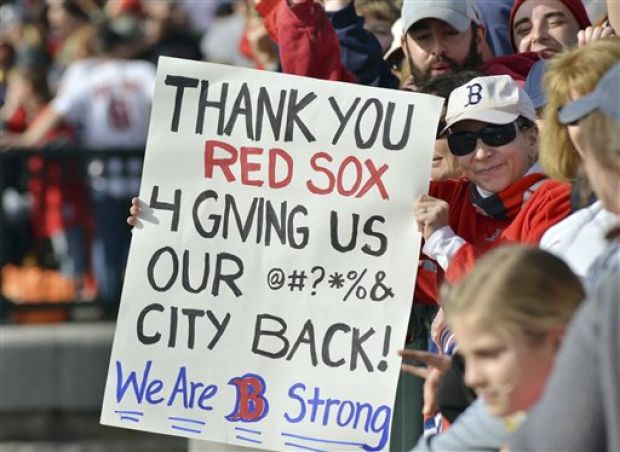
But for me, the most important story is that of April’s human wrought mayhem on Patriot’s Day at the finish line of the world’s favorite marathon.  Once again, as in all such misdeeds, I’m reminded of the human capacity to enact evil.  But I also have faith in the resident goodness of the vast majority to confront and transcend such evil.  As Big Papi famously put it, “This is our … City.  Boston needed to be strong and as the President said, “Boston would celebrate again.”

sox5And that’s where the Red Sox came in, showing the way past adversity to renewal.  That’s what the huge crowds were all about.  They identified with the sleeve patch each player now wore:  “Boston Strong.”

Sadly, in this day of free agency and change as one of life’s non-negotiables, we’ll not see their like again with their bearded idiosyncrasies. Peavy ended up buying the duck boat on which he rode.  (He had previously given us the cigar store Indian, which became a dugout fixture, home and away). Saturday evening, the celebration seemingly carried on, captured in a photo of Napoli, apparently inebriated, bare chested, wandering the streets.  I doubt few Bostonians care.  He earned his indulgence and drinks on the house.  I do know we’ll miss that nightly tugging of the beards!

Every now and then I come across some who disdain sports as a volatile vanity out-of-place in a troubled world.  But I don’t see it that way.  Here we can learn something from wise Vergil, who also knew the depth of suffering first hand.  In one episode of his great Aeneas, he writes entirely of several sport contests.  In his prescience, he knew their analogy with life.  Sports give diversion, and what’s wrong with a time out anyway?  But they are more than that, testing and teaching character, a word whose meaning we’ve largely lost to our own detriment.  Tell me how athletes play the game and I’ll tell you if you can count on them in life.  Their true value lies not in victory, but in pursuit.

This was a team of bonded brothers who went everywhere together.  They loved one another and how we loved them!   They helped Bostonians refocus. The poet Dante defined hell as a place of lost souls who had abandoned hope.  The Red Sox taught Bostonians how to climb out of hell and hope again.  Not least, a whole nation.

sox2How moving their stopping in Copley Square, the singing of God Bless America. Team and city united.  City and team become one.

What a wonderful day.  What a beautiful thing.

Boston Strong.

Thank you, guys!

–rj

To Truman: Beloved Friend

photo 1

You came into our lives twelve years ago in late August 2001, a compact Bichon bundle of playful love, in a pre-arranged handoff at an I-64 road stop.  I had ordered you by phone from a breeder in Myrtle Beach.  It was instant mutual love.  We decided to call you Truman, and it fit you just right.

Rarely, but it does happen, a mind-boggling event brands itself into memory and we never forget what we were doing and where we were at.  My father often reminisced that early Sunday morning, December 7, 1941.  For me, it had been November 22, 1963 and July 20, 1969 that stood out.  And now a third:  You were getting your first shots.  Our vet, a dog show judge, was admiring your confirmation, saying it was the best he had come across among Bichons in his practice, when the news broke of horrendous misdeeds.  It was September 11, 2001.

Now that’s one of the compelling reasons I’ve always been drawn to dogs and cats.  Unlike many humans caught-up in calculated self-interest with cruel consequences, they want only to love and be loved.  You loved everyone and they loved you.  But you gave me preference, waiting at the door for Daddy’s entrance, then bounding up with enthusiasm on my legs.  How wonderful to come home daily from a world of stress and non-entity to unconditional, uninhibited affection.

How you loved your backyard and how we loved watching you playing the mighty hunter card, one-cautious step after another, standing still, then more steps, gaining, then only, inevitably, the scurrying squirrel, knowing you were there all the time, hustling up the tree.  You at its trunk, patiently looking up, waiting for it to come down

You liked roaming the perimeter or fence line.  Your joy was complete when you heard neighbor dogs bark and scrambled full speed for canine fellowship.  I had read  somewhere that for all their human contact, given a choice, dogs prefer their own kind.  I can understand that, sometimes myself opting for their company over that of homo sapiens.

I remember how tiny you were at first and that there were several times you squeezed through the board fencing, even though I had spent days in winter cold nailing chicken wire over the gaps.  There was the time you got into the neighbor’s yard behind us where several llamas grazed and I climbed over the fence to rescue you from an advancing llama, only to have it come after me.  I grabbed you and jumped over to safety.  Close call for us both!

You liked walking on your leash with me down the street.  I never really had to train you at it, since from the beginning you took instantly to walking at my heel on my left, seldom pulling to get ahead.

But I did enroll you in an individualized obedience course.  Unfortunately, your trainer relied on treats and I could never find a way to wean you away from your addiction and do something simply because it was worthy for its own sake.  But then our own children aren’t all that different.  Getting you to stay was simply impossible for someone as passionate as you.  The gold standard was to take you to a safe area of a shopping mall and get you to stay.  I didn’t even try.  $300 dollars down the drain.  Ironically, you trained me!  Still, you did retain the habit of sitting on cue right up to the end, until your arthritic limbs compelled my pardoning you.

You liked keeping company with us on the couch, snuggling up to Karen and me.  You also had this funny habit of flipping the pillows off the couch and finding your way to the other arm and propping yourself up for a cozy snooze.

You also had this cute habit of carrying your metal dish over to your living room pad after your evening meal and licking it clean.  You delighted us with this gesture from the time you were a pup up almost to the end.

How excited you got to go outside with me to feed the birds whenever you saw me filling the plastic pitcher with seed!

At night when we turned out the living room lights, always the landmark clicking of your nails on the hallway floor as you made your way to join us in slumber.

When you were seven they found a heart murmur and I felt then the first scary pangs I might lose you.  You liked to run at full speed.

Around age nine, they found calcium crystals in your bladder, and so they put you on meds and a special diet.  I don’t know if the crystals caused you any discomfort.  You always acted the happy part.

At age eleven you had slowed down and seemed to labor in your walk.  We put you on glucosomine for that.

Just after your twelfth birthday, or this past June, I took you in for another checkup for the crystals and arthritis.  The ultrasound was distressing, showing not only more crystals despite your prescribed diet, but a tumor  over the right adrenal gland and a nodule adjacent to the left adrenal.  Ominously, the tumor occluded the vena cava, making any surgery risky.   The follow-up radiology report didn’t clearly indicate metastasis, but it remained a possibility.

You were still your active self through June, but then came the weight loss.  Once a robust 21 pounds, you were down to 18 by September, and 14 by the end.  You found it difficult to shadow Daddy from room to room and pretty much snoozed on the couch most of the day.  Your dark black eyes, tinged with sadness, gave off a pleading gaze–as if to say, “please help me”!

I knew things were getting really bad when you increasingly turned away from your food or ate very little, though I tried tempting you with lots of treats and canned meat in place of your former kibbles.  You were always crazy after peanut butter filled bones,  but now  you no longer could muster the appetite to enjoy the feast.

It hurt you to walk and even to lie down.  You couldn’t hold your water.  That last night, Tuesday, I knew we needed to do the right thing when you let out two yelps, one of them when Karen tried to pet your head.  Obviously you were hurting all over.

I caught myself in my own selfishness.  I had wanted to keep you forever.  I should have been thinking about your interests.  I needed to let go as my ultimate gift of love for you, my friend, our friend, always kind, gentle and loving.

Yesterday at the vet’s, we were with you in your final moments.  You seemed unafraid as I stroked you and laid a last kiss on your darling head. You went quickly and peacefully into that long sleep.  No more suffering.

I know that death is part of the deal we make for life, but it doesn’t lessen our grief or bridge the emptiness.  We miss you terribly.  You were a gift of love and we thank you for the daily joy you brought into our lives.  You will be in our hearts forever.

–rj and kj

Chemical Attack in Syria: Obama Looks the Other Way

SyriaThe videos from Syria are horrific and unprecedented, with row upon row of corpses, many of them children, in what now seems to indicate some kind of chemical agent, perhaps nerve gas, judging by the symptoms, also captured on camera, of the last gasps and spasms of the dying.  Presumably the attack was launched under the auspices of the Assad regime, since it’s well known they possess a huge stockpile of chemical weapons.  It maintains, however, that rebels are simply staging a scenario for Western consumption to provoke intervention.

But this isn’t the way Britain and France see it, the latter calling for possible force if there is verification.  Even, and this is a shocker, Vladimir Putin has called on the Syrian government to allow UN inspectors, already in the country and just twenty minutes away, to visit the scene, though Russia assumes the whole thing is a rebel ruse.  I don’t think for a minute Assad will allow such a thing, though logic would seem to compel it, if what’s happened is simply a rebel scheme.

It’s conceivable Hezbollah or non-government loyalists could have launched an attack like this using make-shift rockets, which they’ve done before, employing tear gas or industrial toxins fired into a confined space.  Bad as the videos are, we don’t see defecation, vomiting and tremors that usually go along with chemical agents.

Because we can’t pin down, at least for now, what precisely happened, we need to refrain from a rush to judgment.  In America we’ve seen enough of war, of thousands of our children killed and maimed, our treasury depleted, and those we’ve fought to liberate us not liking us one bit more.  We got rid of Saddam, Iran’s nemesis, and stoked  its friendship with largely Shiite Iraq.

If this turns out to have been a genuine chemical attack, then such barbarism should meet with a strong response.  It doesn’t require boots on the ground.  No one wants that.  Nor does it mean a no fly zone.   Cruise missiles fired off shore can take out the missile depots.  Give the beleaguered rebels the weaponry they need so that the Assad regime pays a lingering price and this never occurs again.  Include anti-tank missiles as well.

The truth is that the Obama administration has dilly-dallied too long, allowing extremist forces to enter the fray, al Quaeda fighting with the rebels; Hezbollah, for Assad.  Now the war’s momentum, taking a very dangerous turn, increasingly resembles the imbroglio of Sunni vs Shiite, or what we see in Iraq, spinning out of control.

Like an ugly cancer, it threatens to metastasize, drawing in Turkey, Iraq, Jordan and Lebanon, where 42 died in a Tripoli bomb blast today.  Iran, meanwhile has been sending in fighters.

The toll on civilians is immense:  100,000 dead;  two million refugees, one million of them children divested of a future.

Meanwhile, our government is clearly confused, self-contradictory, and plainly ineffectual.

Obama told us a year ago, August 20, 2012, that chemical weapons would be a “red line” and “a game-changer.”  Shortly after, he concluded that they had been used and pledged arms.  No weapons have arrived.  Nothing changed.

If we discover that chemical weapons were indeed deployed on this occasion, and substantially, will it make any difference this time?  Don’t bet on it.  Politicians often say things they don’t really mean, and that’s why we’re wise not to believe them when they do.

Ironic for a nation that owes its own liberation from the intervention of the French two centuries ago.

–rj