
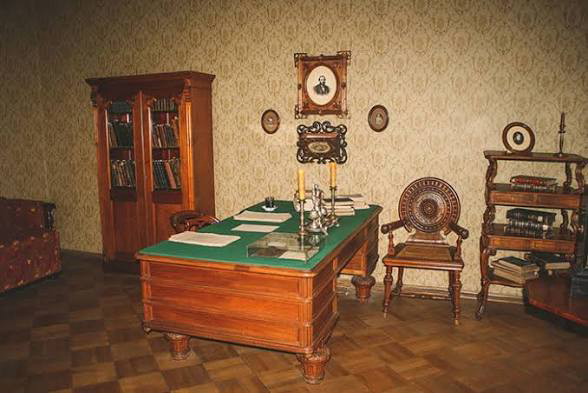
Dostoevsky’s desk
Ove Knausgaard, of My Struggle fame, has often spoken of his admiration for Dostoevsky, who with Proust and Joyce, comprise for him literature’s olympian triad.
While Dostoevsky has always had his admirers that include philosophers Wittgenstein, Heidegger and Camus, he has also had a principal detractor in Vladimir Nabokov who, in his Cornell lectures, dismissed him as a “claptrap journalist and a slapdash comedian, suffering from a fundamental “lack of taste,” manipulating readers through pathos.
In his recent New Yorker essay, “The Light of the Brothers Karamazov” (October 21, 2025), Knausgaard offers readers an informative social, cultural, and authorial milieu, helpful in deriving the novel’s meaning.
Knausgaard sees the novel as a chorus of perspectives, resistant to a gradient analysis. In short, the novel is open-ended.
There isn’t anything new about this view, which emanates from Russian critic Mikhail Bakhtin’s Theory of Polyphony and Dialogism, “a plurality of independent and unmerged voices and consciousnesses, a genuine polyphony of fully valid voices.”
Some will find Knausgaard’s approach the easy exit from the ambiguity that stalks this classic, each character virtually constructed apropos of a rubric.
Dimitri, immensely proud and of a violent temper, it is the military; for the middle one, Ivan, who is rational, cold, and analytical, it is the university; while for the youngest, Alyosha, who is warm, considerate, always accepting, it is the church. In addition, there is the servant Smerdyakov, presumed to be the illegitimate child of Fyodor and the intellectually disabled Lizaveta, nicknamed Stinking Lizaveta.
There exists the more traditional reading of the novel as a theological and cultural debate between Western and Slavic ways of life; of rationalism pitted against Russian spirituality, as represented in the Russian Orthodox Church.
In this view, Alyosha’s spiritual maturation and advocacy of active love constitutes the antithesis of his brother Ivan’s intellectualism, and clarifies the novel’s intended resolve, one latent with tension as to life’s purpose in the context of omnivorous suffering and evil. As Alyosha remonstrates in conversation with Ivan, “Love life more than its meaning.”
The Brother’s Karamazov is principally a wrestling with the problem of evil, the nemesis of theological belief.
In getting down to the roots of an author’s likely intent, a cultural or historical perspective is invaluable in keeping readers from superimposing their opinion on a text. Knausgaard is exemplary in providing this background,
Shortly before undertaking the novel, Dostoevsky’s epileptic son, nearly three years old, died following a three hour seizure. Filled with grief and guilt—his son had inherited his epilepsy— Dostoevsky began The Brothers Karamazov, his eleventh and final novel. The novel’s Alyosha bears the name of his son. Heeding his wife’s counsel, he sought the Church’s comfort, visiting the Optina Pustyn monastery and conversing with the monastery’s elder, Ambrose. Alyosha does the same.
Like the later Solzhenitsyn, and many Russians still, Dostoevsky was deeply devoted to the Russian Orthodox Church, and his Ivan incarnates the antithesis of Russian spirituality—Western in its secular rationalism, ultimately devoid of moral boundary. Dostoevsky is decisively slavophile.
I have been to Russia, visited Dostoevsky’s confining, upstairs apartment in St. Petersburg, where he penned his masterpiece; attended a crowded orthodox mass, where worshippers stood, movingly singing their hymns, a capella.
I came away from Russia, convinced that Russia is different—neither Western nor Asian—a repository of spirituality reflected in its literature, music and art. Russia cannot be fully comprehended apart from this awareness.
Ivan in his direct assault on Christ via The Grand Inquisitor tale, read in the context of Russia’s rampant human suffering, seems, nonetheless, to have the upper hand, reviving the oft-played notion of John Milton’s being of the devil ‘s party in writing Paradise Lost.
That the novel is best understood as polyphonous, a disparate coterie of life perspectives, undifferentiated in significance, does injustice to the novel’s complex subtlety that underpins its greatness.
The novel has its imperfections, as Nabokov noted. Like many readers, I find Alyosha insufficient as a counterweight to Ivan. When we leave off the novel, it is Ivan, not Alyosha, we remember.
Knausgaard informs us that unlike Tolstoy and Turgenev, Dostoevsky labored in poverty to support his family and suffered continuous stress to meet serial deadlines.
In her biography of her husband, his widow Anna indicated he lamented with each novel his inability to find time for revision.
Four months after the novel’s completion, Dostoevsky was dead.
Any final interpretation proves more elusive still in the aftermath of the prolonged stench of the corpse of the saintly monk Zosima, in whom Alyosha had confided. No expectant miracle occurs in liaison with his death.
What lies behind this intentional addition?
Perhaps, it represents Dostoevsky’s understandable lingering doubt, even amidst faith, or as Tennyson put it, “there is more faith in honest doubt than in half the creeds.”
Knausgaard seems to give ground to the notion of Alyosha’s centrality toward essay end:
…there is no doubt that Alyosha represents an ideal for Dostoyevsky—he bears the name of his dead son, Alexei Fyodorovich, and is the character who, in thought and in action, is most closely associated with the novel’s consistent notion of the good. But in comparison with the presence of Dmitri and Ivan—perhaps that of Dmitri in particular—he pales.
I agree with Knausgaard on the overpowering logic of Ivan’s assault on God’s inadequate justice, but then the problem of evil never evades those of genuine religious sensibility and the novel faithfully reflects this inner, cognitive dissonance.
Knausgaard undervalues the novel’s theistic thrust in embracing divergent narrator purviews, qualitatively equal. The Brother’s Karamazov, on the contrary, emerges a vigorous theodicy, defending faith in a world replete with anguish.
I am sympathetic with Albert Camus appraisal of the novel as existential, humanity granted freedom to make choices. I agree with his conclusion that the novel, in its final chapters, reaches for a religious conclusion, confirmed by Ivan’s descent into madness. Camus’ view bears semblance to Dostoevsky’s religious sensibility, however troubled.
Others argue that Dostoevsky deliberately destabilized his text, offering no firm resolution to the quandary of faith in a world of evil.
The novel’s resultant ambiguity is its strength, positing the need for repeated reading and, with it, new understanding. And for believers, sober challenge to the veracity of faith.
I like Knausgaard’s close, seemingly coming to terms with the novel’s complexity:
I write this in the certainty that this interpretation, too, will dissolve as soon as you open the book and begin to read it anew. This is what makes “The Brothers Karamazov” a great novel. It is never at rest.
—rj

 Brimmings: up from the well