Susan Sontag’s Regarding the Pain of Others: A Review

Deborah Feingold/Corbis via Getty Images) Susan Sontag (Photo by Deborah


Taking photos is now so universally accessible via our smartphones that we’re likely to take it for granted.

Until recently, it required buying a dedicated camera, inserting a film roll, setting the lens, then waiting—perhaps a week or more—to see the results of a distant lab.

I think of photos as a freeze on time, lovers as Keats reminded us, still fresh in their youth; sons and daughters, children still; parents and grandparents as we remember them. But photos, buttressed with videos, do even more, providing a window on what ails us.

Susan Sontag in her splendid book I’ve just read, Regarding the Pain of Others, argues that the visual not only helps us remember, but sensitizes us to the plight of those who acutely suffer while we warm ourselves under the blankets on cold winter nights, our bellies full. A moralist and cultural critic, she takes on the scourge of war’s ravages, a predominantly male enterprise it seems, unleashing the human capacity to inflict limitless evil, often with impunity.

Photography reminds us of Hiroshima and Nagasaki viewed aerially following their atom bomb devastations, incinerating 200,000 civilians within minutes; of emaciated prisoners released from Nazi death camps, the residue of 12 million exterminated; of ethnic strife in Bosnia in 1992, culminating in Srebrenica; of the dead and dying of 9/11; the machete butchering, killing 500,000 Tutsis in Rwanda. We cannot afford to let their horrors be relegated to the dumpsters of oblivion.

I remember Vietnam and My Lai (1968) and the American massacre of 500 villagers, the burning of their village, that consolidated American resistance to a needless, barbarous conflict consuming 64000 allied lives and 900,000 Vietnamese, ending a president’s re-election bid. Without film crews, we would have lacked evidence, much like when unleashed Soviet troops raped 130,000 German women after taking Berlin.

The trail is long. Much of Sontag’s narrative isn’t pleasurable reading to be sure, but without photography’s capability for exactitude, man’s inhumanity will never be addressed and perhaps, though distantly, vanish like slavery from the human repertoire. It is our duty not to turn aside, but remember and, beyond acknowledgement, understand war’s antecedents and protest their repetition.

I mourn Sontag’s passing from us in her prime—her cerebral introspection of what ails us, delivered always with compassion and unceasing hope that we can and will do better.

After reading her book, I thought of Palestinians in the Gaza strip, desperate for food, killed daily, many of them women and children. As I write, the UN Office for the Coordination of Humanitarian Affairs (OCHA) informs us that 900 Palestinians seeking food have been killed since mid-May. Unlike other conflicts, the foreign press has been banned from access to Gaza.

I think, too, of Putin’s accelerated nightly aerial assaults, on Ukraine, targeting civilian infrastructures: hospitals, ambulances, apartment buildings, shopping malls and, by day, farmers plowing their fields.

Photography offers documentation. Sontag was right: without photography, we are denied access to the truth and the scourge of war is assured its continuence.

—rj


No Other Land: A Story That Must Be Told

The Academy Awards take place tonight, but I may not watch.

I have misgivings, particularly about the industry’s apparent exclusion of films that highlight the Palestinian plight in Israel.

Like many others, I don’t miss theaters. It’s nice just lounging in an easy chair, scrolling through endless streaming choices on a big-screen TV, microwaved popcorn at hand. Traditional studios have taken the hint, shifting their priorities toward digital platforms.

A few times, I’ve ve been tempted to return to the theater to see films like Top Gun: Maverick for its effects, or Oppenheimer, for its brilliant portrayal of a conflicted scientist. But I always hold off, knowing that within months, I can rent or buy the film and avoid the steep ticket prices.

Now comes another film, a documentary No Other Land, winner of the Berlin International Film Festival and the Gotham Award for Best Documentary, now an Oscar nominee.

Yet no American studio dares to sponsor it.

Jointly directed by Palestinian and Israeli filmmakers, No Other Land lays bare the struggles of Masafer Yatta, a West Bank community facing near-daily assaults from Israeli Defense Forces and encroaching settlers who want them gone, the latter, an updated version of the Ku Klux Klan. The IDF claims it needs the land for a military training base.

Two weeks before the film’s Oscar nomination, masked settlers stormed Masafer Yatta, destroying homes. In one instance, caught on film, a resident was shot in the stomach. The filmmakers themselves have been harassed, even shot at, over five years of production.

Palestinian director Basel Adra, a Masafer Yatta resident, has been targeted multiple times. Yet he refuses to leave the land where his family has lived for generations.

His Israeli co-director, Yuval Abraham, told The New York Times:
“I look at Basel, who’s living a much more difficult life than myself, and as long as he’s continuing, I feel like I also have to continue. Even if reality is only changing for the worse, it’s not as if we know what would happen if there is no documentation.”

So far, the film has reached just 23 American theaters. Still, the directors hope for broader exposure to awaken audiences to Israel’s deepening colonization of the West Bank and shift public perception.

But in America, supporting Palestinian rights often invites accusations of antisemitism. Trump has proposed deporting Palestinian student protesters. As for Gaza, he advocates expelling its 2 million inhabitants without a right of return.

Ta-Nehisi Coates’ new book, The Message, devotes half its pages to his time in the West Bank. Some criticize him for omitting Hamas’ attack on Israel and its atrocities. Daniel Berner of The Atlantic calls Coates’s analysis simplistic. Yet liberal Israelis, though a minority, may find his perspective compelling.

Coates focuses on the West Bank, not Gaza. In an interview with New York Magazine, he remarked: “I don’t think I ever, in my life, felt the glare of racism burn stranger and more intense than in Israel.”

As expected, some have labeled him antisemitic. The New Republic sees it differently, calling the backlash a massive media failing: “Coates is not antisemitic to defend Palestinian human rights” (Shiner, October 2, 2024).

If No Other Land makes it to my local theater, I’ll give up my easy chair, venture out to the theater, pay the ticket price, not only to witness a remarkable documentary, undertaken at great risk, but to lend my support to a story centered in truths that must be told.

RJoly

Biden plays politics: The Gaza fiasco


On one hand, President Biden urges a ceasefire in the nearly six month Gaza conflict; on the other, he has stealthily authorized a potent new military aid package to Israel that includes jets, 1,800 MK84 2,000-pound bombs, and 500 MK82 500-pound bombs.

Although 2000 pound bombs are capable of taking out whole city blocks and have been abandoned by most Western militaries for employment in urban locales, they have dominated Israel’s aerial assault on Gaza, with the death toll currently estimated at 33,000, the vast majority of them civilians.

Anonymous Pentagon sources disclose the armament transfer includes transfer of 25 F-35A fighter jets and engines at a cost of 2.5 billion.
Biden isn’t mandated to disclose any of this to lawmakers since Congress had approved the transfer in 2008, presently unfulfilled.

Israel is currently the largest recipient of U.S. aid since the 1970s, receiving on average $1.8 billion in military and $1.2 billion in economic aid annually.

Such aid incentivizes documented Israeli violations of Palestinian rights by humane organizations such as Amnesty International and Human Rights Watch. They have included ongoing abusive detention practices (including the torture of prisoners), restrictions on freedom of movement of Palestinians, the targeting of medical personnel and facilities, and severe damage to infrastructure such as water and electricity to Palestinian civilians prior to Israel’s current Gaza incursion.

It does not move the needle to a two state solution.

All of this comes even as Biden expresses concern over a pending Israeli assault on the alleged remaining Hamas stronghold of Rafah along the Egyptian border and UN warnings of incipient mass starvation. 1.2 million Gaza refugees have sought refuge in this enclave.

Jewish pressure weighs heavily on the Biden administration in an election year with the American Israel Public Affairs Committee donating millions to unseat Democrats deemed unfriendly to Israel. A recent Pew Research survey indicates 80% of American Jews regard aid to Israel as essential.

Those constituencies calling for suspension of aid to Israel are branded as anti-Semite, with surging efforts to pass legislation abridging their First Amendment right to free speech.

Republicans, even more than Democrat leaning Jews, have vigorously supported aid to Israel, though increasingly resistant to approving aid to a besieged Ukraine.

Biden would do well to mind an increasingly assertive Muslim-American electorate that threatens to boycott him in November.

Meanwhile, any full scale attack on densely populated Rafah, gateway for food convoys, would conceivably result in thousands, not hundreds, of killed and maimed.

The morally compromised Biden administration has been complicit in Israel’s blitzkrieg that includes mosques, churches, hospitals and refugee camps, abetted by American armaments.

For this, the U.S. proves deserving of world condemnation.

The elephant in the room is Biden; but then again, endeavors to dislodge him by voting for his Republican adversary are surely non sequitur.

Conversely, efforts to encourage divestiture at home and abroad of Israel merit encouragement. They brought down South Africa’s apartheid regime.

America must do what is right, not what is easy.

–rj

US Complicity: A Lack of Political Will


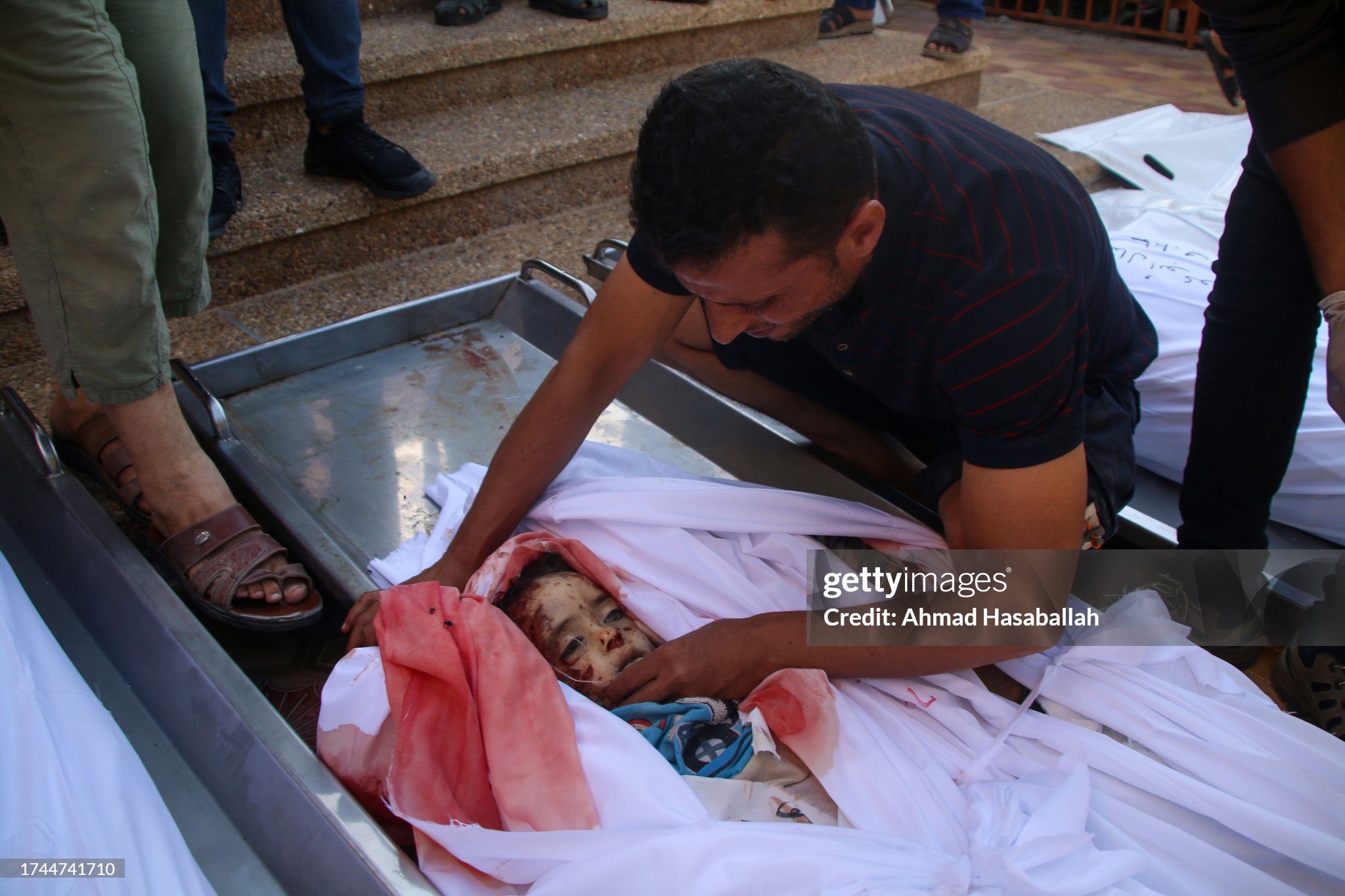
KHAN YUNIS, GAZA -t. (Photo by Ahmad Hasaballah/Getty Images)

If ever there’s been a clarion call for the United States to abandon its military support for Israel, it’s now. Prime Minister Natanyahu has made it clear to Washington that there will be no Palestinian state on the West Bank, rejecting Secretary of State Blinken’s recent plea for a two state resolution as Israel’s surest means to security.

Nor will the Prime Minister, a friend of Donald Trump since the 1980s, scale back Israel’s offensive in Gaza until total victory and return of remaining hostages is achieved.

As I write, nearly 25,000 Palestinians have been killed, two-thirds of them women and children; hospitals, mosques, churches and refugee camps bombed; and a frightened civilian population, 1.9 million of them, or 80% of the Gaza population, herded into a southern corridor, and confronted with disease and starvation.

This constitutes the true genocide, which South Africa has brought to the attention of the International Court of Justice (ICC), the UN’s highest court. Fifty-six other nations support the suit, but not the United States and UK. The European Union has chosen silence.

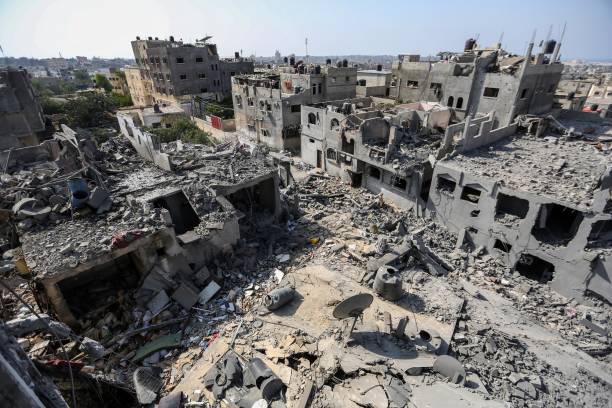
KHAN YUNIS, GAZA – General view of buildings which were destroyed during Israeli bombardment. Photo by Ahmad Hasaballah/Getty Images)

South Africa has also filed a referral to the International Criminal Court (ICC), not to be conflated with the ICJ, though both are located in the Hague. The ICJ can issue arrest warrants, as it did for Vladimir Putin, who must now avoid signatory countries that include South Africa.

What’s not received ample attention is the economic plight Palestinians face. Before Hamas’ October 7 incursion, 400,000 Palestinians were employed by Israel, largely in construction, agriculture and service sectors. I87,000 Gazans have had their work permits canceled; similarly, 167,000 Palestinians on the West Bank.

In the meanwhile, Israel has set up worker recruiting offices in India and Sri Lanka, with the goal of importing between 50,000 to 100,000 replacements.

This may be part of a long term stategy by Israeli nationalists to encourage Palestinians to leave Israel. Take, for example, Finance Minister Bezalel Smotrich’s call for Palestinian residents of Gaza to leave, replaced by Israelis, who could “make the desert bloom.”

Unfortunately, the Biden administration, despite its call for a cease fire and a two state solution, is unwilling to risk political capital and rebuff Netanyahu by suspending military aid to Israel.

By default, it’s rendered the US complicit in Israel’s criminality, angered Progressives, alienated the Muslim community, made the US a global atavar of hypocrisy, and risks dragging the country into a wider conflict, inflicting incalculable consequences, both home and abroad.

–rj

Fiasco at Harvard: A President Resigns

The headlines shout the news of Harvard president Claudine Gay’s resignation.

It should have happened speedily, but not because she allegedly soft-pedaled campus protests calling for intifada while omitting Hamas’ atrocities and was consequently judged antisemitic by Israel supporters. I believe the presidents of Harvard, Penn, and MIT were essentially ambushed when they were interviewed—or is it interrogated?—by a House committee that had already made-up its mind.

As a former academic for nearly forty years, I firmly support the ACLU in its lawsuit defending University of Florida chapter of Students for Justice in Palestine, ordered deactivated in Florida’s public colleges by Governor DeSantis (ACLU defends).

Protecting the First Amendment is paramount and criticism of Israel shouldn’t be conflated with antisemitism. 

Despite the ruckus over her “it depends on context” when asked if threatening Jews with genocide violated Harvard’s code of conduct, I think she was right.

As I write, seventeen members of Biden’s campaign staff sent an anonymous letter to Biden, calling for a permanent truce in Gaza and suspension of arms shipments to Israel.

Is it antisemitic to want the killing of Palestinian civilians, now exceeding 21,000, to stop? Whole families have been wiped out by incessant Israeli bombings; thousands more, nearly half of them children, wounded. Survivors haven’t any place to go. Schools, mosques, churches, hospitals and refugee camps haven’t found reprieve from largely American supplied weaponry. Survivors face disease and famine. 

Was UN Secretary-General António Guterres antisemitic in saying Hamas violence didn’t happen in a vacuum”? Further, that “hospitals have turned into battlegrounds,” amid “the constant bombardment of all parts of Gaza” and rendered Palestinians homelessness and “without the essentials to survive”? 

Meanwhile, West Bank violence continues unabated, with little said about repeated settler incursion on Palestinian lands and a vast expansion of Israeli settlements, rendering any two state resolution increasingly implausible.

A recent poll indicates 61% of the American public fault Biden’s strident support of Israel. Are they therefore antisemitic as well ?

Would it surprise you to learn that most orthodox Jews are anti-Zionists?

And then there’s that gadfly Jewish socialist senator from Vermont. I better stop. I think you see where I’m coming from.

Harvard was right to initially support its beleaguered first black president and just second female holding that post in its nearly 400 year history.

At least, in the beginning. But then money has a way of changing minds. 

What began as a trickle became a tsunami, 1600 big spending Jewish alumni, some of them billionaires, pulling back from any more donations to the university. 

Conservative Washington Post columnist George Will had said suspending giving wouldn’t dent Harvard policy, Harvard enjoying a 51 billion dollar endowment.

But he was wrong. 45% of Harvard’s 2022 $5.8 billion income came from donations. 

When it comes to Gay’s several instances of plagiarism, I part ways with Harvard. Like most academics—I taught college English for forty years—I take plagiarism seriously. Failure to attribute sources constitutes both theft and fraud. The unveiling of her academic misdeeds called for immediate termination of employment.

In an opt-ed yesterday in The Guardian, former Secretary of Labor, Robert Reich, decries what he sees as a threat to campus free speech, donators marshaling monetary divestiture to secure their political perspective. He has a point. 

Reich says, however, that he’s unable to comment knowledgeably on Gay’s alleged ¡plagiarism, but notes the bulk of the charges originated from the online conservative journal Washington Free Beacon (Robert Reich).

So what? Does the source taint its accuracy? It’s the old guilt by association trick McCarthy played so notoriously.

The Left were privy to the allegations for some ten days, but buried it. Not until conservatives persistently pursued the story, led by Christopher Rufo, did the budding scandal take hold in the NYTThe GuardianCNN and elsewhere.

If you pressed me, I could show you the specifics of Gay’s many instances of lifted passages, fifty initially in number with six more added the day before her resignation after meeting with the Harvard Corporation.

Ultimately, the new revelations piled on top of spiraling donator backlash, proved the straw that broke the camel’s back. 

Did she get banished from the campus? Don’t even go there! Harvard, which initially made light of the charges, subsequently helped her correct the faulty passages in eight of her publications and reappointed her to her professorship in the Political Science Department.

If the shoe were on a student’s foot, the frequent punishment at reputable universities is expulsion for a year.

Talk about a double standard and the blatant hypocrisy of its Veritas motto, Harvard, you don’t walk the talk.

Writing anonymously for the Harvard Crimson, a student on the Honor Council that tries such cases, wrote, “When my peers are found responsible for multiple instances of inadequate citation, they are often suspended for an academic year. When the president of their university is found responsible for the same types of infractions, the fellows of the Corporation unanimously stand in support of’ her.” (Harvard president).

But why did an illustrious Ivy League university prove so intransigent in all of this is the bottomline question.

In a recent op-ed, black law school professor and former Harvard graduate Winkfield Tryman, Jr., comments that the plagiarism charges “are well deserved” and “not racial in nature…No one in good faith should defend President Gay because she is the first black president of Harvard. And yet, many are coming to her defense. Having finally got their wish of a Black president of Harvard, Harvard seems unwilling to let her go. The racial wagons have circled around Gay, with President of the NAACP alleging that White Supremacy is afoot and Morehouse President David Thomas claiming in a Forbes interview that Gay is a scholar at the “top of her profession… as qualified as any President Harvard has ever had” (Newsweek).

Truth be told, this illustrious Harvard prez “at the top of her profession” has published a mere eleven papers and not one book.

Now that’s a first, but of a dubious kind. Her predecessor, Larry Becow, the son of immigrants, and whose mother survived Auschwitz, wrote four scholarly books and scores of peer reviewed articles.

Unfortunately, this debacle at Harvard unfairly triggers a mindset of suspicion of legitimate black scholars, deflating their credentials and singular achievements.

–rj

No Room for Palestinians: Israel’s Calculated Violence

The photos featured in today’s media of masses of Palestinians fleeing Israel’s incessant bombing validates the truth that “a photo is worth a thousand words,” but in a sad way.

As I write, more than 11,000 Palestinians have died, 4000 of them children, and 25,000 have been wounded. The violence continues, Israel stubbornly ruling out a cease fire, demanding Hamas first release its 240 hostages.

The news on the West Bank is dismal as well. An area much larger than Gaza and an Arab majority, it has seen 175 civilians killed, nearly all of them Palestinians, 33 of them children, since Hamas’ incursion into Israel on October 7. Israel holds several thousand West Bank prisoners, hundreds without charge or trial.

The UN Office for the Coordination of Humanitarian Affairs reports that more than 1000 Palestinians with title to their land have been forcibly removed from their homes on the West Bank since October 7.

This follow a long history of settler intimidation, abetted by Israel Defense Forces, targeting Bedouin herders, Palestinian olive groves and farms. Homes are burned and protestors killed, yet the media allows this criminality to go unreported. It cares only about normalization, not Palestinian grievances.

Al Jazeera has it right: “Were the American media and political establishment not so firmly committed to transmitting a thoroughly decontextualised version of this war – and of Israel/Palestine in general – perhaps a news anchor would ask whether it never occurred to Israel that the Palestinians would ever “retaliate” for 75 years of ethnic cleansing, suffocating blockades and massacres” (https://www.aljazeera.com/opinions/2023/11/12/how-americas-bloodthirsty-journalism-cheers-on-israels-war-on-gaza).

While Hamas’ barbarism is surely condemnable, it’s the nature of Israel’s disproportionate response that troubles the international community. Disallowing humanitarian aid, curtailing food, water, and energy, bombing hospitals, ambulances and mosques, a refugee camp two days in a row, justifies growing international rage.

Ordering 1.2 million Palestinians to abandon their homes in north Gaza, with no real place to flee while denying them subsistence, constitutes a glaring war crime.

Concurrently, the United States, Great Britain, and France have contributed to Israel’s unmeasured response, accelerating arms shipments to Israel and making themselves complicit

Israeli repression of Palestinians, often violent, has its lengthy narrative. With the seizure of the West Bank following the 1967 War, a new chauvinism of a greater Israel ensued to the detriment of Palestinians in the Negev, Gaza, and the Golan Heights, resulting in the rise of Hamas, a Palestine offshoot of the Muslim Brotherhood.

In 1983, Israel conspired with Christian Phalangists in Lebanon in the massacres of several thousands of Palestinians and was found culpable by both the UN’s and Israel’s own subsequent investigations. The UN termed it “genocide.”

In the aftermath of 1948’s birth of the state of Israel and its victory over Arab armies, Israel expelled 750,000 Palestinians from their homeland, many of whom populate today’s Gaza and West Bank.

Five years ago, during the Great March of Return in Gaza, Israelis killed hundreds of peaceful demonstrators and wounded several thousand others.

While we hear a lot about a two state remedy, it’s unlikely, since it takes a marriage of minds for that to happen. Palestinians don’t trust Israelis, especially a government led by nationalist leadership under Netanyahu. They’ve also witnessed the second class citizenship of Arabs granted citizenship.

There do exist Israelis who want to address Palestinian grievances, but do so at great cost. Many have been arrested, their identities and addresses posted online, their families threatened.

In 1995, a religious extremist killed Prime Minister Yitzhak Rabin, who had sought to implement the Oslo Accords with its provision for Palestinian self rule in Gaza and the West Bank: “We who have fought against you, the Palestinians, we say to you today in a loud and a clear voice: Enough of blood and tears. Enough… We are today giving peace a chance and saying to you and saying again to you: Enough.”

In the aftermath of Rabin’s assassination, Netanyahu came to power, resulting in negotiations for a just settlement with the Palestinians being abandoned in favor of surveillance and military might. Hamas was to be controlled, not dismantled. Netanyahu needed Hamas to offset the West Bank’s Palestinian Authority, open to negotiation. October 7 changed the venue.

Zionism is the real culprit here. Israel has never subscribed to the two state idea in which Palestinians would be masters of their own house.

Addressing Palestinian members of Knesset in 2021, far right Defense Minister Bezalel Smotrich said, “It’s a mistake that Ben-Gurion didn’t finish the job and didn’t throw you out in 1948.”

Recently, Smotrich has voiced sentiment for a one state Israel: “Peace will not emerge so long as we maintain our hold on starting assumptions that this land is fated to contain two collectives with conflicting national aspirations. If this is the case, our grandchildren and our great grandchildren will inevitably be destined to live by the sword….The ‘Palestinian People’ is but a counter-movement to the Zionist movement. Those who choose not to let go of their national ambitions will receive aid to emigrate to one of the many countries where Arabs realize their national ambitions, or to any other destination in the world.”

Is it conceivable that Israel’s vociferous response, defiant of the international community’s call for a ceasefire, is deliberately strategic? That not only Hamas should be eliminated, but the Palestinian presence once and for all? Make it so intolerable for them that they’ll leave?

Ominously, Prime Minister Benjamin Netanyahu, addressing his country on October 28, quoted Deuteronomy: 25:17: “You must remember what Amalek did to you.” If you continue to verse 19, you’ll read, “You shall blot out the memory of Amalek from under heaven. Never forget!” In 1st Samuel 15: 2-3, the Hebrew Bible exhorts, “Now go, attack Amalek, and proscribe all that belongs to him. Spare no one, but kill alike men and women, infants and sucklings, oxen and sheep, camels and asses!”

He didn’t have to go on. He had made his point.

–rj

“I Grant You Refuge”: Hiba Aba Nada’s Final Poem

Palestinian poet, novelist, and educator Hiba Aba Nada, age 32, wrote this poem ten days before her death in her home on October 20, 2023 from an Israeli bombing attack in south Gaza that killed many others. In the poem, God proffers an afterlife of refuge for the besieged and dying. In the closing verse, He assures the martyrs’ ultimate triumph:

1.
I grant you refuge
in invocation and prayer.
I bless the neighborhood and the minaret
to guard them
from the rocket

from the moment
it is a general’s command
until it becomes
a raid.

I grant you and the little ones refuge,
the little ones who
change the rocket’s course
before it lands
with their smiles.

2.
I grant you and the little ones refuge,
the little ones now asleep like chicks in a nest.

They don’t walk in their sleep toward dreams.
They know death lurks outside the house.

Their mothers’ tears are now doves
following them, trailing behind
every coffin.

3.
I grant the father refuge,
the little ones’ father who holds the house upright
when it tilts after the bombs.
He implores the moment of death:
“Have mercy. Spare me a little while.
For their sake, I’ve learned to love my life.
Grant them a death
as beautiful as they are.”

4.
I grant you refuge
from hurt and death,
refuge in the glory of our siege,
here in the belly of the whale.

Our streets exalt God with every bomb.
They pray for the mosques and the houses.
And every time the bombing begins in the North,
our supplications rise in the South.

5.
I grant you refuge
from hurt and suffering.

With words of sacred scripture
I shield the oranges from the sting of phosphorous
and the shades of cloud from the smog.

I grant you refuge in knowing
that the dust will clear,
and they who fell in love and died together
will one day laugh.


The Plight of Palestinians: Repressed and Forgotten

While Americans retire nightly to their flannel sheets and fluffy pillows, their stomachs well fed, two million Palestinians have no where to flee, their homes flattened, their food, water, and energy resources curtailed. They sleep on sidewalks, or sixty in a room. They suffer cold. Whole families wiped out, yet Israeli bombing and gunfire continues. Israel refuses a pause. Ten thousand dead, many of them children.

It’s Israel’s history, Palestinians the Other, not seen as fellow human beings having legitimate grievances.

In the ongoing invasion of Gaza by Israel’s military, two aerial attacks, two days in a row, were launched on Jabaliya, a camp sheltering 116,000 refugees squeezed into a 1.4 square kilometer area, and one of eight refugee camps in Gaza.

Collectively, they shelter displaced families and their descendants from the 1948 war that gave rise to the state of Israel. Expelled, they’ve been denied resettlement in their native land.

Jabaliya features a high number of UN facilities, including 26 schools, a food distribution center, two health centers, a library, a sanitation facility, and seven wells. It didn’t stop the Israelis. They struck in day light, mothers pursuing their laundry, children playing soccer, men at their jobs.

Bombs meant for Hamas tunnels left deep-seated craters, collapsed buildings, smoking rubble, dismembered limbs, scattered flesh, the screams of the wounded, some buried beneath the rubble.

Israeli bombs took out the Al-Fakhoura School, used as a shelter for thousands of homeless Palestinians in the camp, all of this part of incessant bombing that struck still another school in Northern Gaza, air attacks in the vicinity of three hospitals, and on two ambulances.

Even before the invasion, the camp had periodically suffered electricity outages and 90% water contamination.

According to Gaza’s Ministry of Health, run by Hamas, 195 died and 777 were injured in the two attacks. We may not trust Hamas on the figures, but other authorities think the total death toll may be even higher when bodies are fully recovered.

It’s senseless to go after suspected Hamas tunnels underlying the camp’s infrastructure, as no crater can penetrate deep enough to take out tunnels reenforced with concrete some 200 feet below.

Overall, Gaza has seen its death toll exceed 10,000 dead, many of them women and children, as a consequence of indiscriminate bombings of the civilian infrastructure.

As I write, Israel continues to resist mounting international calls, including those of the US, for a ceasefire. They demand hostages be released first.

Amid its carnage, Israel has held back on humanitarian aid, cut off food supplies, energy and water.

Consequently, Palestinians face the near certainty of widespread famine, disease, and death.

This isn’t the first time Israel bombed the camp with deadly result. During the Gaza War (2014), it bombed a UN school in the camp, killing 20 people.

More recently, unreported in US media, six earlier attacks on the camp occurred before the two major deadly attacks. They include attacks on October 10, 12, 19, and 21.

All of this becomes eerily reminiscent of the Sabra and Shatila massacres of 1982 during Lebanon’s Civil War when up to 3,500 civilians—mostly Palestinians and Lebanese—were slaughtered in 24 hours by Christian Phalangist military aligned with Israel.

Sabra was a neighborhood of Palestinian settlement; Shatila, a refugee camp. The Israel Defense Forces, surrounding Shatila , ordered its allies to clear out the PLO. Though they were receiving reports of the massacres, they didn’t intervene.

A subsequent inquiry under UN auspices concluded in February 1983 that the IDF forces, as the major occupying element, had responsibility for preventing the massacres of Sabra and Shatila. It termed it “a form of genocide.”

An Israeli investigation came to a similar conclusion, holding the IDF responsible for knowing the massacres were taking place, but not intervening. This forced the resignation of Defense Minister Ariel Sharon

For too long, successive Israeli governments have ignored the legitimate rights of Palestinians to a sovereign state, with East Jerusalem as its capital.

The United States has abetted Israeli intransigence with massive funding and weaponry, much of it being used in the present conflict.

In short, it’s complicit in the excesses being committed.

While Hamas committed abominable acts against Israeli civilians, resulting in 1400 deaths with its incursion of October 7, it doesn’t justify Israel’s disproportionate response, nor ongoing West Bank settler violence against Palestinian civilians, more than 100 of them recently killed.

Yes, Gaza elected Hamas in 2006 to represent them, but there haven’t been any elections since. Do all Gazans support Hamas? Probably not, given the suffering Hamas has inflicted on Gazans.

All of this carnage is rooted in Britain’s Balfour Declaration of 1917, sanctioning a homeland for Israel. Did anyone ask its Ottoman citizenry, the vast majority, Turk and Arab? Few Jews lived in the area that would become Israel.

In 1948, 750,000 Palestinians were expelled from their homeland and forbidden a return, a vengeful response of incalculable cruelty.

The irony is that many Jews, who themselves have suffered historical displacement and genocide, have become perpetrators of its reiteration.

I would remind dissenters that attacks on civilians and civilian infrastructure are violations of international humanitarian and human rights law. In short, they are war crimes.

–rj

Expired: The UN’s Resolution Prohibiting Exporting of Iranian Missiles and Drones

The Caspian Sea linking Iran and Russia may seem to be a quiet body of water, but the reality is that it has become Iran’s busy artery for exporting weaponry to Russia in violation of the United Nations Security Council’s 2015 prohibition on missile and uninhabited aerial vehicles (UAV) transfer, known as Resolution 2231.

Lloyd’s List Intelligence has indicated a recent uptick in Caspian shipping between Russia and Iran, some ships going dark. Additionally, CNN has tracking data, showing 85 Iranian cargo plane trips to Moscow airports between May 2022 and March 2023.

In any case, Iran has been violating the Resolution for several years, supplying drones to Houthi rebels in Yemen, who’ve employed them to attack Saudi Arabia and, this week, American naval vessels in the Persian Gulf.

Additionally, we know from intelligence sources that they’ve been supplying lethal drones to the Russians since the summer of 2022, who have been employing them on a near daily basis in Ukraine.

Both Iran and Russia vociferously deny violating Resolution 2231. They needn’t worry. It expired on October 18, 2023.

Unfortunately, the Biden administration has been amiss in soft-pedaling Iran’s intransigence in a concerted effort to renew the 2015 Nuclear Arms Limitations Treaty with Iran. Though the US has pledged to monitor the illegal weaponry trade, employing sanctions if needed, Biden approved the return of $6 bn of frozen Iranian funds from South Korean banks as part of a prisoner exchange deal in August.

Qatar will administer Iranian access, to be used only for humanitarian purposes. This will free, however, Iranian budget money elsewhere for terrorist groups such as Hezbollah.

Hamas’ brutal attack on Israeli civilians was augmented by hundreds of Iranian supplied rocket salvos into the Israeli infrastructure, including Tel Aviv. Meanwhile, Hezbollah in Lebanon have been firing missiles into northern Israeli settlements and attacking American forces in Syria and Iraq.

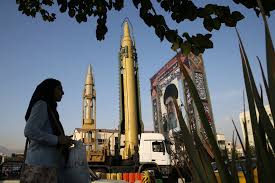
Iran possesses a sophisticated arsenal of some 2000-3000 missiles that include short-and medium-range ballistic missiles, a long-range cruise missile, and long-range rockets. Its medium ballistic missiles could conceivably be armed with a nuclear payload, should Iran continue its advance to a nuclear bomb.

We know, too, that the Iranians have been working on a ballistic anti-ship missile to be potentially used against American aircraft carriers.

Will they ultimately effect a nuclear capacity to hit the US mainland as North Korea has done? Or before then, will Israel, under grave nuclear threat, launch a first strike of its own on Iran’s myriad underground bunkers, plunging the world into a nightmare scenario?

–rj

Space as Identity: The Plight of Bedouins in Israel

Gretel Ehrlich, in her splendid The Solace of Open Spaces, writes that “a person’s life is not a series of dramatic events for which he or she is applauded or exiled but a slow accumulation of days, seasons, years, fleshed out by the generational weight of one’s family and anchored by a land-bound sense of place.”

This brings to mind Israel’s Bedouins, a traditionally nomadic people once populating a vast desert terrain, whom T. E. Lawrence understood and celebrated. And they reciprocated.

In his own time, Lawrence lamented the increasing fate of urbanized Bedouins, their loss of place and a way of life: “The perfectly hopeless vulgarity of the half-Europeanised Arab is appalling. Better a thousand times the Arab untouched.”

Much of that traditional way of life is but memory, especially in Israel, where Jewish settlers in the Negev have frequently seized Bedouin lands and driven out their people.

A vivid example is Twayil Abu Jarwal, one of forty unrecognized Bedouin villages in the Negev. Lying north of Beersheba and off the beaten track, you’ll not find it on any map.

It has no permanent structures for its 450 inhabitants, housed in tents, and clinging stubbornly to place and a way of life.

The village and its fields have been bulldozed so many times that no definitive account exists, perhaps between 25-50 times.

Still they cling to what’s long been theirs for two millennia or more.

After each razing, they re-assess, restore their sheltering tents, and plant anew.

Ilan Yeshurun, who directs the local Israel Land Authority, interviewed in the Jerusalem Report, defends these demolitions: “This is not a village. It doesn’t exist on any map or in any legal registration. It’s only a village in the eyes of the Bedouin.”

Critics call it “urbicide,” an Israeli attempt to destroy perceived communities of potential Palestinian resistance. I think it more than that—a quest for expanding settler homesteads, akin to America’s violent history of seizure of Native American lands.

Meanwhile, some fifty illegal settler farms have sprung up and, politics as usual, nothing is done.

There are now just six Israeli authorized Bedouin villages. Presently, an extended Highway 6 thrusts its way into their traditional landscape, with Israeli plans to continue their policy of demolition and resettlement.

Understandably, Trayil Abu Jarwal villagers fear not only a loss of their land, but a way of life.

Thomas Wolfe famously wrote that “you can’t go home again,” meaning that time brings evolution and experience changes us, uprooting past constituents of our nurturing tied to place.

On the other hand, his dictum locates the modern tragedy of living in a mobile society. Home is an extension of ourselves, evoking sanctuary and fostering identity..

T. E. Lawrence had promised the Bedouins emancipation from the Ottomans Turks. But with takeover of Ottoman land by a modern Israel, they languish still, their cries unheard.

–rj