
Discovering Ourselves Through Writing

What to write about, or finding your subject matter, doesn’t come easily.

Some writers respond to prompts to get them started.

Most writers probably get started out of a chance remark thrown their way in casual conversation or through stimuli in something they’ve read, or a keen interest, say in health research or climate change, that drives their protocol.

Political writers with an agenda find an especially easy route, simply reacting to adversary axioms they view as detrimental to public welfare. They’re never out of material, the spring never running dry in a media era of incessant scrutiny.

Popular author Tim Cotton just throws a sentence out there, not knowing where he’s headed: “What you don’t know about me, and won’t care, is that everything I write starts with a random sentence, typed onto a screen with no idea where I am going.”

Probing deeper, however, you’ll find this may be misleading. Cotton doesn’t simply post an initial sentence without an underlying coterie of everyday happenings—a visit with his aging father, the dream residue of an afternoon nap, the challenge of what to keep or toss, etc.

The key is to be mindful and present in the ordinary, and Cotton does this better than most of us. I suspect he jots down incipient observations he can expand upon later. Like many writers, he may keep a journal.

No matter how the writing venture begins, it has its mysterious aspects that all of us know very well. I remember a fellow graduate seminar student telling me that my writing exhibited a different person from the one of daily conversation.

That doesn’t surprise me. However I begin writing, I tunnel into a buried mineshaft of a separate self, perhaps akin to what Jung called the Shadow, surfacing in the writing act like a Yellowstone geyser bursting from subterranean depths.

Occasionally, I’ll bump into something I wrote several years ago and come away, Did I write that?

The poet Coleridge famously ascribed his Kubla Khan poem to an afternoon opium induced nap. On the other hand, Harvard scholar John Livingston Lowes pointed out Coleridge’s possible myriad reading sources in The Road to Xanadu.

In short, the depth psychologists Freud and Jung were right: We file our experiences, even the most trivial, at the unconscious level, lying dormant, only to spill suddenly into awareness, triggered by associative stimuli.

And so Tim Cotton is also right. However you start, your writing will reveal unknown vistas, revelatory of a much wiser Self than that quotidian persona we publicly assume.

Cotton inspired this post. I simply typed the first sentence, not knowing what I’d say. I had no notes, did not google, etc. That concealed self, automatic writing psychic enthusiasts might call it, filled out the blank.

Our minds are a file cabinet of our human experience, waiting retrieval. Writing may prove laborious, but think of what you miss when you don’t bother to write—the confluence of your life’s journey and its meaning; above all, your linkage with wider humanity, fostering understanding and empathy.

A journey of serpentine twists, leading to unanticipated trajectories, you never really know where you’ll end up.

–rj
Dream Rummaging

We dream–it is good we are dreaming–
It would hurt us–were we awake.
Emily Dickinson

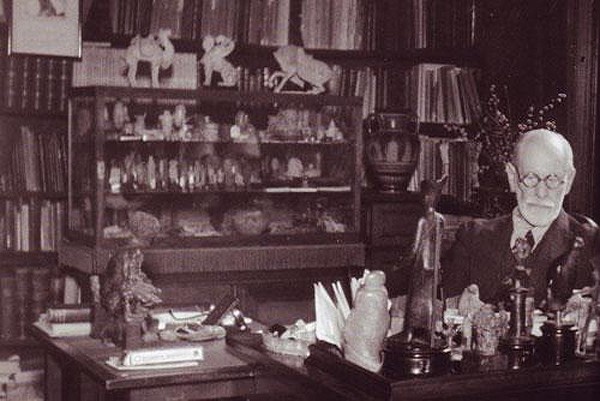
Freud in his London office (1939)

1111_Freuds-Last-Session369887

Do you dream a lot?

I know I do.

Incessantly.

I dream more now that I’ve gotten older, abetted by having to get up in the nights at this juncture.

Should I care about dreams?

Do they have meaning?

Can they help us?

Perhaps show us our real selves?

Make for a better world?

I know I’ve always been interested in them from earliest days.

The catalyst was probably Freud’s massive Interpretation of Dreams, which I confess to reading all the way through.

For Freud, dreams reflected repressed desire, often of libido.

The wish principle always.

But how can that be?

Don’t I often dream my fears?

With Freud, I always sensed a wanna-be novelist at work, ingeniously spinning narratives, howbeit, in the name of science–alas, to confirm an a priori hypothesis without the backup of today’s medical formulae of random testing and cohort studies. But then, how do you quantify something so ethereal as dreams?

But don’t get me wrong.

I think his Civilization and Its Discontents one of the great masterpieces, despite its surprising brevity.

His triad of Id, Ego, and Super Ego continues to spellbind me by virtual of the myriad ways I see it manifest itself in both myself and others.

Auden, as always, said it so well in his “Memory of Sigmund Freud” (1939):

for one who’d lived among enemies so long:
if often he was wrong and, at times, absurd,
to us he is no more a person
now but a whole climate of opinion….

I was surprised to read in neurologist Oliver Sacks’ tell-all memoir, Moving On, published just several months before his death last week, that he was seeing a psychoanalyst for some fifty years–and, remarkably–the same one every week! Sacks kept a notebook on his nightstand, recording his dreams faithfully.

Make no mistake: Sacks is a man I came to love and respect deeply. I just wish I knew why he kept finding psychoanalysis a cornucopia of self-knowledge, apart from crediting it with his rescue from drug addiction acquired from his youthful halcyon California days a la Muscle Beach.

For me, the great influence on how I look at dreams has been Freud’s former disciple, Carl Jung. His notions of anima and animus, often projected in dreams, have proved revelatory personally and hence liberating.

He taught me that so much of living life is finding equilibrium, or the balancing of Ego and Self.  Dreams offer symbols to excesses in ourselves that can be remanded.

He also introduced me to polarity as the essence of mythos truth with its tension of paradox.

If Freud looked to our past as the repository of dream content, Jung saw dreams as projections of possibility and therefore hope.

Jung was more a cultural analyst, or pseudo-anthropologist, finding universality across a wide spectrum of symbolic significance, rummaging what he collectively called archetypes.

In younger days I nearly chose becoming a licensed Jungian therapist and sometimes wonder if I committed one of the great follies in my life in turning down its seduction. Campbell, that ardent Jungian, famously urged we should follow our bliss. That maxim, aside from its latent dangers resident in reductionism, may often prove wise counsel and its rejection the source of substantial human misery.

But to sum up, I think what I’ve liked best in Jung is his acceptance of the banality of evil, Arendt’s phrasing for resident evil in Man. No liberal withering away via socio-economic exegesis, often speciously argued in my view.

Maybe my lifelong fascination with dreams stems from my youthful days drenched in fundamentalist biblical parochialism. There was Joseph, so masterful at dream interpretation that the Pharaoh took him into his confidence, ultimately saving Joseph’s kindred Hebrews.

And of course, there’s Daniel.

For the ancients, dreams gave warning and with it, admonition.

I chose to pursue a Ph. D. in English Literature. Well, you guessed it: Coleridge’s famous Kubla Khan poem, which he explained as the aftermath of an interrupted dream. But that’s just one dream poem. There are scores of other dream poems.

What I’m meaning to say is that there have been so many threads feeding into my dream fixation, not just Freud and Jung who were obviously mesmerized.

Do dreams exhibit patterns?

Do they help us to know ourselves?

I believe they do.

And that’s why I need to go back to exploring my dreams again, now that they seem to occur more frequently.

Like Sacks, I may soon be keeping a notepad on my nightstand.

–rj