
Biden plays politics: The Gaza fiasco


On one hand, President Biden urges a ceasefire in the nearly six month Gaza conflict; on the other, he has stealthily authorized a potent new military aid package to Israel that includes jets, 1,800 MK84 2,000-pound bombs, and 500 MK82 500-pound bombs.

Although 2000 pound bombs are capable of taking out whole city blocks and have been abandoned by most Western militaries for employment in urban locales, they have dominated Israel’s aerial assault on Gaza, with the death toll currently estimated at 33,000, the vast majority of them civilians.

Anonymous Pentagon sources disclose the armament transfer includes transfer of 25 F-35A fighter jets and engines at a cost of 2.5 billion.
Biden isn’t mandated to disclose any of this to lawmakers since Congress had approved the transfer in 2008, presently unfulfilled.

Israel is currently the largest recipient of U.S. aid since the 1970s, receiving on average $1.8 billion in military and $1.2 billion in economic aid annually.

Such aid incentivizes documented Israeli violations of Palestinian rights by humane organizations such as Amnesty International and Human Rights Watch. They have included ongoing abusive detention practices (including the torture of prisoners), restrictions on freedom of movement of Palestinians, the targeting of medical personnel and facilities, and severe damage to infrastructure such as water and electricity to Palestinian civilians prior to Israel’s current Gaza incursion.

It does not move the needle to a two state solution.

All of this comes even as Biden expresses concern over a pending Israeli assault on the alleged remaining Hamas stronghold of Rafah along the Egyptian border and UN warnings of incipient mass starvation. 1.2 million Gaza refugees have sought refuge in this enclave.

Jewish pressure weighs heavily on the Biden administration in an election year with the American Israel Public Affairs Committee donating millions to unseat Democrats deemed unfriendly to Israel. A recent Pew Research survey indicates 80% of American Jews regard aid to Israel as essential.

Those constituencies calling for suspension of aid to Israel are branded as anti-Semite, with surging efforts to pass legislation abridging their First Amendment right to free speech.

Republicans, even more than Democrat leaning Jews, have vigorously supported aid to Israel, though increasingly resistant to approving aid to a besieged Ukraine.

Biden would do well to mind an increasingly assertive Muslim-American electorate that threatens to boycott him in November.

Meanwhile, any full scale attack on densely populated Rafah, gateway for food convoys, would conceivably result in thousands, not hundreds, of killed and maimed.

The morally compromised Biden administration has been complicit in Israel’s blitzkrieg that includes mosques, churches, hospitals and refugee camps, abetted by American armaments.

For this, the U.S. proves deserving of world condemnation.

The elephant in the room is Biden; but then again, endeavors to dislodge him by voting for his Republican adversary are surely non sequitur.

Conversely, efforts to encourage divestiture at home and abroad of Israel merit encouragement. They brought down South Africa’s apartheid regime.

America must do what is right, not what is easy.

–rj

Tibet’s Tragedy: A Culture Teetering into Oblivion

_90482485_28344675572_e210e10c4e_bThe horror began with the Chinese invasion of Tibet in 1949. In the decades since, Chinese oppression has continued relentlessly, with several hundred thousand Tibetans having been executed, tortured or imprisoned.
Commenting after her recent release, one survivor informs us that “Chinese officials used different torture instruments on me to break my spirit…to make me denounce his Holiness and the aspirations of my people. My fellow political prisoners and I were subjected to electric shocks from batons and prods…I spent weeks in solitary confinement. This torture and mistreatment started when I was just a child of thirteen and continued through most of my life in prison.”

I knew that the Chinese regime had signaled out Buddhists in Tibet to denigrate its culture as one effort among others to suppress their identity and, with it, their desire to be a free people.

Of an original 6,254 monasteries that existed before the Chinese invasion, just 13 remain fully intact, the others either destroyed or severely damaged.

A few days ago, I finished reading Stephen Batchelor’s fascinating book, Confessions of an Atheist Buddhist. Batchelor had converted to Buddhism as a young man and was formally ordained as a monk in 1974, and knows both the Tibetan language well and the woes of Buddhism, Tibet’s ancient faith.

He recalls visiting Lhasa in 1984. While the Potala Palace remains, it’s now a museum. Few traces of Buddhism, in fact, remain in this city once filled with Buddhist shrines and ubiquitous prayer flags.

From the Potala, you can glimpse what remains of the nearby Sera Monastery. 3000 monks lived there in 1959, the year of the Tibetan uprising. Now, only 100 lamas remain, all of them elderly.

Twenty miles east of Lhasa lies the Ganden Monastery, founded in the 14th century. Sadly. the infamous Red Guards ordered the local people to dismantle it, stone by stone. Once the residence of some 5,000 monks, only a scattering of aged monks remains.

Chinese persecution of Tibetan Buddhists continues unabated even beyond Tibet proper. In June 2016, the PRC mandated that half of the world’s largest Buddhist conclave, the Tibetan Buddhist Institute at Larung Gar, with its estimated 40,000 monks and nuns in Szechuan, be razed and its numbers reduced to 3,500 nuns and 1500 monks.

According to Radio Free Asia, expelled monastics must sign a pledge to “uphold the unity of the nation and not to engage in behavior opposing government policy in the area.”

Last month (December 6, 2016), the Tibetan government-in-exile asked the UN to intervene.

Meanwhile, the European Parliament on December 15, 2016, adopted a resolution condemning the destruction of the community.

Here at home, President Obama hosted Tibet’s spiritual leader, the Dalai Lama in both 2010 and 2014, giving verbal support for the preservation of Tibet’s culture, while subsequently restating the U. S. position that Tibet is part of the People’s Republic of China.  (He did not meet with the Dalai Lama in the Oval Office.)

China views the Dalai Lama as a separatist, however, and hence a threat to government hegemony, even though the Dalai Llama has never advocated independence..

Meanwhile China is pressing forward with resettling thousands of Chinese in Tibet and plans to build a second railway into the country to expedite commerce and tourism in particular.

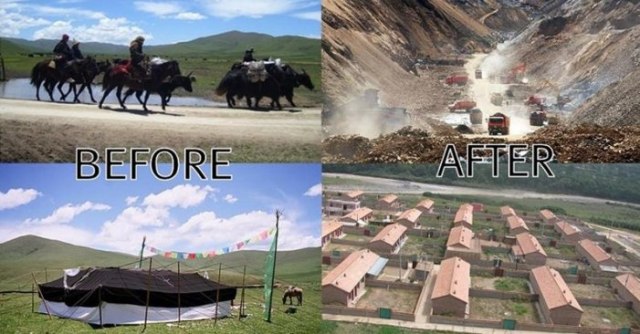
Since 1990, China has relocated more than 2 million nomads into barrack settlements under the guise of protecting grazing land.

9-7-15_nomads_before_after_thumbnailIn urban areas, new schools are being built with Mandarin the primary language of instruction.

Though most of Tibet remains overwhelmingly Tibetan, an estimated 17% of Lhasa’s population is now Chinese.

In short, the Chinese have been following the Soviet formula of resettling volatile areas such as Ukraine, Lithuania, Latvia and Estonia, where a large Russian population now resides.

There are a few Westerners who argue that reports of Chinese repression have been exaggerated.

I have more faith in Amnesty International, which relies upon documentary evidence. In its 2014 report, it concluded that “ethnic Tibetans continued to face discrimination and restrictions on their rights to freedoms of religious belief, expression, association and assembly.”

We are now into 2017, and while the world largely goes its own way, Tibet’s fate continues to deter towards extinction of its culture as the Chinese People’s Republic recent ordnance demolishing Larung Gar clearly demonstrates in its strident callousness.

Since 2011, American International has documented 131 self-immolations in protest of Chinese incursions upon its way of life.

—rj