
I’m currently reading travel connoisseur Pico Iyer’s A Beginner’s Guide to Japan, a delightful read. Unlike many travel writers who guide us to a country’s tourist amenities—sights, hotels, restaurants—Iyer illuminates its culture. He knows Japan intimately, married to a Japanese wife and calling the country home for the past thirty-two years.
As a serviceman, terribly young at the time, I visited Japan twice on R & R. I was impressed by its remarkable post-war recovery and, even more, by its people—the most courteous, polite, clean, and honest of any nation I’ve been privileged to visit. Leave a camera in your room at checkout, and they’ll have it waiting at the desk when you return to inquire
The Japanese aim to please, integral to a culture of collectivized kindness.
Iyer shares a German visitor’s observation from 1910:
“If a fisherman sees you emerge from the ocean after swimming, he will quickly remove the sandals from his feet, bow, and place them before you in the sand so that you do not have to walk down the street barefoot.”
It’s still that way.
Purchase a gift and it will often be wrapped—even in newspaper, say from The New York Times—simply to heighten your pleasure.
Don’t be surprised to find a basket of toothbrushes, toothpaste, and floss in your hotel bathroom.
For sheer convenience, Japan has 5.6 million vending machines—more than anywhere else in the world.
In America, convenience stores are a way of life, especially along interstate highways. They are also, sadly, frequently robbed.
In Japan, which has more than 50,000 convenience stores in a nation roughly the size of California, they are places of safety when one fears assault.
Outwardly and inwardly, they are uniform—for your convenience.
And yet they differ.
Some deliver.
Some are expansive, two-story outlets.
Some are specialized for the elderly.
If you need someone to console you in your grief, Amazon Japan can send a Buddhist priest to your door.
Feeling lonely? There are companies that will provide a pseudo-relative or friend—a mother or father, even a girlfriend.
Train stations, spotlessly clean, often feature signs:
“In order not to bother other customers, please show good manners and create a comfortable atmosphere.”
One of my special memories of Japan—beyond the scalding baths where nudity among the sexes was not a problem (though that may be changing as immigration increases) was the custom of not opening a gift in the giver’s presence, lest one reveal disappointment or offer false praise.
I like Iyer’s observation of Japan’s intuitive grasp that some things cannot be perfected:
“Japan has a sharp-edged sense of what can be perfected—gizmos, surfaces, manners—and of what cannot (morals, emotions, families). Thus it’s more nearly perfect on the surface than any country I’ve met, in part because it’s less afflicted by the sense that feelings, relationships, or people can ever be made perfect.”
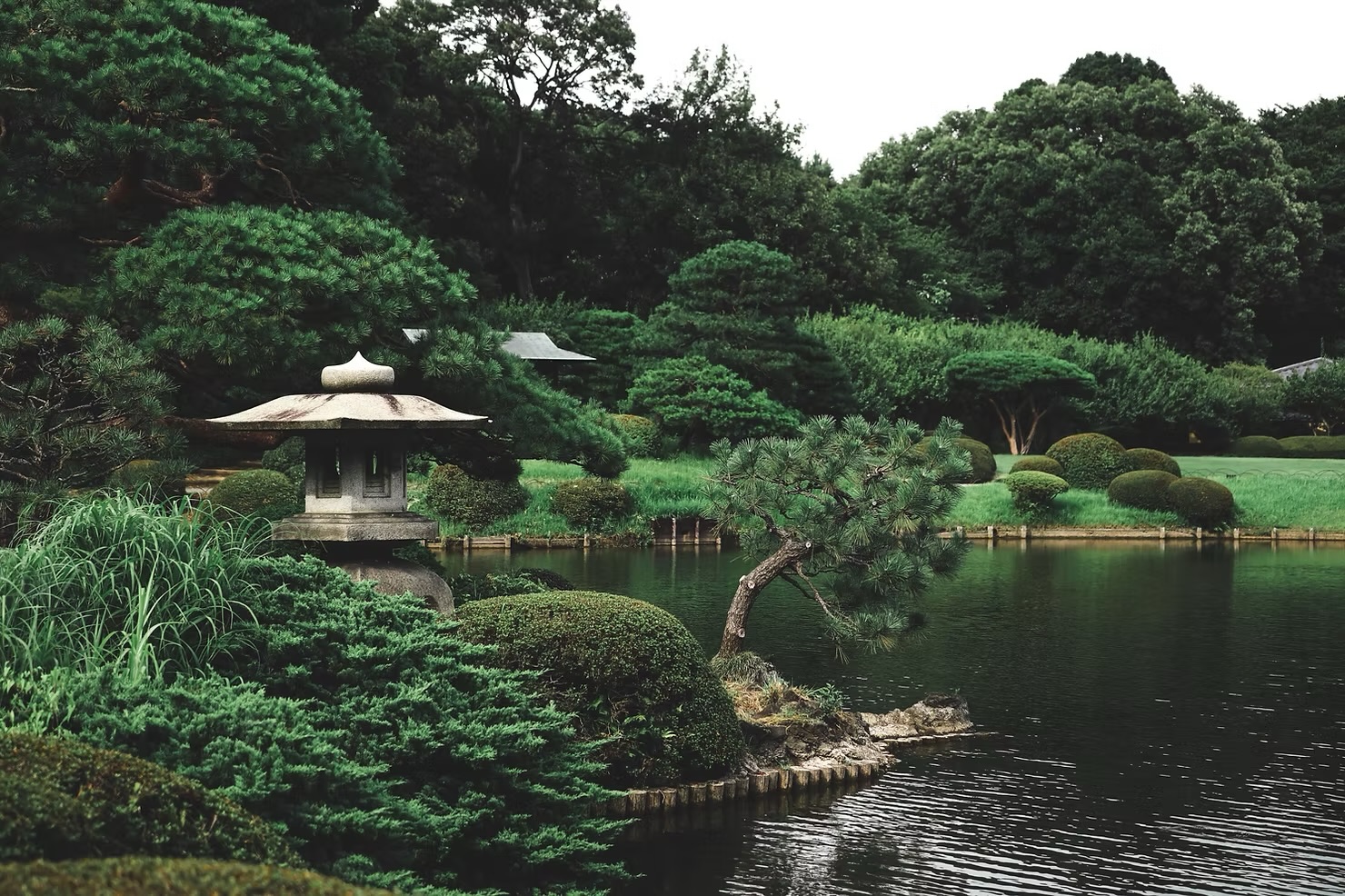
I adore the Japanese penchant for harmony with nature, of which we are a part—reflected in meticulous gardens replete with lanterns, bridges, fountains, lakes, and ponds; sculpted cherry trees and moss marking the seasonal passage; myriad stone and pebbled pathways; sanctuaries of stillness instilling reflection—the way of Zen.
I love their cherishing of the ceremonial, their intuitive sense of inherent beauty in redeeming a pattern—whether arranging flowers or serving tea.
Above all, I love Japan’s simplicity. Dressed in kimono, I slept on floors in narrow rooms divided by fragile sliding doors: beneath me, my shikibuton; my head resting on a single makura; a kakebuton drawn close against the night chill. Nothing excessive. Nothing clamoring. Only wood, paper, cloth, and quiet. A nation refined not by accumulation, but by restraint.
Japan—a place apart. May it always remain so.
—rj
Discover more from Brimmings: up from the well
Subscribe to get the latest posts sent to your email.

 Brimmings: up from the well