
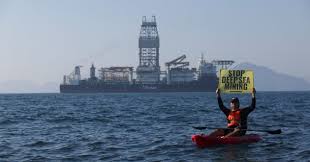
Mankind’s invasive footprint appears deplete of boundary, whether of earth, sky, or ocean depth, and not without consequences for an already shrinking biodiversity and a burning planet and, therefore, for ourselves.
Today, July 9, 2023, marks an incipient crisis for our oceans, already menaced by rising temperatures, accelerating acidity and melting glaciers, all of it human induced. Applications to mine the sea can now begin.
It all goes back to 1982 when the United Nations negotiated The Convention on the Law of the Sea (Unclos), mandating a vast area of the ocean, a designated 53m sq. mile coastal economic zone, be excluded from seabed mining until the adoption of a code safeguarding the environment. Meanwhile, it approved an area of 1,700,000 sq. miles (half the size of Canada) known as the Clarion-Clipperton Zone, for seabed mining.
To this end, the International Seabed Authority was founded in 1994, with a current 167 subscribing members along with the European Union. After 28 years of negotiating, it has been unable to agree upon a code. It administers the Clarion-Clipperton Zone.
A clause in Unclos, however, provided an escape mechanism allowing any application for seabed mining be allowed should no code be adopted. Today, that moratorium ends.
We are caught in a catch 22 dilemma, compounded by both need and greed.
We rely upon nickel, cobalt and manganese, along with lithium from land resources, to propel our wind farms and electric vehicles. Potentially, the ocean seabeds offer us tons of needed minerals.
Even if there were a code, I seriously doubt it would be meaningfully implemented and mitigate environmental degradation to sea life.
The ISA has always been poorly funded and many of its negotiators have fishery interests. It has yet to deny any application for exploration, granting 31 of them. Five of them are by China. It lacks empowerment and resources to mandate candid environmental impact appraisals, leaving that up to the corporate sector.
We need to be doubly painstaking in assessing opening up our last earthly frontier for exploitation.
As environmental writer, Guy Standing (The Blue Commons: Rescuing the Economy of the Sea), cautions, “All of us should be deeply alarmed. The environmental impact of deep-sea mining could be catastrophic. Massive machines will scour the ocean bed to pick up polymetallic nodules, destroying everything in their path and creating sediment plumes that can suffocate coral reefs and other organisms hundreds of miles from the mining site. Mining will damage the ocean’s ability to act as a carbon sink, accelerating global warming. And new research suggests the polymetallic nodules could contain radioactive substances, endangering human health cautions.”
And what about noise, vibration and light pollution, or fuel leaks and chemical spills? The list is long and the unplanned for has a way of happening.
In June, the European Academies Science Advisory Council spoke of the dismal impacting on marine ecosystems and denounced “the misleading narrative” that deep-sea mining is necessary to harvesting the metals vital to a green economy. Lithium, not a pervasive ocean element, and other minerals vital to EV technology, are presently land-based. Further, technology constantly changes.
Our oceans comprise a vast cornucopia of biodiversity yet to be discovered. Consider the recent finding of 5,000 new species living on the seabed of the Clarion-Clipperton zone, open to deep-sea mining firms.
I fear where we’re about to tread.
I fear for ourselves.
And for our oceans, from whence we come.
–rj
Discover more from Brimmings: up from the well
Subscribe to get the latest posts sent to your email.

 Brimmings: up from the well