Growth is Good?

When driving, I not infrequently see bumper stickers proclaiming, “Growth is Good.” I’m not sure about that. I never have been.

I’m drawn to solitude. I can’t fully explain why; I only know it has always been so.

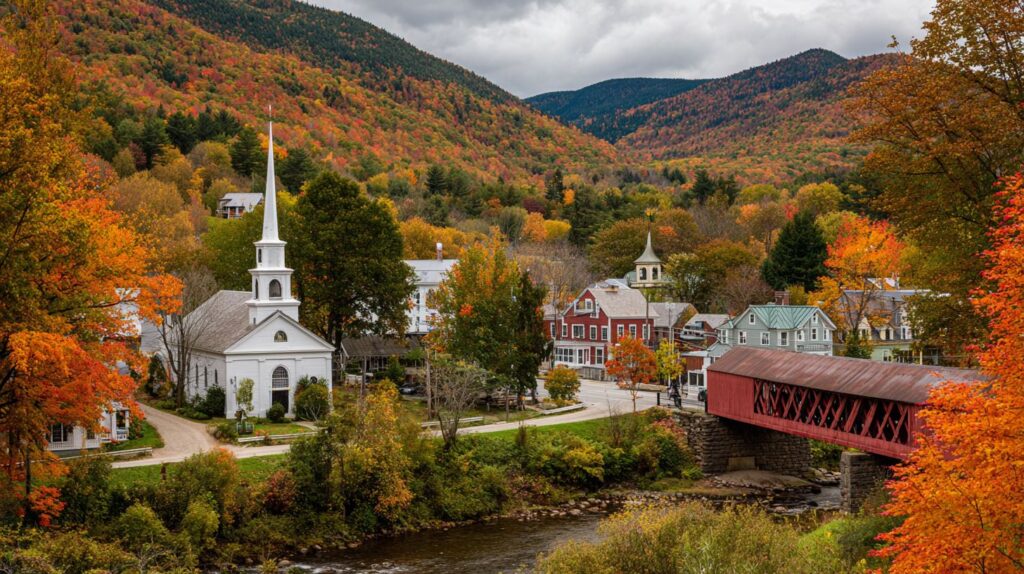
From childhood, I loved my native New England—its rural charm, its villages gathered around commons harkening back to Revolutionary times. I miss the sea, the rolling mountains, the stone walls and white-steepled churches.

Vermont has long held me in its grip, with Maine not far behind—rural, twisting lanes with scant traffic, mountains rising beyond charming villages, the faint salt scent of the seashore.

For all my love of open space, my early years were divided between rural Rowley, MA, and Philadelphia. I’ll take Rowley any day over the so-called City of Brotherly Love. I have returned to Philadelphia twice; both visits stirring up memories I would rather forget—urban blight, high crime, dirty streets, endless row houses and sweltering summer nights.

When I lived in Rowley in the 1950s, the town numbered about 1,600 souls. Thirty-five miles north of Boston, it has since tripled in population to roughly 6,400 and become a fashionable bedroom community for Boston’s well-paid professionals, aided by the MBTA Commuter Rail—a comfortable fifty-five-minute jaunt into Boston’s North Station.

We lived on Bennett Hill Road, a mile’s walk from the common. In summer I would rush out the door, glove hooked over my bicycle’s handlebar, eager for baseball on the green.

I loved walking that narrow, curving road lined with beach plum bushes and open fields, breathing the smell of nearby salt marsh bordering the ocean, as I waited for the school bus at the corner.

Home was a two-hundred-year-old house set on twenty-six wooded acres of pine. Its long driveway was lined with boulder stone walls in the old New England manner, guarded by towering elms like ancient sentries.

Deep in those woods I had a private place I visited often, drawn by its stillness—the scent of pine rising from fallen needles that softened the earth beneath my feet.

Today, Rowley finds itself embroiled in debate over a state mandate requiring density zoning for roughly six hundred new multi-family housing units near the train station.

Bennett Hill Road has changed. The beach plum bushes are gone; open fields have yielded to wooded suburban enclaves. In the 1950s, the average home sold for $10,000. Today it approaches $1 million.

I cannot forecast Rowley’s fate, though I hope it doesn’t become another Danvers or Peabody—once distinct towns now absorbed into the dense sprawl of greater Boston.

A major development called “Rowley Farms” proposes a “town within a town,” combining denser housing and retail—an idea that would have been unimaginable in 1957.

Bumper stickers may insist that growth is good. I remain unconvinced. I am, and likely will remain, a stubborn holdout for a way of life that prized quiet contentment—secluded from the noise, the restlessness, and the accumulated griefs of urban life.

—rj

New England Memories

York Beach, Maine
York Beach, Maine

Sometimes a long delay gives you better perspective. I hadn’t been back home to New England in eleven years until our recent trip. Thinking of Thomas Wolfe’s dictum, “You can’t go home again,” I didn’t really know if my previous enthusiasm about the place could withstand a revisit after being away so long.

But it did:

There was exciting Boston with its history, culture, and trail-blazing architecture. And being a retired prof, I salivated thinking of those 100-plus colleges and universities within its 4.5 million metropolitan area. Unfortunately, we could only spend one night there, but at least Karen and I got over to Fenway for a night game to watch our beloved Red Sox. Yeah, they lost; in fact, got routed, but we were compensated big time exploring the Prudential Center’s seemingly endless mall with its myriad shops and culinary haunts.

Then Rowley, founded in 1639, where I lived several years. My cousin, Susan, more like a sister than a cousin, still lives there. Sharing memories was just the right brew amid the town’s quiet ambience with its 5000 population, though only 35-miles north of Boston. It had 1500 people back in 1957 when I left, yet retains its delightful small town feel. Like so much of New England’s sleepy rural towns nestled in bucolic splendor, time hasn’t played its heavy hand.

And then our visit for a week to Maine with its inviting beaches at York Beach and Ogunquit, “lobsta,” “chowda,” freshly caught fish and fried clams. As a child I had loved the nearby sea, whether living in Rowley or visiting New Hampshire or going ” down” to Maine as New Englanders like to put it.

The same crescendoes of waves hurling themselves against the rocky shore echoing the tidal poundings that I could hear sometimes from my bed at night in Rowley just six miles away from the Massachusetts shore..

No, we didn’t get to my favorite part of Maine reaching up to Boothbay, Camden, Bar Harbor and resplendent Acadia National Park. I’ve yet to see jagged Mt. Katahdin with its spectacular hiking trails and grand vistas, or the many forest secluded lakes that comprise northern Maine’s landscape that fascinated Thoreau; but it’s all there to be drawn upon for future visits, perhaps more often because I’m frankly running low on time.

Places yet to renew my spirit in an increasingly savage world of human abode, New England with its mountains, lakes, thundering seas, white steepled churches, long history where time gets honored over newness; sailing ventures to Martha’s Vineyard and Nantucket; 4th of July bonfires and the Boston Pops along the Charles; Harvard Square teeming with bookstores; nature’s autumnal artistry transforming foliage into flaming hues of red and flamboyant orange; jazz festivals in Newport and on Yale’s green; and, yes, the fall of snow bringing hush to a busy world.

After so long absence, I’ve been like a lover returning home, renewed in spirit, “surprised by joy” as Wordsworth put it. Somethings remain stubborn against time’s ceaseless push and you really do find you can go home again.

–rj