Spare me your heart: the plight of the mentally ill

300px-Cover_of_Diagnostic_and_Statistical_Manual_of_Mental_DisordersIn the aftermath of the Newtown shootings, a shocked nation seems finally to be taking a hard look at mental illness, although for the wrong reasons.  Gun control, with 250 to 300 million guns out there, owned by 60 million across the United States, would be a hard nut to crack even if legislation, unlikely, were to become law and remains the salient issue.  Unfortunately, indicting the mentally distressed is subterfuge for not dealing with the primary source of our national mayhem.

While I agree with those voices calling for attention to our mental illness epidemic,  I think it’s kindled by media sensationalism that would indict millions who suffer grievously as it is.  I must point out that only 4% of our annual murders are committed by someone mentally ill (Richard Friedman, NYT, December 17, 2012).  These vociferous voices simply add to the stigmatizing  of the mentally ill.  On the other hand, guns are very much the public health issue, if we define health as well-being.   In the wrong hands, they foster tragedy, and most of these guns are found in American homes as happened with the Lanzas.

I want to outline here, however, just how serious mental illness is as a pervasive and growing presence and the compassion it should elicit from us rather than lynch mob condemnation.   At the conclusion, I’ll offer some final commentary.

What is mental illness?  When we talk of someone being mentally ill we’re not necessarily dealing with hard core psychotics such as schizophrenics.  Mental illness affects  how one feels, thinks, and ultimately behaves.   While all of us occasionally experience ups and downs,  those suffering from a “mental disorder” are simply overwhelmed and unable to cope.  They may suffer, for example, from acute depression, anxiety, obsessive thoughts,  and addictions that simply won’t go away.  This frequently results in problems at work and at home and needs prompt, professional intervention.

What are its causes? Possible causes may include

Heredity: Genetics may be suspected when mental illness affects several family members within or across generations.  Certain stress situations may trigger it.

Trauma: an experience such as a death of  a loved one or break-up in a relationship, being a crime victim,  group rejection, war violence, declining health, a financial loss and a problematic childhood leading to low self-esteem and distorted thinking can be tipping points.

Chemical imbalance: Changes in brain chemistry affecting neurotransmitters and/or hormonal abnormalities may affect mood.

How common is it?  Mental illness is pervasive world-wide.  The World Health Organization (WHO) reports an incidence rate of  33% . In the United States, the figure approaches 46%.  It affects all social-economic sectors.

Key symptoms:                                                                                                                            

Inability to focus
Constant sadness
Excessive worrying
Insomnia
Difficulty managing anger and hostility
Detachment from reality: hallucination, delusional thinking, Paranoia
Obsessive-Compulsive rituals
Sudden mood fluctuations
Excessive anxiety
Suicide thoughts
Feelings of abandonment
Eating disorders: anorexia, bulimia, etc.
Substance abuse (frequently addiction is associated with mental illness).

How is it treated? Treatment includes counseling, often accompanied with medication; brain stimulation such as electroconvulsive therapy for those not responding to traditional methods; treatment in a residential community (hospital).

Prognosis:  Outcomes can be positive for milder forms of mental illness, provided the individual adheres to treatment protocol, has a network of support, and makes lifestyle changes such as reducing stress,  exercising,  making friends, finding interests, and developing a positive outlook.  There are many others, however, who can only be managed, not cured.

Cost impact: The costs of mental illness are staggering, both direct and indirect costs.  Direct costs include therapy, hospitalization and medication.  Presently, these outlays consume nearly 20% of medical expenditures annually.  Indirect costs, more difficult to measure, outweigh direct costs by a hefty margin in lost income (an estimated $192 billion in 2008), educational attainment, disability payments, homelessness (one third of our homeless population is deemed mentally ill), social violence, litigation and incarceration (22% of prison inmates have been diagnosed as mentally ill).  (Thomas Insel, “Assessing the Economic Costs of Mental Illness,” Journal of American Psychiatry, June 2008).

And then there are the suicides, those thousands who have simply surrendered to their depression.  (Suicide numbers, by the way, have been increasing, not helped by the economic recession, and currently are the 10th leading cause of death annually.

Final Reflections:  The mentally ill, unfortunately, are frequently stigmatized as “maniacs,” “loonies,” “crazies,” “weirdoes,” “zombies,” etc.  I think we know the litany.  It’s so bad that a large number of the mentally distressed are afraid to get help.  Psychiatry itself hasn’t helped the situation.  Many psychiatrists in private practice turn down Medicare patients in favor of more lucrative insurance payouts, or cater to a more affluent clientele.  They eschew paper trails and generally require  cash payment in full for each session, though they may allow you the convenience of your credit card, but don’t bet on it.  Like all professionals, they differ in quality or competence.

Psychiatry itself, since the 90s, has primarily surrendered therapy to the psychologists and social workers, opting for chemical treatment instead and, for this, a client can expect a usual allotment of 15 minutes to periodically check on the SSRI effectiveness at $100 plus.  The truth is that much of this medication may be dubious, as new research continues to confirm that those given a placebo do virtually as well.

Health insurance, meanwhile, more often than not, discriminates against those with a “history,” that may simply be a prescription for anxiety or depression.  Formularies have a way of being akin to finger prints in tracking down the mentally distressed, even if now recovered, under the guise of pre-existent illness.  While the Health Reform Act when fully implemented in 2014 prohibits using pre-existent illness as a pretext for rejecting an applicant, it does not prohibit insurance companies from setting higher rates, which is like trusting the fox to take care of the chickens.

The one tool that has helped a good many to cope is cognitive therapy, sometimes called Rational Emotive Therapy) in which patients are taught how to think past painful emotions by substituting positive thought alternatives. We need more of it—a whole lot more.

One of the dismaying aspects of the mental illness syndrome is how neglected it has been, from the homeless right down to the incarcerated.  While you can find a plethora of resources for the mentally challenged, not so for those suffering mental distress and we, as well as they, suffer the consequences.

All of this should not be!  Consider that every year nearly 60 million Americans wrestle with mental illness.  It knows no social/economic boundary.  It could be your neighbor, your fellow worker, your spouse, your child.  It could someday be you.

Returning to Richard Friedman in his NYT article, he hits the nail on the head in summarizing the wolves howling to get at the mentally ill when he writes, “All the focus on the small number of people with mental illness who are violent serves to make us feel safer by displacing and limiting the threat of violence to a small, defined group.  But the sad and frightening truth is that the vast majority of homicides are carried out by outwardly normal people in the grip of all too ordinary human aggression to whom we provide nearly unfettered access to deadly force.”

In the 1930s there was a landmark song that defined those tough times:  “Brother, can you spare a dime?”  There’s a new song in town:  Brother, sister, can you spare your heart?”

rj

POSTSCRIPT: I came upon this just published article on the paucity of mental health resources since publishing this post two weeks ago. it reinforces what I’ve written in my post:
Families Face Mental Illness Barriers
The enigma of coincidence

synchronicityChance often plays a key part in our lives.  In fact, it’s how we got here.

It also sometimes saves our lives.  I’ve come close several times, escaping only by a hair.

You might even say chance rules our lives, determining where we’re born, the culture that shapes our behaviors and beliefs, friends we make, and our life mates.

On occasion, I find myself asking What ifs.  What if I had chosen to do that instead of this?  Frost wrote a famous poem about it called “The Road not Taken” with its telling rejoinder,  “And that has made all the difference.”

In short, chance has this mysterious aspect to it, a sense that it’s more than randomness or simple caprice; that just maybe it’s the work of an entity transcending both ourselves and nature. This is especially true when coincidence, a kind of sub-species of chance, occurs. The famous Swiss psychiatrist, Carl Jung, thought so and called it synchronicity, a way of happening whose effects are to be associated with meaning rather than cause.  Jung wasn’t alone here, as Arthur Koestler gave it prominence in his compelling, The Roots of Coincidence.

All of us can probably recount those odd, inexplicable intrusions of coincidence in our lives;  for example, you’ve just been thinking about someone you’ve lost connection with and, lo and behold, there they are.

Or you and your spouse suddenly come out with the same word or phrase.  When my wife and I were first dating we both simultaneously blurted out “deciduous” on that one autumn day graced with beauty.

Coincidence, or synchronicity  elements tend to fall into the two categories of time and space.  Those I just gave deal with convergency in a temporal way.  Those of space, on the other hand,  deal with place.  For instance, years ago, I was changing trains for Vienna in a small German town, Fūssen, when a woman with an American accent came up to me asking if I spoke English, as she needed train information.  As we talked she asked where I was from, and I told her Kentucky.  She then inquired if I had ever heard of Wilmore.  She had a sister teaching at Asbury University.  It so happened that I lived in Wilmore and was teaching at the same university.  And all of this in a remote station in a foreign land.  For most of us, that kind of synchronicity is hard to explain away as simple coincidence. and we remember it always.

The most remarkable occurrence of coincidence, however, happened when I was in India many years ago.  Taking advantage of the several hour layover in Frankfurt, Germany, I wandered into the airport bookstore and ultimately purchased Erich Fromm’s To Have Or To Be.  I didn’t suspect the rebound of this choice with its brilliant critique of Man’s insatiable penchant for acquisition that conversely preys on his well-being.  A few days later, I was at a tiger sanctuary in India, having supper at a long table with mostly Aussies and a fair sprinkling of Europeans, when across from me sat this Swiss couple talking about Fromm’s book!  Now mind you, this wasn’t exactly a hot, top ten item out of the NYT’s listing.  A densely written book about economics, most people wouldn’t bother, and yet here this couple was into it.  And then there was the oddity that had I been just a few places down the table, I’d have missed all of this.

Coincidence didn’t stop there, however, as three weeks later there I was sitting in the Bombay (as it used to be called) airport waiting for my flight to Germany, and  took out my Fromm again to pass the time.  Nearby sat the crew of an Air France flight waiting to board their plane to Paris.  Out of the blue, this beautiful French flight attendant got up and sat down beside me.  She told me she had been reading this book recently, too.  No sooner were the words out of her mouth, and she was whisked away as the call came to board.

How can something so unlikely like this even happen?  To this day, I can’t explain it.  At the time, I thought there might be some message being sent me from above, a signal if you will.  Jung, whom ironically I would take up in serious study just a few years later, held that it was important to be sensitive to such moments as they hinted at a higher reality transcending the causal that can only be perceived intuitively.

I suppose you can resort to the law of higher numbers to explain such phenomena;  for example, the more people in a room above 25, the more likely you’ll find two of them sharing the same birthday.

This is why many scientist believe there exist other worlds among the myriad galaxies that populate the universe.  Sooner or later, the unlikely proves probable, given the high numbers.

Still, this law of numbers seems incongruous to me in unraveling my Indian moment as I really don’t fly that much, or read Fromm-like books frequently, or am into making myriad connections with others, or simply encountering a stimulating focus that filters out competing dissonance.

One thing I do know is that life with its quirks can sometimes prove stranger than fiction, which of course makes it all the more interesting.

Do well. Be well,

rj

Death with Dignity: the last great civil-rights crusade

Karen Ann Quinlan
Karen Ann Quinlan

My biggest disappointment in last month’s election has to do with the Death with Dignity proposal going down to defeat in my native Massachusetts. I was surprised, given the progressive politics of the Bay State. Early indications suggested it would win public approval easily.

The story behind its defeat is a familiar one featuring a pile on of reactionary interests, conservative and religious, who vehemently oppose gays, and free choice seemingly habitually.  I won’t  bother you with specific details of Question 2’s defeat, as Paula Span has touched all the bases in her informative NYT piece (December 6, 2012), except to note that it came down to, as it usually does, big bucks and, in Massachusetts, largely from out-of-state.

I speak for myself, but I find it galling when people attempt to impose their moral and/or religious views on others.  History is replete with the bloody violence of parochialism, and it continues as one of our primary challenges globally since 9/11. In America, the violence gets transposed to highly charged rhetoric such as “assisted suicide,” as if words possess truth density.

When it comes to wanting to die with dignity, we’re talking about an individual’s right to choose in its most fundamental sense as an exercise in personal sovereignty.  In violating that space we perpetrate suffering at another’s expense and, frankly, what’s moral about that?  We do better by our pets when we withhold compassion for our terminally ill loved ones.

I remember how my father died in the VA hospital in Chesea, strapped in his bed to subdue his thrashings. It went on for days.  Where lies the nobility in all of that?

I remember my brother after his surgery for brain cancer, no longer himself. He languished another six months, dying on his 47th birthday.

How would they have opted had they been granted a choice?  I don’t think I need to go there.

We forget that should luck and genes lengthen our days, that ultimately we may wish they hadn’t, given the many exits death provides,  In the distancing of our complacency, we can too easily forfeit our humanity.  But we needn’t wait for whatever our last years hold, since none of us knows his daily fate.

Forgotten in all this is the landmark case of 21-year old Karen Ann Quinlan (1954-1986), who lapsed into a vegetative state for several months following her alleged drug use at a party, leading to her parents’ request to remove her from the ventilator.  The hospital refused, culminating in a torturous litigation.  The same voices we heard in last fall’s discussion of the landmark proposal were heard then.  Finally, the New Jersey Supreme Court would rule in her parents’ favor and Karen Ann was removed from her mechanical ventilator.  She would-live on for nearly ten years before her succumbing to pneumonia.

Today, we don’t blink an eye at “passive euthanasia,” including those who have vehemently opposed Death with Dignity legislation.  What’s more, we grant individual wish in such matters universally via that early question they always ask in pre-surgery registration:  Do you have a Living Will?  What provides the difference in the Death with Dignity Act is that I can exercise that right for myself, fully conscious, in the context of my final 6-months of life and exclude a hydra-head of suffering that profits no one and weighs down my loved ones with both grief and expense.

Only two states have passed such legislation, but I’m not discouraged.  As one embattled New Englander, Paul Revere, put it long ago concerning his resolve not to yield to his foes, “We have not yet begun to fight.”

Vermont, my favorite state, both for its green mountain beauty and fiercely independent people, is a coming battleground. I think we shall prevail.

I hear rumblings from all over this land as state legislators become more mindful and wrestle with progressive proposals. While we haven’t yet succeeded in states beyond Oregon and Washington, the groundswell is there for achieving a civil right long past its due.  The seed has been planted.

Someday our children will look back in disbelief at a society that once embraced slavery, denied women the vote, free choice and equal pay, railed against unions, bullied gays, upheld segregation and, lastly, denied dignity to the terminally I’ll.

What a wonderful day that will be!

Do well.  Be well,

rj

My iPad as game-changer

iPadBuying the first generation iPad in July, 2010, has been a game changer for me like nothing else in town.  Let me tell you the how-so:

Reading: I thought I read a lot before, but it pales to what I do now; often I’m into several ebooks at a time and have to hold myself in check from downloading still more. In the last year alone I’ve read at least 20 books, maybe more. It helps that I’m increasingly exposed to new titles and book reviews, having access to applications like iBooks, Kindle, and Nook along with Publishers Weekly. Since my iPad makes me more alert for new reads, I’m easy prey for best sellers lists and new offerings. I’ve even found applications that give me access to free books, many of them classics like Fitzgerald’s Tender is the Night. Currently I’m into Arthur Conan Doyle’s first Sherlock Holmes creation, A Study in Scarlet.

News: I’ve always been a news aficionado, something I picked up from my father, but now it’s nearly a vice, as I’ve largely stopped watching the local and network newscasts. There’s this plethora of news media, domestic and foreign, I simply can’t resist on the iPad. This doesn’t include journal and magazines. I’m surprised so much of it still remains free, though the scene is in flux.

Games: I know people who are into games around the clock. That’s not where I’m at, but when I do, it’s nearly always a game of mental dexterity such as Sudoku, Better Brain, Wordladder, and Blosics. They say they’re good dementia preventatives, which spurs me into wanting to play one daily round at the very least to keep the Beast outside the door.

Productivity: I scarcely use my laptop now, since most of what I do like blogging I can do on my iPad, and this includes printing from any room in the house. I’ve become fond of Pages for its ease and facility to handle most of my needs. In fact, I do all my blogs on iPad, save using my laptop for publishing.

Music: Though access to iTunes comes standard, I like fetching my music from sites like Pandora or NPR. I especially like to listen when I first hit the sack. There’s an advantage to such sites as well since they’ll frequently introduce me to new music, which I then can download from iTunes for my personal collection. I have this one nifty app that gives the lyrics of nearly any song I list.

Reference: As a writer, or just being plain curious, I’ve several apps grouped together that access databases yielding myriads of offerings not normally accessible to a google search. If I need stats, this is where I go. If I have questions on a health issue, here I can tap into the leading med files that physicians and pharmacists use.

Social: I’m big with this, especially Twitter. And I don’t need my laptop for this either.

Sports: Couldn’t get by without access to ESPN or CBS Sports, especially in baseball season when I can find scores, player stats, standings, the latest happenings.

Travel: I can make travel arrangements on my iPad, with access to travel guides for cities and countries. I can even see the flight arrival and departure monitors at virtually any selected airport via Flightboard. Can’t beat that!

Hobbies: I’m into languages, another one of those mind game things I suppose. Maybe I’m overboard, but I’ve got around 50 apps applying to all aspects of Spanish, for example. Nothing has done more for language learning than the iPad. Then there’s gardening. Not as many, but quite a few apps, right down to identifying weeds.

Miscellaneous: I’m using this category for all those subtle apps I rely upon frequently. For cooking, I often research recipes for nutrition facts about specific foods, whether carbs, fiber, proteins, etc., or even glycemic index. I have one app that takes your pulse! Another, Ambient Science 300, that provides bio-feedback to help you relax, promote better sleep or lower blood pressure. My special favorite is StumbleUpon, which introduces you to web and blog sites by interest that you’re likely to miss. You get the picture. By the way, at last count, Apple now features around 700,000 apps, many of them available on iPad. This just blows my mind.

Back to where I started, I use my iPad virtually for every need; my laptop solely for say banking and paying bills. Computer desktop sales have dropped off precipitously with three quarters of Apple computer purchases going for laptops. Increasingly, you’re seeing the iPad invading the professional world. Have you looked at what your doctors have in their hands? In our public schools, iPads are gaining ground, replacing textbooks.

I currently use my laptop as my default device. With the mini, I see the iPad becoming the default option, and the mini with its unbelievable lightness and retina screen becoming my mainstay for daily use. Like the desktop, laptops will largely go the way of the dinosaur.

One thing I know: I’m using my laptop less and my iPad more while relishing moving up to the next iPad generation. Or maybe to the mini!

Why winter sucks!

chicago-lakeshore-21111-350x300

Sometimes I think about moving out of Kentucky, maybe to some place like dry Arizona or milder Oregon or Washington. Had we the bucks, maybe a compromise like Ft. Meyers, FL in the winter.  Hey, that would be a real plus, since it’d mean we’d see our beloved Bosox in their new digs.

You see, I think winter sucks!

Aw, can’t be that bad living winters in Kentucky.  What about real winter hells like the upper Midwest.  You haven’t seen anything till you’ve seen a blizzard sweep its way through South Dakota or January temps plummet to 30 below in Minnesota.  How about a New England snowdrop of 20 inches?

Yeah, man, I know what you’re saying.  In fact, I spent my boyhood in New England and lived in South Dakota and Minnesota, too.  I should add Wyoming.  Damn, that’s a place makes hell’s heat look easy!

Ok, guess it’s an age thing then.  I still don’t like it right down to my sniffles and shivers.  Let me count the reasons why:

1.  Because winter keeps me indoors:

Me, I’m an outdoor guy who lives for his garden.  Dawn means rising to eager endeavors of trimming roses, cutting the lawn, a bit of weeding here and there, off to Lowe’s for plants and fertilizer.  Winter’s like wearing a monitor bracelet.  I can look out, but I can’t really leave.  TV sucks for the most part.   Why I can’t even wash the car.

2.  Because winter makes me feel blah

Think of it this way.  Beginning with spring, nature turns technicolor, with daffodils, tulips and hyacinths bursting through winter’s cold, denuded earth, followed by summer’s contagion of color gone wild in sharp contrast to winter’s monochrome back and white.  Is there a tie-in between weather and how you feel.  You bet there is!  I know summer buoys me and winter drags.

3.  Because winter wars against my taste buds:

Winter means hothouse foods with their dull taste and often decimated nutrition. Warm weather means fresh food, farmer markets, and roadside stands; your own garden veggies just picked, free of sprays.  While frozen veggies and berries help preserve nutrition in our stores during winter, nothing goes down better than just harvested strawberries or home grown tomatoes.

4.  Because winter means shoveling snow:

When  I was a kid, it was a different matter.  Now it’s a damn nuisance that just won’t go away.  It insists on getting done right away and, like housework, often comes right back.  Used to be the kids did it.  They have their own nests now.  Suddenly I ‘m aware I’m up there with the big ones, the import nations like my own.  Food, mail, other victuals–they have to find a way in and that means I’ve got to find a way out.  Shoveling doesn’t get easier when you’re packing on years.  Snow blower?  Would have to dig a path to the shed just to retrieve it, plus more money to buy and “feed” it.

5.  Because winter busts the budget:

Higher energy costs are now a salient feature of modern life and are destined to go still higher, maybe even skyrocket, given diminishing resources concurrent with increasing demand and environmental mandates.  As is, we’re on the budget leveling formula to equalize monthly payments.  Even that plan taxes the budget as winter weighs upon  the summer months in shaping monthly outlay.  Geothermal’s the way to go–that is, if you’re young, don’t plan to move, and have $30,000 handy.

6.  Because winter menaces my health:

Case in point:  my wife and I just had this conversation last night about taking-in Spielberg’s new Lincoln movie, only to decide we didn’t want to put up with the coughing, sneezing, throat-clearing cacophony of the movie audience.  Germs like crowded contexts, multiplying sputum contact and dirty surfaces.  Bad enough in the box stores, made worse by hacking coughers who don’t seem to mind sharing their misery in friendly fire in a crowded aisle.  I can’t even say I feel safe visiting my doctor and enduring the waiting room of obviously people feeling quite miserable,  T’is the season to be jolly?  No, t’is the season to catch the flu!

7.  Because winter inconveniences:

It’s no fun having to chip your windshield free of ice or dealing with handles refusing to budge; or irritating others in holding up traffic while you wait for the defroster to kick-in; or slipping on black ice along with other assorted evils.  Winter driving can even get you to the hereafter sooner than expected or end in serious maiming or an expensive bumper encounter.  It’s a risk you can lessen by escaping to a warmer sanctuary.  Then there are those power outages, falling limbs, and advanced supermarket raids leaving shelves empty just when you need foodstuffs most.  Last, very least, but still annoying–that dry skin that defies all lotion.

8.  Because winter interferes with my wanting to go almost naked:

I like jumping out of the car and into the store unencumbered by a coat.  Much better to enter in near runner’s garb, move to the goal line quickly, hop back in and return home.  No hat or gloves to fuss over or accidentally leave behind in a restaurant.  No coat buttons to deal with.

Now don’t tell me you like winter.  Only in places like Minnesota do people say crazy things like that.  Here, you can take my shovel.  I’ll not be needing it in Arizona.

Personal Reflections on Dave Brubeck

medium

We lost a great jazz musician this week, Dave Brubeck.  As I write, “Take Five” reverberates in my mind.  The two seem connected automatically.  Think of one, you think of the other.  He didn’t compose it  (that was Paul Desmond), but his fingerprints are all over it.

I didn’t know beans about jazz until one day, as a 19-year old air force serviceman stationed at Ellsworth AFB near Rapid City, SD, I was waiting to catch a bus back to base when I chanced upon one of those memorable chats we sometimes sereptiously run into with strangers we never meet again.  For some reason, we fell upon jazz, or rather he introduced me to it, mentioning names I’d never heard of like George Shearing and Dave Brubeck.

In coming days, I began tuning in, beginning with those muffled, soothing keyboard sounds of Shearing, whom I came to adore.  Soon I was into a growing repertoire of jazz greats–the likes of the inimical Duke, Mingus,  Satchmo, Montgomery and, of course, Dave Brubeck. I was hooked!

Across the years, my love for jazz hasn’t diminished, though I confess I’m not enamored of the popular species passed around today as “smooth jazz,” which I won’t pursue here.  I often like to think of jazz as today’s classical music.  I thought I had coined an original in that observation till one day I came across a jazz notable, name forgotten, saying the same thing.  Anyway, I appreciate the confirmation from a reputable source.

I also would contend that jazz has been our best art export, often taking on more popularity abroad in places like London and Paris than here at home where it seems relegated like poetry to backstage scenarios or college campuses, NPR and, sometimes, PBS.  If you’re looking for some great live renditions, you can still find them of course in New York, Chicago, and San Francisco.

Local gigs, alas, seem background to dinner conversation in most clubs these days, with dissonance smothering even the most sultry rhythms with one improvement:  in the old days when public smoking was in, you’d be lucky even to make out the combo in the densely floating haze.

The thing I like most about jazz and that binds me to it fiercely is its heart-and-soul improvisation.  If it isn’t there, hey, it ain’t jazz.  Jazz is the music of freedom, doing it your own way, always in  process, an ever happening.  Jazz makes me feel free, speaks to my uniqueness and yours, captivates with its reverberations of old themes in new ways.

Brubeck was the master improviser, fiercely independent, even defiant.  Ahead of his time, he ardently opposed segregation and refused to perform where it was practiced.

In music, he defined the octet, quartet and trio.  At his most innovative, he departed from the traditional 4/4 jazz beat, composing or playing at 5/4 (e.g., “Take Five”).  It didn’t stop there.

Few people know he barely survived the Battle of the Bulge, which saw his unit trapped behind enemy lines.

Or that he loved classical music deeply, especially Bach and Beethoven.  Like many of his cohorts, his roots lay in classical music and continues in contemporaries like Herbie Hancock and Alicia Keyes.  He aspired to writing serious pieces of his own, composing music for ballets, operas, and even a mass oratorio.  (He became a Catholic in 1980.)

Or that his Time Out album (1959) was the first jazz album to exceed a million sales.

Back in the summer of 1986 while a stipend summer student at Yale, I came across Dave Brubeck within touching reach when he performed on the New Haven Green. And of course it included the mesmerizing “Take Five.” I regret I was then too shy to shake his hand.

Brubeck, a deeply religious man, once described heaven as where his friends Satchmo, the Duke, and Basie were jamming all day, everyday, forever.  They’ve a new member now. and they’re jamming like crazy!

Thank you, Dave, for the music.  Thank you for the man you were.

rj

The why of anxiety and the how of coping

anxiety
How is it we learn to be anxious? Surely it’s rooted in our past, maybe even in our childhood: a teacher’s stinging reprimand, a parent’s rejecting scorn, unsuspecting betrayal by a friend, a passionate love not returned. We all carry wounds and though outwardly they heal, we trace the scars where the knife went in.  Anxiety flourishes when subsequent instances get past our defenses and replay the past.

Anxiety also takes hold when we face threats to our well-being, as in encountering a new geography, job, or intimidating individual, since we find safety in the familiar.  In extreme cases, it can develop into agoraphobia where leaving the house, for example, can trigger a panic response.  I have known such people in their trembling and labored breathing, and my heart swells with compassion.

Anxiety always pervades when we want something too much, forgetting every gain, even when achieved, is encumbered with the threat of loss. Life’s tendency, after all, is to lend rather than grant and to choose when to take back. Anxiety anchors itself in musts, when the true law of happiness is to discern what we can’t control and when it’s time to let go. I once met a woman who clung to a self-centered man, who often treated her badly. Though she knew the relationship was faulty, her anxiety for validation precluded her doing the right thing. Sometimes when we think we’re loving others we’re demanding love for ourselves. When love eludes us in our early years, we look for it repeatedly through others.

In matters of declining health, the scenario can become very scary and our imagination runs wild, rendering us hypochondriacs. It’s easy to become anxious when our bodies no longer respond as they used to and what we once found easy becomes more labored. Like our cars, our bodies take-on mileage and parts begin to break down. Declining health can nullify carefully laid plans and jeopardize our happiness. We help ourselves when we make lifestyle changes affecting diet, exercise, stress and sleep.

Related to the former, our greatest anxiety flows from wrestling with our mortality. When we’re young we give it little regard. As we grow older, we know the actuary tables don’t lie. Indeed, we feel it in our bones. Religion with its tenet of an afterlife capitalizes on the universality of such anguish. Life’s temporal nature can’t be altered, but its dividend is to teach us to value what truly matters. Accepting our mortality and doing what we can to enhance our health, while not easy, works like ginger tea on a nervous stomach.

Living life happily in a context of limitation takes a raw, every day courage, and I’ve met and often read of such people with admiration. It’s not that these heroes escape anxiety, but they”re not wallowing in it. I’m very fond of baseball, not because it’s exciting, which it often isn’t, but because of all the sports I like such things as the constant replay of the face-to-face duel between pitcher and hitter as an exemplum of grace under pressure. The pitcher needs the out; the batter needs the hit. Neither must flinch. I’ve known of players who lose their cool and whom anxiety masters, ending their stardom.

It’s easy to talk about freeing ourselves of anxiety. The trick is in knowing how. Psychology is built upon helping us find our way past worry and dread and sometimes it resorts to pills to help us through, when the truth is the answer lies within ourselves and not a pill that merely treats symptoms.   All anxiety is born of desire–whether for security, love, power, or fame.

To truly overcome anxiety requires our developing a sense of detachment and avoiding taking ourselves too seriously. Life needs to be lived in perspective. Wrong things, hurtful things happen, whether of man or nature’s making. The healing comes from not wanting anything overly, but living with acceptance of life’s rhythms one day at a time, doing what we can. Anxiety changes nothing, and often makes matters worse.

Living life free of anxiety is something akin to a would be swimmer, who before he can swim must first learn to float. It’s all in letting go.

rj

Reflections on Hope

Hope is the thing with feathers
That perches in the soul
That sings the tune without the words
And never stops at all.
Emily Dickinson

Hope is a type of faith, a belief it will get better, whether today or tomorrow or then some.

Hope spurs the unemployed to seek work again; lies behind every college student’s quest; perseveres in the face of illness; is the new born child cradled in its mother’s arms.

Hope checkmates impossibility; colors every dream, informs all kindness.

Hope softens hardened grief; propels our good wishes; trumps experience.

Hope is the elixir of imagination; grants patience; teaches forgiveness.

Hope makes love possible; validates the future.

Hope is a tender flower. Nourish it and it will bloom.

Be well,

rj

Let’s get rid of the SATS!

Call it the “Rites of Adolescence,” but every month millions of high school students will sweat through the ACT or SAT tests in hopes of earning scores that will get them in to the college of their choice.

I happen to think there’s a better way than assessing scores to determine “the worthy,” and fortunately the gig may soon be up for such tests anyway as more colleges are dropping the requirement or making it optional.

As is, the traditional way of ranking students on the basis of test results is fraught with cultural bias, even though testing originally had potential for leveling the playing field. Now all you had to do was prove your smarts, and no matter your ethnicity, gender, locale, or social-economics, you were guaranteed a place at the table. No more governing factors such as money and class. Whatever the nobility of the seminal motive, the system now in place hardly assures equity.

Consider that test results are sensitive to coaching and those who can afford it resort to this approach. Some take the test multiple times, trusting schools will consider their highest score only.

There’s also the risk of cheating as in this year’s Long Island scandal.

Additionally, some institutions wanting their way into U.S. News and World Report‘s annual rankings manipulate the data to their advantage, the most notorious example occurring at Claremont McKenna College in 2007, leading to the resignations of several administrators.

Those who defend testing contend it has value in assessing how well students will perform in their first year of college. I would counter that the new research indicates students outside the testing paradigm do fairly well so long as their grades were good in high school. After all, motivation plays a big part in succeeding as a college student, given the rigor of many college courses, and good grades throughout high school are strong markers of that needed discipline.

Advocates would also claim the tests indicate mastery of writing, reading, and reasoning, skills needed in college.

If the latter is true, you might think that SATs and the like are essentially IQ tests and you wouldn’t be wrong, since researchers have found a strong correlation. I think of IQ tests as setting up a kind of caste system, again with the more affluent at the top, reflecting greater access to good schools and high culture. It reminds me of playing Trivial Pursuit. If you win, does it mean you’re smarter than your fellow game players? On the contrary, it merely shows you may be more informed through greater exposure.

I have always thought we would do better by evaluating aptitude. We’re all different, and we all know people who are book smart, but rather clumsy at anything else. On the other hand, I’ve known everyday people with little education beyond high school whom I’ve relied upon to solve the daily complexities that often render me helpless. I don’t know about you, but I’m all thumbs when it comes to mechanics, carpentry, and things electrical. I have two graduate degrees, but I’m really horrendously bankrupt in so many areas. I may second guess my doctor, but never when it comes to my plumber!

In closing, consider the wise counsel of former Towson University president James L. Fisher:

“For more than 50-years, replicable research has indicated there is a better predictor than any combination of all the present predictors (class rank, GPA, and standardized test). The best predictor is an easily computer academic composite score derived from subjects taken in secondary schools and English, mathematics, grades received, certain science courses, foreign language and advanced placement courses with weights assigned based on grades received)”(www.tcp/news/).

Sorry Abraham Lincoln, Thomas Edison, Mark Twain, Henry Ford that you didn’t get-in. Have you thought about joining the Army?

Raindrops keep falling on my head and I’m lovin’ it


What comes to your mind when you think of rain?  I started thinking about this the other day after taking-in a round of pop music on my iPad.  While love pervades as a music theme, the rain motif isn’t any slacker.  I think of songs like

    “I’m Singing in the Rain”

    “Rain Rain Beautiful Rain”

    “Rain”

    “Broken Umbrella”

    “The Gentle Rain”

    “What Have They Done to the Rain?”

    “Raindrops Keep Falling on my Head”

    “September in the Rain”

    “Because of Rain”

    “It never rains in California”

In brief, there are scores of songs featuring rain, often not apparent in song titles. So what gives?

To be sure, many of us find rain depressing.  I knew a woman years ago who lived a year in Tacoma, and found she couldn’t bear it.  Rain as a downturner is common even in some of our frequent idioms:  “I don’t mean to rain on your parade.”  Psychology confirms that rain can be a depressant and often employs a passed-around acronym, RAIN, to mark off the steps in overcoming the blues.

But that isn’t the way rain usually works for me.  Sure, I rail against it when it spoils picnic plans, etc., or when there’s too much, too long.  On the other hand, I often find rain an elixir in slowing my pace, a catalyst to deeper thought bringing me into better contact with myself and spilling over into reassessed, more appreciative relationships with loved ones.  In this sense, I think of rain as a sweetener, or sugar, that can actually enhance life’s daily brew. Rain gives me time-out.

I suppose the latent psychology of this is why our movies so often foreground interims of reassessment as in The Bridges of Madison County.

It’s like this in serious literature, too, where rain often assumes the role of archetype, or innate symbolization in humanity, regardless of culture.  While rain can connote death as fate in Heminway’s A Farewell to Arms, a novel that both begins ands with rain, it more often intuits regeneration as in the ancient myths.  Rain offers hope, if there is any, in Eliot’s The Wasteland, and the poem’s thunder towards its end augurs salvation.

I can’t speak for you, but I love going to sleep at night to the soft snare drum of raindrops on the roof.  And when I can’t have it that way, I’ll resort to my iPad Nature application with its bubbling brooks, ocean surf and, my favorite–the pitter-patter of falling rain. Who needs Ambien?

Insatient Romantic that I am, I’ll often fall into these moods with the first gentle Spring rains of April, and just wish I could stay outside all day in it.

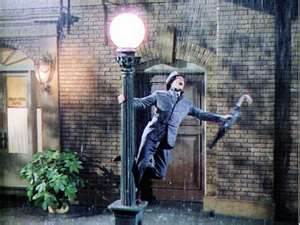
And when I’m actually caught in such a shower, I’m transposed into Gene Kelly, replete with unfurled umbrella, and I’m singing, yes, I’m singing in the rain!

rj