Opening Paragraphs Matter

The opening paragraph is among literature’s most important gestures, or like the fly fisher’s fly line and crafted lure, imperative to netting her catch, in this case, the reader.

Exemplars of this refined craft are many: the opening of Tolstoy’s Anna Karenina, or Orwell’s 1984, and not least, Dickens’ Tale of Two Cities, spring to mind. I’m sure you have your own favorite.

Surprisingly, my favorite opening comes from Rachel Carson’s Silent Spring, a non-fiction classic latent in its prelapsarian beauty, resonance and relevance, an America of pristine promise in its unspoiled abundance. She caught me in her cast:

There was once a town in the heart of America where all life seemed to live in harmony with its surroundings. The town lay in the midst of a checkerboard of prosperous farms, with fields of grain and hillsides of orchards where, in spring, white clouds of bloom drifted above the green fields. In autumn, oak and maple and birch set up a blaze of color that flamed and flickered across a backdrop of pines. Then foxes barked in the hills and deer silently crossed the fields, half hidden in the mists of the fall mornings. 

If I were still teaching a college composition course, I’d likely point out the opening’s rich, visual detail. When it comes to description, abstractions won’t suffice. Good writers, ever mindful of their readers, seek to gain their readers’ attention, employing the sensory, i.e., taste, smell, sight, touch, and hearing. Take, for instance, Carson’s choice of “checkerboard,” to achieve concreteness and economy.

Good writing, action-centered, selects its verbs adroitly for the sensory and kinetic (movement): clouds drift, “oak and maple and birch set up a blaze of color that flamed and flickered,” “foxes barked” and “deer silently crossed the fields.”

Among still other things, I’d emphasize the paragraph’s unity and varied sentence structure, lending ambience.

Superb openings like this don’t just happen. They are wrought through multiple revision.

Carson’s opening paragraph, prescient in its parabolic foreboding of a lost Eden, initiated a lasting awareness in me of nature’s frailty amidst human assault. It changed the way I live my life, to do no hurt to Nature that gave me birth and sustains me.

—rj

Jack Kerouac: Soulful Wanderer

Jack Kerouac turned 102 a week ago. The fierceness of his writing overwhelms, lyrical, sensory, harnessing human moods, a fiery warmth beneath a canopy of gazing stars on cold stellar nights:

“Fury flashing on rocks that rise like gloomy sea shroud towers out of the cove, the bingbang cove with its seas booming inside caves and slapping out, the cities of seaweed floating up and down you can even see their dark leer in the phosphorescent seabeach nightlight.”

Big Sur

“…the only people for me are the mad ones, the ones who are mad to live, mad to talk, mad to be saved, desirous of everything at the same time, the ones who never yawn or say a commonplace thing, but burn, burn, burn like fabulous yellow roman candles exploding like spiders across the stars and in the middle you see the blue centerlight pop and everybody goes ‘Awww!’”

—Jack Kerouac, On the Road

We were never really born, we will never really die. It has nothing to do with the imaginary idea of a personal self, other selves, many selves everywhere: Self is only an idea, a mortal idea. That which passes into everything is one thing. It’s a dream already ended. There’s nothing to be afraid of and nothing to be glad about. I know this from staring at mountains months on end. They never show any expression, they are like empty space. Do you think the emptiness of space will ever crumble away? Mountains will crumble, but the emptiness of space, which is the one universal essence of mind, the vast awakenerhoo 0d, empty and awake, will never crumble away because it was never born.”

The Portable Jack Kerouac

The world you see is just a movie in your mind.
Rocks dont see it.
Bless and sit down.
Forgive and forget.
Practice kindness all day to everybody
and you will realize you’re already
in heaven now.
That’s the story.
That’s the message.
Nobody understands it,
nobody listens, they’re
all running around like chickens with heads cut
off. I will try to teach it but it will
be in vain, s’why I’ll
end up in a shack
praying and being
cool and singing
by my woodstove
making pancakes.

—The Portable Kerouac

I miss you, Jack. You left us all too soon.

rj

Fiasco at Harvard: A President Resigns

The headlines shout the news of Harvard president Claudine Gay’s resignation.

It should have happened speedily, but not because she allegedly soft-pedaled campus protests calling for intifada while omitting Hamas’ atrocities and was consequently judged antisemitic by Israel supporters. I believe the presidents of Harvard, Penn, and MIT were essentially ambushed when they were interviewed—or is it interrogated?—by a House committee that had already made-up its mind.

As a former academic for nearly forty years, I firmly support the ACLU in its lawsuit defending University of Florida chapter of Students for Justice in Palestine, ordered deactivated in Florida’s public colleges by Governor DeSantis (ACLU defends).

Protecting the First Amendment is paramount and criticism of Israel shouldn’t be conflated with antisemitism. 

Despite the ruckus over her “it depends on context” when asked if threatening Jews with genocide violated Harvard’s code of conduct, I think she was right.

As I write, seventeen members of Biden’s campaign staff sent an anonymous letter to Biden, calling for a permanent truce in Gaza and suspension of arms shipments to Israel.

Is it antisemitic to want the killing of Palestinian civilians, now exceeding 21,000, to stop? Whole families have been wiped out by incessant Israeli bombings; thousands more, nearly half of them children, wounded. Survivors haven’t any place to go. Schools, mosques, churches, hospitals and refugee camps haven’t found reprieve from largely American supplied weaponry. Survivors face disease and famine. 

Was UN Secretary-General António Guterres antisemitic in saying Hamas violence didn’t happen in a vacuum”? Further, that “hospitals have turned into battlegrounds,” amid “the constant bombardment of all parts of Gaza” and rendered Palestinians homelessness and “without the essentials to survive”? 

Meanwhile, West Bank violence continues unabated, with little said about repeated settler incursion on Palestinian lands and a vast expansion of Israeli settlements, rendering any two state resolution increasingly implausible.

A recent poll indicates 61% of the American public fault Biden’s strident support of Israel. Are they therefore antisemitic as well ?

Would it surprise you to learn that most orthodox Jews are anti-Zionists?

And then there’s that gadfly Jewish socialist senator from Vermont. I better stop. I think you see where I’m coming from.

Harvard was right to initially support its beleaguered first black president and just second female holding that post in its nearly 400 year history.

At least, in the beginning. But then money has a way of changing minds. 

What began as a trickle became a tsunami, 1600 big spending Jewish alumni, some of them billionaires, pulling back from any more donations to the university. 

Conservative Washington Post columnist George Will had said suspending giving wouldn’t dent Harvard policy, Harvard enjoying a 51 billion dollar endowment.

But he was wrong. 45% of Harvard’s 2022 $5.8 billion income came from donations. 

When it comes to Gay’s several instances of plagiarism, I part ways with Harvard. Like most academics—I taught college English for forty years—I take plagiarism seriously. Failure to attribute sources constitutes both theft and fraud. The unveiling of her academic misdeeds called for immediate termination of employment.

In an opt-ed yesterday in The Guardian, former Secretary of Labor, Robert Reich, decries what he sees as a threat to campus free speech, donators marshaling monetary divestiture to secure their political perspective. He has a point. 

Reich says, however, that he’s unable to comment knowledgeably on Gay’s alleged ¡plagiarism, but notes the bulk of the charges originated from the online conservative journal Washington Free Beacon (Robert Reich).

So what? Does the source taint its accuracy? It’s the old guilt by association trick McCarthy played so notoriously.

The Left were privy to the allegations for some ten days, but buried it. Not until conservatives persistently pursued the story, led by Christopher Rufo, did the budding scandal take hold in the NYTThe GuardianCNN and elsewhere.

If you pressed me, I could show you the specifics of Gay’s many instances of lifted passages, fifty initially in number with six more added the day before her resignation after meeting with the Harvard Corporation.

Ultimately, the new revelations piled on top of spiraling donator backlash, proved the straw that broke the camel’s back. 

Did she get banished from the campus? Don’t even go there! Harvard, which initially made light of the charges, subsequently helped her correct the faulty passages in eight of her publications and reappointed her to her professorship in the Political Science Department.

If the shoe were on a student’s foot, the frequent punishment at reputable universities is expulsion for a year.

Talk about a double standard and the blatant hypocrisy of its Veritas motto, Harvard, you don’t walk the talk.

Writing anonymously for the Harvard Crimson, a student on the Honor Council that tries such cases, wrote, “When my peers are found responsible for multiple instances of inadequate citation, they are often suspended for an academic year. When the president of their university is found responsible for the same types of infractions, the fellows of the Corporation unanimously stand in support of’ her.” (Harvard president).

But why did an illustrious Ivy League university prove so intransigent in all of this is the bottomline question.

In a recent op-ed, black law school professor and former Harvard graduate Winkfield Tryman, Jr., comments that the plagiarism charges “are well deserved” and “not racial in nature…No one in good faith should defend President Gay because she is the first black president of Harvard. And yet, many are coming to her defense. Having finally got their wish of a Black president of Harvard, Harvard seems unwilling to let her go. The racial wagons have circled around Gay, with President of the NAACP alleging that White Supremacy is afoot and Morehouse President David Thomas claiming in a Forbes interview that Gay is a scholar at the “top of her profession… as qualified as any President Harvard has ever had” (Newsweek).

Truth be told, this illustrious Harvard prez “at the top of her profession” has published a mere eleven papers and not one book.

Now that’s a first, but of a dubious kind. Her predecessor, Larry Becow, the son of immigrants, and whose mother survived Auschwitz, wrote four scholarly books and scores of peer reviewed articles.

Unfortunately, this debacle at Harvard unfairly triggers a mindset of suspicion of legitimate black scholars, deflating their credentials and singular achievements.

–rj

No Room for Palestinians: Israel’s Calculated Violence

The photos featured in today’s media of masses of Palestinians fleeing Israel’s incessant bombing validates the truth that “a photo is worth a thousand words,” but in a sad way.

As I write, more than 11,000 Palestinians have died, 4000 of them children, and 25,000 have been wounded. The violence continues, Israel stubbornly ruling out a cease fire, demanding Hamas first release its 240 hostages.

The news on the West Bank is dismal as well. An area much larger than Gaza and an Arab majority, it has seen 175 civilians killed, nearly all of them Palestinians, 33 of them children, since Hamas’ incursion into Israel on October 7. Israel holds several thousand West Bank prisoners, hundreds without charge or trial.

The UN Office for the Coordination of Humanitarian Affairs reports that more than 1000 Palestinians with title to their land have been forcibly removed from their homes on the West Bank since October 7.

This follow a long history of settler intimidation, abetted by Israel Defense Forces, targeting Bedouin herders, Palestinian olive groves and farms. Homes are burned and protestors killed, yet the media allows this criminality to go unreported. It cares only about normalization, not Palestinian grievances.

Al Jazeera has it right: “Were the American media and political establishment not so firmly committed to transmitting a thoroughly decontextualised version of this war – and of Israel/Palestine in general – perhaps a news anchor would ask whether it never occurred to Israel that the Palestinians would ever “retaliate” for 75 years of ethnic cleansing, suffocating blockades and massacres” (https://www.aljazeera.com/opinions/2023/11/12/how-americas-bloodthirsty-journalism-cheers-on-israels-war-on-gaza).

While Hamas’ barbarism is surely condemnable, it’s the nature of Israel’s disproportionate response that troubles the international community. Disallowing humanitarian aid, curtailing food, water, and energy, bombing hospitals, ambulances and mosques, a refugee camp two days in a row, justifies growing international rage.

Ordering 1.2 million Palestinians to abandon their homes in north Gaza, with no real place to flee while denying them subsistence, constitutes a glaring war crime.

Concurrently, the United States, Great Britain, and France have contributed to Israel’s unmeasured response, accelerating arms shipments to Israel and making themselves complicit

Israeli repression of Palestinians, often violent, has its lengthy narrative. With the seizure of the West Bank following the 1967 War, a new chauvinism of a greater Israel ensued to the detriment of Palestinians in the Negev, Gaza, and the Golan Heights, resulting in the rise of Hamas, a Palestine offshoot of the Muslim Brotherhood.

In 1983, Israel conspired with Christian Phalangists in Lebanon in the massacres of several thousands of Palestinians and was found culpable by both the UN’s and Israel’s own subsequent investigations. The UN termed it “genocide.”

In the aftermath of 1948’s birth of the state of Israel and its victory over Arab armies, Israel expelled 750,000 Palestinians from their homeland, many of whom populate today’s Gaza and West Bank.

Five years ago, during the Great March of Return in Gaza, Israelis killed hundreds of peaceful demonstrators and wounded several thousand others.

While we hear a lot about a two state remedy, it’s unlikely, since it takes a marriage of minds for that to happen. Palestinians don’t trust Israelis, especially a government led by nationalist leadership under Netanyahu. They’ve also witnessed the second class citizenship of Arabs granted citizenship.

There do exist Israelis who want to address Palestinian grievances, but do so at great cost. Many have been arrested, their identities and addresses posted online, their families threatened.

In 1995, a religious extremist killed Prime Minister Yitzhak Rabin, who had sought to implement the Oslo Accords with its provision for Palestinian self rule in Gaza and the West Bank: “We who have fought against you, the Palestinians, we say to you today in a loud and a clear voice: Enough of blood and tears. Enough… We are today giving peace a chance and saying to you and saying again to you: Enough.”

In the aftermath of Rabin’s assassination, Netanyahu came to power, resulting in negotiations for a just settlement with the Palestinians being abandoned in favor of surveillance and military might. Hamas was to be controlled, not dismantled. Netanyahu needed Hamas to offset the West Bank’s Palestinian Authority, open to negotiation. October 7 changed the venue.

Zionism is the real culprit here. Israel has never subscribed to the two state idea in which Palestinians would be masters of their own house.

Addressing Palestinian members of Knesset in 2021, far right Defense Minister Bezalel Smotrich said, “It’s a mistake that Ben-Gurion didn’t finish the job and didn’t throw you out in 1948.”

Recently, Smotrich has voiced sentiment for a one state Israel: “Peace will not emerge so long as we maintain our hold on starting assumptions that this land is fated to contain two collectives with conflicting national aspirations. If this is the case, our grandchildren and our great grandchildren will inevitably be destined to live by the sword….The ‘Palestinian People’ is but a counter-movement to the Zionist movement. Those who choose not to let go of their national ambitions will receive aid to emigrate to one of the many countries where Arabs realize their national ambitions, or to any other destination in the world.”

Is it conceivable that Israel’s vociferous response, defiant of the international community’s call for a ceasefire, is deliberately strategic? That not only Hamas should be eliminated, but the Palestinian presence once and for all? Make it so intolerable for them that they’ll leave?

Ominously, Prime Minister Benjamin Netanyahu, addressing his country on October 28, quoted Deuteronomy: 25:17: “You must remember what Amalek did to you.” If you continue to verse 19, you’ll read, “You shall blot out the memory of Amalek from under heaven. Never forget!” In 1st Samuel 15: 2-3, the Hebrew Bible exhorts, “Now go, attack Amalek, and proscribe all that belongs to him. Spare no one, but kill alike men and women, infants and sucklings, oxen and sheep, camels and asses!”

He didn’t have to go on. He had made his point.

–rj

The Plight of Palestinians: Repressed and Forgotten

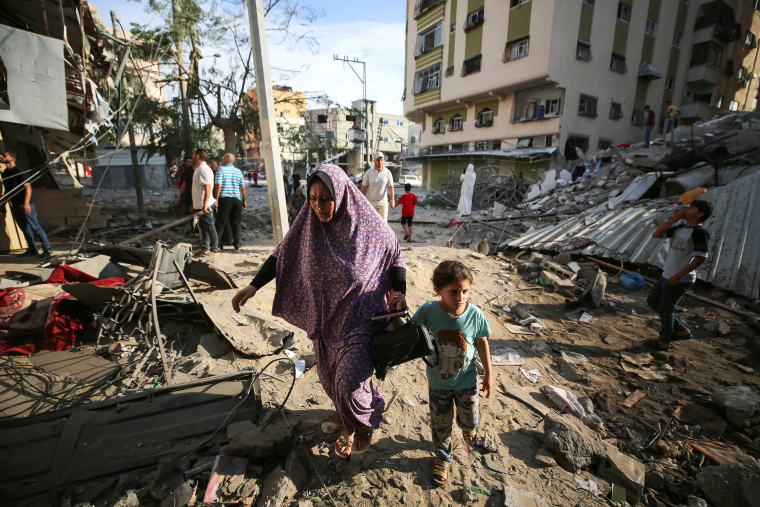
While Americans retire nightly to their flannel sheets and fluffy pillows, their stomachs well fed, two million Palestinians have no where to flee, their homes flattened, their food, water, and energy resources curtailed. They sleep on sidewalks, or sixty in a room. They suffer cold. Whole families wiped out, yet Israeli bombing and gunfire continues. Israel refuses a pause. Ten thousand dead, many of them children.

It’s Israel’s history, Palestinians the Other, not seen as fellow human beings having legitimate grievances.

In the ongoing invasion of Gaza by Israel’s military, two aerial attacks, two days in a row, were launched on Jabaliya, a camp sheltering 116,000 refugees squeezed into a 1.4 square kilometer area, and one of eight refugee camps in Gaza.

Collectively, they shelter displaced families and their descendants from the 1948 war that gave rise to the state of Israel. Expelled, they’ve been denied resettlement in their native land.

Jabaliya features a high number of UN facilities, including 26 schools, a food distribution center, two health centers, a library, a sanitation facility, and seven wells. It didn’t stop the Israelis. They struck in day light, mothers pursuing their laundry, children playing soccer, men at their jobs.

Bombs meant for Hamas tunnels left deep-seated craters, collapsed buildings, smoking rubble, dismembered limbs, scattered flesh, the screams of the wounded, some buried beneath the rubble.

Israeli bombs took out the Al-Fakhoura School, used as a shelter for thousands of homeless Palestinians in the camp, all of this part of incessant bombing that struck still another school in Northern Gaza, air attacks in the vicinity of three hospitals, and on two ambulances.

Even before the invasion, the camp had periodically suffered electricity outages and 90% water contamination.

According to Gaza’s Ministry of Health, run by Hamas, 195 died and 777 were injured in the two attacks. We may not trust Hamas on the figures, but other authorities think the total death toll may be even higher when bodies are fully recovered.

It’s senseless to go after suspected Hamas tunnels underlying the camp’s infrastructure, as no crater can penetrate deep enough to take out tunnels reenforced with concrete some 200 feet below.

Overall, Gaza has seen its death toll exceed 10,000 dead, many of them women and children, as a consequence of indiscriminate bombings of the civilian infrastructure.

As I write, Israel continues to resist mounting international calls, including those of the US, for a ceasefire. They demand hostages be released first.

Amid its carnage, Israel has held back on humanitarian aid, cut off food supplies, energy and water.

Consequently, Palestinians face the near certainty of widespread famine, disease, and death.

This isn’t the first time Israel bombed the camp with deadly result. During the Gaza War (2014), it bombed a UN school in the camp, killing 20 people.

More recently, unreported in US media, six earlier attacks on the camp occurred before the two major deadly attacks. They include attacks on October 10, 12, 19, and 21.

All of this becomes eerily reminiscent of the Sabra and Shatila massacres of 1982 during Lebanon’s Civil War when up to 3,500 civilians—mostly Palestinians and Lebanese—were slaughtered in 24 hours by Christian Phalangist military aligned with Israel.

Sabra was a neighborhood of Palestinian settlement; Shatila, a refugee camp. The Israel Defense Forces, surrounding Shatila , ordered its allies to clear out the PLO. Though they were receiving reports of the massacres, they didn’t intervene.

A subsequent inquiry under UN auspices concluded in February 1983 that the IDF forces, as the major occupying element, had responsibility for preventing the massacres of Sabra and Shatila. It termed it “a form of genocide.”

An Israeli investigation came to a similar conclusion, holding the IDF responsible for knowing the massacres were taking place, but not intervening. This forced the resignation of Defense Minister Ariel Sharon

For too long, successive Israeli governments have ignored the legitimate rights of Palestinians to a sovereign state, with East Jerusalem as its capital.

The United States has abetted Israeli intransigence with massive funding and weaponry, much of it being used in the present conflict.

In short, it’s complicit in the excesses being committed.

While Hamas committed abominable acts against Israeli civilians, resulting in 1400 deaths with its incursion of October 7, it doesn’t justify Israel’s disproportionate response, nor ongoing West Bank settler violence against Palestinian civilians, more than 100 of them recently killed.

Yes, Gaza elected Hamas in 2006 to represent them, but there haven’t been any elections since. Do all Gazans support Hamas? Probably not, given the suffering Hamas has inflicted on Gazans.

All of this carnage is rooted in Britain’s Balfour Declaration of 1917, sanctioning a homeland for Israel. Did anyone ask its Ottoman citizenry, the vast majority, Turk and Arab? Few Jews lived in the area that would become Israel.

In 1948, 750,000 Palestinians were expelled from their homeland and forbidden a return, a vengeful response of incalculable cruelty.

The irony is that many Jews, who themselves have suffered historical displacement and genocide, have become perpetrators of its reiteration.

I would remind dissenters that attacks on civilians and civilian infrastructure are violations of international humanitarian and human rights law. In short, they are war crimes.

–rj

Compassion: What It Really Means and How to Cultivate It

In a needy, often dark world, there thankfully exist compassionate people, going the last mile, thinking always of others, their sufferings and needs.

I think of Doctors Without Borders, for example, a French organization of physicians and nurses, working not only in Third World Countries, but often in war zones such as Somalia, South Sudan, and Gaza at considerable risk, their starting pay, a mere $2600 a month.

This ability to feel another’s pain and taking it on, where does it come from? I know that personal suffering can trigger it, perhaps a bad childhood, an abusive relationship, a betrayal by one we trusted, the death of a close friend or relative, unemployment, poverty, or personal illness.

Some just seem endowed with it from birth. I think of the poet Percy Bysshe Shelley and his wife Mary, author of Frankenstein, keenly sensitive to the social ills of their time; Tolstoy, rich and famous, but disclaiming it all, in sympathy with the poor; John Stuart Mill, champion of the minority’s right to be heard.

Empathy’s great, putting yourself in the shoes of another, but I think of compassion as going beyond sympathy as with these individuals committed to helping others.

I would offer what’s been called emotional intelligence” (EQ) as a principal starting point in generating compassion. Pioneered by psychologist and behavioral science journalist Dr. Daniel Goleman in his 1995 book, Emotional Intelligence: Why it May be More Important Than IQ, it offers potential for amelioration of intrapersonal relationships across a wide spectrum.

Its hallmarks are several:

An ability to intuit what others are feeling.

A calmness in contexts of stress.

An ability to accept change.

An ability to defuse highly charged situations

An awareness of your own feelings.

We often conceive IQ as a denominator of ultimate academic and professional success, but I’d posit emotional intelligence as far more consequential for your happiness in everyday life.

Like to know if you possess this wonderful attribute? Well, the good news is that there are tests to measure it.

But don’t fret if you fall short. You can cultivate it, something I’ve been trying to do.

Some of these measuring tools are popular self-response tests. You’re asked to respond to conflict scenarios and select from multiple choices you’re likely response. This takes a lot of honesty, however.

More formally, a psychological test, [the Mayer-Salovey-Caruso Emotional Intelligence Test (MSCEIT)], has you do performance tasks assessing your ability to perceive, identify, understand, and manage emotions. These comprise the generally recognized four aspects of emotional intelligence. I confess I’ve work to do.

A salient element of emotional intelligence is learning to listen and getting at the cause behind someone’s feelings. Not interrupting them is crucial, signaling not only politeness, but your regard for them and taking their narrative seriously.

Emotional intelligence has helped me especially in contexts of social tension. Seeing things from the African-American perspective, for example, has afforded me an understanding of black rage: enslaved, lynched, denied the vote, profiled by police, overly imprisoned, discriminated against in housing and employment, their rage and distrust of white authority is symptomatic. Those with high EQ don’t react with condemnation. They address the milieu of that disconnect.

In summary, EQ people think things out before they react.

They’re sensitive to their own feelings and willing to objectively assess their origin.

In considering the perspectives and emotions of others, they understand motivating factors behind their behavior, moving to address them.

If you ask me for contemporary models of EQ, I would include former president Jimmy Carter, superb negotiator associated with Habitat for Humanity; Nelson Mandela, imprisoned 27 years, but advocate of reconciliation; Jane Goodall, redefining our relationship with animals and spokesperson for both the environment and the African poor. Each of these individuals, teeming with awareness, translated their EQ into activism. Beyond empathy, it’s compassion.

As Indian sage Amit Ray has eloquently expressed it, “Compassion is all inclusive. It knows no boundaries. Compassion comes with awareness, and awareness breaks all narrow territories.”

By the way, if people tell you you’re too sensitive or emotional, it just may be you have high EQ. I think that’s a good thing!

—rj

I’m Not Who I Was: Welcoming Change

I’ve lived a long life of varied hue, ultimately shaping me into who I am and, hopefully, a better self. As I’d tell my college students, one of the worst things that can happen to you is to wake up old and find you’ve never changed.

Life happenings, with their undulating insistence, have impacted me greatly, teaching me that human suffering is a life constant and that desire can effect unhappiness, for life inevitably brings loss and the anticipated often yields dissatisfaction. We live with temporality and must seize the day, for the past is but memory, impalpable and subject to nostalgia’s distortions. At best, we can learn from it, avoid repeating its errors, and relish its positives. As for our future, we create it daily, advancing toward a retreating horizon with every step.

Exposure to other viewpoints has been a salient catalyst to who I’ve become. Much of it has come from wide travel. Most of us travel to explore different vistas. The good traveler lingers among the people, exchanging viewpoints, sipping their way of life. I have done that, spending lengthy sojourns in places like France, Germany, Mexico, India, Japan, and Korea. I know Britain, Ireland, and Italy well, have traveled to Spain and Russia.

I think everyone should visit a developing country, see impoverished people for who they are, people like ourselves, wanting the essentials, or as the Lord’s Prayer renders it, “Give us this day our daily bread.” We might return more sympathetic to the plight of the displaced, now some 60 million. I think of India, a nation of 1.4 billion, 80 million of whom are impoverished, the begging multitudes, the poor with whom I shared my victuals, my Hindu guide and his young Muslim helper as we ventured across Kerala’s jungle landscape, for whom one bowl of rice daily was sufficient. It was the hardest farewell I’ve had to make. We are leaves on one tree. We need each other. India changed me profoundly.

Education, ten grinding years of it beyond high school, also promoted growth, exposing me to a plethora of viewpoints, which in my conservative innocence I initially resisted. Little did I know that the seeds had been planted and that I would ultimately invest my life with the liberating values I had fervently opposed.

It happened in the context of Vietnam, racial turbulence, revolutionaries, some of whom I met. As an English major, I learned the magic of a good sentence, the elements of sound reasoning, the way of words, enhancing context through metaphor, the tension of irony lending resonance, the beauty of poetry—Keats, Shelley, Hopkins, Dickinson,Yeats, Auden— the wisdom of intellects like John Stuart Mill, “the saint of rationalism,” who initiated my fierce resistance to censorship and book banning. I wouldn’t trade any of this.

There was also the young Franklin Case, my greatest teacher, who lit the fire and launched my career. He’s gone now, but I remain forever grateful. Through him, I learned how to plumb literature’s hidden depths. He gave me Mansfield, Hemingway and Fitzgerald.

Additionally, wide reading, whether fiction or non-fiction, has affected me greatly, exposing me to diverse viewpoints. A lot of this came from teaching canonical writers, such as Vergil, Dante, Swift, Voltaire, Joyce, Tolstoy, Chekov and Faulkner.

When I was eight, my brother returning from war in Europe, gifted me with Huckleberry Finn. I was on my way. By fifteen, I had read many of the classics, including through the Bible twice and Tolstoy’s sprawling War and Peace. Tolstoy is my favorite writer and I visited his homestead at Yasnaya Polyana near Tula. Pervading everything he wrote, Tolstoy asked, How ought we to live? Aware of his shortcomings, the character Levin in Anna Karenina mirrors who he wanted to be.

At 17, I was stationed in South Korea as an airman at Osan AFB, thirty miles below Seoul. The Korean armistice had been four years earlier, but the aftermath of war was everywhere with people sheltering underground, tin sheets as a roof, and children, poorly clothed, begging for food.

There wasn’t much to do for recreation during that dreary thirteen months, but the base did have a theater where you could see a recent movie for 25 cents. The base also had a humble Quonset hut, housing a modest library collection. Among the books was Thomas Wolfe’s Look Homeward Angel, which I took a liking to. Subsequently, I would read everything he wrote. I identified with protagonist Eugene Gant in his aspiration to escape the confines of Appalachia. My father was a violent alcoholic. We had no family life and my mother fled before I was eight. That’s how I ended up in the Air Force.

I should mention that ultimately I did a Ph. D. at the University of North Carolina at Chapel Hill, Wolfe’s undergraduate alma mater (Pulpit Hill in LHA). My first day on campus I met a retired professor. He had been one of Wolf’s teachers and sponsor of his fraternity. They became friends and he traveled with Wolfe to Germany.

Books taught me I wasn’t alone, gave me choices, heightened my sensitivity and provided solace. I’ve perhaps read several thousand books. They remain with me as friends and I keep reading. On New Year’s Day, I publish in this blog a contemporary list of the very best reads. Books accelerated my growth.

In sum, it’s not always easy for us to be open to change, especially when you’re from a dysfunctional family. I beat-up myself, deeming myself unworthy. Books inspired me, taught me never to give up hope. As Browning famously put it, “A man’s reach should exceed his grasp.”

One day, I woke up. I liked who I had become. I had found my way.

—rj

Expired: The UN’s Resolution Prohibiting Exporting of Iranian Missiles and Drones

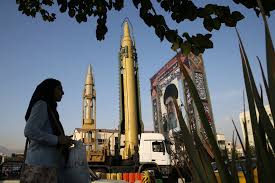
The Caspian Sea linking Iran and Russia may seem to be a quiet body of water, but the reality is that it has become Iran’s busy artery for exporting weaponry to Russia in violation of the United Nations Security Council’s 2015 prohibition on missile and uninhabited aerial vehicles (UAV) transfer, known as Resolution 2231.

Lloyd’s List Intelligence has indicated a recent uptick in Caspian shipping between Russia and Iran, some ships going dark. Additionally, CNN has tracking data, showing 85 Iranian cargo plane trips to Moscow airports between May 2022 and March 2023.

In any case, Iran has been violating the Resolution for several years, supplying drones to Houthi rebels in Yemen, who’ve employed them to attack Saudi Arabia and, this week, American naval vessels in the Persian Gulf.

Additionally, we know from intelligence sources that they’ve been supplying lethal drones to the Russians since the summer of 2022, who have been employing them on a near daily basis in Ukraine.

Both Iran and Russia vociferously deny violating Resolution 2231. They needn’t worry. It expired on October 18, 2023.

Unfortunately, the Biden administration has been amiss in soft-pedaling Iran’s intransigence in a concerted effort to renew the 2015 Nuclear Arms Limitations Treaty with Iran. Though the US has pledged to monitor the illegal weaponry trade, employing sanctions if needed, Biden approved the return of $6 bn of frozen Iranian funds from South Korean banks as part of a prisoner exchange deal in August.

Qatar will administer Iranian access, to be used only for humanitarian purposes. This will free, however, Iranian budget money elsewhere for terrorist groups such as Hezbollah.

Hamas’ brutal attack on Israeli civilians was augmented by hundreds of Iranian supplied rocket salvos into the Israeli infrastructure, including Tel Aviv. Meanwhile, Hezbollah in Lebanon have been firing missiles into northern Israeli settlements and attacking American forces in Syria and Iraq.

Iran possesses a sophisticated arsenal of some 2000-3000 missiles that include short-and medium-range ballistic missiles, a long-range cruise missile, and long-range rockets. Its medium ballistic missiles could conceivably be armed with a nuclear payload, should Iran continue its advance to a nuclear bomb.

We know, too, that the Iranians have been working on a ballistic anti-ship missile to be potentially used against American aircraft carriers.

Will they ultimately effect a nuclear capacity to hit the US mainland as North Korea has done? Or before then, will Israel, under grave nuclear threat, launch a first strike of its own on Iran’s myriad underground bunkers, plunging the world into a nightmare scenario?

–rj

The Truth Must be Told: The Tragedy of Gaza


As we all know, several thousand Gaza Hamas fighters bulldozed their way through an Israeli security fence on October 7, 2023, and committed some of the most barbaric crimes against humanity not seen since Cambodia, Rwanda, and the Holocaust.

More than 1400 Israelis died, most of them civilians, some slaughtered in nearby fields while celebrating the ending of Sukkot, an annual fall event in the Jewish calendar; others, in their beds on nearby kibbutzim. Reports are that Hamas insurgents raped, pillaged, and slaughtered even children, including babies. More than 200 civilians and soldiers were taken hostage, including citizens of other countries. Israeli wounded stands at 4600.

The Israeli response has been unceasingly withering in Gaza, Prime Minister Netanyahu declaring war on Hamas, calling up 300,000 reservists, bombing Gaza’s civilian infrastructure daily, and ordering one million Gaza civilians to evacuate to southern Gaza.

A land invasion of Gaza by Israel Defense Forces (IDF) is anticipated. They will face up to 50,000 Hamas fighters, dispersed in a labyrinthian tunnel weave, threatening a Stalingrad consequence of casualties in house-to-house fighting. American pressure has slowed any launching of an immediate invasion, but not halted the daily bombing, killing 700 civilians in the last twenty-four hours, half of them women and children.

Hezbollah, to the north in Lebanon, have been firing rockets into nearby Israeli border towns, forcing their evacuation and possibly opening a second front in a dangerously escalating Middle East conflict. Iran has pledged to intervene if Israel launches a land invasion of Gaza.

In the meantime, the death toll of Gaza civilians now exceeds 5,000, including more than 2000 children, the cut off of food, water, and energy to Gaza, the forestalling of shipments of humanitarian aid from Egypt, which threatens the closure of hospitals treating thousands of wounded civilians. Mass starvation and disease looms as an aftermath, Israel insisting that hostages be released, despite international calls for restraint and observance of humanitarian values.

Recently, a Christian hospital in Gaza came under rocket attack, killing 500 people among those taking shelter. International intelligence indicates it was an errant Hamas rocket that caused this tragedy. Nonetheless, the World Health Organization has documented 171 Israeli attacks on health care in the occupied Palestinian territory,” killing 473 health workers.

As I write, unrest continues on the West Bank, with some 100 Arab protestors killed. A pending historic security alliance has been withdrawn by the Saudis and Israel’s peaceful relationship with Jordan has been strained. Settler crimes against West Bank farmers have been chronicled over the years, with killing of livestock, destruction of olive groves, and slaying of those who resist.

The U.S. response has been typical, Biden ordering two aircraft carriers into the gulf and threatening to intervene should Hezbollah open a second front.
It has called for a two state settlement for many years, yet overlooked Israeli intransigence. It gives $3 billion in aid annually to Israel and recently concluded a $37 billion loan agreement in military aid. Israel will have access to the F-35, the world’s most advanced fighter jet.

At home, dissenters are regaled as antisemitic. Many, including Democrats, have called for disbandment of Palestinian student campus organizations and denounced the growing Leftist faction in the Democratic Party that includes Bernie Sanders. Frenzied Republicans, increasingly resistant to continuing aid to Ukraine, have no difficulty supporting huge expenditures to Israel. Lindsey Graham says, “Do whatever the hell you have to do to defend yourself. Level the place!”

There is, in short, a context for Arab and Palestinian resentment and outburst.
We seem to have learned nothing from the rage that lay behind the 9/11 horror. We began two long wars, fought by America’s poor White and Blacks. We lost both. Did Vietnam teach us nothing?

Do we lust for another war? Have we forgotten George Washington’s warning to avoid “entangling alliances”? “The nation which indulges toward another an habitual hatred or an habitual fondness is in some degree a slave” (Farewell Address).

UN secretary-general António Guterres speaks for me: “Hamas did not happen in a vacuum. The Palestinian people have been subjected to 56 years of suffocating occupation.” He likewise condemned Hamas: “No injustice to the Palestinians justifies the appalling attacks by Hamas.”

The Israeli response to Guterres? “Due to his remarks we will refuse to issue visas to UN representatives” (Gilad Erdan, Israel ambassador to the UN). “The time has come to teach them a lesson. Guterres should resign.”

Hamas was elected to power in 2006. There have been no elections since. Does “Israel’s right to defend itself” (Biden) justify its war on Gaza civilians, half of whom are children?

Ultimately an apartheid Israel will reap its own folly. Israel’s growing Arab population will soon outnumber Israelis. It will become a South Africa before Nelson Mandela’s victorious crusade for a liberated biracial nation enjoying equity.

-rj

America’s Emissary: Walt Whitman

I’ve never formally studied Walt Whitman’s poetry, despite a graduate degree in English. That’s because I made Victorian Literature my major interest, with modern American and British Literature secondary. Still, I’ve read his landmark Leaves of Grass many times, America’s psalmody in its pioneering free verse; in its robustness, an encomium of America were it doing more than lip service to the American dream.

It says much about Whitman, out-of-joint with his generation much like contemporary Emily Dickinson, uncomfortable with the cultural shibboleths of middle class Amherst. Perhaps influenced by his father’s radical views on politics and religion, Whitman emerges an essential element of America’s constant of progressive rebellion, resistant to mercenary interests that gave us slavery, wealth inequality, desecration of nature, racial injustice, and imperialism.

If you’re looking for a summation of Leaves of Grass, nothing excels his “Credo” in the poem’s Preface. Conscious of America’s failure to live up to its promise, “Credo” exemplifies its gulf and champions its realization:

“This is what you shall do; Love the earth and sun and the animals, despise riches, give alms to everyone that asks, stand up for the stupid and crazy, devote your income and labor to others, hate tyrants, argue not concerning God, have patience and indulgence toward the people, take off your hat to nothing known or unknown or to any man or number of men, go freely with powerful uneducated persons and with the young and with the mothers of families, read these leaves in the open air every season of every year of your life, re-examine all you have been told at school or church or in any book, dismiss whatever insults your own soul, and your very flesh shall be a great poem and have the richest fluency not only in its words but in the silent lines of its lips and face and between the lashes of your eyes and in every motion and joint of your body.”

—rj